






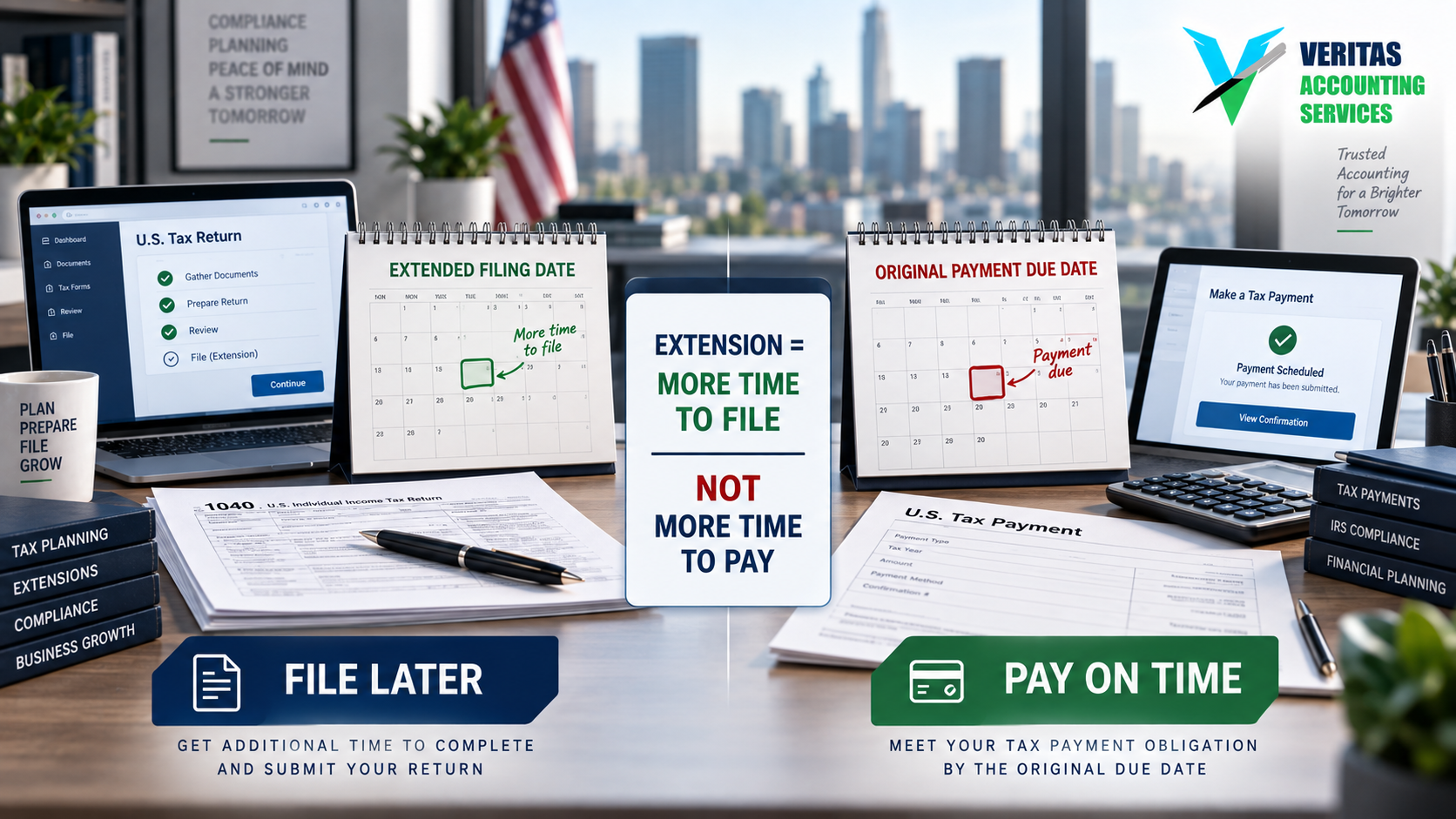

Extended Tax Return vs Tax Payment: Why an Extension Does Not Mean More Time to Pay
A tax extension can be extremely useful for a business that needs additional time to complete its tax return. But there is one important distinction that business owners often misunderstand: more time to file does not generally mean more time to pay.
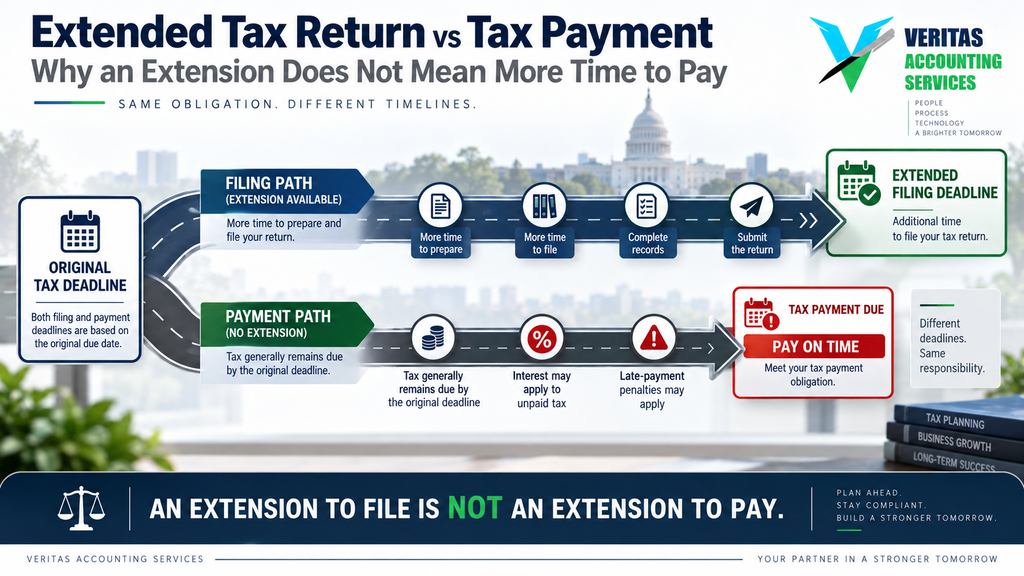
An extended tax return allows an eligible taxpayer to postpone the filing of the return. The tax liability itself generally remains due by the original payment deadline.
The distinction matters because a business may file its return several months after the original deadline while still being responsible for tax, interest, and potentially penalties from the original due date.
The IRS is explicit about this distinction. Its instructions for Form 7004 state that the form does not extend the time to pay tax due. Interest generally applies to unpaid tax from the original due date until the tax is paid.
For U.S. businesses approaching an extended filing deadline, understanding the difference between filing and payment can prevent an expensive misunderstanding.
This article explains how tax extensions work, when payment is due, what happens when the final liability is higher than expected, and what businesses should do before an extension deadline.
Table of Contents
- What Is a Tax Extension?
- Filing Deadline vs Payment Deadline
- How Business Tax Extensions Work
- Why Tax Is Still Due by the Original Deadline
- What Happens If You Pay Less Than You Owe?
- Interest and Late-Payment Penalties
- How to Estimate the Amount to Pay
- Common Mistakes Businesses Make
- What CPA Firms Should Tell Their Clients
- Practical Checklist Before an Extended Filing Deadline
- Frequently Asked Questions
- Conclusion
What Is a Tax Extension?
A tax extension is a mechanism that gives an eligible taxpayer additional time to file a tax return.
For certain business returns, Form 7004 is used to request an automatic extension of time to file. The IRS describes Form 7004 as an application for an automatic extension for certain business income tax, information, and other returns.
The purpose of an extension is primarily to provide additional time to prepare accurate and complete information.
For example, a partnership may still be waiting for financial records, a business may need additional time to reconcile its books, or a tax preparer may require more time to finalize complex schedules.
An extension can therefore reduce the pressure of preparing a return by the original filing date.
However, an extended tax return should not be interpreted as a postponement of the underlying tax liability.
That is where the difference between filing and payment becomes important.
Filing Deadline vs Payment Deadline
There are two separate questions every business should ask:
When does the return need to be filed?
When does the tax need to be paid?
These dates may be different.
The extension generally changes the first date. It does not automatically change the second.
The IRS states that an extension of time to file is not an extension of time to pay. For individual taxpayers, the IRS similarly advises that taxes owed should generally be paid by the original filing deadline even when an extension is requested.
This distinction is particularly important when a business expects to owe federal income tax.
A taxpayer who waits until the extended filing date to make the entire payment may find that interest has accumulated from the original due date.
For businesses, this can also affect cash-flow planning. A company may have several additional months to finalize its return but still need to reserve funds for the tax liability much earlier.
How Business Tax Extensions Work
For many business taxpayers, Form 7004 provides an automatic extension for eligible returns when properly filed by the original due date.
The extension period depends on the specific return and taxpayer circumstances. Businesses should therefore confirm the applicable period rather than assuming that every return receives the same extension.
For example, a calendar-year partnership or S corporation may have an extended filing deadline later in the year. This is why September becomes an important filing period for many U.S. businesses.
The additional filing time can be valuable.
It allows the business and tax professional to:
- complete bookkeeping;
- reconcile accounts;
- gather missing records;
- review transactions;
- prepare supporting schedules;
- resolve tax questions; and
- finalize the return accurately.
But none of these steps should create confusion about the payment obligation.
The business should separately determine whether tax was due by the original deadline and whether an estimated payment should have been made.
Why Tax Is Still Due by the Original Deadline
The basic principle is straightforward: the extension provides additional time to complete the paperwork, not additional time to settle an existing tax liability.
The IRS explains that Form 7004 does not extend the time to pay tax due. Its current instructions also explain that interest is charged on unpaid tax from the original due date until the tax is paid.
Consider a simple example.
A business estimates that it will owe $40,000 in federal tax. It requests an extension because its books and supporting records are not ready.
The business now has additional time to complete the return.
That does not automatically mean it can keep the $40,000 until the extended filing deadline without consequences.
If the business does not pay the tax when required, interest may begin accumulating from the original due date.
This is why businesses should treat the filing extension and payment obligation as two separate tasks.
What Happens If You Pay Less Than You Owe?
Estimating tax before the return is finalized is not always easy.
A business may make an estimated payment based on its available financial information and later discover that the actual tax liability is higher.
That does not necessarily mean the original payment was incorrect.
Tax returns often involve deductions, credits, depreciation, owner information, state adjustments, and other items that can affect the final liability.
However, any unpaid tax generally remains subject to applicable interest from the original due date.
The IRS also explains that late-payment penalties can apply when tax is not paid by the due date. The specific penalty depends on the taxpayer and circumstances.
The important point is that businesses should not avoid making a reasonable payment simply because the final return is not ready.
If the tax liability is uncertain, the business should work with its tax professional to develop a reasonable estimate.
Interest and Late-Payment Penalties
The financial consequences of waiting to pay can include both interest and penalties.
IRS guidance states that underpayment interest generally begins from the due date of the unpaid amount and continues until the balance is paid. This applies even when the taxpayer has received an extension to file.
The IRS instructions for Form 7004 also explain that a late-payment penalty can generally apply to tax that remains unpaid after the due date.
The exact amount depends on the taxpayer’s circumstances, the amount unpaid, applicable safe-harbor or payment rules, and other factors.
For certain corporations, there are specific rules concerning whether sufficient tax was paid by the original due date. The Form 7004 instructions, for example, describe a rule under which a corporation may avoid a late-payment penalty if the required percentage of tax was paid by the original deadline and the remaining balance is paid by the extended filing date.
Because these rules can vary, businesses should not assume that one payment strategy applies to every entity.
How to Estimate the Amount to Pay
One of the most practical steps before an extension deadline is estimating the expected tax liability.
This does not require the final tax return to be complete.
Instead, the business and tax preparer can use current financial information to develop a reasonable estimate.
Start with the year-to-date profit and loss statement and balance sheet. Then review significant transactions that may affect taxable income.
Consider:
- Current-year revenue and profitability.
- Major expenses and potential deductions.
- Depreciation and fixed-asset activity.
- Payroll and shareholder compensation.
- Owner or partner transactions.
- Estimated tax payments already made.
- Prior-year tax information.
- Significant changes in business operations.
The quality of this estimate depends heavily on the quality of the underlying bookkeeping.
If the books contain unreconciled accounts, missing transactions, or incorrect classifications, the estimated liability may be less reliable.
This is why tax planning and bookkeeping should not be treated as completely separate processes.
Common Mistakes Businesses Make
One of the most common mistakes is assuming that filing an extension means the business has no tax obligation until the extended filing date.
Another is waiting until the return is completely prepared before considering payment.
Businesses may also underestimate the liability because their financial statements are not current.
A further problem occurs when owners focus only on federal income tax and overlook state obligations.
State tax rules vary significantly, and a federal extension does not necessarily provide the same treatment for every state filing or payment.
Businesses operating across multiple states should review their state requirements separately.
Another mistake is failing to retain payment confirmations.
Tax payments should be properly documented and reconciled to the accounting records so the tax preparer can accurately reflect payments when completing the return.
What CPA Firms Should Tell Their Clients
CPA firms play an important role in helping clients understand the difference between filing and paying.
A client who says, “I filed an extension, so I can pay in September,” may have misunderstood the purpose of the extension.
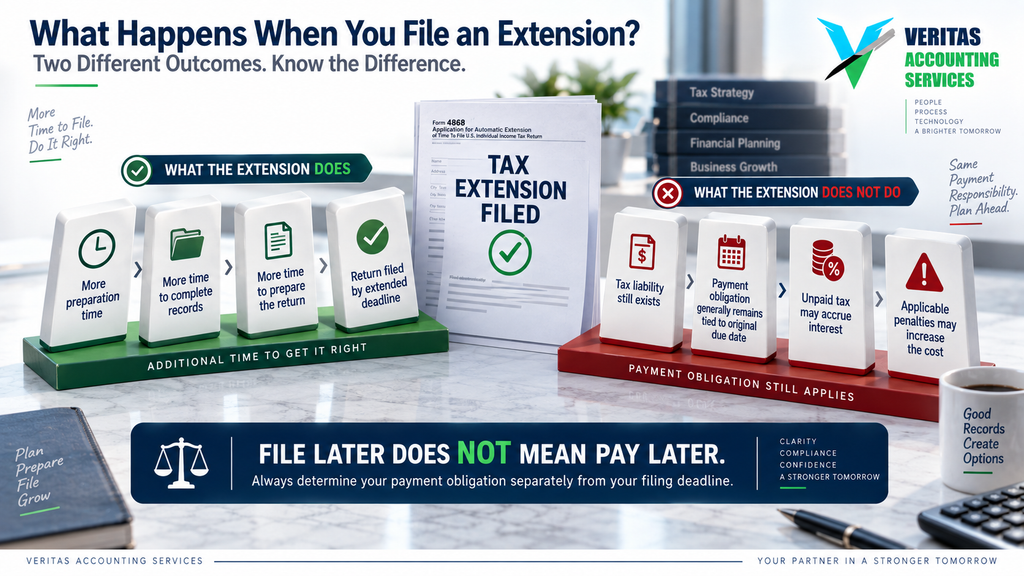
The CPA should clearly explain that the extension primarily provides additional filing time and that tax payment obligations generally remain tied to the original deadline.
This conversation should happen before the original payment deadline whenever possible.
For CPA firms, proactive communication can also reduce later questions about interest and penalties.
A standardized client communication can explain:
- what the extension covers;
- what it does not cover;
- the estimated tax liability;
- the recommended payment amount;
- the payment method;
- the consequences of underpayment; and
- what information is still needed to complete the return.
This creates a clearer process for both the firm and the client.
Practical Checklist Before an Extended Filing Deadline
Before an extended tax return is finalized, the business should review both filing and payment status.
Confirm that the extension was properly filed and accepted.
Review the estimated tax liability and compare it with payments already made.
Reconcile the accounting records through the relevant period.
Confirm that all major income and expense accounts have been reviewed.
Check shareholder, partner, and owner transactions.
Review fixed assets, loans, and other significant balance-sheet accounts.
Confirm federal and state filing requirements separately.
Provide missing documents and responses to the tax preparer.
Finally, confirm that all required tax payments have been made and properly recorded.
The objective is not simply to submit the return on time. It is to ensure that the return, payment records, and accounting records all tell the same story.
Frequently Asked Questions
Does an extension give a business more time to pay taxes?
Generally, no. An extension provides additional time to file an eligible return, but it does not generally extend the time to pay tax due. The IRS specifically states that Form 7004 does not extend the time to pay tax.
What happens if I cannot pay the full tax amount?
A taxpayer who cannot pay the full amount should still address the liability promptly. The IRS provides payment options for taxpayers who cannot immediately pay their full balance. Interest and applicable penalties can continue until the balance is paid.
Does interest apply if I filed an extension?
Yes. IRS guidance states that interest generally applies to unpaid tax from the original due date until payment is made, even when an extension was granted.
Can a business estimate its tax payment?
Yes. Businesses commonly estimate their expected tax liability before the final return is completed. The estimate should be based on reliable financial information and reviewed with the business’s tax professional.
What form is commonly used for a business filing extension?
Form 7004 is used to request an automatic extension for certain business income tax, information, and other returns.
Does a federal extension automatically extend state taxes?
Not necessarily. State filing and payment requirements can differ from federal rules. Businesses should confirm the requirements in each state where they have tax obligations.
Conclusion
The difference between filing and paying is one of the most important concepts businesses should understand when requesting a tax extension.
An extended tax return gives the taxpayer additional time to complete and submit the return. It does not generally provide additional time to pay the underlying tax liability.
That distinction matters because unpaid tax can lead to interest and potentially penalties from the original payment deadline.
Businesses can reduce the risk by keeping accurate books, estimating their liability before the original deadline, making appropriate payments, and communicating with their tax professional early.
For CPA firms, explaining this distinction clearly can also improve client relationships and reduce confusion when extended returns are finalized.
An extension should be viewed as a tool for completing an accurate return, not as a way to postpone the tax payment itself.
If your business needs support with bookkeeping, tax preparation, tax compliance, or U.S. tax filing, Veritas Accounting Services can help organize the financial information and tax workflow needed to manage these obligations more efficiently.
Important: Tax rules can vary based on entity type, tax year, state, payment history, and individual circumstances. This article is for general educational purposes and should not replace advice from a qualified tax professional. Always verify the applicable rules with the IRS and relevant state tax authorities.
Official IRS resources: IRS Form 7004 Instructions · IRS Topic No. 304 — Extensions of Time to File · IRS — Pay Taxes on Time
GET IN TOUCH
Schedule a FREE Call









Connect on our Socials!
