






Global Business Growth: The Hidden Challenges of Operating Across Borders
Expanding into another country can be one of the most exciting stages in a company’s development. New markets can create additional revenue, access to new customers, international talent and opportunities that simply do not exist in the domestic market.
But global business growth also changes the way a company needs to operate.
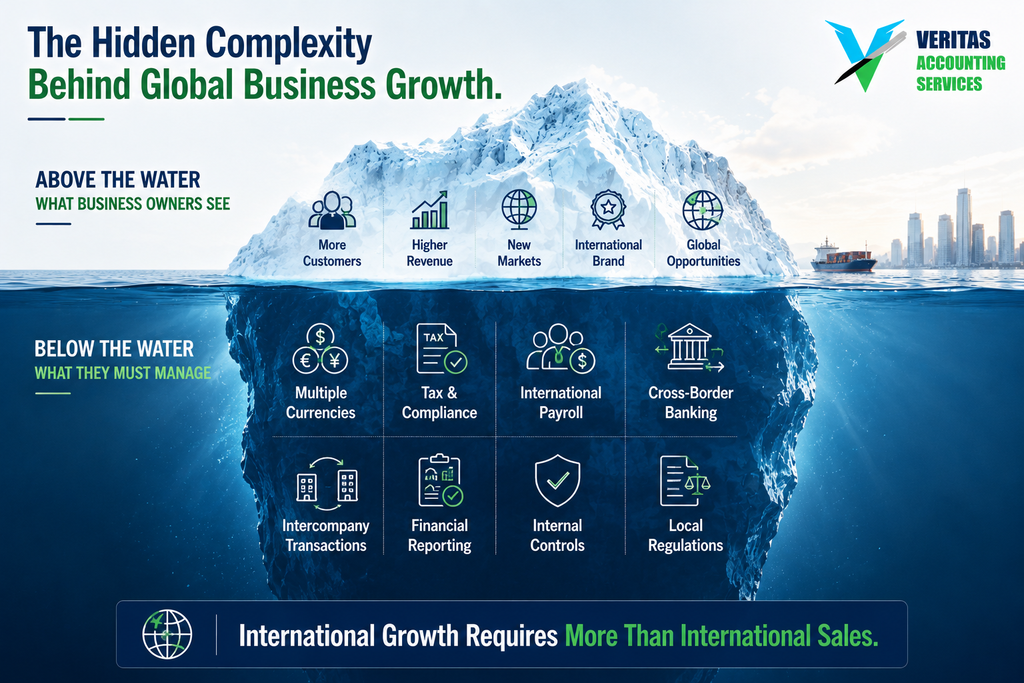
A business that was relatively easy to manage in one country can become significantly more complicated when it starts operating across several jurisdictions. Multiple currencies, tax systems, payroll rules, banking relationships and reporting requirements can quickly create a level of complexity that management did not anticipate.
The challenge is not simply entering another market.
The challenge is maintaining financial visibility, compliance and operational control while the business becomes more international.
For business owners, understanding these challenges early can make international expansion much more manageable.
Table of Contents
- Why International Expansion Changes the Business
- Managing Multiple Currencies
- Accounting Across Different Countries
- Tax and Compliance Complexity
- International Payroll and Employees
- Banking and Cross-Border Payments
- Intercompany Transactions and Transfer Pricing
- Financial Reporting and Management Visibility
- Internal Controls Across Borders
- Communication and Operational Challenges
- What Should You Outsource?
- How Professional Accounting Teams Can Help
- A Practical Framework for International Expansion
- FAQ
- Conclusion
Why International Expansion Changes the Business
In a domestic business, many processes can be relatively straightforward.
The company may have one primary currency, one banking environment, one payroll system and a familiar tax structure.
Once operations cross borders, the picture changes.
A growing international company may need to manage:
- Multiple currencies
- Different tax systems
- Foreign bank accounts
- Local payroll requirements
- Different accounting requirements
- Multiple legal entities
- Cross-border transactions
- Intercompany payments
- International contracts
- Country-specific compliance
Each requirement may be manageable individually. The difficulty comes from managing them simultaneously and consistently.
This is why global business growth can create pressure even when revenue and customer numbers are increasing.
A company can be growing successfully from a sales perspective while its financial and administrative infrastructure is falling behind.
Managing Multiple Currencies
Currency management is one of the first issues international businesses encounter.
A company may receive revenue in U.S. dollars, pay suppliers in euros, maintain a bank account in British pounds and prepare consolidated reports in another currency.
That creates important accounting and management questions.
Which exchange rate should be applied?
How should foreign-currency transactions be recorded?
How should realized and unrealized foreign-exchange gains or losses be treated?
How should management compare profitability between countries when exchange rates are constantly changing?
Currency movements can also affect cash flow.
For example, a foreign subsidiary may increase its local revenue while the parent company’s reporting-currency results appear weaker because of exchange-rate movements.
Management therefore needs reporting that helps distinguish actual operating performance from currency movements.
Without this visibility, business owners may make decisions based on numbers that do not tell the complete story.
Accounting Across Different Countries
International expansion also changes the role of bookkeeping and accounting.
Different jurisdictions may have different accounting practices, statutory requirements and documentation standards.
Even when a group uses a common internal reporting structure, local requirements may still need to be addressed.
The key is consistency.
Management should be able to answer questions such as:
- How much revenue did each country generate?
- Which entity is profitable?
- Where is cash being held?
- What does each entity owe?
- Which customers have unpaid balances?
- Which costs are increasing?
- How does each market compare with the group?
A standardized chart of accounts and consistent bookkeeping procedures can make this information much easier to analyze.
The objective is not necessarily to make every country’s accounting identical.
The objective is to produce reliable and comparable information for decision-making.
For global business growth, that distinction becomes increasingly important.
Tax and Compliance Complexity
Tax is another major consideration when a company begins operating internationally.
Depending on its activities, a business may have obligations in its home country as well as other jurisdictions.
Potential areas may include:
- Corporate income tax
- Sales tax or VAT
- Payroll taxes
- Withholding taxes
- Tax registrations
- Information reporting
- Local filings
- Cross-border transactions
- Permanent-establishment considerations
- Transfer pricing
The exact requirements depend on the countries involved and the structure of the business.
That is why businesses should not wait until a filing deadline to determine what obligations apply.
A better approach is to identify requirements before entering a new market, assign responsibility, maintain documentation and coordinate with qualified professionals in each relevant jurisdiction.
Tax compliance should be part of the expansion strategy—not an administrative task addressed after the business has already entered the market.
International Payroll and Employees
Hiring employees internationally can provide access to valuable skills and help businesses establish a presence in new markets.
It also introduces additional responsibilities.
Employment and payroll rules can vary significantly from one country to another.
Businesses may need to consider:
- Payroll taxes
- Social contributions
- Employment classifications
- Benefits
- Leave requirements
- Local employment agreements
- Reporting requirements
- Currency of payment
- Employee documentation
Payroll also connects directly with accounting.
Employee costs need to be accurately recorded and reflected in management reporting.
As international teams grow, companies should establish a consistent process for collecting payroll information from each country and incorporating it into their financial reporting.
Poor coordination between payroll and accounting can lead to inaccurate expenses, cash-flow forecasts and profitability analysis.
Banking and Cross-Border Payments
International businesses also need strong control over how money moves.
A company may have several bank accounts across different countries, each with different currencies, fees, payment processes and reconciliation requirements.
This can lead to:
- Unreconciled transactions
- Duplicate payments
- Unidentified bank charges
- Delayed transfers
- Foreign-exchange costs
- Weak approval procedures
- Poor visibility over cash
Management should know more than the company’s total cash balance.
It should understand where the cash is located, which entity owns it and how readily it can be used.
A consolidated cash-flow report can help management understand working capital requirements and make better decisions about investments, transfers and operating expenses.
Strong bank reconciliation procedures are equally important because small errors across multiple accounts can become significant when they accumulate over time.
Intercompany Transactions and Transfer Pricing
As companies establish subsidiaries or related entities, transactions between those entities become more common.
For example:
- One entity may provide management services to another.
- A parent company may fund a subsidiary.
- One entity may purchase inventory from another.
- A central office may allocate shared costs across locations.
These transactions require appropriate accounting and documentation.
Transfer pricing can also become an important consideration when related entities operate in different tax jurisdictions.
Businesses should be able to explain:
- What service or product was provided?
- Which entity benefited?
- How was the transaction priced?
- How was it recorded?
- What documentation supports the transaction?
- What local requirements apply?
Poorly documented intercompany transactions can create unnecessary accounting and tax risks.
This is one area where coordination between accounting and tax professionals can provide significant value.
Financial Reporting and Management Visibility
One of the hidden risks of international expansion is losing visibility into the business.
A company may receive one type of report from its U.S. operation, another from Europe and another from Asia.
Each report might be individually accurate, yet management may struggle to compare them.
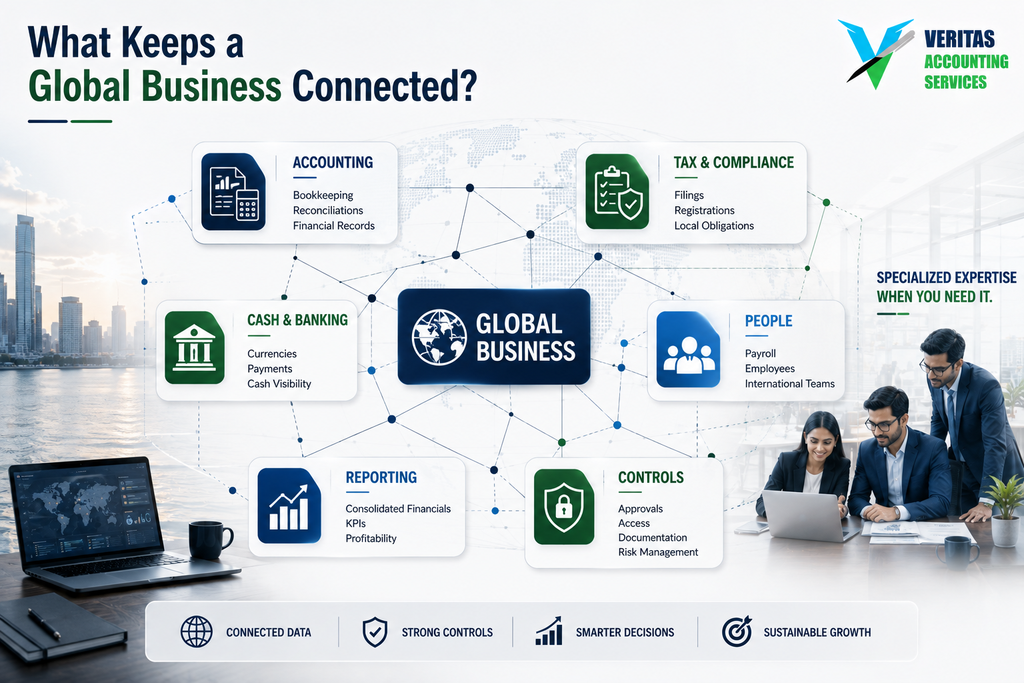
A strong international finance function should establish standardized management reporting.
Useful reports may include:
- Consolidated profit and loss
- Balance sheet
- Cash-flow reports
- Country-level profitability
- Accounts receivable aging
- Accounts payable
- Budget versus actual
- Revenue by market
- Gross-margin analysis
- Key performance indicators
This allows leadership to view the organization as one connected business rather than several unrelated operations.
As global business growth accelerates, financial visibility becomes more important—not less.
Internal Controls Across Borders
Geographic expansion also increases the number of places where financial errors can occur.
Different employees may access different systems. Payments may be processed from different countries. Documentation may be stored across multiple platforms.
Appropriate internal controls should cover areas such as:
- Bank access
- Payment approvals
- Vendor setup
- Expense approvals
- Journal entries
- User permissions
- Account reconciliations
- Financial close procedures
Controls do not need to make the organization bureaucratic.
The goal is to create a reasonable balance between control and efficiency.
A growing company should regularly review whether its internal controls still match the size and complexity of its operations.
Communication and Operational Challenges
Not every international challenge involves finance.
Time zones can make meetings difficult. Cultural differences can influence communication and expectations. Teams in different locations may develop their own working habits.
Even basic processes can become inconsistent.
One finance team might close its books on the fifth working day while another takes two weeks.
One manager might expect weekly reporting while another works with monthly information.
These differences can create confusion.
Standard operating procedures, reporting calendars, shared documentation and clearly assigned responsibilities can create consistency without preventing local teams from operating effectively.
Good international operations require both global standards and reasonable local flexibility.
What Should You Outsource?
International expansion does not mean every capability needs to be built internally.
In fact, hiring a complete accounting, tax and finance team in every country may not be financially practical.
Business owners should evaluate each function based on:
Complexity + Frequency + Risk + Expertise Required + Cost
Some responsibilities need daily internal involvement and should remain within the organization.
Others can be handled efficiently by experienced external professionals.
Common outsourced functions include:
- Bookkeeping
- Accounts payable
- Accounts receivable
- Bank reconciliation
- Payroll support
- Tax compliance support
- Financial reporting
- Budgeting
- Cash-flow forecasting
- CFO advisory
Outsourcing can therefore become a useful part of global business growth when it provides access to expertise without unnecessarily increasing fixed overhead.
However, outsourcing should not mean losing control.
The business should establish clear deliverables, deadlines, review procedures, communication expectations and data-security requirements.
How Professional Accounting Teams Can Help
International businesses often need more than someone to record transactions.
They need reliable financial information that management can use.
An experienced outsourced accounting team can help standardize bookkeeping, reconciliations, reporting and financial processes across locations.
For example, an external professional team can support:
- Monthly bookkeeping
- Bank and credit-card reconciliation
- Accounts receivable and payable
- Financial statement preparation
- Management reporting
- Budgeting
- Cash-flow forecasting
- Tax coordination
- Intercompany accounting support
- Financial analysis
At Veritas Accounting Services, we support businesses and professional firms with bookkeeping, accounting, tax support, financial reporting and outsourced finance services.
The objective is not simply to keep financial records organized.
It is to provide management with timely, accurate and useful financial information.
For an international business, this can make a meaningful difference.
When financial processes are standardized and reporting is timely, business owners can spend less time trying to understand what happened and more time deciding what should happen next.
That is particularly valuable when the organization is entering new markets, adding employees or managing multiple entities.
A Practical Framework for International Expansion
Before entering a new country, business owners can work through seven practical questions.
1. Is the Market Opportunity Strong Enough?
Understand the potential revenue and strategic value before committing significant resources.
2. What Compliance Requirements Apply?
Identify accounting, tax, payroll and regulatory obligations before operations begin.
3. How Will the Financial Structure Work?
Determine which entity will generate revenue, hold contracts, employ people and incur expenses.
4. What Information Does Management Need?
Establish consistent reporting requirements across countries.
5. Who Controls the Cash?
Define bank access, payment approvals and transfer authority.
6. Which Functions Should Be Outsourced?
Identify activities where an external professional team can provide expertise more efficiently than building an internal department immediately.
7. When Will the Structure Be Reviewed?
International operations change as the business grows. Review processes, controls and reporting regularly.
This framework makes global business growth more deliberate and less reactive.
FAQ
What are the biggest challenges of global business growth?
The most common challenges include multiple currencies, different tax systems, international payroll, banking, intercompany transactions, financial reporting, internal controls and communication across countries.
Why does international expansion make accounting more complicated?
Businesses may need to manage multiple currencies, entities, accounting requirements and intercompany transactions while still producing consistent information for management.
How can businesses manage international tax compliance?
Businesses should identify applicable obligations early, maintain accurate records, use a compliance calendar and work with qualified professionals who understand the relevant jurisdictions.
Should businesses outsource accounting when expanding internationally?
Outsourcing can be effective when a company needs specialized bookkeeping, accounting, reporting or tax support without the cost of establishing a complete internal finance function in every country.
How can management maintain financial visibility across countries?
Standardized bookkeeping, consistent reporting formats, consolidated financial statements, regular reconciliations and clear performance indicators can significantly improve visibility.
Conclusion
International expansion creates opportunities, but it also changes the infrastructure a business needs.
More countries can mean more currencies, employees, banking relationships, tax obligations, transactions and financial information.
The goal is not to eliminate that complexity.
The goal is to build systems capable of managing it without losing control.
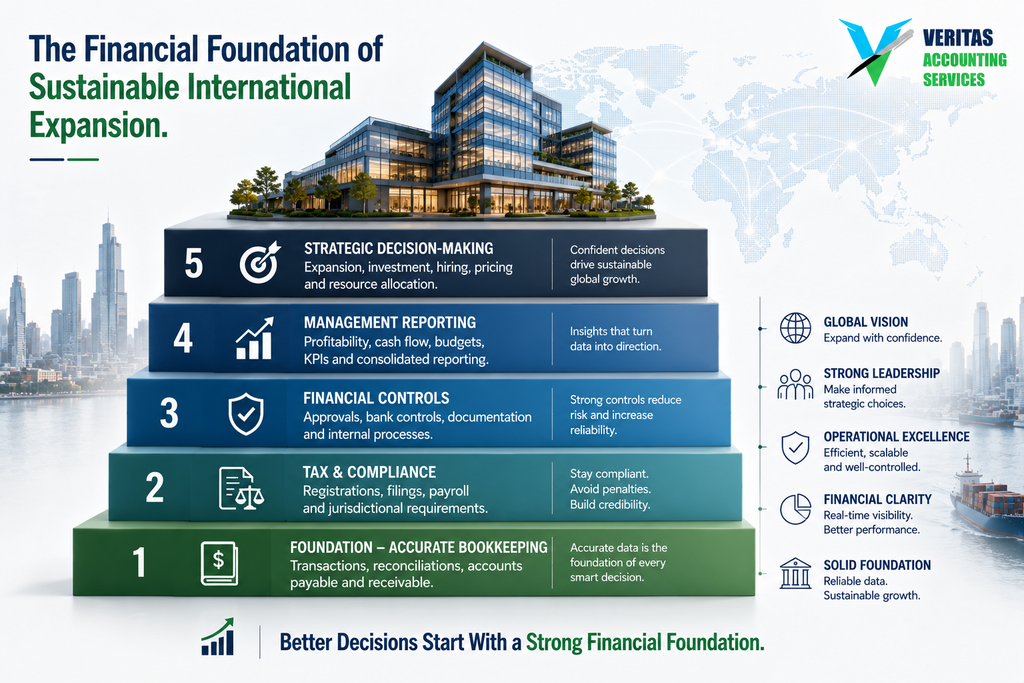
Strong bookkeeping, reliable accounting, timely financial reporting, appropriate tax support, effective internal controls and disciplined cash management provide the foundation.
Business owners should also avoid assuming that every capability must be built internally.
Experienced outsourced professionals can provide specialized accounting, bookkeeping, tax and financial support while the internal team focuses on customers, products, strategy and growth.
For businesses pursuing global business growth, the important question is not simply:
“How quickly can we expand?”
It is:
“Can our financial and operational infrastructure support that expansion responsibly?”
At Veritas Accounting Services, we help businesses and professional firms manage bookkeeping, accounting, tax support, financial reporting, forecasting and outsourced finance requirements.
The right financial partner can help an expanding business turn cross-border complexity into better visibility, stronger controls and more confident decisions.
GET IN TOUCH
Schedule a FREE Call