







The Ultimate 9-Step Guide for Non-US Founders to Start & Run a US Company Legally
Starting a U.S. business as a foreign founder is no longer complex—but it is structured. With the right steps, non-US founders can legally form, operate, and scale a U.S. company while staying compliant with IRS and state regulations.
This guide breaks down the complete 9-step process for non US founders US company setup, covering formation, compliance, taxation, and ongoing management.
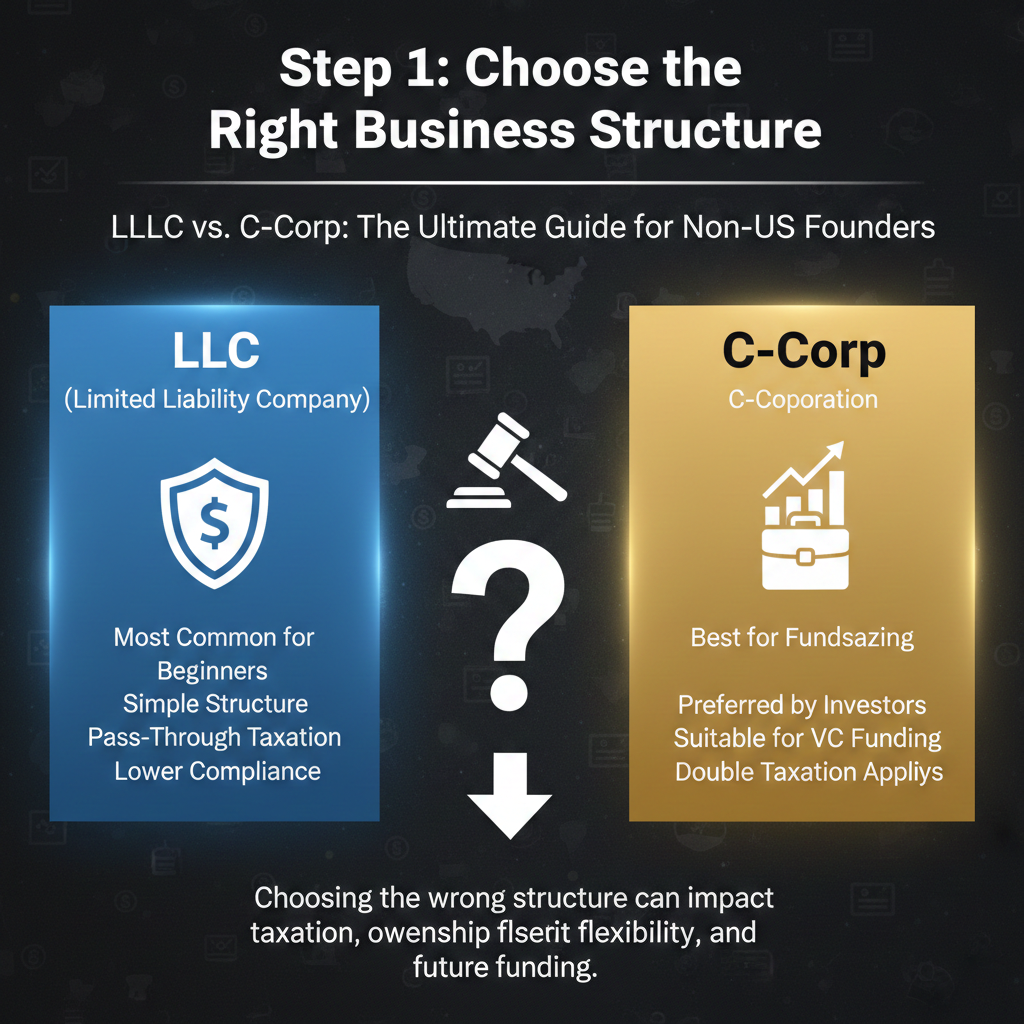
Step 1: Choose the Right Business Structure
The first and most critical decision for any non US founders US company setup is choosing the right entity.
Most foreign founders choose between:
- LLC (Limited Liability Company)
- C Corporation (C-Corp)
LLC (Most Common for Beginners)
- Simple structure
- Pass-through taxation
- Lower compliance requirements
C-Corp (Best for Fundraising)
- Preferred by investors
- Suitable for startups seeking VC funding
- Double taxation applies
Choosing the wrong structure can impact taxation, ownership flexibility, and future funding for non US founders US company setup.
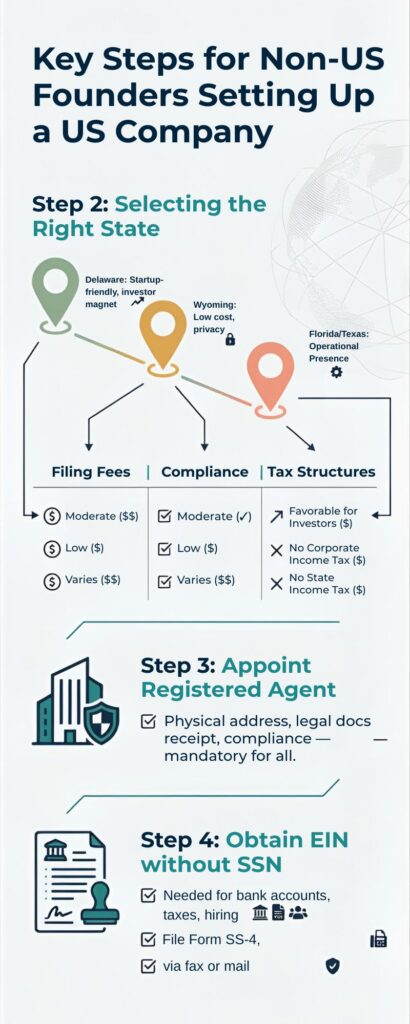
Step 2: Select the Right State
Non-US founders are not required to live in the U.S. to register a company, but they must choose a state.
Popular options include:
- Delaware – Best for startups and investors
- Wyoming – Low cost and privacy
- Florida / Texas – Operational presence
Each state has different:
- Filing fees
- Annual compliance requirements
- Tax structures
Step 3: Appoint a Registered Agent
Every U.S. company must have a registered agent with a physical address in the state of formation.
The agent:
- Receives legal documents
- Handles government notices
- Ensures compliance
This is mandatory for all non US founders US company setups.
Step 4: Obtain an EIN (Without SSN)
The Employer Identification Number (EIN) is essential for:
- Opening a bank account
- Filing taxes
- Hiring employees
Non-US founders without an SSN can still obtain an EIN by:
- Filing Form SS-4
- Applying via fax or mail
This step is often misunderstood but critical for compliance.
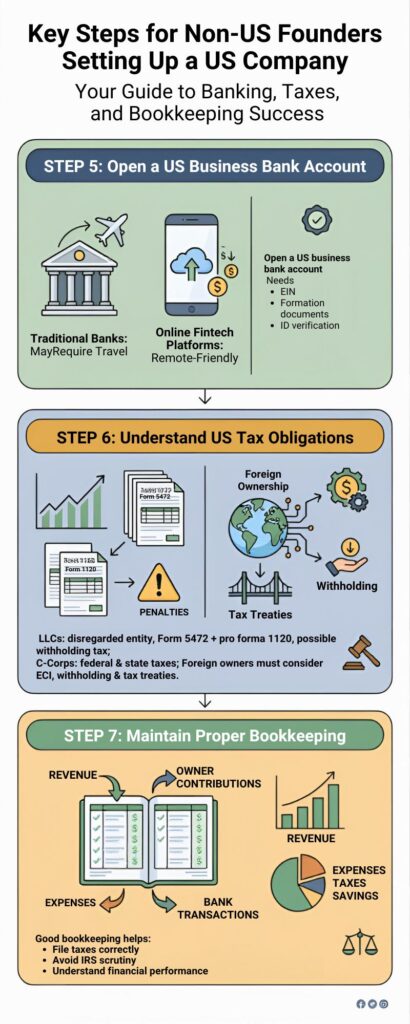
Step 5: Open a US Business Bank Account
A U.S. bank account is required to operate legally and manage finances.
Options include:
- Traditional banks (may require travel)
- Online fintech platforms (remote-friendly)
You will typically need:
- EIN
- Formation documents
- ID verification
Banking is a key step in running a compliant non US founders US company.
Step 6: Understand US Tax Obligations
This is where many for non US founders US company setup make mistakes.
For LLCs:
- May be treated as disregarded entity
- Requires Form 5472 + pro forma 1120
- Possible withholding tax obligations
For C-Corps:
- Corporate tax at federal level
- State taxes (if applicable)
Foreign owners must also evaluate:
- Effectively Connected Income (ECI)
- Withholding requirements
- Tax treaties
Ignoring taxation rules can lead to penalties.
Step 7: Maintain Proper Bookkeeping
Accurate bookkeeping is not optional—it is required.
You must track:
- Revenue
- Expenses
- Bank transactions
- Owner contributions
Good bookkeeping helps:
- File taxes correctly
- Avoid IRS scrutiny
- Understand financial performance
Many non US founders US company setups fail due to poor financial records.
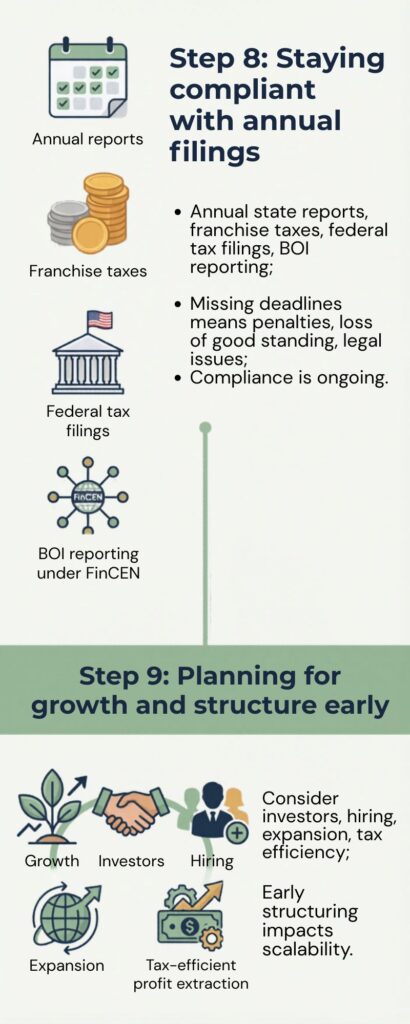
Step 8: Stay Compliant with Annual Filings
Every U.S. company must comply with ongoing requirements.
These include:
- Annual state reports
- Franchise taxes
- Federal tax filings
- BOI reporting (new requirement under FinCEN)
Missing deadlines can result in:
- Penalties
- Loss of good standing
- Legal complications
Compliance is not a one-time step—it is continuous.
Step 9: Plan for Growth & Structure Early
Once the company is set up, planning becomes critical.
Consider:
- Bringing in investors
- Hiring employees
- Expanding operations
- Tax-efficient profit extraction
Structuring decisions made early impact long-term scalability.
Common Mistakes Non-US Founders Make
Even with the right intent, mistakes happen.
Top errors include:
- Choosing the wrong entity
- Ignoring U.S. tax filing requirements
- Not maintaining proper bookkeeping
- Missing compliance deadlines
- Not understanding treaty benefits
Avoiding these mistakes ensures your non US founders US company remains compliant and scalable.
Why the US Remains Attractive for Foreign Founders
Despite compliance requirements, the U.S. remains one of the best places to start a business due to:
- Access to global markets
- Strong legal framework
- Investor ecosystem
- Business-friendly environment
With proper planning, non-US founders can fully leverage these advantages.
Final Takeaway
Starting a non US founders US company is not just about registration—it is about compliance, structure, and long-term planning.
Follow the 9-step framework:
- Choose the right entity
- Select the right state
- Appoint a registered agent
- Obtain EIN
- Open a bank account
- Understand taxation
- Maintain bookkeeping
- Stay compliant
- Plan for growth
Getting these steps right ensures your business operates legally and scales successfully.
GET IN TOUCH
Schedule a FREE Call







Connect on our Socials!
