








Why Financial Literacy Is the New Business Superpower
Running a business requires making decisions every day. Should you hire another employee? Can you afford new equipment? Is it time to expand? Should you increase prices? Can you take on more debt?
These decisions may look operational on the surface, but many of them are actually financial decisions.
That is why financial literacy has become such an important business skill.
Financial literacy does not mean becoming an accountant. It means understanding the numbers well enough to know what is happening inside your business, why it is happening, and what you should consider doing next.
For business owners, that understanding can turn financial information into better decisions.
What Is Financial Literacy in Business?
Financial literacy is the ability to understand and use financial information when making business decisions.
A financially literate business owner should be comfortable discussing areas such as:
- Revenue
- Expenses
- Profit
- Cash flow
- Assets
- Liabilities
- Working capital
- Debt
- Margins
- Taxes
- Financial forecasts
You do not need to prepare every journal entry yourself.
You do need to understand what the numbers are telling you.
That difference is important.
A business owner who understands the numbers can ask better questions, challenge assumptions, identify risks, and work more effectively with accountants, CAs, CFOs, and other professionals.
Why Financial Literacy Matters for Business Owners
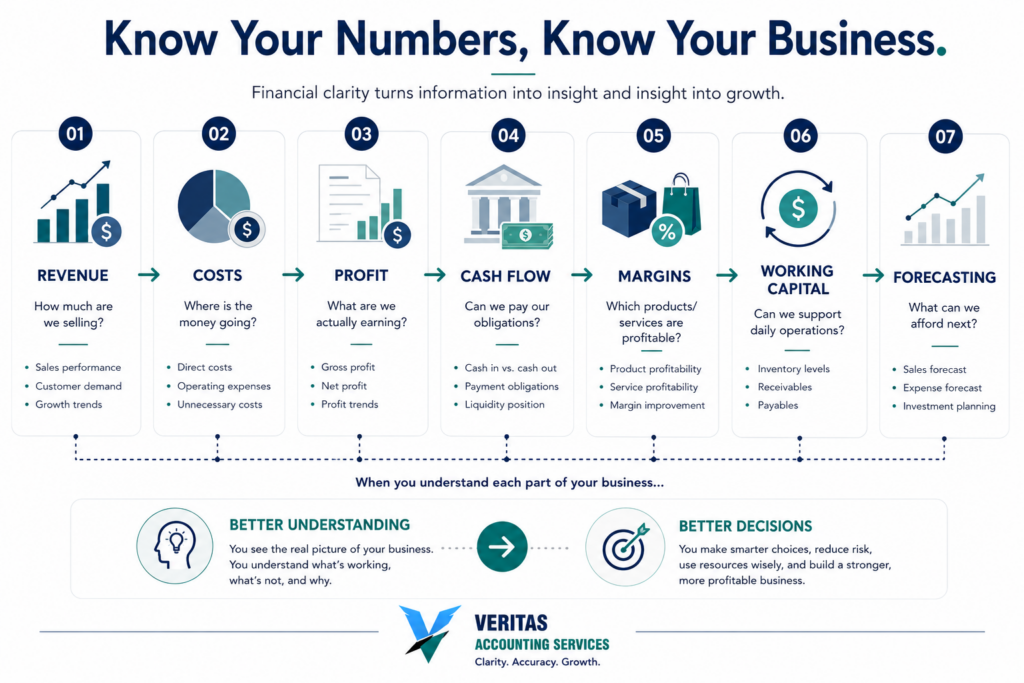
A business can have strong sales and still experience financial problems.
It can show accounting profit while struggling with cash.
It can have growing revenue but declining margins.
It can have plenty of customers but not enough working capital.
Financial literacy helps business owners see beyond one number.
1. It Improves Decision-Making
Every important business decision has a financial consequence.
Hiring an employee increases payroll.
Opening another location increases fixed costs.
Buying equipment requires capital.
Reducing prices affects margins.
Taking a loan creates repayment obligations.
Understanding these effects helps owners evaluate decisions before committing resources.
Instead of asking only, “Can we do this?”, financially informed owners can ask:
“What will this decision do to our cash flow, profitability, and financial position?”
That is a much stronger question.
Profit Is Not the Same as Cash
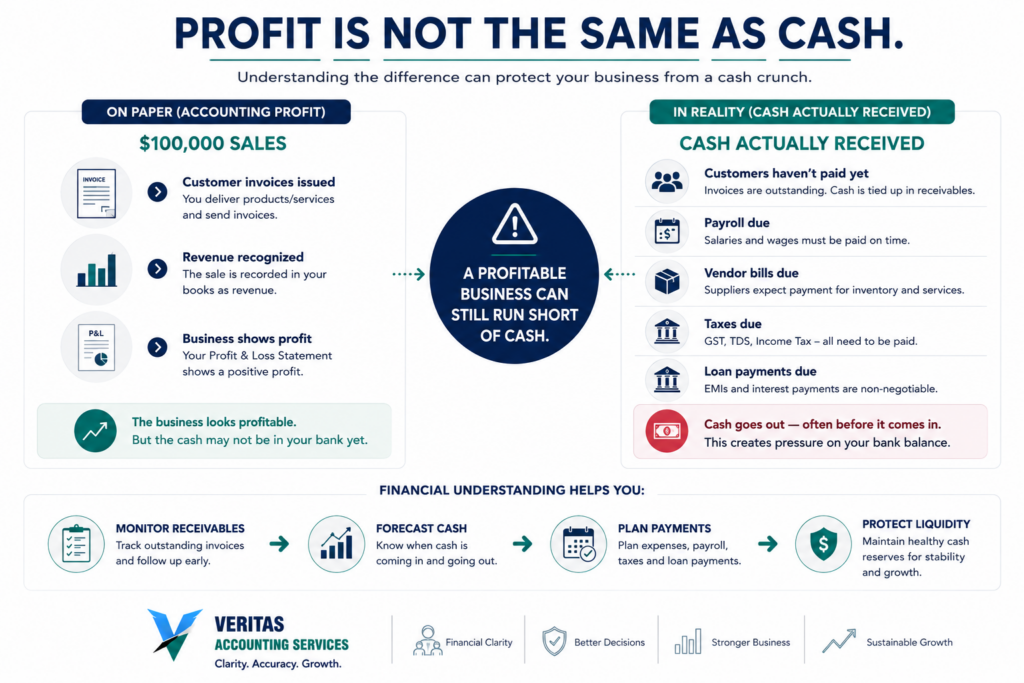
One of the most important concepts business owners should understand is the difference between profit and cash flow.
A company can report a profit but still experience cash shortages.
For example, imagine a business makes $100,000 in sales during a month but customers have 60-day payment terms.
The business may record revenue according to applicable accounting rules, but the cash may not arrive immediately.
Meanwhile, the company still has to pay:
- Employees
- Vendors
- Rent
- Utilities
- Taxes
- Loan payments
Understanding this difference helps owners manage working capital more effectively.
Financial literacy gives business leaders the ability to recognize that a profitable business still needs healthy cash management.
Understanding the Profit and Loss Statement
The profit and loss statement is one of the most useful reports for a business owner.
It helps answer questions such as:
- How much revenue did we generate?
- What did it cost to generate that revenue?
- What are our operating expenses?
- What is our gross profit?
- What is our net profit?
- Are margins improving or declining?
But simply receiving a monthly report is not enough.
Business owners should look for trends.
For example:
If revenue increases by 20% but profit increases by only 5%, what happened?
Perhaps:
- Costs increased
- Prices were too low
- Payroll increased
- Marketing became less efficient
- Gross margins declined
This is where understanding financial information becomes a management advantage.
Understanding the Balance Sheet
Many business owners pay more attention to the profit and loss statement than the balance sheet.
That can be a mistake.
The balance sheet provides information about:
- Assets
- Liabilities
- Equity
- Cash
- Accounts receivable
- Inventory
- Loans
- Other obligations
It can help answer an important question:
What is the financial position of the business today?
A business may be profitable while carrying significant debt or having too much money tied up in inventory and receivables.
Understanding the balance sheet helps owners recognize these issues.
Financial Literacy Helps With Pricing
Pricing decisions should not be based only on what competitors charge.
Business owners should understand:
- Direct costs
- Labor costs
- Overhead
- Gross margin
- Customer acquisition costs
- Desired profit
- Market conditions
For example, increasing sales volume does not necessarily improve profitability if every additional sale generates very little margin.
A financially informed owner can evaluate whether a product, service, or customer is actually contributing enough to the business.
It Helps Business Owners Control Expenses
Not every expense is bad.
The real question is whether an expense creates sufficient value.
Financial literacy helps owners distinguish between:
Essential costs
Costs required to operate the business.
Growth investments
Spending intended to generate future revenue or efficiency.
Unnecessary spending
Expenses that provide little measurable business value.
Reviewing expenses regularly can reveal opportunities to improve profitability without simply cutting costs across the board.
It Makes Cash Flow Planning Easier
Cash flow problems can develop before a business owner realizes there is a problem.
A company may have:
- Increasing sales
- Growing receivables
- Large inventory purchases
- Higher payroll
- New equipment payments
All of these can increase the amount of cash required to operate.
Financial literacy helps owners understand how these moving parts interact.
A cash flow forecast can then help answer:
- How much cash will we need next month?
- When will major payments become due?
- Can we afford the planned investment?
- Will customer collections cover upcoming expenses?
- Do we need additional working capital?
These questions are critical for growing businesses.
Financial Literacy Supports Smarter Growth
Growth sounds positive, but growth also consumes resources.
A company that doubles its sales may need:
- More employees
- More inventory
- Larger premises
- More technology
- More working capital
- Additional financing
Without understanding the financial requirements of growth, a business can expand faster than its cash resources allow.
Financial literacy helps owners evaluate whether growth is not only possible but financially sustainable.
Understanding Debt Before Taking It
Borrowing can help a business grow, but debt creates future obligations.
Before taking a loan, business owners should understand:
- Interest costs
- Repayment schedules
- Total borrowing costs
- Collateral requirements
- Cash flow impact
- Debt-to-equity considerations
The important question is not simply:
“How much can the bank lend us?”
It is:
“How much debt can our business comfortably manage?”
Financial literacy helps owners evaluate borrowing decisions more responsibly.
It Helps Identify Problems Earlier
Financial problems rarely appear overnight.
There are often warning signs.
These may include:
- Declining gross margins
- Increasing receivables
- Falling cash balances
- Rising debt
- Increasing overhead
- Slower customer payments
- Inventory building up
- Declining profitability
Business owners who understand their financial information are more likely to notice these changes early.
Early identification gives management more time to respond.
Financial Literacy Makes Professional Advice More Valuable
Working with a CA, accountant, CFO, or financial advisor does not mean the business owner should stop understanding the numbers.
In fact, the opposite is true.
When owners understand the basics, professional conversations become more productive.
Instead of simply asking:
“Is the business doing well?”
they can ask:
- Why did gross margin change?
- Why is cash flow lower than profit?
- Which expenses increased?
- How much working capital do we need?
- What happens if revenue falls by 10%?
- Can we afford another employee?
- Which services generate the strongest margins?
Better questions lead to better discussions and better decisions.
How a CA Can Help Improve Financial Understanding
A CA can play an important role in helping business owners turn financial reports into practical business information.
Financial Reporting
A CA can help ensure that financial statements are properly prepared and useful for management.
Financial Analysis
Historical results can be analyzed to identify trends in revenue, expenses, margins, and profitability.
Cash Flow Forecasting
A CA can help prepare forecasts that show expected cash inflows and outflows.
Budgeting
Budgets provide a financial roadmap and allow actual results to be compared with expectations.
Tax Planning
Understanding expected tax obligations can help owners avoid unexpected cash requirements.
Business Advisory
A CA can help owners evaluate the financial impact of hiring, expansion, pricing, financing, and other major decisions.
The goal is not simply to provide reports.
The goal is to help the owner understand what those reports mean.
Financial Literacy Is Not About Doing Everything Yourself
There is a common misconception that financially literate business owners should handle their own bookkeeping, accounting, tax preparation, and financial analysis.
That is not the objective.
A business owner should know enough to:
- Understand key reports
- Ask relevant questions
- Recognize warning signs
- Evaluate major decisions
- Communicate effectively with professionals
- Understand financial consequences
Professional support can then handle the technical work.
Think of it this way:
You do not need to be a mechanic to understand your car’s dashboard.
You need to know what the warning lights mean and when to call a professional.
Business finances work in a similar way.
Simple Financial Habits Every Business Owner Can Build
Improving financial knowledge does not have to happen overnight.
Start with a few practical habits.
Review Financial Statements Monthly
Do not wait until tax season to look at your numbers.
Compare Actual Results With Budget
Understand where the business is performing above or below expectations.
Monitor Cash Flow
Know how much cash is available and what major payments are coming.
Track Key Metrics
Depending on the business, monitor:
- Gross margin
- Net margin
- Accounts receivable
- Accounts payable
- Customer acquisition cost
- Revenue growth
- Operating expenses
Ask Why, Not Just What
Do not stop at “revenue decreased.”
Ask why revenue decreased and what management can do about it.
Discuss Results With Your CA
Use regular financial reviews to turn reports into action.

Financial Literacy Creates Better Leadership
Leadership is ultimately about making decisions under uncertainty.
Financial information reduces some of that uncertainty.
A financially informed business owner can evaluate opportunities more objectively, recognize risks earlier, and understand the consequences of major decisions.
This can create a stronger relationship between financial data and business strategy.
Instead of finance being something reviewed after decisions are made, it becomes part of the decision-making process itself.
The Future of Business Requires Financial Understanding
Technology is making financial information more accessible than ever.
Cloud accounting platforms, dashboards, automated reporting, forecasting tools, and artificial intelligence can help businesses analyze information faster.
But technology does not automatically create understanding.
Someone still needs to interpret the information, question unusual results, consider business context, and decide what action makes sense.
That is why financial literacy remains valuable even as technology becomes more powerful.
The future is not about business owners replacing financial professionals.
It is about business owners and financial professionals working together more effectively.
The Bottom Line
Financial literacy is becoming one of the most valuable skills a business owner can develop.
You do not need to become an accountant.
You need to understand enough about your numbers to recognize what is happening, ask better questions, evaluate opportunities, and identify risks before they become serious problems.
Profitability, cash flow, pricing, debt, expenses, taxes, and growth are all connected.
A CA or financial professional can provide the technical expertise, analysis, forecasting, and advice needed to turn financial information into practical decisions.
But the more financially informed the business owner is, the more value that professional relationship can create.
Financial literacy is not about knowing every number in your business. It is about knowing which numbers matter, what they are telling you, and what you should do next.
That is what makes financial literacy a true business superpower.
Frequently Asked Questions
What does financial literacy mean for a business owner?
It means understanding key financial concepts and reports well enough to make informed decisions about profitability, cash flow, expenses, debt, pricing, and growth.
Does a business owner need to know accounting?
A business owner does not need to become an accountant, but understanding basic financial reports and concepts can significantly improve decision-making.
Why is cash flow important if a business is profitable?
Profit and cash flow are different. A profitable company can still experience cash shortages when customers pay later, inventory consumes cash, or large expenses become due.
How can a CA help a business owner?
A CA can help with financial reporting, analysis, budgeting, forecasting, tax planning, profitability analysis, and strategic financial decisions.
What financial reports should business owners review?
The profit and loss statement, balance sheet, and cash flow information are among the most important reports for understanding business performance and financial position.
How can business owners improve their financial knowledge?
Start by reviewing financial reports regularly, understanding key metrics, comparing actual results with budgets, monitoring cash flow, and discussing financial performance with a qualified professional.
GET IN TOUCH
Schedule a FREE Call










Connect on our Socials!
