







Build In-House or Outsource? How to Choose the Right Business Model
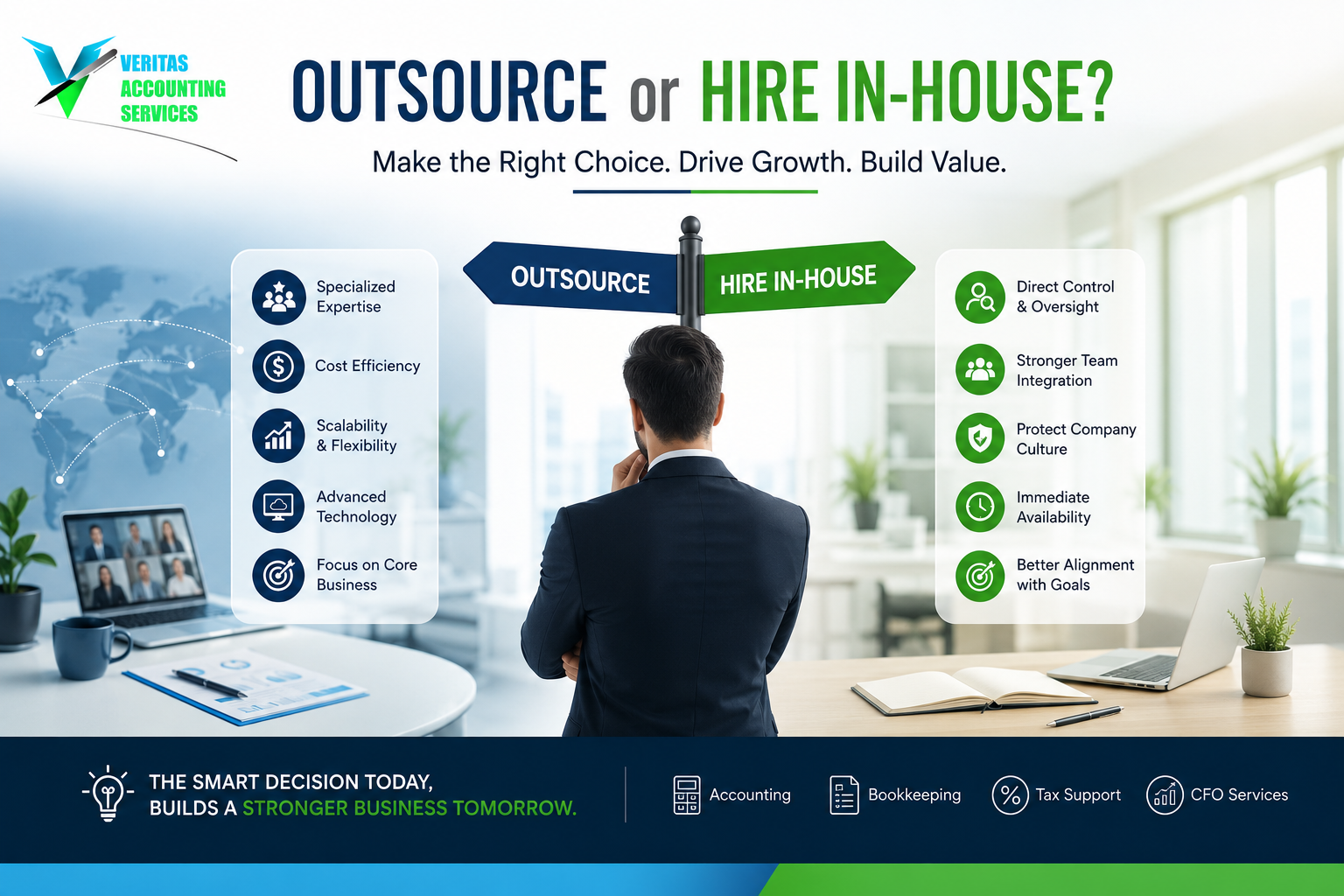
As a business grows, management eventually faces an important question: should a particular function be handled by an internal employee or entrusted to an experienced external team?
The answer is rarely as simple as comparing an employee’s salary with an outsourcing fee.
A better decision considers expertise, total cost, flexibility, quality, management time, scalability, risk, and the strategic importance of the function.
This is why business outsourcing has become an important consideration for growing companies. Businesses can access experienced professionals without necessarily building a complete department internally.
But outsourcing everything is not the answer either.
The real question is:
What should remain in-house, what should be outsourced, and which responsibilities require professional expertise?
For accounting, bookkeeping, tax, financial reporting, and CFO support, working with an experienced professional team can allow business owners to maintain better financial control while focusing their time on customers, operations, and growth.
Table of Contents
- In-House vs. Outsourcing: What Is the Difference?
- Pros and Cons of Hiring In-House
- Pros and Cons of Outsourcing
- When Should a Business Consider Outsourcing?
- Why Accounting and Bookkeeping Are Strong Candidates
- Why Tax Services Require Professional Expertise
- Other Functions Businesses Can Outsource
- How Outsourcing Can Improve Productivity
- The Importance of Choosing the Right Partner
- The Hybrid Model
- A Practical Decision Framework
- FAQ
- Conclusion
In-House vs. Outsourcing: What Is the Difference?
Hiring in-house means the company employs and manages its own people to perform a function.
Business outsourcing means engaging an external professional or organization to perform defined responsibilities on behalf of the company.
Both models have legitimate advantages.
An internal employee may have deeper day-to-day knowledge of the company, while an external team may provide broader technical expertise and access to multiple professionals.
The right model depends on the nature of the work.
For example, a business may want its sales leadership and customer relationships managed internally while using business outsourcing for bookkeeping, tax preparation support, payroll administration, or financial reporting.
The decision should therefore be made function by function, not as an all-or-nothing strategy.
Pros and Cons of Hiring In-House
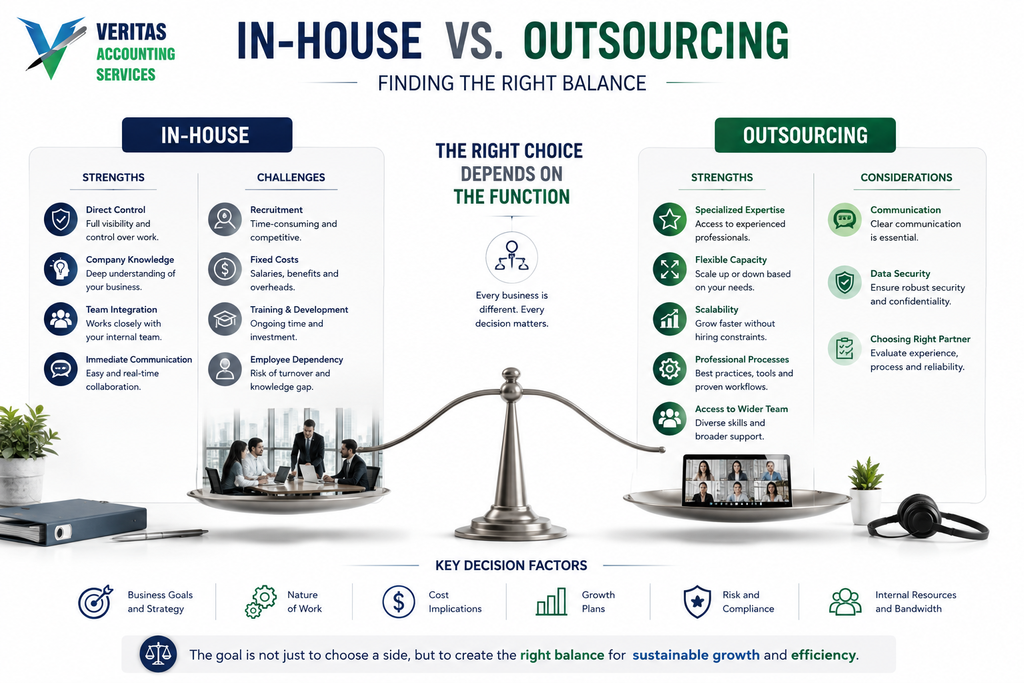
Advantages of an In-House Team
An internal team can provide:
- Direct supervision
- Immediate communication
- Strong company-specific knowledge
- Greater control over daily activities
- Closer integration with other departments
- Stronger understanding of internal culture
- Dedicated attention to the company’s priorities
For highly strategic functions that require constant collaboration, an internal employee may be the right choice.
For example, a company developing proprietary technology may prefer to keep its core development team in-house.
Disadvantages of Hiring In-House
However, hiring internally also creates responsibilities for the business.
Management needs to consider:
- Recruitment costs
- Salaries and benefits
- Training
- Software and technology
- Employee turnover
- Leave and backup coverage
- Performance management
- Office infrastructure
- Professional development
- Management time
There is also a specialization problem.
A small business may need the expertise of a senior accountant, tax professional, financial analyst, and CFO—but may not have enough workload to justify hiring four separate specialists.
That is one situation where business outsourcing can provide an alternative.
Pros and Cons of Outsourcing
Advantages of Outsourcing
A well-managed outsourcing arrangement can provide:
- Access to specialized professionals
- Flexible capacity
- Lower fixed staffing requirements
- Established processes
- Multiple levels of review
- Faster access to expertise
- Reduced recruitment burden
- Better scalability
- Access to technology and accounting systems
- More time for management to focus on strategic work
One major advantage is that the business may gain access to a team rather than one employee.
For example, an outsourced accounting arrangement could include a bookkeeper, accountant, senior reviewer, and manager.
This structure can provide continuity if one team member is unavailable.
Disadvantages of Outsourcing
Outsourcing is not automatically successful.
Potential challenges include:
- Communication gaps
- Poor-quality providers
- Lack of business understanding
- Data-security concerns
- Inconsistent service
- Unclear responsibilities
- Overdependence on an external provider
- Transition difficulties
Therefore, the quality of the outsourcing partner matters enormously.
A low-cost provider that creates errors and requires constant supervision may ultimately cost more than a competent professional team.
When Should a Business Consider Outsourcing?
Business outsourcing becomes particularly attractive when a company faces one or more of the following situations.
The Owner Is Doing Too Much Routine Work
If the owner spends several hours every week reviewing transactions, chasing documents, preparing reports, or solving recurring administrative problems, there is an opportunity cost.
That time could instead be spent on customers, strategy, pricing, partnerships, and growth.
Specialized Expertise Is Difficult to Hire
Some businesses need specialist knowledge without needing a full-time specialist.
A growing company may need financial forecasting every month but may not need a full-time CFO.
It may need experienced tax support during filing periods without needing a permanent tax department.
Business outsourcing can provide access to this expertise when it is required.
Workload Changes Throughout the Year
Tax, accounting, payroll, financial reporting, and compliance workloads can fluctuate.
Maintaining a large permanent team during low-volume periods may not be efficient.
External professionals can provide additional capacity when the workload increases.
The Business Is Growing Faster Than Its Internal Team
Hiring takes time.
Recruiting, interviewing, onboarding, training, and developing employees can delay the expansion of a department.
A qualified external team can sometimes provide additional capacity much faster.
Why Accounting and Bookkeeping Are Strong Candidates
Accounting and bookkeeping are often excellent areas for business outsourcing because they require technical knowledge, consistent processes, attention to detail, and regular execution.
These functions are essential to the business, but that does not necessarily mean every task needs to be performed internally.
A professional accounting team can support:
- Daily bookkeeping
- Bank reconciliation
- Credit-card reconciliation
- Accounts payable
- Accounts receivable
- Transaction classification
- Month-end closing
- Financial statement preparation
- Management reports
- Bookkeeping cleanup
- Financial analysis
- Cash-flow reporting
The biggest advantage is not simply saving the cost of an employee.
It is gaining access to a structured process and professional review.
Consider a company with one internal bookkeeper.
If that person leaves, the business may suddenly face delays in reconciliations, reporting, and month-end closing.
A properly structured external team can provide greater continuity because responsibilities can be distributed among multiple professionals.
For international businesses, business outsourcing can also provide access to professionals experienced with different accounting platforms, reporting requirements, currencies, and business models.
Why Tax Services Require Professional Expertise
Tax is another area where businesses should be careful about choosing between internal hiring and business outsourcing.
Tax rules can be complex, and requirements can vary based on business structure, location, transactions, employees, and jurisdictions.
The objective should not simply be to find the lowest-cost tax preparer.
A professional tax team should understand the client’s financial information, identify relevant compliance requirements, maintain appropriate documentation, and communicate issues clearly.
Tax-related outsourcing may include:
- Tax return preparation support
- Tax document organization
- Tax compliance coordination
- Sales tax support
- Payroll tax support
- Tax notice assistance
- Tax planning support, where appropriately qualified
Businesses operating in multiple jurisdictions may have an even stronger need for professional assistance.
The important point is to clearly define who is responsible for preparation, review, filing, communication, and final approval.
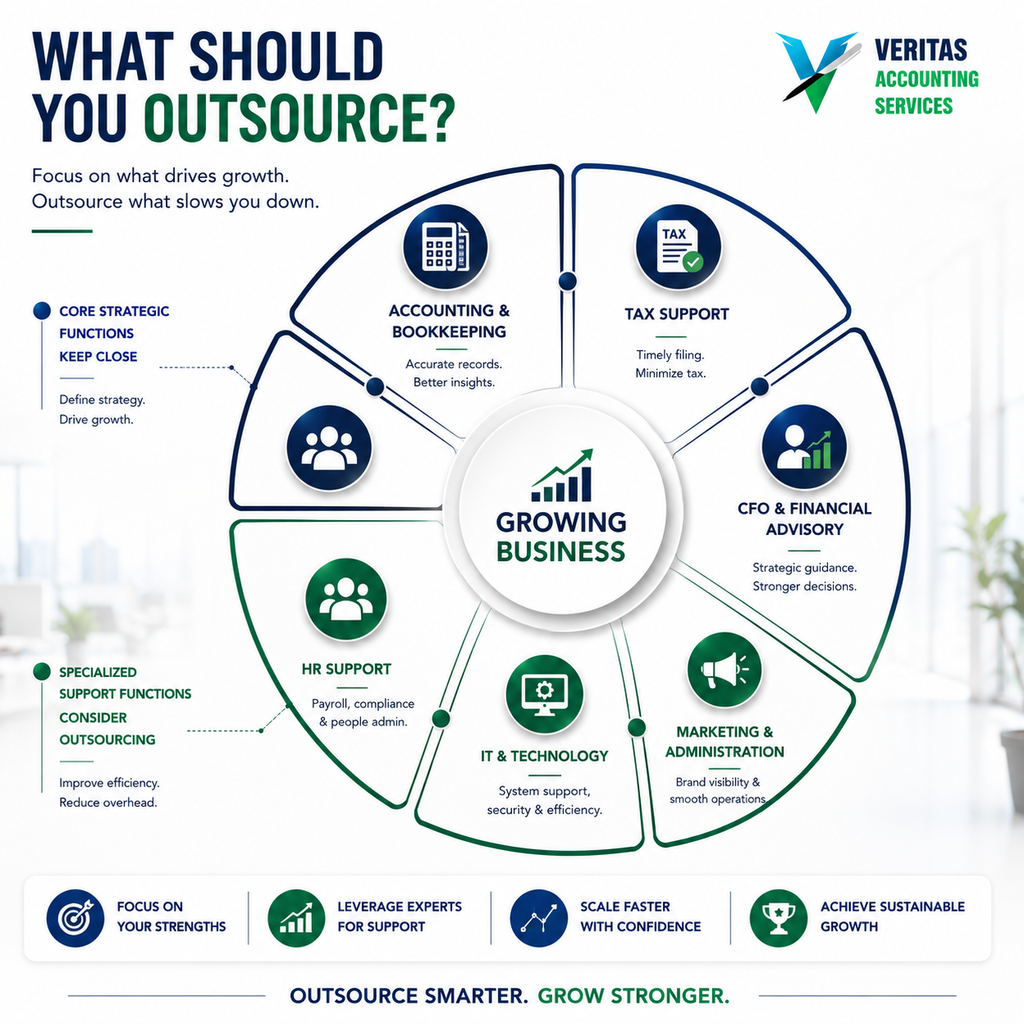
Other Functions Businesses Can Outsource
Accounting and tax are not the only areas where external expertise can help.
CFO and Financial Advisory
A growing company may require:
- Budgeting
- Financial projections
- Cash-flow forecasting
- KPI dashboards
- Profitability analysis
- Scenario planning
- Management reporting
An outsourced CFO can provide senior financial guidance without the cost of employing a full-time executive.
Human Resources
Recruitment coordination, payroll administration, employee documentation, and selected HR functions can often be handled externally.
Information Technology
Businesses may outsource IT support, cybersecurity, software administration, infrastructure, and technical assistance.
Digital Marketing
SEO, advertising, social media management, content development, and analytics are specialist areas that may be more efficient when managed by experienced external professionals.
Administrative Functions
Data entry, document management, scheduling, research, and other repetitive tasks can also be outsourced.
The principle is simple:
Keep strategic ownership where it matters and use specialists where they can deliver better value.
How Outsourcing Can Improve Productivity
The value of business outsourcing should not be measured only by the monthly invoice.
Consider a business owner who spends eight hours every week managing routine accounting issues.
That represents more than 400 hours a year.
What could the owner accomplish with those hours?
Perhaps:
- Develop new customers
- Improve pricing
- Review profitability
- Build strategic partnerships
- Improve operations
- Develop employees
- Plan expansion
- Strengthen customer relationships
This is where business outsourcing can become a productivity strategy.
The business is not simply purchasing labor.
It is gaining capacity, expertise, processes, and management time.
However, productivity improvements only happen when the outsourced team is capable of performing the work with limited supervision.
A poor provider can create additional work.
An experienced team should reduce the owner’s workload rather than transfer the workload into another form.
The Importance of Choosing the Right Outsourcing Partner
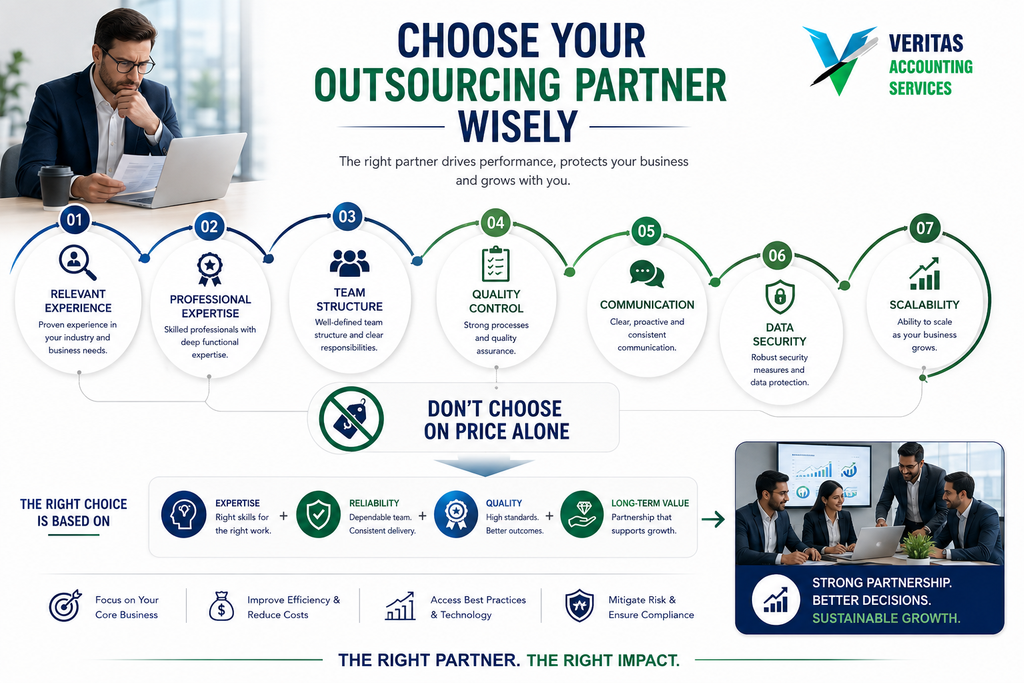
Choosing the right provider is one of the most important decisions in business outsourcing.
Price should be considered, but it should never be the only criterion.
1. Relevant Experience
Does the team understand your industry, accounting software, business model, and geographic requirements?
2. Professional Expertise
Who performs the work?
Who reviews it?
What qualifications and experience do they have?
3. Team Structure
Does the relationship depend entirely on one individual?
A structured team with backup and review procedures can provide greater continuity.
4. Quality Control
Ask how the provider reviews work before delivering it.
For accounting and tax-related services, review procedures are particularly important.
5. Communication
Agree on:
- Response times
- Reporting deadlines
- Meeting frequency
- Escalation procedures
- Primary contacts
6. Data Security
Financial and tax information is highly sensitive.
Understand how documents are transferred, stored, accessed, and protected.
7. Scalability
Ask whether the provider can support additional transactions, entities, employees, or reporting requirements as the company grows.
8. Transparent Scope
A professional provider should clearly define:
- Deliverables
- Fees
- Responsibilities
- Turnaround times
- Review procedures
- Exclusions
Choosing the right partner makes business outsourcing significantly more effective.
The Hybrid Model: Often the Best of Both Worlds
Companies do not have to choose between completely internal and completely external operations.
A hybrid structure can often provide the best balance.
For example, a business might have an internal Finance Manager who maintains management control while outsourcing:
- Bookkeeping
- Reconciliations
- Accounts payable
- Accounts receivable
- Month-end preparation
- Tax support
- Financial reporting
The internal manager maintains oversight while the external team handles recurring execution.
This creates a combination of control, flexibility, expertise, and scalability.
For many growing companies, this can be more practical than building a large finance department immediately.
A Practical Decision Framework
Before deciding whether to hire internally or outsource a function, ask these questions:
Is It Core to Our Competitive Advantage?
If the function directly creates competitive differentiation, keeping ownership internally may make sense.
Do We Need Specialized Expertise?
If expertise is expensive or difficult to recruit, an external professional team may be more practical.
Is the Workload Consistent?
If demand changes significantly throughout the year, flexible external capacity can be valuable.
Does the Function Require Daily Internal Collaboration?
If constant interaction is essential, an internal role may be preferable.
What Is the Total Cost?
Do not compare only salary against an outsourcing fee.
Include:
- Recruitment
- Benefits
- Training
- Software
- Management time
- Infrastructure
- Employee turnover
- Professional development
- Opportunity cost
Then compare the total cost with the external solution.
This creates a more realistic decision.
FAQ
Is business outsourcing always cheaper than hiring in-house?
No. The objective should not simply be to find the cheapest option. Businesses should compare total cost, expertise, flexibility, quality, management time, and expected outcomes.
Should accounting and bookkeeping be outsourced?
For many growing companies, outsourcing accounting and bookkeeping can provide access to experienced professionals and structured processes without building a complete internal accounting department.
Can tax services be outsourced?
Yes. Many tax-related functions can be handled by appropriately qualified professionals. Businesses should verify experience, qualifications, responsibilities, review procedures, and compliance scope.
How do I choose the right outsourcing company?
Evaluate experience, qualifications, team structure, quality control, communication, technology, data security, scalability, transparency, and references or relevant track record.
Can outsourcing work together with an internal finance team?
Absolutely. A hybrid model can combine internal management oversight with external execution, particularly for bookkeeping, accounting operations, tax support, and financial reporting.
Is outsourced CFO support suitable for small businesses?
It can be. A growing business may need forecasting, budgeting, cash-flow planning, profitability analysis, and strategic financial advice without requiring a full-time CFO.
Conclusion
The decision to outsource or hire in-house should not be based solely on cost.
The better question is:
Which structure gives your business the right combination of expertise, control, flexibility, quality, and productivity?
Some functions are better kept internally. Others can be handled more efficiently by experienced specialists.
Accounting, bookkeeping, tax support, financial reporting, and selected CFO functions are often strong candidates for business outsourcing because they require technical expertise, consistent processes, and reliable execution.
But outsourcing successfully depends on choosing the right partner.
The right provider should not simply complete assigned tasks. It should understand your business, communicate clearly, maintain quality controls, protect confidential information, and scale with you.
At Veritas Accounting Services, we support businesses and professional firms with outsourced bookkeeping, accounting, tax support, financial reporting, financial projections, and CFO-related services. Our objective is to work as an extension of your team while allowing business leaders to focus on customers, strategy, and growth.
The goal is not to outsource everything.
The goal is to build the right team around your business.
Keep strategic responsibilities where they belong. Delegate specialized work to experienced professionals. And choose outsourcing partners based on expertise, reliability, processes, security, and long-term value—not simply price.
When approached strategically, business outsourcing is not merely a staffing decision.
It can become a competitive advantage.
GET IN TOUCH
Schedule a FREE Call










Connect on our Socials!
