






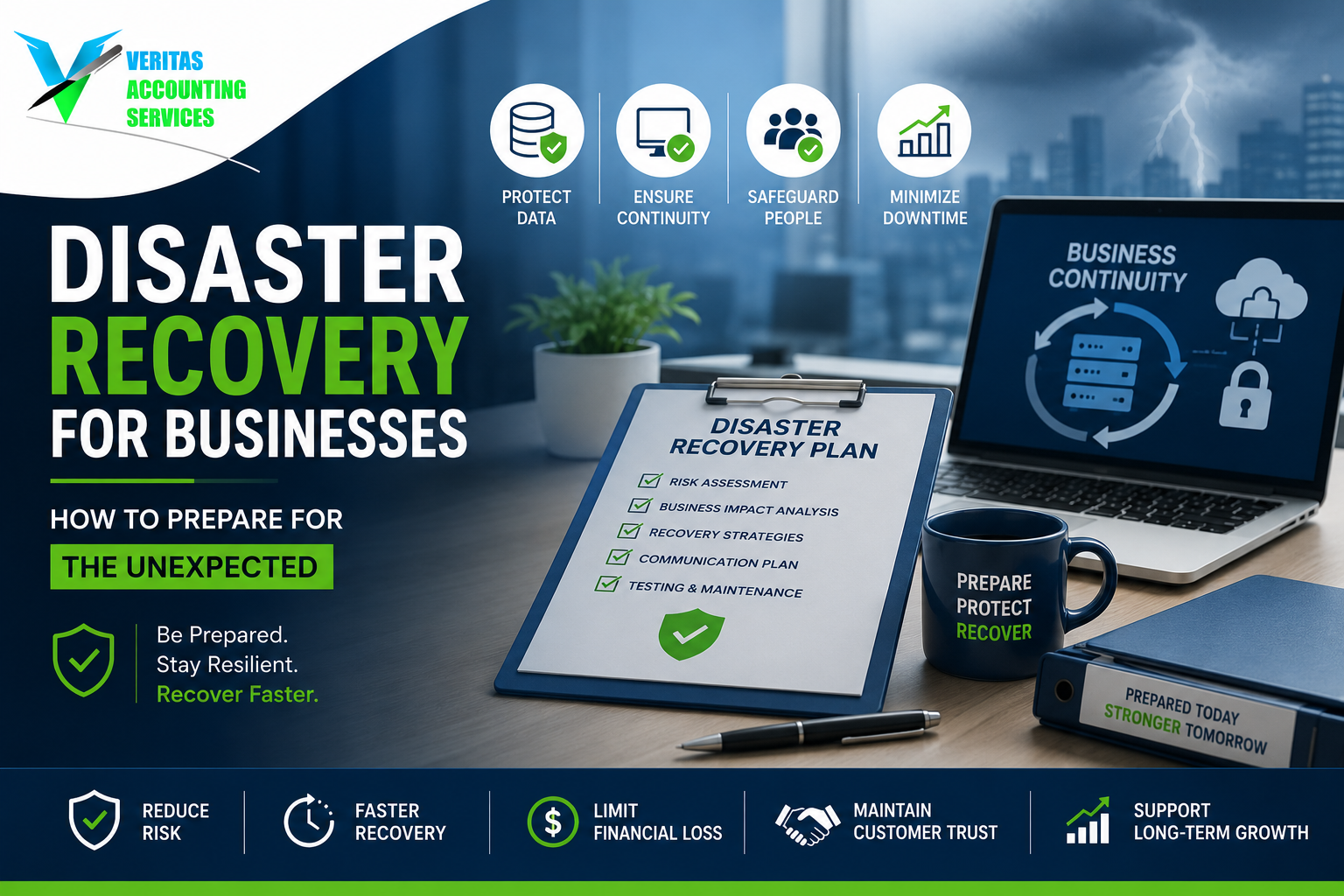

Disaster Recovery for Businesses: How to Prepare for the Unexpected
A disaster does not have to destroy a building to disrupt a business. A cyberattack, ransomware incident, prolonged power outage, critical software failure, severe weather event, supplier disruption, or sudden loss of key personnel can interrupt operations just as effectively.
A well-designed disaster recovery plan helps a business determine what happens when normal operations are no longer possible. It identifies critical systems, protects important information, establishes responsibilities, and provides a practical path toward restoring operations.
For business leaders, preparation is not simply an IT responsibility. Financial records, payroll information, customer data, tax documents, bank access, accounting systems, invoices, contracts, and management reports are all part of the business’s ability to recover.
The objective is not to predict every possible disaster. It is to make sure the company can continue functioning when something unexpected happens.
Table of Contents
- What Is a Disaster Recovery Plan?
- Why Businesses Should Prepare Before a Crisis
- Identify the Risks That Matter Most
- Protect Financial and Business Records
- Build a Reliable Backup Strategy
- Protect Accounting and Tax Information
- Plan for People and Communication
- Prepare for Cybersecurity Incidents
- Consider Vendors and Third Parties
- Establish Financial Continuity
- Test and Update the Plan
- How Professional Accounting Teams Can Help
- FAQ
- Conclusion
What Is a Disaster Recovery Plan?
A disaster recovery plan is a documented framework explaining how a business will respond to a serious disruption and restore critical operations.
It should answer practical questions such as:
- What are our most important business processes?
- Which systems must be restored first?
- Where are our critical records stored?
- Who is responsible for each recovery activity?
- How will employees communicate during an emergency?
- How will customers and suppliers be informed?
- How will we access cash and banking services?
- How will accounting and payroll continue?
- What happens if our primary office or technology becomes unavailable?
A disaster recovery plan should be practical rather than theoretical. Employees should be able to understand it and use it under pressure.
The U.S. Small Business Administration recommends that businesses assess their risks, create a tailored response plan, and practice the plan with employees.
Why Businesses Should Prepare Before a Crisis
The worst time to decide how your business will recover is after the disruption has already occurred.
A disaster recovery plan gives management the opportunity to make important decisions while there is still time to think clearly.
Without preparation, different people may make different assumptions about what should happen. Employees may not know who has authority to approve emergency payments. Management may not know where backup records are stored. Customers may receive conflicting information.
Preparation creates structure.
The IRS specifically encourages businesses to safeguard financial and tax records, back up computer data systems, establish communication procedures, and review emergency plans regularly.
Preparation also protects management time. Instead of inventing a response during a crisis, leadership can follow a framework that has already been discussed and tested.
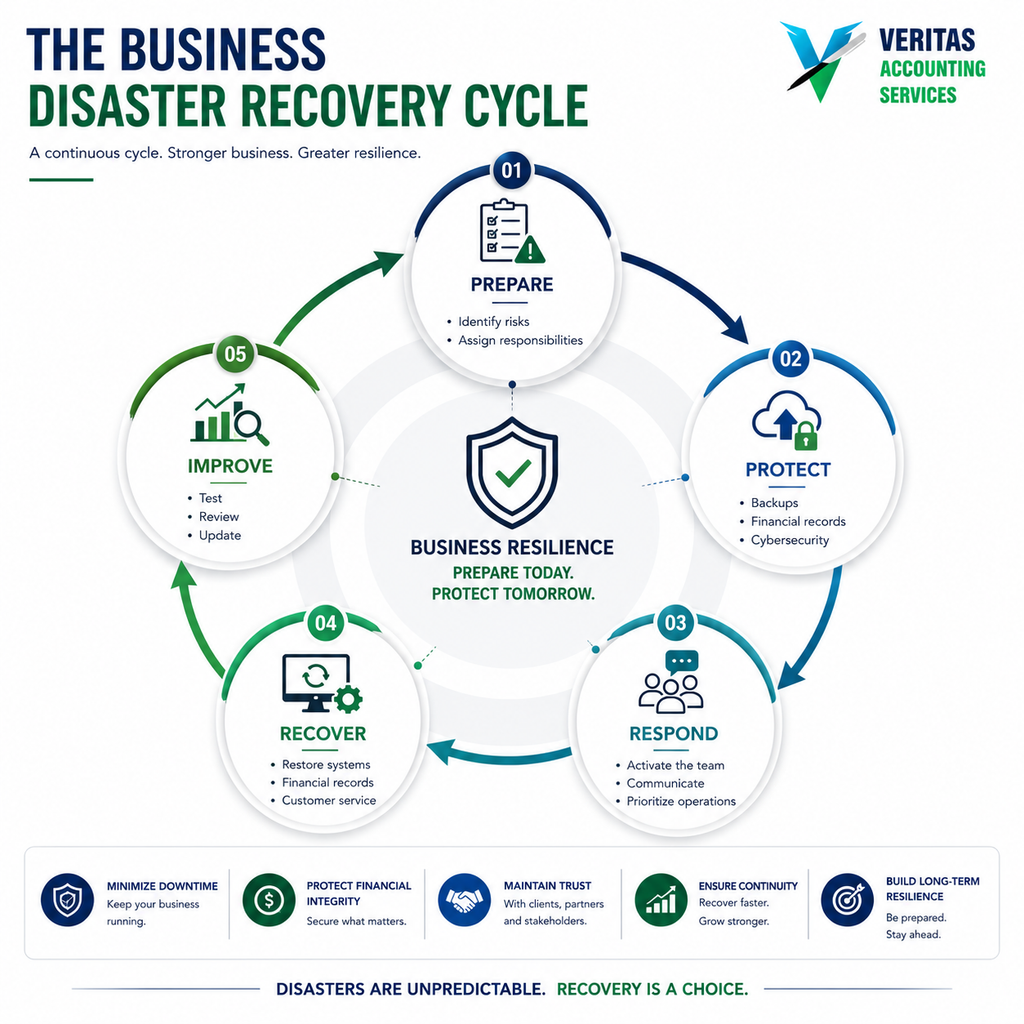
Identify the Risks That Matter Most
Not every business faces the same threats.
A retailer may be highly exposed to physical property damage and supply-chain interruptions. A professional services firm may be more dependent on cloud systems, internet access, and employee availability. An e-commerce company may face significant risks if its payment platform, website, or fulfillment partner becomes unavailable.
Start by identifying the events that could materially interrupt operations.
Consider:
- Natural disasters
- Fire or building damage
- Cyberattacks and ransomware
- Extended power or internet outages
- Cloud or software failures
- Loss of critical employees
- Supplier failure
- Banking or payment disruptions
- Theft or physical loss of records
- Major equipment failure
The goal is not to create a hundred-page document covering every theoretical scenario.
Focus on realistic risks and the consequences they could create.
Protect Financial and Business Records
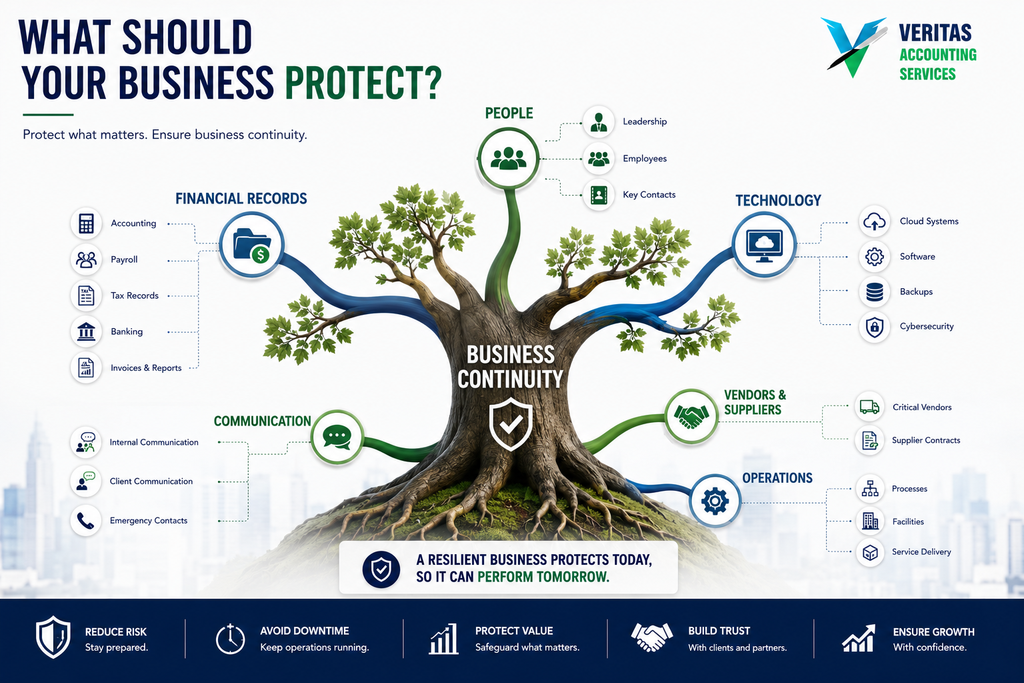
Financial information is one of the most important assets to protect.
A business may need access to:
- Bank statements
- Accounting records
- Invoices
- Customer balances
- Vendor records
- Payroll information
- Tax returns
- Sales tax records
- Contracts
- Insurance documents
- Fixed-asset records
- Financial statements
- Budgets and forecasts
A disaster recovery plan should identify where these records are maintained, who can access them, and how they can be recovered if the primary system becomes unavailable.
The IRS recommends paperless recordkeeping, electronic backups, and storing duplicate records in a separate location.
This is particularly important for businesses that depend heavily on accounting software and cloud-based applications.
Cloud software can reduce certain risks, but simply using cloud software does not mean every recovery risk has disappeared. Businesses still need appropriate access controls, backups, authentication procedures, and documented recovery processes.
Build a Reliable Backup Strategy
A backup is useful only if the business can actually restore the information when required.
Companies should identify their critical data and establish a regular backup process.
Consider:
What needs to be backed up?
Identify essential accounting, customer, operational, HR, tax, and management information.
How frequently should it be backed up?
Critical information may require more frequent protection than less important records.
Where should backups be stored?
Avoid relying entirely on a single physical location or device.
Who can restore the information?
The recovery process should not depend on one employee who may be unavailable.
Has the backup actually been tested?
A backup that has never been restored is an assumption, not a proven recovery solution.
Testing should be part of the disaster recovery plan because recovery procedures can fail even when backups exist.
Protect Accounting and Tax Information
Accounting and tax records deserve special attention because losing them can affect more than day-to-day operations.
A business may need historical financial information for:
- Tax filings
- Insurance claims
- Financing
- Audit support
- Customer or vendor disputes
- Government requirements
- Management analysis
- Reconstructing financial records after a loss
The IRS notes that businesses may need to reconstruct records after a disaster to support tax purposes, insurance reimbursement, or applications for assistance.
A disaster recovery plan should therefore include a financial records section.
That section can identify where accounting files are maintained, how bank records are accessed, who has administrative permissions, how payroll information is recovered, and who is responsible for communicating with accountants and tax professionals.
Plan for People and Communication
Technology is only one part of recovery.
People need to know what to do.
Employees should understand:
- Who makes emergency decisions
- Who communicates with customers
- Who communicates with suppliers
- Who handles payroll
- Who contacts banks and insurers
- Who manages technology recovery
- Where emergency procedures are stored
- How employees will receive updates
A communication tree can be useful.
For example:
Leadership → Department Managers → Employees → Customers/Suppliers
The business should also identify alternative communication methods if its primary email, phone, office, or internet connection becomes unavailable.
A disaster recovery plan should be accessible when normal systems are unavailable. Keeping the only copy of the plan inside the system that may be affected by the disaster defeats the purpose.
Prepare for Cybersecurity Incidents
Cyber incidents deserve specific attention because the business may have no physical warning before losing access to systems or data.
A ransomware attack, compromised account, phishing incident, or stolen credentials can interrupt operations quickly.
Businesses should consider:
- Multi-factor authentication
- Strong password management
- Restricted administrative access
- Employee security training
- Regular software updates
- Endpoint protection
- Secure backups
- Incident-response procedures
- Vendor access controls
The recovery process should also identify who has authority to isolate systems, contact technology providers, communicate with employees, and involve appropriate legal or cybersecurity professionals.
The purpose of a disaster recovery plan is not to replace cybersecurity. It is to ensure the organization has a structured response when preventive controls are unsuccessful.
Consider Vendors and Third Parties
Many businesses cannot operate without external providers.
A company may depend on:
- Banks
- Payment processors
- Payroll providers
- Cloud accounting platforms
- Shipping companies
- IT providers
- Tax professionals
- Suppliers
- Outsourced accounting teams
- Customer relationship platforms
What happens if one of these providers becomes unavailable?
Businesses should identify critical vendors and understand alternative arrangements where practical.
For example, if payroll is processed externally, management should know how payroll information can be accessed and what happens if the provider experiences an outage.
Supplier concentration should also be reviewed.
If one supplier provides a critical product or service, consider whether an alternative supplier exists and how quickly the relationship could be activated.
Establish Financial Continuity
A business can survive many operational disruptions if it maintains sufficient financial flexibility.
Cash flow therefore belongs in the recovery conversation.
Management should understand:
- Available cash
- Bank relationships
- Credit facilities
- Upcoming payroll
- Major vendor obligations
- Customer receivables
- Insurance coverage
- Recurring expenses
- Emergency spending authority
A disaster recovery plan should identify who can approve emergency payments and how the company will continue accessing banking services if normal office operations are disrupted.
Financial forecasting can also help management understand how long the business can continue operating under different disruption scenarios.
For example, leadership could model what happens if revenue falls by 30% for three months or if a major facility becomes unavailable for six weeks.
The objective is not to predict the future precisely.
It is to understand the company’s financial resilience.
Test and Update the Plan
A document sitting in a folder is not enough.
The business needs to test whether its procedures actually work.
The SBA recommends practicing preparedness plans with staff, while the IRS advises businesses to review emergency plans regularly and update them as circumstances change.
Testing can include simple exercises:
Scenario: The accounting system is unavailable.
Ask:
- Who contacts the provider?
- Where are recent financial reports stored?
- How will invoices be issued?
- How will payments be approved?
- How will payroll be processed?
- Who communicates with customers?
Another scenario could involve the loss of the company office.
Ask:
- Where will employees work?
- How will they access systems?
- How will management communicate?
- Where will physical records be retrieved?
- Who has authority to activate alternative arrangements?
After every test, document what worked and what failed.
That feedback should be incorporated into the next version of the plan.
How Professional Accounting Teams Can Help
Financial continuity is often overlooked when businesses create emergency plans.
This is where an experienced accounting team can provide practical support.
An outsourced accounting partner can help maintain organized financial records, establish consistent bookkeeping procedures, perform regular reconciliations, prepare financial reports, and ensure that important information is not dependent on one individual.
For businesses using an outsourced accounting model, the external team can also provide continuity when an internal employee is unavailable.
Services may include:
- Bookkeeping
- Bank reconciliation
- Accounts payable
- Accounts receivable
- Month-end closing
- Financial reporting
- Tax support
- Cash-flow forecasting
- Management reporting
- Financial record cleanup
At Veritas Accounting Services, we work with businesses and professional firms to provide outsourced accounting, bookkeeping, tax support, financial reporting, and CFO-related services. A structured external team can become one part of a broader business continuity strategy by helping maintain reliable financial information before, during, and after a disruption.
The key is to establish responsibilities in advance.
A disaster recovery plan should clearly identify who maintains financial records, who has access to important information, who communicates with the external accounting team, and how financial reporting will continue during an interruption.
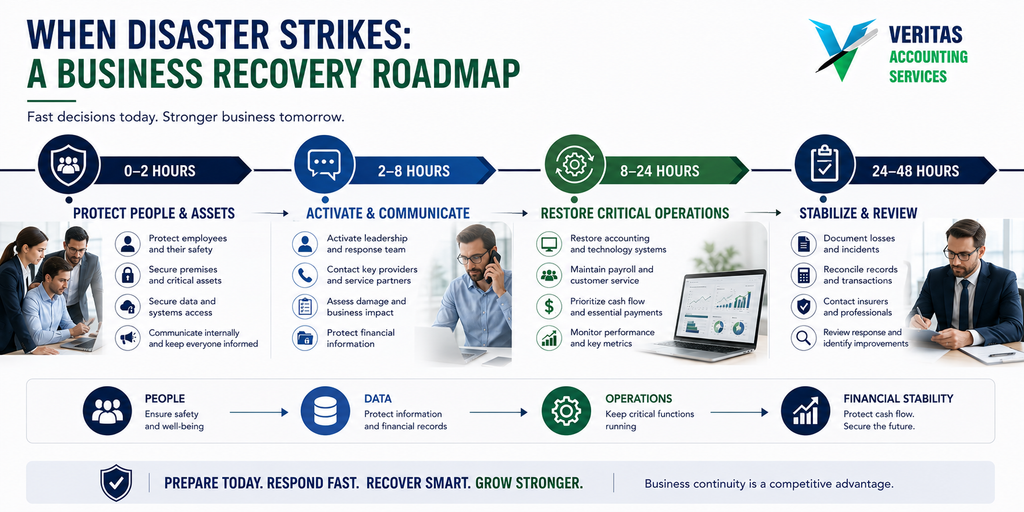
A Practical Recovery Checklist
Business leaders can use the following checklist as a starting point:
Before a Disaster
- Identify critical business processes
- Assess major risks
- Back up important records
- Protect financial and tax documents
- Document key contacts
- Establish communication procedures
- Review insurance coverage
- Define emergency spending authority
- Identify alternative suppliers
- Test recovery procedures
During a Disaster
- Protect employees first
- Activate the recovery team
- Establish reliable communication
- Protect financial information
- Prioritize critical operations
- Contact key vendors and service providers
- Monitor cash flow
- Document losses and expenses
After a Disaster
- Restore critical systems
- Reconcile financial records
- Reconstruct missing documents
- Document business losses
- Communicate with customers
- Review insurance and assistance options
- Identify weaknesses in the recovery process
- Update the plan based on lessons learned
FAQ
What is the purpose of a disaster recovery plan?
The purpose is to help a business respond to a disruption, protect critical information, restore important operations, and reduce the financial and operational impact of an unexpected event.
How often should a disaster recovery plan be updated?
Businesses should review it regularly and whenever there are significant changes to employees, technology, locations, vendors, systems, or business operations. The IRS specifically recommends reviewing emergency plans annually.
Should financial records be included?
Absolutely. Accounting, payroll, tax, banking, customer, vendor, and financial reporting information can be critical to continuing operations and documenting losses.
Can an outsourced accounting firm help with recovery?
Yes. An experienced accounting team can help maintain organized financial records, reporting processes, reconciliations, and access to important financial information, making the recovery process more manageable.
Is a disaster recovery plan only for large businesses?
No. Smaller businesses may be particularly vulnerable because they often depend on a small number of employees, systems, suppliers, and customers. A practical plan can be scaled according to the size and complexity of the business.
Conclusion
Unexpected events are part of doing business. The difference between a temporary disruption and a prolonged crisis often depends on how prepared the organization was before the event occurred.
A disaster recovery plan does not need to be complicated. It needs to be realistic, accessible, tested, and connected to the way the business actually operates.
Business leaders should think beyond physical emergencies. Cybersecurity incidents, technology failures, employee loss, supplier disruptions, and financial-system interruptions can all affect business continuity.
Financial information deserves particular attention. If management cannot access accounting records, banking information, payroll data, invoices, tax documents, or financial reports, recovering operations can become considerably more difficult.
The IRS recommends safeguarding financial and tax records, maintaining backups, and planning for continuity of operations.
A strong disaster recovery plan gives management something valuable during an uncertain situation: clarity.
Know what matters. Protect it. Assign responsibility. Test the process. Review it regularly.
And do not wait for a disaster to discover that an important process depended on one person, one computer, one supplier, or one undocumented procedure.
At Veritas Accounting Services, we help businesses maintain organized bookkeeping, accounting, tax support, financial reporting, and CFO-related processes so that financial information remains structured and accessible when management needs it most.
Business continuity is not simply about recovering technology.
It is about recovering the business.
GET IN TOUCH
Schedule a FREE Call










Connect on our Socials!
