






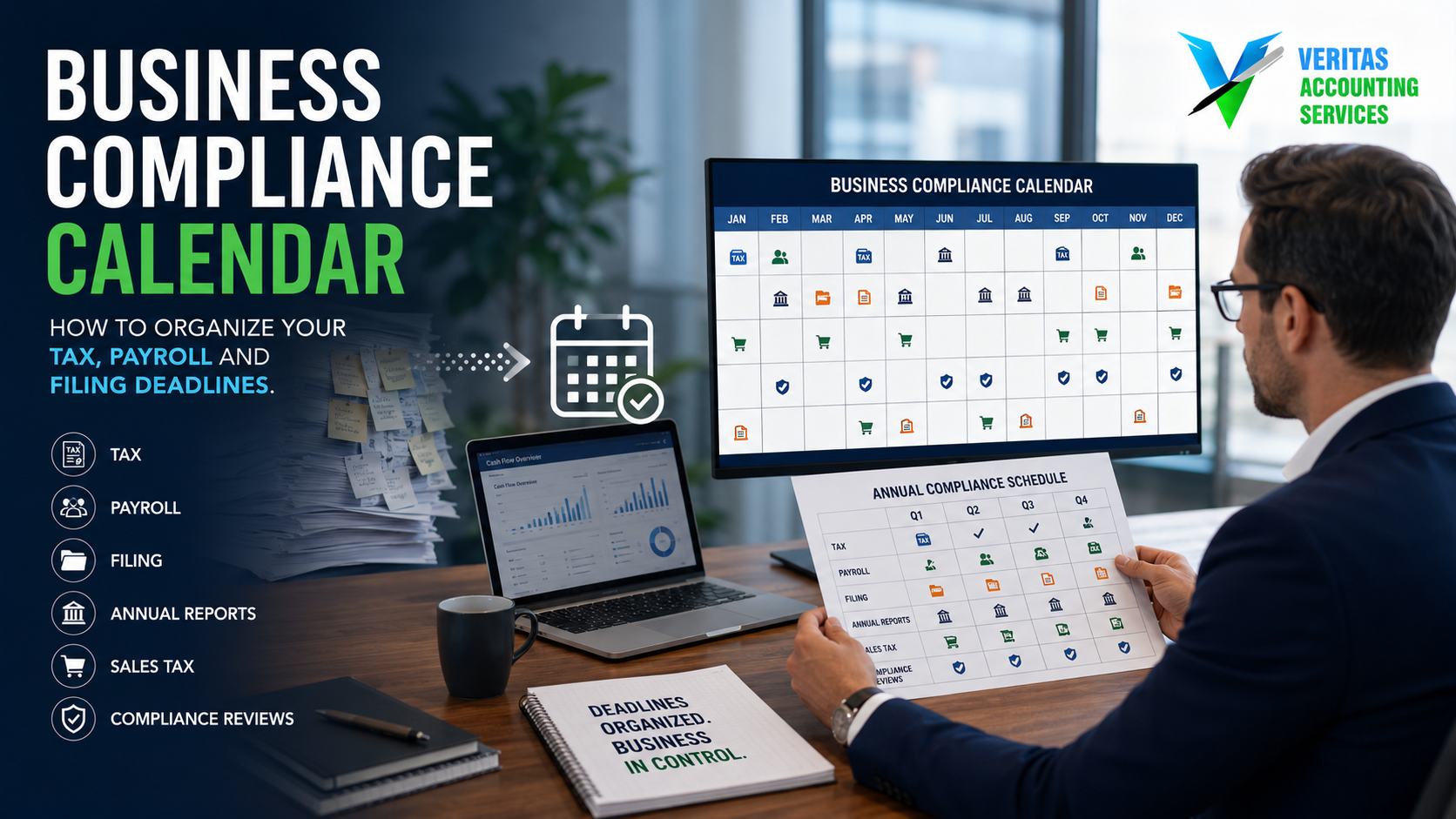

Business Compliance Calendar: How to Organize Your Tax, Payroll and Filing Deadlines
Running a business involves more than generating revenue and managing customers. Every company has recurring obligations that must be completed on time—tax filings, payroll reports, sales tax returns, annual registrations, licenses, information returns, and other regulatory requirements.
The challenge is that these obligations rarely follow one simple schedule.
Some are monthly. Others are quarterly or annual. Certain requirements depend on the state where the business operates, the type of entity, the number of employees, or the nature of its transactions.
A well-designed compliance calendar turns these scattered obligations into a structured management process. Instead of relying on memory or reacting to approaching deadlines, business leaders can see what needs to be done, who is responsible, and when each task must be completed.
For growing businesses, this is particularly important. As operations expand across states, entities, employees, and tax jurisdictions, compliance becomes more complex.
The goal is not simply to remember deadlines. It is to create a system that makes compliance predictable, accountable, and manageable.
Table of Contents
- Why Every Business Needs a Compliance Calendar
- What Should Be Included?
- Organizing Tax Deadlines
- Managing Payroll and Employment Tax Obligations
- Tracking Sales Tax and Other Indirect Taxes
- Annual Reports, Licenses and Registrations
- Organizing Information Returns
- Assigning Responsibility for Every Deadline
- Building an Effective Reminder System
- Common Compliance Calendar Mistakes
- How Accounting Professionals Can Help
- FAQ
- Conclusion
Why Every Business Needs a Compliance Calendar
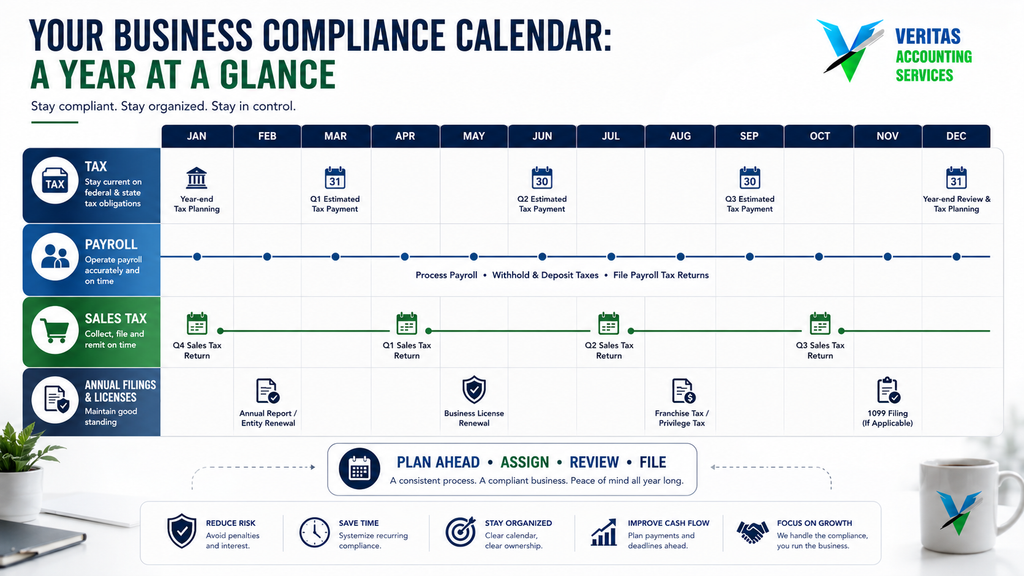
A compliance calendar is essentially a central schedule containing the recurring filings, payments, renewals, reports, and other obligations applicable to a business.
Without one, businesses often manage deadlines through disconnected emails, spreadsheets, accounting software reminders, and individual employees’ calendars.
That approach can work when a company is very small.
It becomes risky as the business grows.
A structured compliance calendar helps management answer five basic questions:
- What needs to be filed or paid?
- When is it due?
- Who is responsible?
- Which documents or information are required?
- Has the obligation been completed and reviewed?
This creates accountability.
It also reduces the risk of a common problem: everyone assumes someone else is handling the filing.
What Should Be Included?
A good compliance calendar should be customized to the company’s actual obligations.
For a U.S. business, this may include federal, state, and local requirements.
Depending on the business, consider including:
- Federal income tax filings
- Estimated tax payments
- State income or franchise tax filings
- Payroll tax filings
- Sales and use tax returns
- Annual reports
- Business license renewals
- Information returns
- Property tax obligations
- Foreign-related information reporting
- Registered-agent requirements
- Insurance renewals
- Employee-related filings
- Financial reporting deadlines
Not every business will have every obligation.
The objective is to identify the requirements that actually apply and place them into one controlled system.
A compliance calendar should also record the frequency of each obligation. Categorizing tasks as monthly, quarterly, annual, or event-based makes the schedule easier to manage.
Organizing Tax Deadlines
Tax obligations are usually among the most important items on the schedule.
However, businesses should avoid treating “tax filing” as one single category.
Depending on the entity and circumstances, the calendar may need to distinguish between:
- Federal income tax
- State income or franchise taxes
- Estimated tax payments
- Sales and use taxes
- Payroll taxes
- Excise taxes
- Information reporting
- Local taxes
A business operating in multiple states may have several different filing calendars.
For example, a company could have employees in one state, customers creating sales tax obligations in another, and an entity registration in a third.
That means the finance team should maintain a jurisdiction-by-jurisdiction view rather than relying on one generic tax deadline list.
The calendar should also identify whether each obligation requires a return, payment, or both.
This distinction matters because filing and payment requirements do not always operate in exactly the same way.
Managing Payroll and Employment Tax Obligations
Payroll compliance deserves its own section because payroll mistakes can affect both the business and its employees.
Depending on the business and jurisdiction, responsibilities may include:
- Federal payroll tax deposits
- Federal payroll tax returns
- State payroll tax filings
- State unemployment filings
- Local payroll requirements
- Employee wage reporting
- Year-end employee forms
- New-hire reporting
The appropriate frequency can depend on factors such as payroll size, tax liability, jurisdiction, and employer status.
A compliance calendar should therefore identify the exact requirement rather than simply creating a generic “payroll filing” reminder.
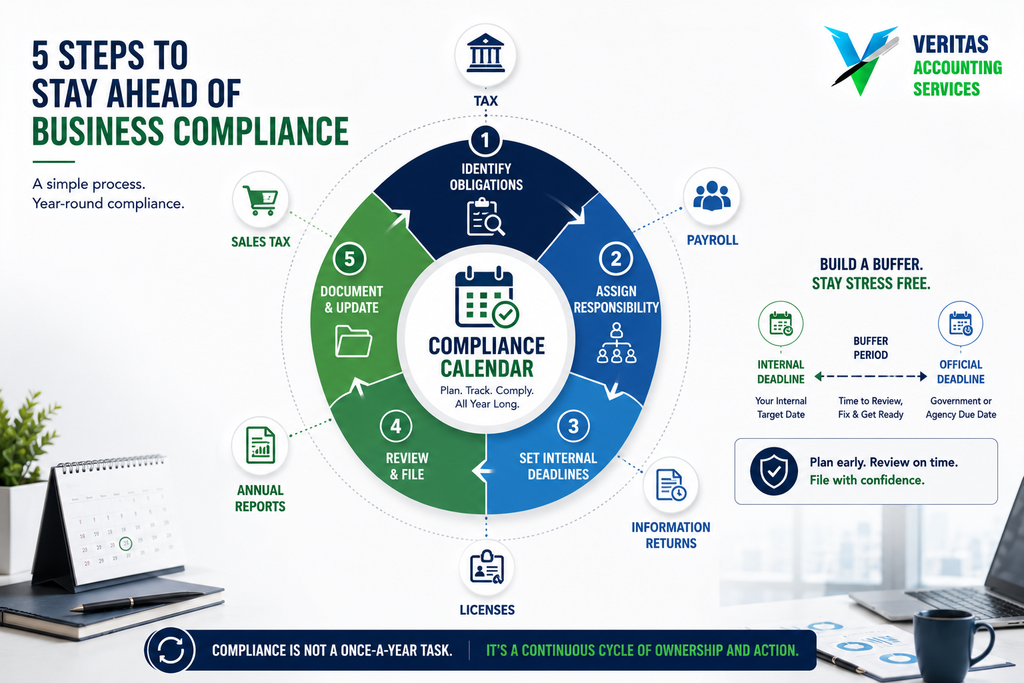
It is also useful to schedule internal deadlines before the official due date.
For example, if a filing is due on a particular date, the business might require payroll information to be reviewed several business days earlier.
That buffer gives the accounting team time to identify missing information or resolve discrepancies.
Tracking Sales Tax and Other Indirect Taxes
Sales tax can become complicated quickly when a business sells across multiple jurisdictions.
Requirements can depend on factors such as:
- Location of customers
- Nexus
- Product or service type
- Registration status
- Filing frequency
- State and local requirements
A growing e-commerce business, for example, may have customers across many states while using several sales channels.
Its compliance calendar should identify the jurisdictions where registration and filing obligations exist and track each requirement separately.
The same principle applies to other indirect taxes.
Instead of one row labeled “sales tax,” create a clear record showing the jurisdiction, filing frequency, responsible person, filing requirement, payment requirement, and completion status.
Annual Reports, Licenses and Registrations
Tax filings are not the only deadlines businesses need to manage.
Companies may also have annual or periodic requirements involving:
- Secretary of State filings
- Business registrations
- Professional licenses
- Local business licenses
- Registered-agent information
- Foreign qualifications
- Industry-specific registrations
These deadlines are particularly easy to overlook because they may occur only once a year.
A compliance calendar should therefore include annual renewals well in advance.
The business should also record the consequences of missing a requirement.
Some missed filings may result in penalties or late fees. Others can affect a company’s good standing or ability to operate.
Organizing Information Returns
Information reporting is another area that should be considered separately.
Depending on the business, information returns may relate to:
- Payments to independent contractors
- Payments to certain vendors
- Interest
- Dividends
- Foreign transactions
- Employee compensation
- Other reportable payments
The finance team should identify which forms apply to the business and establish internal deadlines for collecting the necessary information.
This is where organized bookkeeping becomes extremely valuable.
If vendor information, payment classifications, and supporting documentation are incomplete throughout the year, preparing information returns at the last minute becomes much more difficult.
Assigning Responsibility for Every Deadline
Creating a compliance calendar is only the first step.
Someone must own each task.
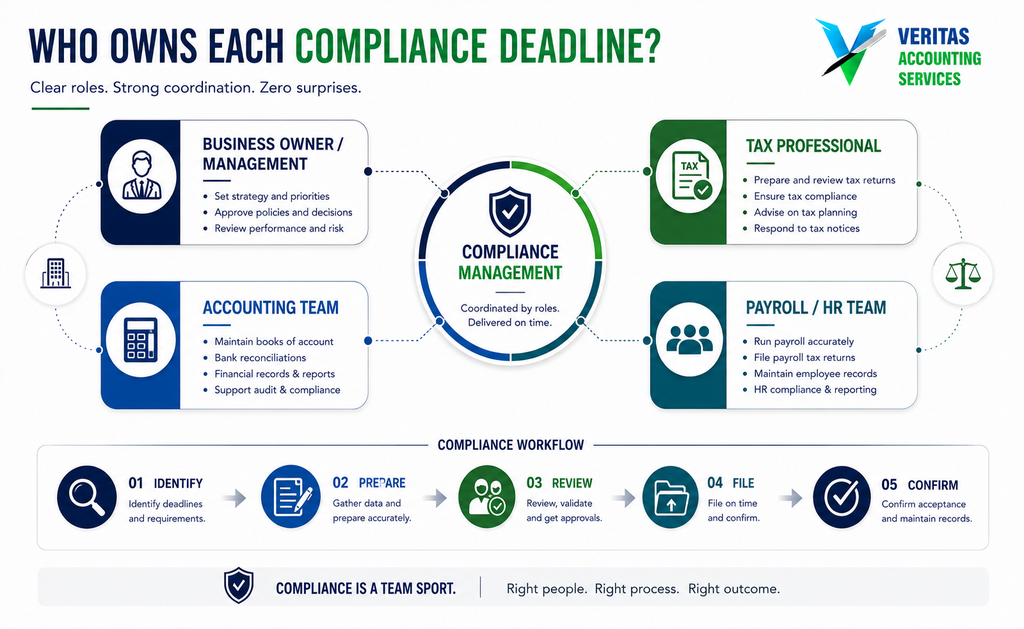
For every obligation, identify:
Task → Jurisdiction → Due Date → Responsible Person → Reviewer → Status
For example:
| Compliance Item | Frequency | Owner | Reviewer | Status |
|---|---|---|---|---|
| Payroll filing | Monthly/Quarterly | Payroll Team | Finance Manager | Pending |
| Sales tax | Monthly/Quarterly | Accounting Team | Senior Accountant | Complete |
| Annual report | Annual | Corporate Admin | Management | Upcoming |
| Income tax | Annual/Estimated | Tax Professional | Management | Pending |
The exact responsibilities will vary by business.
The important principle is that every deadline should have a clearly identified owner.
A backup person should also be identified for critical obligations.
This prevents compliance from becoming dependent on one employee.
Building an Effective Reminder System
A good compliance calendar should not simply show due dates.
It should create a workflow.
For each task, consider having reminders at several stages:
30 Days Before
Confirm that the requirement still applies and identify the documents needed.
15 Days Before
Collect supporting information and begin preparation.
5–7 Days Before
Complete review and resolve outstanding questions.
Due Date
Confirm filing and payment.
After Filing
Save confirmation, payment evidence, and final documents.
This approach creates an audit trail and makes it easier to prove that the obligation was completed.
Digital calendar tools, accounting software, workflow systems, and shared spreadsheets can all be used. The technology matters less than having a consistent process.
Common Compliance Calendar Mistakes
Even businesses that maintain a calendar can make mistakes.
Mistake 1: Using a Generic Deadline List
A generic tax calendar does not automatically reflect the company’s actual obligations.
The calendar should be customized by entity, jurisdiction, tax type, and business activity.
Mistake 2: Tracking Filing but Not Payment
A business may submit a return but forget that a separate payment is required.
Track both.
Mistake 3: No Internal Deadline
Using the government deadline as the team’s internal deadline leaves little room for correction.
Build a buffer.
Mistake 4: No Review Process
A preparer should not necessarily be the only person responsible for reviewing important filings.
Define appropriate review procedures.
Mistake 5: Not Updating the Calendar
Business circumstances change.
New employees, additional states, new entities, acquisitions, new products, or changes in business structure can create new obligations.
The calendar should be reviewed whenever the business changes materially.
How Accounting Professionals Can Help
Managing compliance becomes more difficult when business owners are responsible for both running the company and monitoring every financial obligation.
This is where experienced accounting and tax professionals can provide significant value.
A professional team can help businesses:
- Identify recurring accounting requirements
- Organize financial records
- Track filing deadlines
- Prepare supporting schedules
- Coordinate tax filings
- Reconcile accounts before filing
- Maintain documentation
- Monitor outstanding obligations
- Prepare management reports
- Coordinate with tax professionals
- Maintain a centralized compliance calendar
For international businesses and companies operating across multiple jurisdictions, professional support can be particularly useful because requirements may vary between federal, state, and local authorities.
Outsourcing does not mean giving up management control.
A well-structured arrangement can actually improve control because responsibilities, deadlines, documentation, and review procedures are clearly defined.
For example, an outsourced accounting team can maintain the bookkeeping and supporting records while the company’s tax professional reviews and files the appropriate returns.
This creates a clear division of responsibility.
FAQ
What is a compliance calendar?
A compliance calendar is a centralized schedule that tracks a business’s tax, payroll, regulatory, licensing, reporting, and other recurring obligations.
How often should a compliance calendar be reviewed?
It should be reviewed regularly and whenever the business experiences significant changes, such as entering a new state, hiring employees, forming an entity, or changing its operations.
Should payroll deadlines be included?
Yes. Payroll tax deposits, payroll returns, unemployment filings, employee reporting, and year-end payroll forms should be included when applicable.
Should a small business have a compliance calendar?
Yes. A smaller business may have fewer obligations, but missed deadlines can still result in penalties, additional costs, or administrative problems. Starting with a simple calendar makes it easier to scale the process.
Can an outsourced accounting firm maintain a compliance calendar?
Yes. An experienced accounting team can maintain deadlines, collect supporting information, prepare accounting records, coordinate with tax professionals, and track completion while management retains oversight.
Conclusion
Compliance should not be managed as a collection of isolated deadlines.
It should be treated as a business process.
A well-maintained compliance calendar gives business leaders visibility into upcoming obligations, assigns responsibility, creates internal review points, and reduces dependence on memory.
The process becomes even more important as a business expands into new states, hires employees, adds entities, or increases transaction volume.
The most effective approach is to identify every applicable obligation, assign an owner, establish internal deadlines, maintain supporting documentation, and review the schedule regularly.
Professional accounting and tax teams can also play an important role by maintaining organized financial records, coordinating recurring requirements, and helping management stay ahead of upcoming obligations.
At Veritas Accounting Services, we support businesses and professional firms with bookkeeping, accounting, tax support, financial reporting, and CFO-related services. Our role is not simply to record transactions. We help clients build organized financial processes that give management better visibility and control.
A missed deadline can create unnecessary cost and stress.
A well-managed compliance calendar turns those deadlines into a predictable process.
Know what is due. Know when it is due. Know who owns it. And review it before the deadline—not after it.
GET IN TOUCH
Schedule a FREE Call








Connect on our Socials!
