







Startup Hiring: Generalists or Specialists? How to Make the Right Choice
Building a startup team is rarely about finding the most impressive person for every position. In the early stages, founders usually work with limited cash, changing priorities, and more responsibilities than the team can comfortably handle.
That makes startup hiring a strategic decision. A generalist may be able to manage several functions and adapt quickly. A specialist may bring the depth required to solve a complex problem that cannot be handled effectively by someone wearing several hats.
The right choice depends on what the business needs now, what it expects to need next, and whether the role requires broad adaptability or deep expertise.
For many founders, the answer may also involve a third option: outsourcing specialized functions until the business is ready for a full-time hire.
Table of Contents
- What Is a Generalist?
- What Is a Specialist?
- Generalists vs. Specialists: What Should Founders Consider?
- When a Startup Needs Generalists
- When a Specialist Makes More Sense
- The Cost Factor
- Consider Outsourcing Before Hiring Full-Time
- Accounting and Tax as a Practical Example
- Hire, Outsource, Automate or Delegate?
- How the Right Mix Changes as You Grow
- Common Hiring Mistakes
- A Practical Decision Framework
- FAQ
- Conclusion
What Is a Generalist?
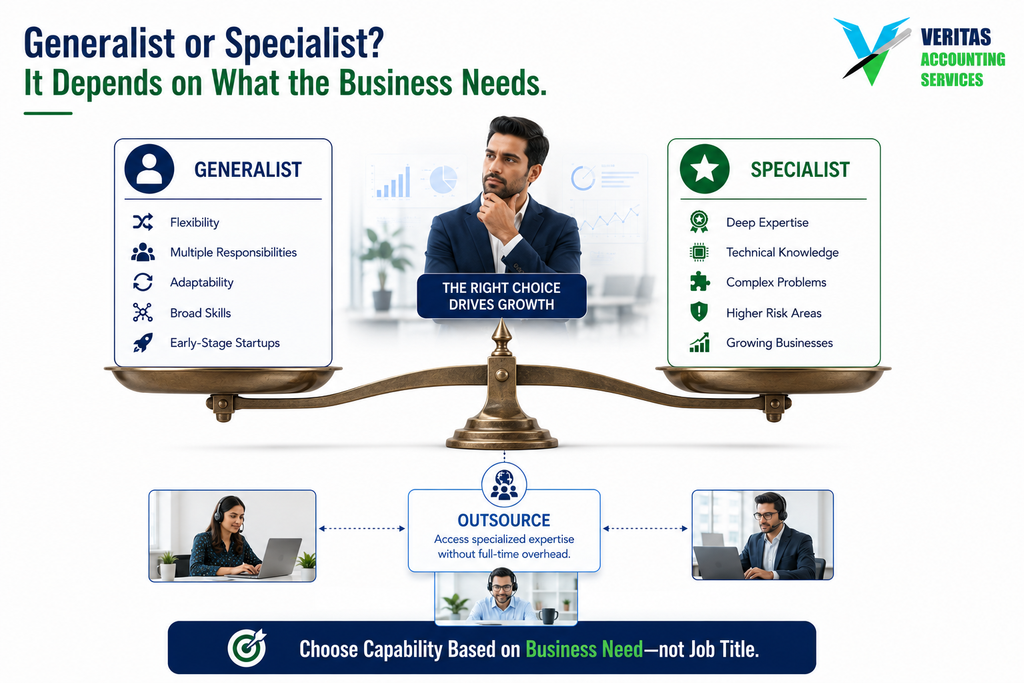
A generalist is someone who can contribute across multiple areas rather than being narrowly focused on one technical discipline.
In a startup, that might mean an operations employee who can coordinate vendors, support customers, prepare reports, and help improve internal processes.
Generalists are particularly valuable when priorities change frequently. They can move between responsibilities without requiring a separate hire for every new requirement.
This flexibility can be important when the business is still testing its market, refining its business model, or building its internal processes.
However, flexibility has a limit. A generalist may be capable of handling many tasks but may not have the depth required for highly technical, regulated, or specialized work.
What Is a Specialist?
A specialist brings deep knowledge to a particular function.
Examples include a tax professional, software engineer, cybersecurity expert, financial controller, legal professional, or performance marketing specialist.
Specialists become increasingly valuable when a business reaches a point where mistakes are expensive, complexity is increasing, or a function requires expertise that cannot be developed quickly internally.
The trade-off is cost and flexibility. A specialist may be highly effective in one area but may have less value when priorities change or the workload is inconsistent.
For founders, startup hiring is therefore not simply about choosing between two types of employees. It is about matching capability with the business problem.
Generalists vs. Specialists: What Should Founders Consider?
There is no universal formula, but several factors can guide the decision.
1. Business Stage
An early-stage startup often benefits from people who can wear multiple hats.
A later-stage company may need specialists as departments become more complex.
2. Nature of the Work
If the work involves changing priorities, coordination, and problem-solving across departments, a generalist may be effective.
If it involves technical knowledge, regulatory requirements, or high-risk decisions, a specialist may be more appropriate.
3. Frequency of the Work
A role that requires expertise every day may justify a full-time specialist.
A specialized task needed only a few hours a month may not.
4. Cost of Mistakes
Some errors are inconvenient. Others can result in tax penalties, compliance issues, security problems, lost customers, or financial losses.
The higher the potential cost of an error, the more important appropriate expertise becomes.
When a Startup Needs Generalists
Generalists can be especially useful during the early stages of a company.
They can help founders build processes while learning what the business actually needs.
A strong generalist may:
- Take ownership of multiple operational tasks
- Adapt to changing priorities
- Work across departments
- Identify process improvements
- Communicate with different stakeholders
- Help founders reduce operational bottlenecks
For example, an operations generalist might coordinate customer onboarding, maintain internal documentation, assist with vendor management, and prepare basic management reports.
The value is not that the employee does everything.
The value is that the startup does not need to create a separate position for every responsibility.
This makes startup hiring particularly important during the early stage because founders are often buying flexibility, not just labor.
When a Specialist Makes More Sense
As a startup grows, some functions become too important or complex to manage through broad generalist skills alone.
Consider areas such as:
- Tax compliance
- Cybersecurity
- Software architecture
- Legal matters
- Financial controls
- Regulatory compliance
- Advanced digital marketing
- Complex financial reporting
In these areas, experience can prevent expensive mistakes and improve the quality of decisions.
A specialist is particularly valuable when the business has reached sufficient scale to keep the person productive.
That last point is important.
Hiring a specialist simply because the function is important does not necessarily make financial sense. The company must also have enough recurring work to justify the cost.
A startup may need expert knowledge without needing an expert sitting on its payroll eight hours a day.
The Cost Factor
Founders often compare salaries when evaluating a hire.
That is only part of the calculation.
The actual cost of an employee can include:
- Salary
- Payroll taxes
- Benefits
- Recruitment costs
- Training
- Software
- Equipment
- Office costs
- Management time
- Paid leave
A full-time specialist can therefore represent a substantial fixed commitment.
This does not mean specialists are too expensive. It means the business should compare the expected value of the role with the total cost of maintaining it.
Cash flow is particularly important for startups. A business can be profitable on paper and still struggle if it commits too much cash to fixed costs before revenue becomes predictable.
A disciplined startup hiring strategy should therefore consider total employment cost, not just the advertised salary.
Consider Outsourcing Before Hiring Full-Time
One option that founders sometimes overlook is outsourcing.
Not every business function needs to be performed by an internal employee.
Outsourcing can make sense when a function requires specialized expertise but does not require full-time attention.
Common examples include:
- Bookkeeping
- Tax preparation and support
- Payroll processing
- Financial reporting
- IT support
- Legal services
- HR administration
- Digital marketing
The advantage is access to expertise without immediately creating another full-time position.
This can give a startup greater flexibility while it validates demand and builds predictable revenue.
However, outsourcing works best when the external provider has clear responsibilities, defined deliverables, reliable communication, and appropriate controls.
The cheapest provider is not necessarily the best choice.
For functions involving financial records, tax compliance, or sensitive business information, experience, security, responsiveness, and quality should be part of the evaluation.
This is why startup hiring should not be viewed as an automatic answer to every capability gap.
Sometimes the smarter decision is to buy expertise as a service.
Accounting and Tax as a Practical Example
Accounting is a good example of why the generalist-versus-specialist decision needs careful thought.
A founder may be able to record basic transactions or manage simple bookkeeping during the earliest stage.
But as the company grows, financial requirements usually become more complex.
The business may need:
- Monthly closing procedures
- Bank and credit card reconciliations
- Accounts receivable and payable management
- Cash-flow forecasting
- Management reporting
- Budgeting
- Tax coordination
- Payroll support
- Financial controls
At that point, the question is not simply whether to hire an accountant.
The founder should ask what level of financial support is actually required.
A startup may not need a full-time controller or CFO immediately. It may benefit more from an experienced outsourced accounting team that manages the recurring work and provides financial insight as needed.
For example, Veritas Accounting Services can support bookkeeping, accounting, financial reporting, tax support, budgeting, forecasting, and CFO-related requirements without requiring the startup to build an entire finance department internally.
That can allow founders to access experienced professionals while keeping their internal structure lean.
For a founder, the result can be better financial visibility without adding unnecessary fixed overhead.
Hire, Outsource, Automate or Delegate?
A useful approach is to evaluate every recurring function through four options.
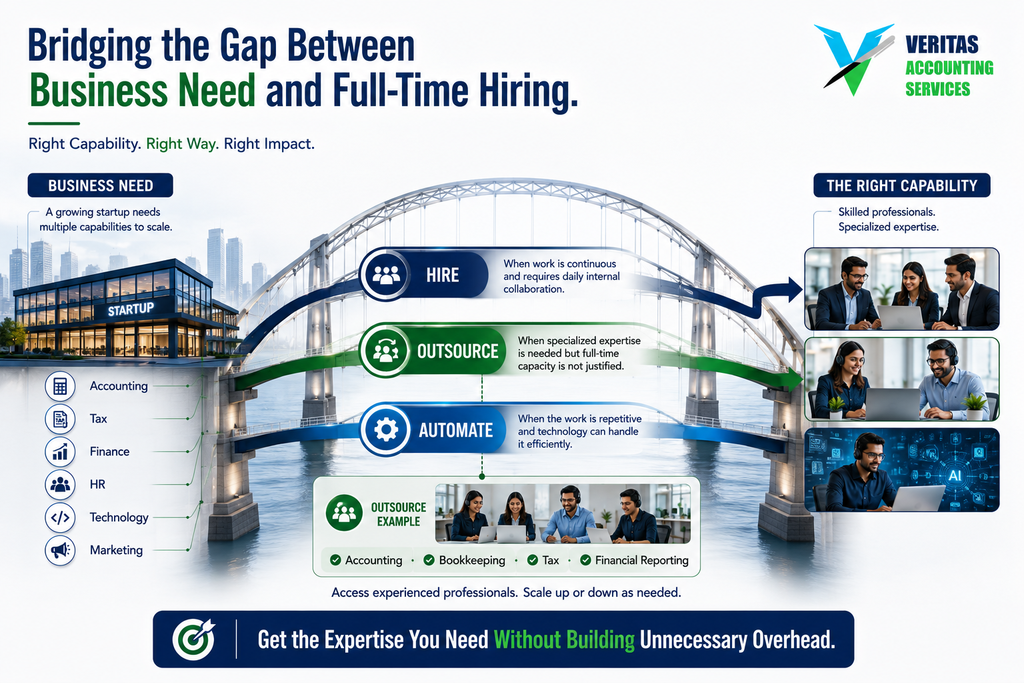
Hire
Hire internally when the workload is substantial, continuous, strategically important, and requires close daily collaboration.
Outsource
Outsource when specialized expertise is needed but a full-time position is not yet justified.
Automate
Automate repetitive, rule-based processes where technology can deliver reliable results.
Delegate
Delegate tasks that are important but do not require the founder’s direct involvement.
These options are not permanent decisions.
A function can move from outsource to hire as the company grows. Similarly, a manual task can become automated after the process becomes standardized.
This flexible approach makes startup hiring more closely aligned with actual business needs rather than assumptions about what a “proper” company should look like.
How the Right Mix Changes as You Grow
The ideal team structure at $500,000 of annual revenue may look very different from the structure needed at $5 million.
Early-stage businesses often need adaptable people who can work across functions.
As revenue, customers, employees, and operational complexity increase, specialization usually becomes more valuable.
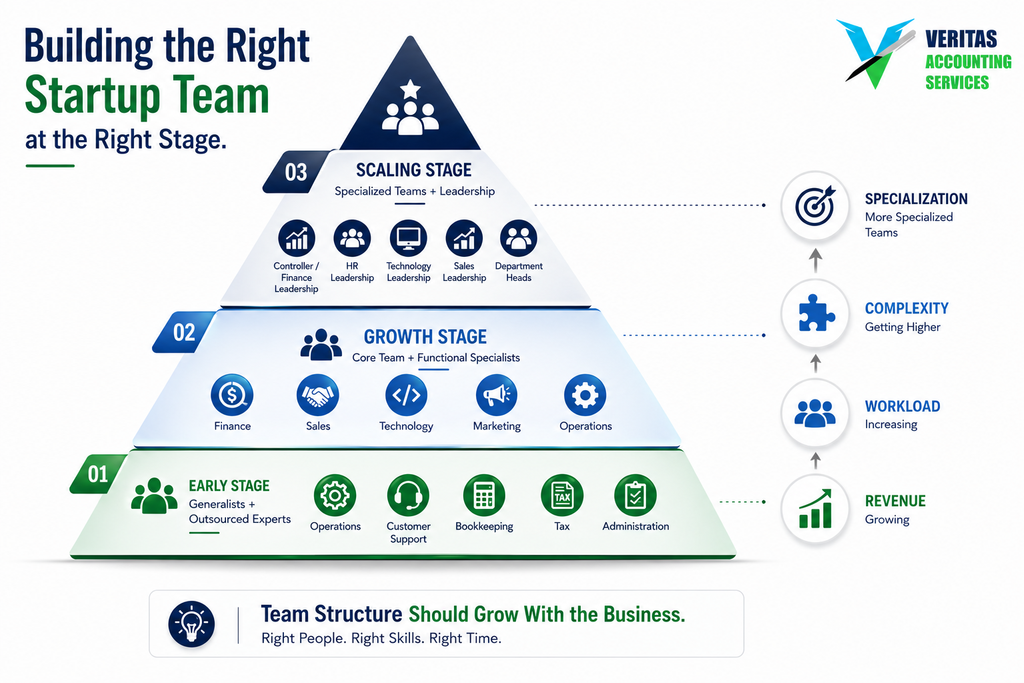
A common progression might look like this:
Early Stage → Generalists + Outsourced Specialists
Growth Stage → Core Internal Team + Functional Specialists
Scaling Stage → Dedicated Departments + Specialized Leadership
This is not a fixed formula.
Some startups will specialize earlier because their industry requires it. Others may remain lean for longer because their operating model is highly standardized.
The important point is to avoid building organizational complexity faster than the business can support.
A good startup hiring plan should evolve with revenue, workload, risk, and management capacity.
Common Hiring Mistakes
Hiring for a Title Instead of a Problem
Do not start with:
“We need a CFO.”
Start with:
“What problem are we trying to solve?”
The second question produces a much better hiring decision.
Hiring Too Early
A position can be strategically important without requiring a full-time employee today.
If the workload is inconsistent, outsourcing may be more practical.
Choosing Only on Salary
The lowest-cost candidate may create higher costs through errors, rework, supervision, or turnover.
Look at the total value of the role.
Expecting One Person to Do Everything
Generalists are valuable, but expecting one employee to perform accounting, tax, HR, technology, sales, and operations at a professional level is unrealistic.
Ignoring Scalability
A role should be evaluated not only for today’s needs but also for how it fits the company’s expected growth.
A Practical Decision Framework
Before making a hiring decision, founders can ask seven questions:
- How frequently is this work required?
- How specialized is the knowledge?
- What happens if the work is done incorrectly?
- Can the responsibility be automated?
- Can an existing employee handle it with training?
- Would outsourcing provide better expertise at the current stage?
- At what workload would a full-time hire become financially justified?
The answers can make the decision much clearer.
For example, if a task is highly specialized, performed occasionally, and carries significant risk, outsourcing may be more sensible than hiring.
If the work is continuous, central to operations, and requires daily collaboration, an internal hire may be the better long-term choice.
The strongest startup hiring decisions are usually based on workload, risk, economics, and business strategy rather than simply following what other startups are doing.
FAQ
Should startups hire generalists or specialists first?
There is no single answer. Early-stage companies often benefit from adaptable generalists, while specialized expertise can be brought in through targeted hiring or outsourcing when the need arises.
When should a startup hire a specialist?
A specialist becomes more attractive when the workload is recurring, the function is business-critical, mistakes are costly, and the company can support the role financially.
Is outsourcing better than hiring?
Neither is automatically better. Outsourcing can be effective when a startup needs expertise without enough full-time workload to justify an internal employee.
Should startups outsource accounting?
Many startups can benefit from outsourcing accounting and bookkeeping, particularly when they need reliable financial records, reporting, tax coordination, and cash-flow visibility but do not yet need a full internal finance department.
How should founders decide whom to hire?
Start with the business problem, determine the capability required, estimate the workload and risk, and compare hiring, outsourcing, automation, and delegation before deciding.
Conclusion
Startup hiring should not be driven by titles or trends.
The better question is:
What capability does the business need right now, and what is the most effective way to obtain it?
Generalists can provide flexibility when priorities are changing. Specialists can provide depth when complexity and risk increase. Outsourcing can bridge the gap when a startup needs expertise without enough workload to justify a full-time position.
The smartest approach is often a combination.
Keep critical, high-frequency work close to the business. Use specialists where expertise genuinely matters. Outsource functions that require professional knowledge but do not justify full-time capacity. Automate repetitive work wherever practical.
For finance and accounting, this approach can be particularly valuable. A reliable external team can maintain the books, prepare management reports, support tax requirements, and provide financial insight while founders remain focused on customers, products, and growth.
At Veritas Accounting Services, we help businesses and professional firms access bookkeeping, accounting, tax support, financial reporting, budgeting, forecasting, and CFO-related expertise without automatically building a large internal finance function.
The right team is not necessarily the biggest team.
It is the team with the right capabilities, at the right time, in the right structure.
GET IN TOUCH
Schedule a FREE Call