







The Difference Between Leadership and Management: Why Businesses Need Both
A business can have talented employees, strong products and healthy revenue—and still struggle to grow.
One common reason is the gap between leadership and management.
The two terms are often used interchangeably, but they represent different responsibilities. Leadership is largely about direction, purpose and people. Management is about execution, systems, resources and accountability.
A growing business needs both.
A company with strong leadership but weak management may have an inspiring vision but struggle with deadlines, processes and consistency. A company with strong management but weak leadership may run efficiently but lack innovation, direction or the ability to adapt.
The challenge for business owners is learning when to lead, when to manage, and when to build systems that allow others to take responsibility.
Table of Contents
- What Is Leadership?
- What Is Management?
- Leadership vs. Management: The Core Difference
- Why Businesses Need Both
- Leadership Creates Direction
- Management Turns Plans Into Results
- Where Business Owners Often Struggle
- Delegation: The Bridge Between Leadership and Management
- Financial Information Supports Better Management
- How Outsourced Professionals Can Support Leaders
- Building a Business That Does Not Depend on One Person
- Practical Questions for Business Owners
- FAQ
- Conclusion
What Is Leadership?
Leadership is about influencing people toward a shared objective.
A leader answers questions such as:
- Where are we going?
- Why does the business exist?
- What do we want to achieve?
- What values should guide our decisions?
- What kind of organization are we building?
Leadership requires communication, judgment and the ability to make decisions when the future is uncertain.
For a founder, leadership might mean deciding which market to enter, which customers to serve, what type of culture to build, or when the business needs to change direction.
Leadership is not necessarily connected to a job title.
A department head, project leader or experienced employee can demonstrate leadership even without being the business owner.
What Is Management?
Management focuses on turning objectives into organized action.
Managers are responsible for areas such as:
- Planning
- Budgeting
- Scheduling
- Resource allocation
- Performance monitoring
- Process management
- Delegation
- Accountability
- Problem resolution
If leadership determines where the organization should go, management helps determine how it will get there.
Consider a company that wants to expand into a new market.
Leadership may establish the objective and communicate why the expansion matters.
Management must then coordinate budgets, employees, timelines, technology, marketing, operations and reporting to make the plan achievable.
Neither function is sufficient on its own.
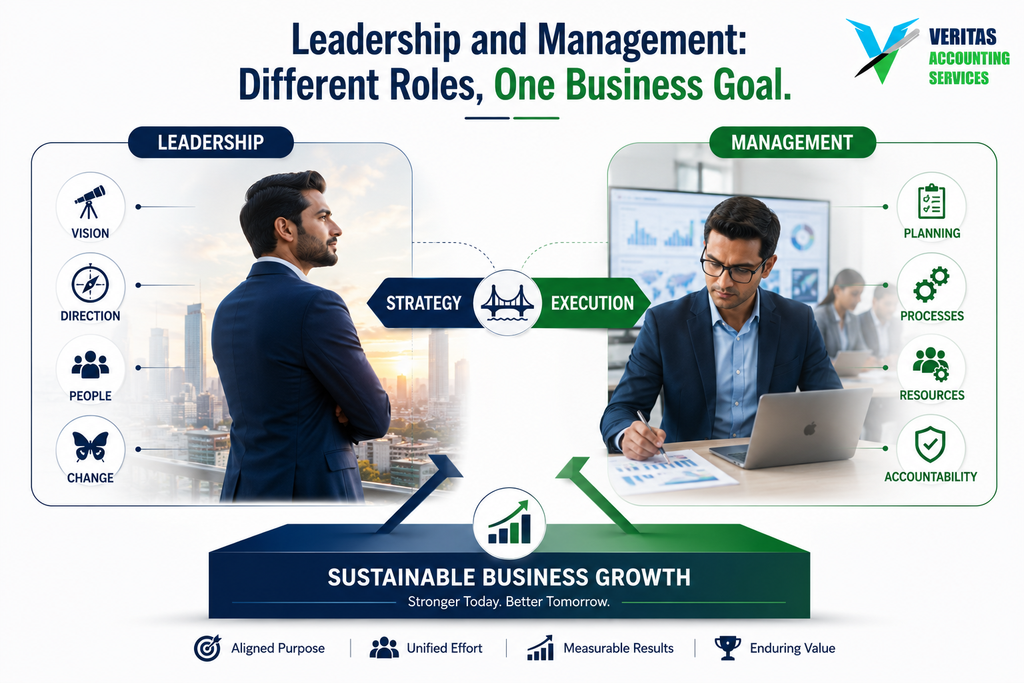
Leadership vs. Management: The Core Difference
The difference becomes clearer when we compare their primary focus.
| Leadership | Management |
|---|---|
| Creates direction | Organizes execution |
| Builds a vision | Builds processes |
| Inspires people | Coordinates people |
| Encourages change | Creates consistency |
| Focuses on the future | Focuses on current performance |
| Makes strategic choices | Implements plans |
| Builds commitment | Creates accountability |
These are not competing responsibilities.
They are complementary.
A strong business leader should understand management, and an effective manager should understand the broader direction of the organization.
The most successful companies create an environment where vision and execution reinforce each other.
Why Businesses Need Both
A business needs leadership to determine its destination and management to make the journey sustainable.
Imagine a company with an ambitious five-year growth target.
Leadership might establish the target, define the strategic priorities and communicate the vision to the team.
Management then needs to answer practical questions:
- How much investment is required?
- How many employees are needed?
- What processes need to change?
- Which performance indicators should be monitored?
- What is the monthly budget?
- How will customer service capacity increase?
- What risks need to be controlled?
Without leadership, the organization may lack direction.
Without management, the strategy may never become reality.
This is why leadership and management should be developed together rather than treated as completely separate disciplines.
Leadership Creates Direction
One of the most important responsibilities of a business leader is deciding what not to pursue.
Growing companies constantly encounter new opportunities.
A new customer may request a different service. An employee may suggest a new product. A competitor may enter a new market.
Leadership requires evaluating these opportunities against the company’s long-term strategy.
For example, a professional services firm may receive an opportunity to offer ten different services.
The leadership question is not simply:
“Can we do this?”
It is:
“Should this be part of our strategic direction?”
Good leaders create focus.
They communicate priorities clearly so that employees understand what deserves attention and what does not.
Management Turns Plans Into Results
Once direction has been established, management becomes critical.
A strategy is only valuable when it can be executed.
Suppose management has decided to improve profitability by 10%.
That objective needs to become measurable actions.
The management team may need to:
- Analyze current margins.
- Identify high-cost areas.
- Review pricing.
- Monitor employee productivity.
- Reduce unnecessary expenses.
- Improve billing and collections.
- Establish monthly performance targets.
This is where effective management creates structure.
Without processes and accountability, even a strong strategy can remain an attractive presentation rather than a measurable business outcome.
Where Business Owners Often Struggle
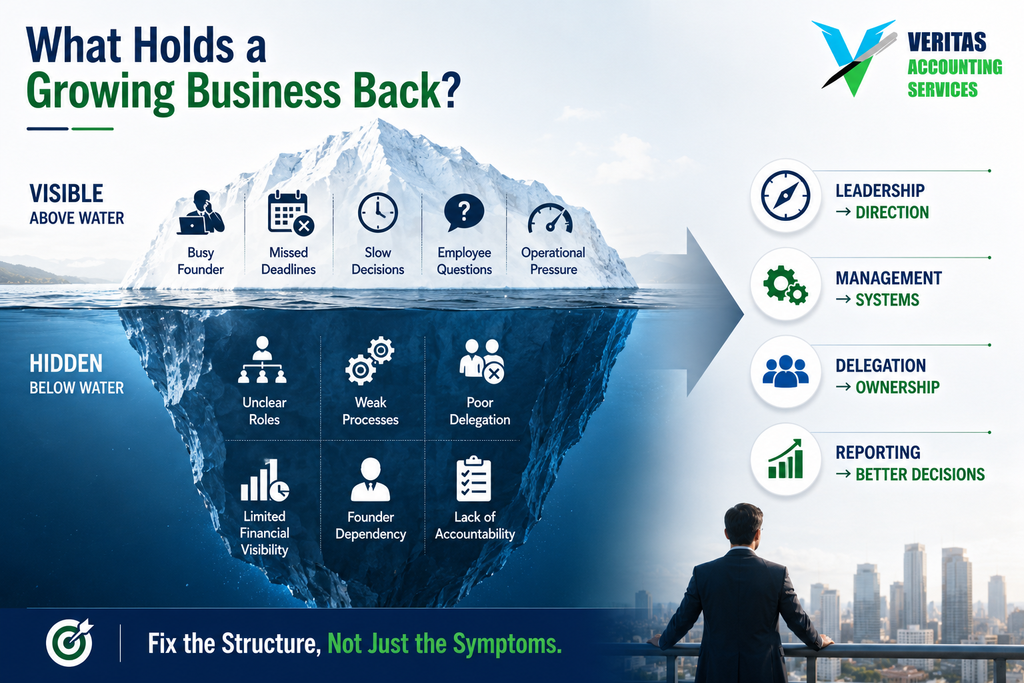
Many founders begin as both the leader and the manager.
They sell to customers, approve payments, supervise employees, review bookkeeping, solve operational problems and make strategic decisions.
That may work in the early stages.
The problem arises when the business grows but the owner’s role does not change.
A founder who continues to personally approve every small decision can become the organization’s biggest bottleneck.
This is often a sign that management systems have not evolved with the business.
Business owners should gradually move away from being the person who solves every problem and toward becoming the person who builds the people, processes and systems that solve problems consistently.
That transition is an important part of leadership development.
Delegation: The Bridge Between Leadership and Management
Delegation is not simply assigning tasks to employees.
Effective delegation involves transferring responsibility and authority while maintaining appropriate accountability.
A business owner should be clear about:
- What needs to be completed
- Who owns the responsibility
- What standard is expected
- When it must be completed
- How performance will be measured
- When the issue should be escalated
Poor delegation sounds like:
“Please take care of this.”
Effective delegation sounds more like:
“You own this process. Here is the expected outcome, deadline and reporting requirement. Let me know if an issue exceeds these defined limits.”
This allows the owner to spend more time on strategic decisions while managers and employees handle operational responsibilities.
Financial Information Supports Better Management
Leadership decisions become stronger when they are supported by reliable financial information.
Revenue alone does not tell a business owner whether the company is performing well.
Management should understand:
- Gross margins
- Operating expenses
- Cash flow
- Accounts receivable
- Accounts payable
- Customer profitability
- Budget versus actual results
- Revenue trends
- Key performance indicators
For example, a business may report strong sales growth while cash flow deteriorates because customers are taking longer to pay.
Leadership needs to decide how the company should respond.
Management needs reliable reporting to identify the problem, monitor collections and measure whether corrective action is working.
This is one reason accounting should not be viewed only as a compliance function.
Accurate financial reporting provides information that supports better management decisions.
How Outsourced Professionals Can Support Leaders
As businesses grow, owners often discover that they need more expertise than they can build internally.
That does not necessarily mean hiring a full-time specialist for every function.
Outsourcing can provide access to experienced professionals in areas such as:
- Bookkeeping
- Accounting
- Tax support
- Financial reporting
- Budgeting
- Cash-flow forecasting
- Payroll
- CFO advisory
An external accounting team can take responsibility for recurring financial processes while giving management timely information for decision-making.
For example, instead of spending hours reviewing transactions, a business owner can receive organized monthly financial reports and focus on questions such as:
Why did gross margin change?
Which customers are most profitable?
Can we afford the next hire?
What will our cash position look like three months from now?
This is where professional accounting support can contribute to both management and leadership.
At Veritas Accounting Services, we support businesses and professional firms with bookkeeping, accounting, tax support, financial reporting, budgeting, forecasting and CFO-related services.
The objective is not simply to maintain records.
It is to help businesses maintain reliable financial information so owners and managers can spend more time making informed decisions.
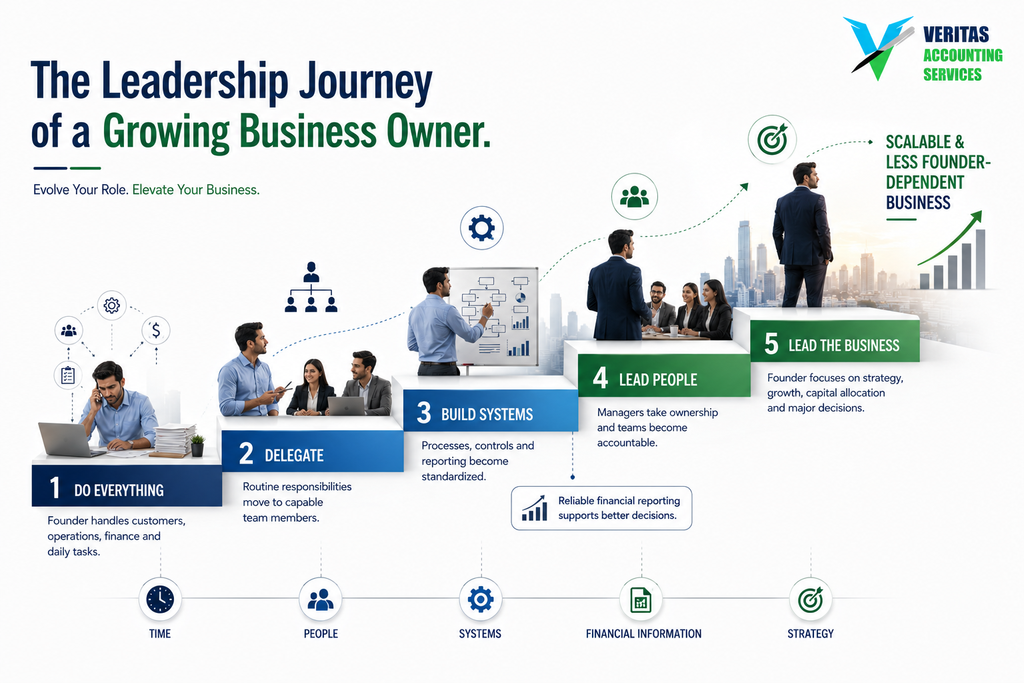
Building a Business That Does Not Depend on One Person
A strong business should not stop functioning when its founder takes a week off.
If every customer relationship, approval, financial decision and operational process depends on one person, the business has a scalability problem.
Leaders should gradually build:
Clear Roles → Documented Processes → Delegated Authority → Reliable Reporting → Accountability
This creates organizational independence.
For example, instead of the owner personally reviewing every supplier invoice, the business can establish an approval process with defined limits.
Instead of the owner preparing every management report, the accounting team can produce standardized reports each month.
Instead of employees asking the founder about every operational issue, documented procedures can provide clear guidance.
These systems allow the leader to focus on growth while management keeps the organization running effectively.
Practical Questions for Business Owners
If you are evaluating your own organization, ask these questions:
1. Am I spending enough time on strategy?
If most of your week is consumed by operational tasks, your business may need better delegation or management systems.
2. Are responsibilities clearly assigned?
Every important recurring process should have an identifiable owner.
3. Do managers have enough authority?
Responsibility without authority creates frustration and slows decision-making.
4. Do I receive financial information on time?
Late or unreliable reports make both management and leadership decisions harder.
5. Can the business operate without me?
If the answer is no, identify the processes that depend on you and begin documenting and delegating them.
6. Are we measuring outcomes?
Employees should understand how their work contributes to business objectives.
7. Where do we need external expertise?
Some functions can be handled internally, while others may be more efficiently supported by specialized external professionals.
These questions can reveal whether the organization has a leadership problem, a management problem, or simply a systems problem.
FAQ
What is the main difference between leadership and management?
Leadership focuses primarily on direction, vision, people and strategic change, while management focuses on planning, execution, processes, resources and accountability.
Can someone be both a leader and a manager?
Yes. In many businesses, particularly smaller companies, the same person performs both roles. As organizations grow, these responsibilities may become distributed across different people.
Why do growing businesses need both leadership and management?
Leadership provides direction and purpose, while management creates the structure needed to execute the strategy consistently.
How does accounting support leadership and management?
Reliable accounting provides financial information about profitability, cash flow, expenses, margins and performance, helping leaders and managers make informed decisions.
Can outsourcing help improve management?
Yes. Outsourcing specialized functions such as bookkeeping, accounting and tax support can give businesses access to expertise while allowing internal managers to focus on core operations.
Conclusion
Leadership and management are not opposing approaches.
They are two sides of building a sustainable business.
Leadership establishes direction, creates purpose and helps people understand where the organization is going.
Management turns that direction into processes, responsibilities, budgets, measurements and results.
As a business grows, the owner’s role must evolve as well. Doing everything personally may help a company get started, but building systems, developing people and delegating responsibility are essential for sustainable growth.
Financial information plays an important role in that transition. Reliable bookkeeping, accounting and reporting allow owners to understand what is happening inside the business rather than relying solely on intuition.
At Veritas Accounting Services, we work with businesses and professional firms to provide bookkeeping, accounting, tax support and financial advisory services that help management operate with better information.
The goal is not simply to keep the numbers organized.
It is to give business leaders the information, structure and support they need to lead with confidence and manage with clarity.
GET IN TOUCH
Schedule a FREE Call