








From Oversight to Ownership: How to Build Accountability Without Micromanaging
As a business grows, leaders often face a difficult question: How do you make sure work gets done properly without checking every task yourself?
The natural response is often more meetings, more approvals, more messages, and more follow-ups. Over time, this can create a management style where employees wait for instructions rather than taking ownership. The leader becomes the person everyone depends on for decisions, corrections, and reassurance.
The goal is not to remove oversight. Good leaders still need visibility into performance, deadlines, quality, and financial results. The challenge is creating accountability without micromanaging so employees understand what is expected, take responsibility for their work, and know when they need to communicate.
Accountability is strongest when people have clarity, authority, and a clear connection between their actions and results. Micromanagement usually appears when one or more of those elements is missing.
What Accountability Really Means
Accountability is not simply asking whether a task was completed. It means an employee understands the expected outcome, owns the responsibility, communicates problems early, and accepts responsibility for the result.
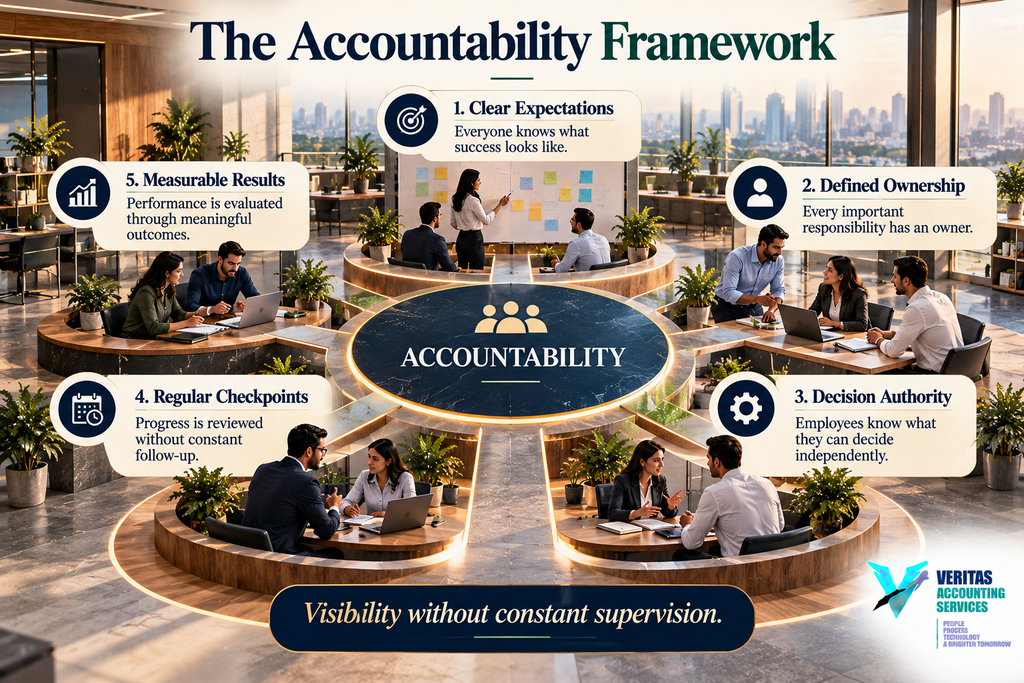
A healthy accountability system answers five practical questions:
- What am I responsible for?
- What does good work look like?
- When is it due?
- What decisions can I make independently?
- When should I escalate an issue?
When these questions are clear, accountability without micromanaging becomes much easier. Employees do not need constant supervision because they understand both the destination and the boundaries.
The Difference Between Accountability and Micromanagement
The two can look similar from a distance, but they operate very differently.
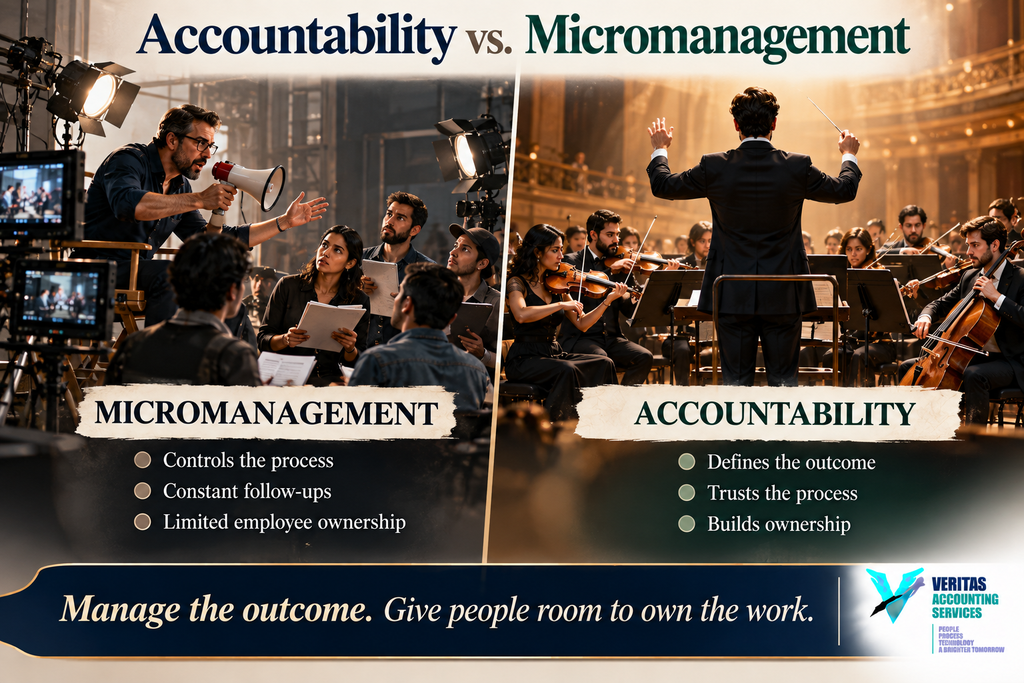
A manager practicing accountability sets expectations, establishes deadlines, measures results, and reviews outcomes. The employee has room to decide how to complete the work.
A micromanager focuses heavily on the process. They may repeatedly ask for updates, rewrite small details, insist on their preferred method, or become involved in decisions that do not require their involvement.
For example, an accounting manager might tell an employee that all assigned bank reconciliations must be completed and reviewed by Friday. The manager can define the quality standard and review the final work without dictating every step.
That approach creates accountability without micromanaging because the employee owns the process while the manager owns the standard.
1. Define the Outcome, Not Every Step
One of the simplest ways to reduce micromanagement is to change the way work is assigned.
Instead of explaining every action an employee should take, define the expected result.
For example:
Instead of:
“Open the bank statement, check each transaction, mark the matching items, then send me a screenshot.”
Try:
“Complete the bank reconciliation for March, investigate all unmatched transactions, and submit it for review by Thursday.”
The second instruction creates a clear outcome while allowing the employee to use professional judgment.
This is especially important when managing experienced employees. If someone has the skills to perform a task, excessive instructions can communicate a lack of trust.
A clear outcome is one of the foundations of accountability without micromanaging because employees know what they are expected to deliver without being told how to perform every step.
2. Set Clear Standards From the Beginning
Accountability becomes difficult when expectations are vague.
Employees should know what quality means before they are evaluated against it. A manager might establish standards for accuracy, turnaround time, documentation, communication, and escalation.
For example, a bookkeeping team could define standards such as:
- Bank accounts must be reconciled monthly.
- Unusual transactions must be documented.
- Client questions should be acknowledged within an agreed timeframe.
- Open issues should be tracked until resolution.
- Completed work must pass the defined review process.
Clear standards make accountability without micromanaging practical because employees can measure their own work before handing it to a manager.
The standard should be written down whenever possible. Verbal expectations can easily be interpreted differently by different team members.
3. Give People Ownership of a Defined Area
Ownership is stronger when responsibility is specific.
Instead of telling an employee to “help with bookkeeping,” assign ownership of a defined area such as accounts payable, bank reconciliations, payroll entries, or month-end close procedures.
The employee then becomes responsible for the condition of that area, not simply for completing individual tasks.
This changes the conversation from:
“Did you do what I asked?”
to:
“Is your area complete, accurate, and under control?”
That is a significant shift in management thinking.
Clear ownership also makes accountability without micromanaging easier because managers know who is responsible for a result instead of repeatedly checking which employee is handling each individual task.
4. Use Checkpoints Instead of Constant Follow-Ups
Leaders need visibility, but visibility does not require continuous checking.
Create predictable checkpoints based on the type of work. A daily check may be appropriate for a critical short-term project, while a weekly review may be enough for routine work.
For example, a manager might hold a 20-minute weekly review covering:
- What was completed?
- What remains open?
- What is at risk?
- What decisions are needed?
- What will be completed next?
This gives management a reliable view of progress without creating a constant stream of “Any update?” messages.
The goal is accountability without micromanaging: establish a rhythm where updates are expected rather than demanded repeatedly.
5. Measure Results With Simple KPIs
People cannot consistently own outcomes they cannot measure.
KPIs do not need to be complicated. A small team may only need a few meaningful measures, such as:
- On-time completion rate
- Error or rework rate
- Outstanding issues
- Client response time
- Month-end closing time
- Collection performance
The important point is to measure outcomes rather than activity.
For example, counting how many emails an employee sends may create activity but does not necessarily show effectiveness. Measuring whether client requests are resolved within the agreed timeframe is more useful.
Good measurement supports accountability without micromanaging because the numbers provide visibility without requiring managers to watch every action.
6. Build a Culture of Early Communication
Accountability does not mean employees should solve every problem alone.
A strong team knows when to escalate an issue. Leaders should clearly explain which problems require immediate attention and which decisions employees can make independently.
For example, an employee might be expected to resolve routine bookkeeping discrepancies independently but escalate a material client issue, unusual transaction, compliance concern, or recurring process failure.
This distinction prevents two common problems. One is excessive escalation, where employees ask for permission for everything. The other is silent failure, where employees hide problems until they become serious.
Early communication makes accountability without micromanaging much more sustainable.
Employees should never feel that reporting a problem early will automatically result in criticism. If the organization punishes early communication, employees may learn to delay difficult conversations.
7. Let People Own Mistakes and Solutions
If managers immediately fix every employee mistake, employees may learn to bring problems upward instead of solving them.
When an error occurs, the first question does not always need to be “Who made the mistake?” A better starting point is:
What happened?
Why did it happen?
What should have happened?
How will we prevent it next time?
The employee should participate in identifying the cause and proposing the corrective action.
This does not mean ignoring serious performance problems. It means using mistakes as opportunities to strengthen processes and develop judgment.
A leader who allows employees to solve problems is gradually building a team that needs less supervision. This is a core principle of accountability without micromanaging.
8. Create a Clear Escalation Framework
Employees often depend too heavily on managers because they are unsure about their decision-making authority.
Create simple boundaries.
Green: Employee can decide independently.
Yellow: Employee can proceed but should inform the manager.
Red: Manager approval is required before proceeding.
The same concept can be applied to spending, client communication, accounting adjustments, hiring decisions, discounts, refunds, and compliance matters.
When authority is clear, employees can act faster and leaders receive fewer unnecessary questions.
This is one of the most practical ways to create accountability without micromanaging across a growing organization.
9. Review Performance, Not Personality
Accountability conversations should focus on observable facts.
Instead of saying:
“You are not responsible enough.”
Discuss the specific result:
“The reconciliation was submitted three days late.”
“Three material transactions were not investigated.”
“The client question remained unanswered for four business days.”
Then discuss the expected standard and what needs to change.
Specific feedback is easier to understand and act upon. It also makes performance management more objective.
The conversation should focus on behavior, results, expectations, and improvement rather than personal judgments.
10. Recognize Ownership, Not Just Results
If leaders only reward final results, employees may focus narrowly on completing tasks.
Recognize behaviors that demonstrate ownership:
- Identifying a problem before it becomes serious
- Improving a process
- Helping another team member
- Communicating a delay early
- Taking responsibility for an error
- Finding a better way to complete recurring work
Recognition reinforces the behavior you want repeated.
When employees see that ownership is valued, accountability without micromanaging becomes part of the culture rather than simply a management technique.
What Leaders Should Stop Doing
Building accountability also requires leaders to change their own habits.
Stop asking for updates that are not useful.
Stop correcting minor issues that do not affect the outcome.
Stop taking back tasks because someone uses a different method.
Stop approving decisions that employees are already authorized to make.
Stop solving every problem before the employee has had a chance to think.
Before stepping into an employee’s work, ask yourself:
“Does this require my involvement, or am I simply uncomfortable not being in control?”
That question can reveal the difference between necessary oversight and unnecessary interference.
A leader can remain responsible for the outcome without controlling every step taken by the team.
A Practical Accountability Framework
For a growing business, a simple framework can make accountability part of the operating system.
First, define ownership.
Every important recurring responsibility should have a clear owner.
Second, define standards.
Explain what accurate, complete, timely, and acceptable work looks like.
Third, define authority.
Make it clear what the employee can decide independently.
Fourth, establish checkpoints.
Review progress at agreed intervals rather than continuously.
Fifth, measure results.
Use a small number of meaningful KPIs.
Sixth, review and improve.
Discuss what worked, what failed, and what should change.
This framework creates accountability without micromanaging because leaders remain informed while employees retain responsibility for execution.
It also creates a repeatable management system. As the business grows and new employees join, expectations do not have to depend entirely on the personality or management style of one leader.
The Role of Trust
Trust does not mean assuming everything will always go perfectly. Trust means giving capable people the opportunity to perform while maintaining reasonable systems for review and correction.
There is also an important distinction between trust and blind delegation. A leader should not simply hand over responsibility and disappear. Employees need training, resources, clear standards, and access to support.
The objective is controlled independence: enough freedom for people to own their work, combined with enough structure to protect quality and business performance.
This balance is essential to accountability without micromanaging. Too little structure can create confusion, while too much control can prevent employees from developing judgment.
When Accountability Is Not Working
If an accountability system is not producing results, do not automatically respond with more supervision.
First ask whether the problem is caused by:
- Unclear expectations
- Insufficient training
- Unrealistic deadlines
- Inadequate resources
- Poor processes
- Unclear authority
- A genuine performance issue
For example, if an employee repeatedly misses a deadline because the workload is unrealistic, more follow-up will not solve the underlying problem.
Likewise, if an employee makes recurring errors because the process has never been documented, the solution may be better training and documentation rather than closer supervision.
Good leadership looks for the cause before increasing control.
Conclusion
The goal of accountability is not to create a workplace where managers constantly check on employees. It is to create a workplace where people understand what they own, what success looks like, and when they need to ask for help.
The strongest teams are not necessarily those with the most supervision. They are often the teams where expectations are clear, authority is appropriate, results are measurable, and people are trusted to do their jobs.
Building accountability without micromanaging requires leaders to move from controlling activities to managing outcomes. When that shift happens, employees gain ownership, managers regain time, and the organization becomes less dependent on one person to keep everything moving.
For growing businesses, that is more than a management improvement. It is an important step toward building a scalable organization.
Frequently Asked Questions
What is the difference between accountability and micromanagement?
Accountability focuses on agreed responsibilities, standards, deadlines, and results. Micromanagement focuses excessively on how employees perform each step of the work.
How can managers create accountability without micromanaging?
Set clear expectations, assign ownership, define decision-making authority, establish regular checkpoints, and measure meaningful results. This creates accountability without micromanaging day-to-day execution.
How often should managers check on employees?
There is no universal frequency. It should depend on the employee’s experience, the importance of the work, the risk involved, and the project timeline. Routine work may need weekly reviews, while critical projects may require more frequent checkpoints.
What should a manager do when an employee makes a mistake?
Understand what happened, identify the root cause, agree on corrective action, and determine how to prevent recurrence. If the issue reflects a performance problem, address that directly with specific evidence and expectations.
Can accountability work with remote teams?
Yes. Remote teams often benefit from particularly clear ownership, written expectations, documented processes, agreed communication standards, and measurable deadlines. These systems reduce the need for constant monitoring.
How does accountability improve business growth?
Clear ownership reduces dependency on the founder or manager, improves consistency, identifies problems earlier, and allows leaders to focus more on strategy instead of supervising every task.
Final Takeaway
Accountability is not about watching people more closely. It is about creating enough clarity and structure that people can take responsibility for their work.
When leaders define outcomes, establish standards, provide appropriate authority, and review results consistently, they can build a team that operates with greater independence.
That is how a business moves from oversight to ownership.
GET IN TOUCH
Schedule a FREE Call










Connect on our Socials!
