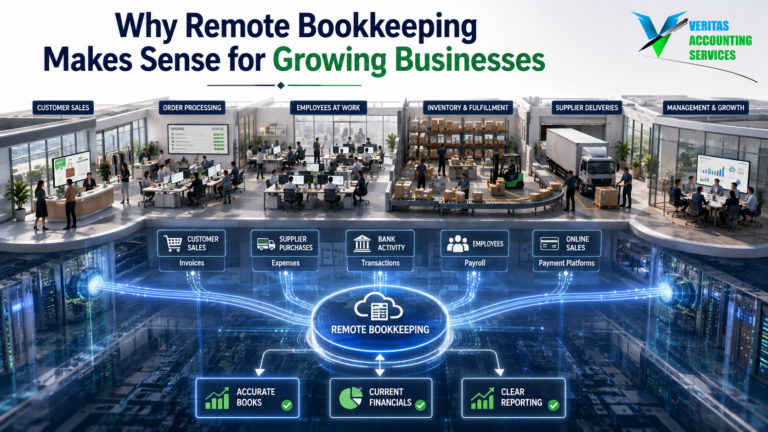
The need for bookkeepers to become strategic partners in today’s eCommerce landscape has never been greater. With eCommerce businesses rapidly expanding to multiple sales channels and automation technologies advancing at lightning speed, understanding how to streamline compliance, especially for sales tax, is essential for both client success and the growth of bookkeeping practices.
Why Multi-Channel eCommerce Changes Everything
Moving Beyond Traditional Bookkeeping
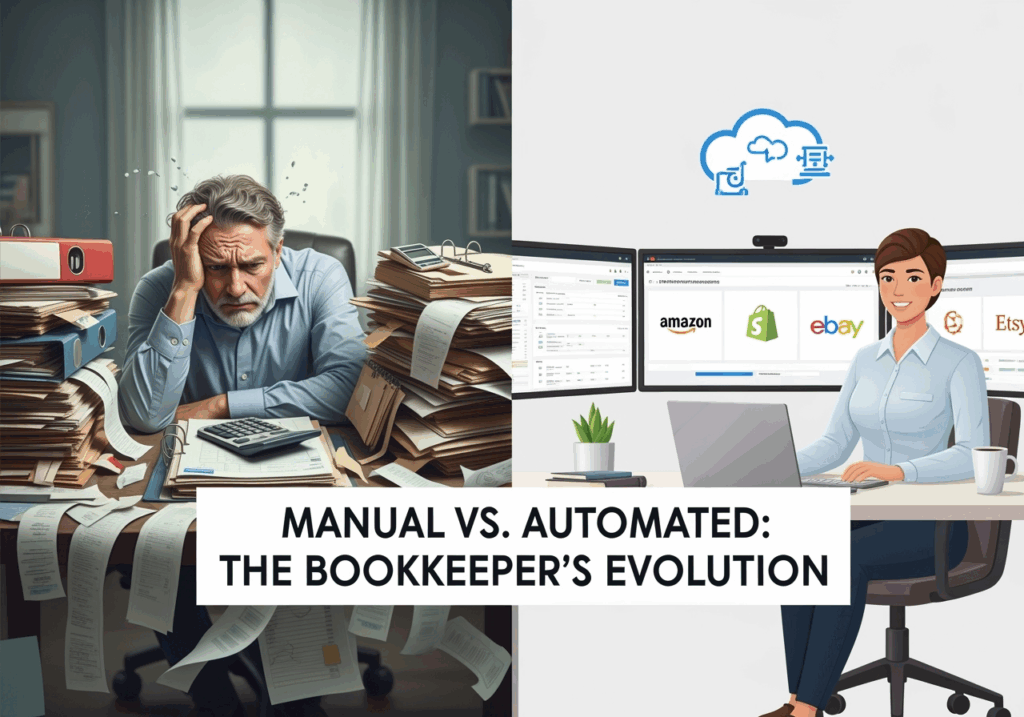
In the past, bookkeeping focused on ledgers and periodic reconciliations for a single online platform like Shopify or Amazon. Today, thriving eCommerce businesses operate on numerous platforms—Amazon, Shopify, eBay, Etsy, Walmart, Facebook Shops, and their own websites. Each generates unique data streams, reporting requirements, and tax obligations.
Key challenge: Manual processes can’t keep up. Studies show bookkeepers relying on old methods spend significantly more time for lower accuracy—investing up to 73% more effort yet achieving only around 64% accuracy in tracking sales tax compliance for multi-channel clients.
The Opportunity: Bookkeepers must transform into orchestrators of automated systems and real-time data specialists—using technology to minimize manual work and maximize insight.
The Rise of AI in Bookkeeping
Artificial intelligence has revolutionized multi-channel bookkeeping. AI-powered tools can now:
Auto-categorize transactions across channels.
Detect sales tax nexus triggers in real time.
Predict upcoming compliance needs based on client growth.
Results from AI adoption include:
89% reduction in manual data entry.
94% increase in sales tax tracking accuracy.
Capability for a bookkeeper to handle 3x more clients without extra staff.
This shift frees professionals to move from repetitive data entry into valuable client advisory and strategic roles instead.
Common Platform-Specific Bookkeeping Challenges
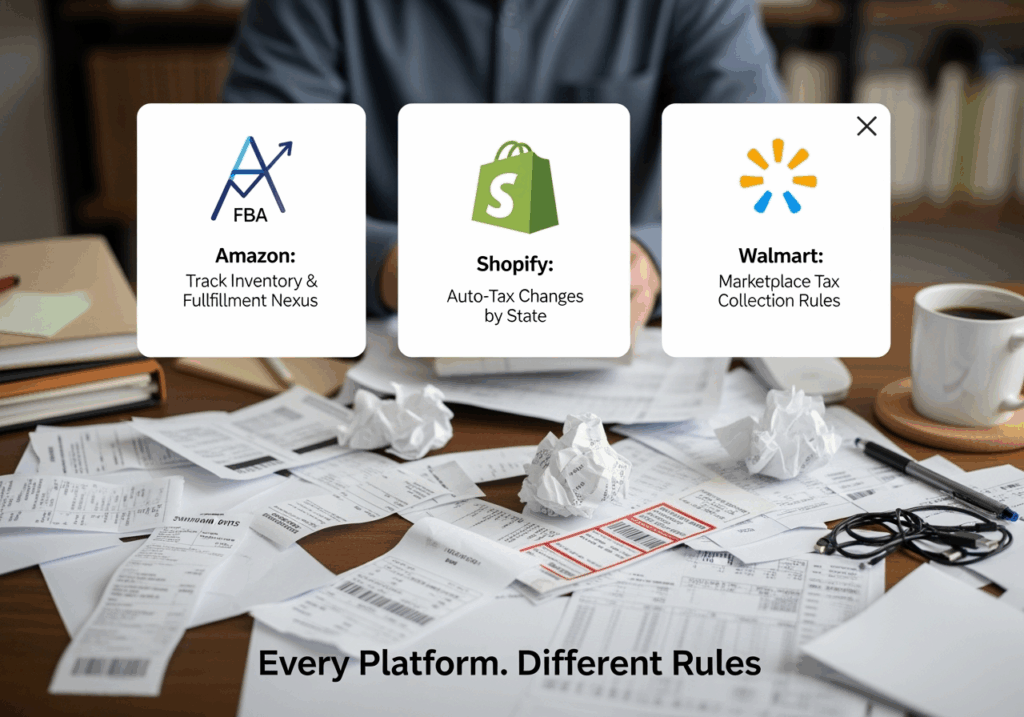
Each sales platform presents unique headaches:
Amazon FBA: Requires inventory tracking across fulfillment centers and a deep understanding of marketplace tax collection rules.
Shopify: Ongoing regulatory changes make it crucial to re-examine sales tax setups, particularly as Shopify introduces automatic tax collection for relevant states.
Multi-channel Inventory: Managing stock and margins across platforms can quickly spiral out of control without automation.
General Compliance: Ensuring accurate documentation in the event of a tax audit is much more complex when multiple platforms are involved.
The Financial Impact of Multi-Channel Complexity
Bookkeepers can help clients not only avoid costly tax penalties but also directly improve operational efficiency.
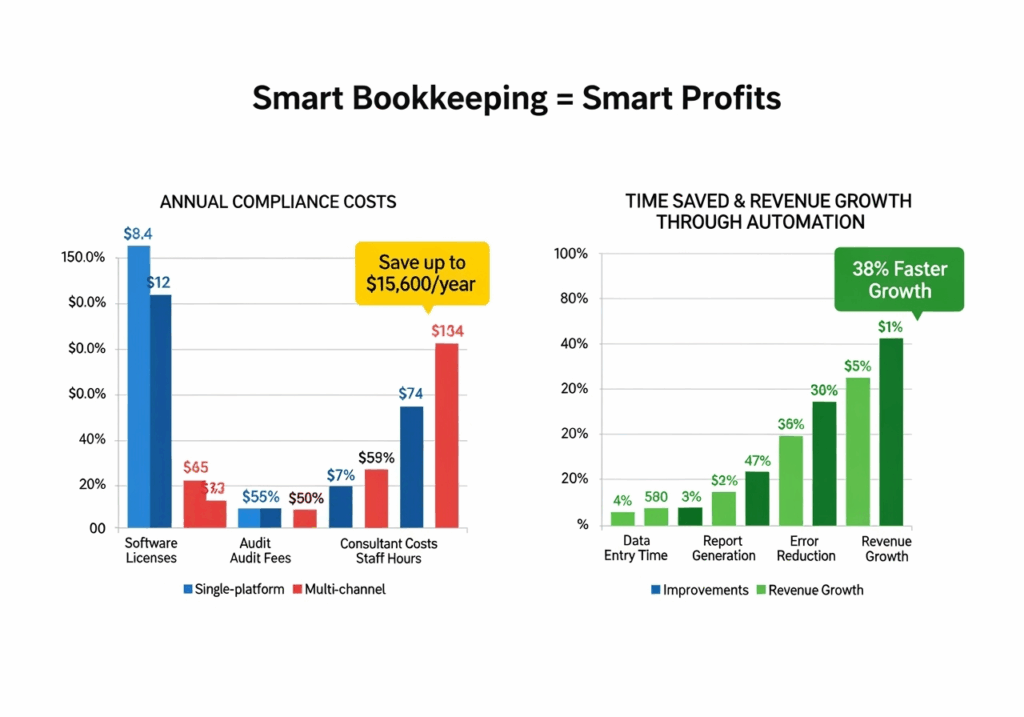
Cost of compliance and bookkeeping: Multi-channel stores typically spend $2,400–$4,800 a year (vs. $800–$1,200 for single-platform sellers).
Potential savings from professional management: $8,400–$15,600 per year through streamlined, automated workflows.
Revenue growth advantage: Businesses on multiple channels grow revenue 38% faster than those on a single platform.
The bottom line: Effective bookkeeping turns what many see as a cost into a profit driver, enabling scalability and peace of mind.
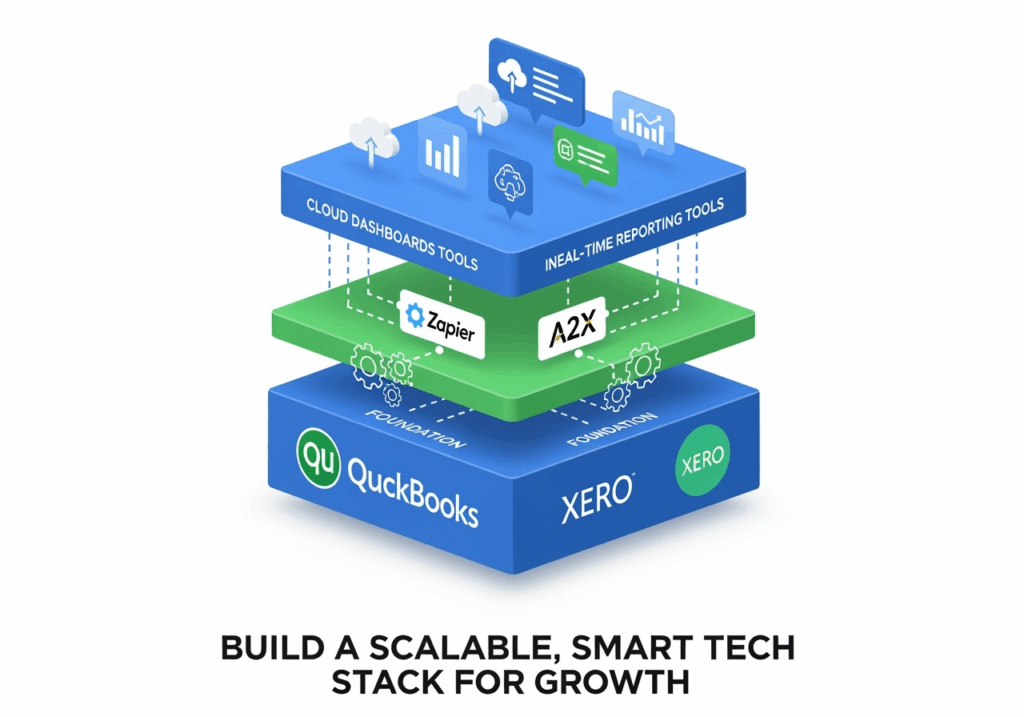
Today’s most successful bookkeeping practices rely on much more than accounting software like QuickBooks or Xero (though these should be your foundation).
Best-in-class practices also adopt:
eCommerce integration and automation tools (for sales data import, inventory sync, and multi-platform reconciliation).
Cloud-based dashboards, for 24/7 real-time access and collaboration.
Custom reports, breaking down profitability and compliance status by channel.
These investments deliver transparency, scalability, and confidence for both bookkeepers and clients.
Why Automated Sales Tax Management Is Essential
Sales tax compliance is the highest-value, most urgent service for eCommerce clients:
Multi-state nexus triggers: Identifying and registering for state sales tax as required by law.
Marketplace facilitators: Some platforms collect and remit tax, but your client is still responsible for reporting and proper record-keeping.
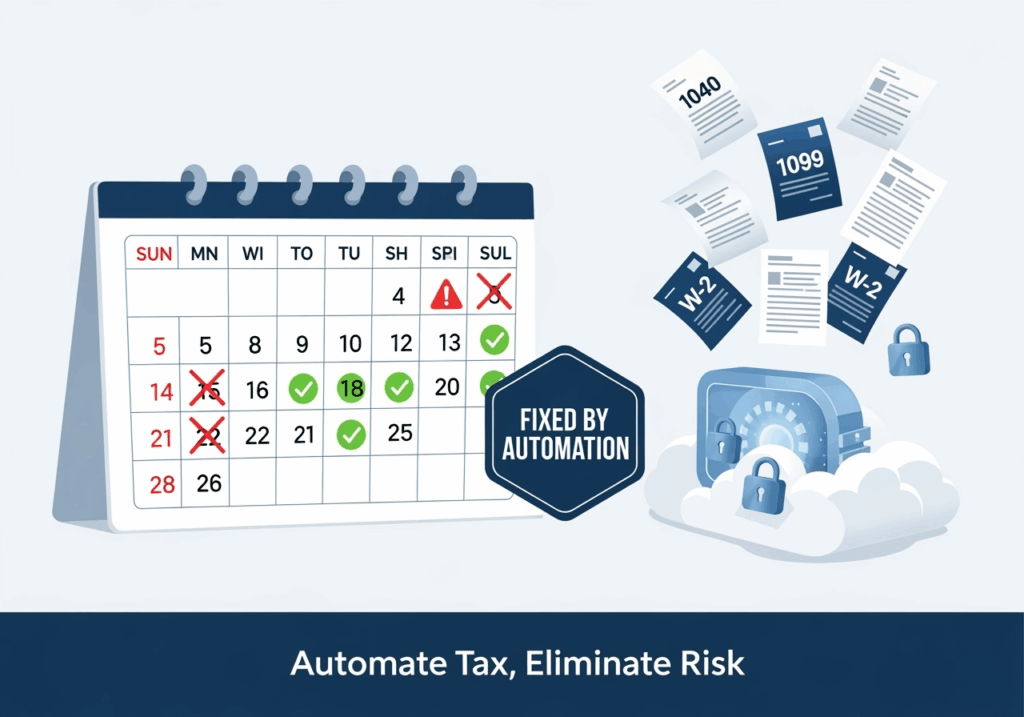
Automation platforms: Specialized sales tax apps eliminate manual tracking and ensure every filing is timely and complete.
Business impact: Clients typically see payback on automation within 4-6 months through penalty avoidance and saved time. For bookkeepers, sales tax services command premium rates but require minimal hands-on work after setup.
International Operations: A Lucrative Niche
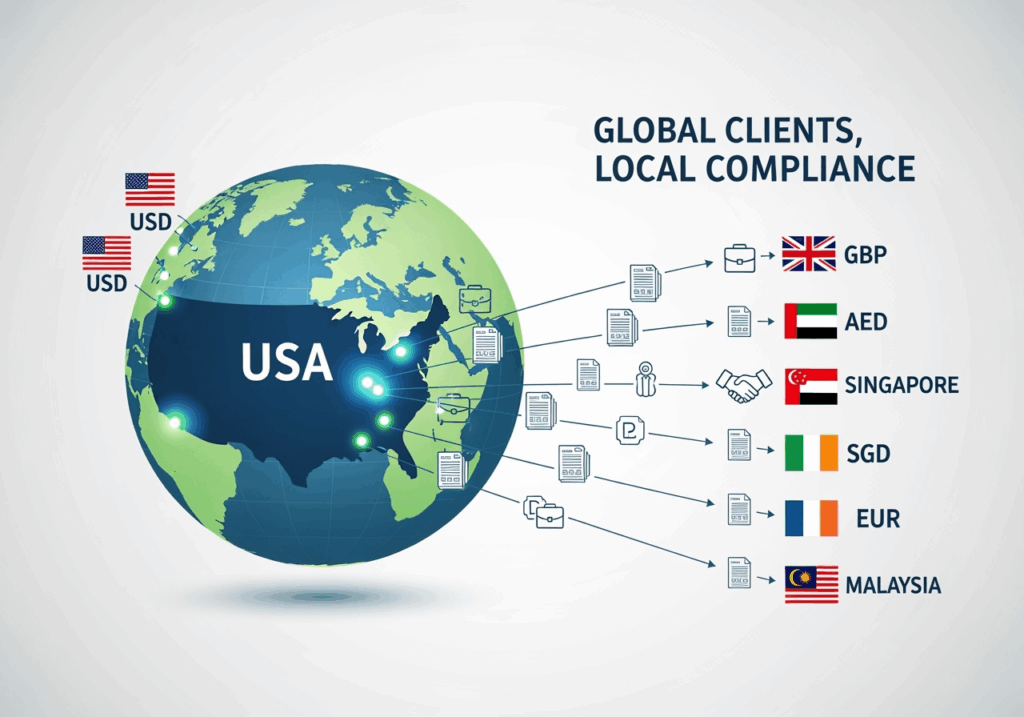
International sellers entering the US face even greater complexity:
Navigating both US and home country regulations.
Handling US tax ID registration.
Managing currency and banking requirements.
These clients see the value in premium, expert services—often investing 40–60% more than domestic-only businesses. Mastering this area can set your firm apart and substantially grow your client base.
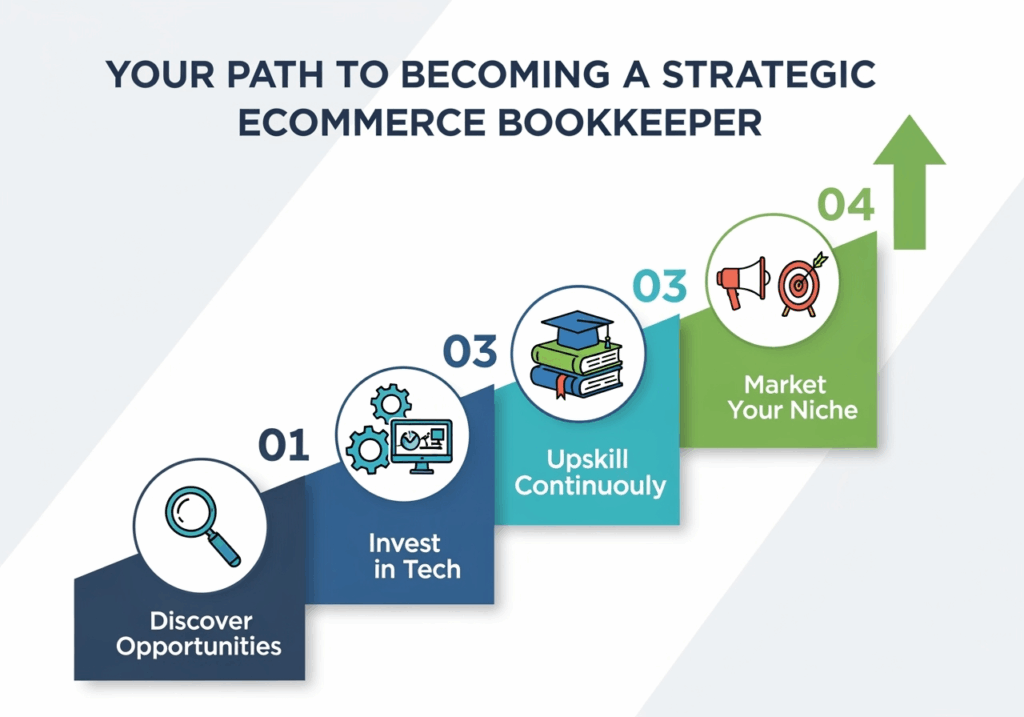
Step-by-Step: Growing Your Multi-Channel Bookkeeping Specialization
Identify potential within your existing clients. Many may be considering new sales channels—position yourself as their go-to advisor for expansion.
Invest systematically in technology. Start with core accounting integrations. Layer in automation as you add clients and revenue.
Commit to continuous learning. Stay up-to-date on eCommerce trends, tax rules, and new automation tools. This fosters innovation and justified premium billing.
Market your expertise. Tell your story clearly—how you help clients save time, avoid penalties, and optimize growth.
What the Future Holds?
eCommerce complexity and automation are only going to increase. Bookkeepers who future-proof their practices now will seize the biggest opportunities:
Combining technical skill with strategic advice.
Vying for top positioning in an expanding, lucrative market.
Serving as true partners in their clients’ growth journeys, rather than just vendors.
Why Partner with Veritas Accounting Services?
Choosing the right partner for your accounting and bookkeeping can be the difference between surviving and thriving in today’s eCommerce landscape. Veritas Accounting Services stands out through its deep expertise, innovative technology, and commitment to your business’s long-term success.
Built on Decades of Multi-Channel Experience
Veritas Accounting Services draws upon decades of hands-on experience, managing books and compliance for businesses with operations spanning the globe. This cross-border expertise means clients benefit from specialized knowledge in managing the challenges of international VAT, US sales tax, and complicated multi-channel reporting requirements. Whether you sell on Amazon, Shopify, Etsy, Walmart, or your own website, the Veritas team understands the pain points unique to eCommerce and knows how to navigate them smoothly.
Proprietary, Seamless Integration with Leading Software
The technology stack at Veritas is robust and highly adaptable. Clients enjoy seamless integration with industry-leading cloud platforms, including QuickBooks Online, Xero, Wave, Zoho Books, and other specialized eCommerce accounting tools. This integration not only speeds up processes, but also enables real-time reconciliation, inventory tracking, and advanced analytics across every channel you utilize—all while maintaining absolute accuracy and compliance. Automated solutions provided by Veritas eliminate manual data entry, drastically reduce errors, and free you to focus on scaling your business.
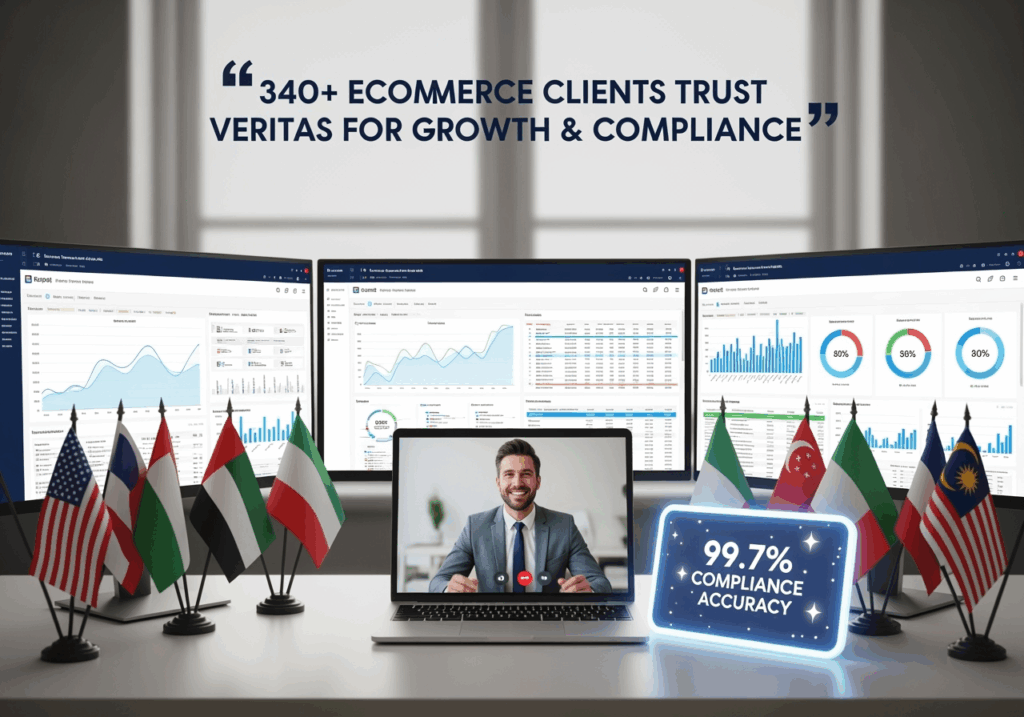
Proven Track Record: 340+ International Clients Served
When you work with Veritas, you join an expanding network of 340+ happy international brands who have successfully optimized and protected their financial operations. The results speak for themselves—Veritas clients consistently achieve a 99.7% compliance accuracy rate, drastically lowering exposure to penalties, tax audits, and administrative burden. By minimizing risk and creating transparent, audit-ready reporting, Veritas provides peace of mind so you can pursue growth with confidence.
More Than Bookkeepers—Strategic Growth Partners
Veritas doesn’t just keep your books; the team acts as your virtual CFO, advisor, and strategic partner. Their personalized process includes in-depth business analysis, proactive compliance monitoring, and recommendations on cashflow management, forecasting, and even process automation for scaling up efficiently. This level of involvement helps clients unlock hidden savings, capture new opportunities, and stay ahead of regulatory changes, both in the US and internationally.
Flexible, Scalable Services Designed for You
Whether you’re a fast-growing startup or a seasoned multinational, Veritas tailors its solutions to fit your needs. You gain the flexibility to scale services up or down as your operations evolve, thanks to the team’s experience with a wide range of business models and industries—from eCommerce and logistics to restaurants and professional services.
If you’re ready to build a future-proof, competitive, and growth-oriented practice—or need a dedicated accounting partner capable of supporting your multi-channel eCommerce ambitions—reach out to Veritas Accounting Services today at hello@veritasaccountingservices.com or call +1(678) 723-6003.
Navigating sales tax compliance as a marketplace seller can be overwhelming, especially with constantly evolving regulations across 45 US states. With marketplace facilitator laws now generating over $13.7 billion annually and economic nexus thresholds affecting 2.4 million e-commerce businesses, knowing what to prioritize—and what to skip—has never been more critical. Prioritizing the right compliance strategies protects both your bottom line and your peace of mind.
Recent data from the sales tax Institute reveals a startling reality: 67% of marketplace sellers are either over-complying, wasting valuable resources on unnecessary tasks, or under-complying, risking substantial penalties. The average penalty for non-compliance reached $4,200 per business in 2024, while businesses that over-comply spend an unnecessary $2,400 annually on redundant compliance activities. This comprehensive guide will help you focus your efforts where they matter most while avoiding common compliance traps that drain time and resources without adding value.
Understanding Your Marketplace Coverage: The Foundation of Smart Compliance
Before diving into any compliance activities, you must understand your specific situation as a marketplace seller. Data-backed approach, 87% process reduction determines approximately 80% of your compliance obligations and can save you from countless hours of unnecessary work. The landscape has changed dramatically since marketplace facilitator laws took effect, with platforms now handling the vast majority of sales tax collection and remittance on behalf of their sellers.
Amazon, the largest marketplace, now collects tax in all 45 sales tax compliance states for FBA transactions, covering 89% of third-party seller obligations automatically. This means if you’re exclusively selling through Amazon FBA, your compliance burden has been reduced by nearly 90% compared to just five years ago. However, FBM (Fulfilled by Merchant) sellers still need to conduct separate analysis for transactions not covered by Amazon’s collection system.
eBay has similarly revolutionized compliance for its sellers through eBay Managed Payments, which covers 94% of transactions on the platform. Since implementation, seller registration requirements have been reduced by 67%, simplified the compliance landscape significantly for millions of sellers. Etsy handles collection in all applicable states for its craft and handmade sellers, maintaining a 91% compliance rate across its platform and providing small seller protection for transactions under $600 annually.
The key insight here is that many sellers are registering in states where their marketplace already handles everything, creating unnecessary filing obligations and ongoing costs. Data shows that 34% of marketplace sellers over-register, spending an average of $1,200 annually on compliance activities that provide no value. Understanding your platform’s coverage is the first step toward efficient compliance management.
Economic Nexus: Focusing on What Actually Matters
Economic nexus thresholds determine when you’re required to collect and remit sales tax in each state, but many sellers either over-monitor their obligations or focus on outdated metrics. The landscape has simplified significantly, with 67% of states eliminating transaction count requirements in favor of revenue-only thresholds.
California leads the pack with $891 million collected in 2024 from economic nexus enforcement, maintaining a $500,000 threshold with no transaction count requirement. Texas generated an additional $312 million through nexus enforcement, recently eliminating its transaction count requirement in January 2025. New York continues its aggressive enforcement approach with a $500,000 threshold and 100 transaction requirement, averaging $4,200 in penalties per non-compliant business. Florida has implemented a new automated nexus detection system, resulting in an 89% increase in penalty collections throughout 2024.
The smart approach to nexus monitoring involves tracking only revenue-based thresholds in states where you have realistic potential to reach them. Most marketplace sellers trigger nexus in an average of 3.2 states, making it counterproductive to monitor all 45 states if you’re only generating $200,000 in annual sales across all platforms. Setting alerts at 75% of relevant thresholds provides adequate planning time while avoiding the administrative burden of constant monitoring.
Transaction count tracking has become largely obsolete, with states like North Carolina, South Dakota, Wyoming, and Vermont eliminating these requirements in 2024-2025. This trend has resulted in an average 18% reduction in compliance costs for affected businesses and 4.2 hours of monthly time savings per business. The focus should be on states representing 80% of your sales volume rather than attempting to track every possible nexus scenario.
Strategic Registration: Avoiding the Over-Compliance Trap
Registration strategy is one of the most critical compliance decisions for marketplace sellers. Done correctly, it can save thousands annually. Done prematurely, it creates ongoing costs and filing burdens.
Home State vs. Multi-State Registration
Home State: Registration in your business’s home state is always required, even if your marketplace handles sales tax. Many sellers overlook this basic obligation.
Multi-State: Only register in other states if:
You’ve crossed economic nexus thresholds
Your marketplace doesn’t collect in those states
You conduct direct sales (non-marketplace)
Avoid registering in states just because they’re “potential” markets. Every registration triggers recurring obligations—even if you have no sales.
When Not to Register
Marketplace Handles Everything: If Amazon, Etsy, or eBay covers all tax collection and remittance in a state, registration is usually unnecessary.
No Nexus: If you’re far below the economic nexus threshold and not growing in that region, it’s inefficient to register.
No Sales Tax States: Alaska, Delaware, Montana, New Hampshire, and Oregon have no sales tax. Avoid unnecessary filings here.
Cost of unnecessary registration: $150–300 per year in filing fees per state, plus administrative costs and time.
Use Voluntary Disclosure When Appropriate
If you’ve operated without registering in a state where you had a tax obligation:
Consider Voluntary Disclosure Agreements (VDAs) in 38 states.
These can reduce penalties by up to 67% if addressed proactively.
Particularly helpful if you’re more than 6 months non-compliant.
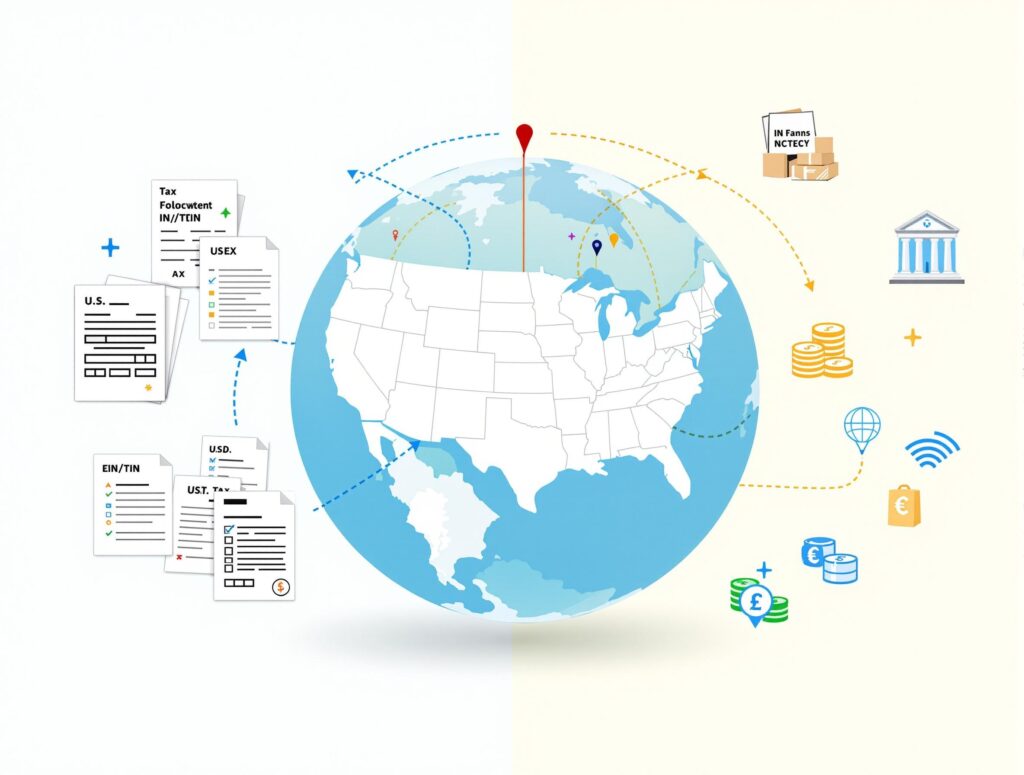
Special Rules for International Marketplace Sellers
International sellers face additional complexity when selling in U.S. marketplaces. From tax IDs to banking and compliance gaps, the risks—and penalties—can be high.
Tax Identification & Entity Setup
Most U.S. states require either:
An Employer Identification Number (EIN) or
An Individual Taxpayer Identification Number (ITIN)
Choose the correct entity type (e.g., sole proprietor, LLC, corp) to avoid double taxation and classification issues.
Banking & Payment Infrastructure
Opening a U.S. bank account simplifies remittance and improves compliance.
Track currency conversions, international fees, and wire transfers to maintain a clean audit trail.
Use multi-currency accounting tools (e.g., Xero, Zoho Books) with U.S. tax integration.
Common Mistakes to Avoid
Applying home country VAT rules to U.S. sales tax
Assuming marketplace coverage applies in every state
Delaying U.S. compliance due to perceived complexity
Not realizing that marketplace coverage varies by state
Why Professional Guidance Helps
84% of international sellers use U.S.-based experts
Setup time reduced by 67%
Prevents costly errors that often cost $3,000+ to fix later
Unlocks cross-border tax efficiencies not visible to DIY sellers
Record Keeping: Essential Documentation Without Excessive Overhead
Effective record keeping strikes a balance between audit preparedness and operational efficiency. The key is maintaining critical documentation while avoiding the trap of over-documentation that consumes resources without adding protection value.
Essential documentation includes monthly sales reports broken down by state and jurisdiction, with clear separation between marketplace and direct sales. This information should categorize taxable versus non-taxable sales and maintain a clear audit trail for all transactions. Valid exemption certificates, including resale certificates, non-profit exemption documentation, and government entity exemptions, must be maintained for the full statutory period, typically four years or more.
Tax collection records deserve special attention, documenting the amount collected by jurisdiction, remittance confirmations, and complete audit trail documentation. For marketplace sellers, maintaining marketplace facilitator confirmations becomes crucial, including platform tax collection confirmations, coverage verification documents, and gap analysis documentation that clearly shows which transactions are covered by the platform versus requiring direct compliance.
The temptation to over-document can be counterproductive and expensive. Consider changing to: Daily sales tracking offers minimal audit advantage compared to monthly summaries, while individual transaction documentation for marketplace-collected sales creates unnecessary administrative burden. Detailed product categorization is only necessary when selling exempt items, and customer address verification is handled by the marketplace for platform sales.
Modern accounting software integration eliminates much of the manual documentation burden while providing superior audit trails. QuickBooks integration is used by 67% of small businesses, while Xero maintains a 23% market share with 91% satisfaction rates. Wave integration has become popular among startups due to its free tier availability, and Zoho Books continues growing at 45% annually with comprehensive feature sets.
Technology and Automation: Smart Investments for Long-Term Success
Technology investment in sales tax compliance delivers measurable returns when properly implemented. Sales tax automation tools provide an average ROI of 340% in the first year, with 94% error reduction in calculation mistakes and 87% reduction in manual processes. The key is selecting appropriate tools for your business size and complexity rather than over-engineering solutions.
Nexus monitoring systems provide real-time threshold tracking with 24-hour alert systems, maintaining 100% accuracy in nexus determination when properly configured. These systems integrate seamlessly with popular accounting platforms, creating automated workflows that eliminate manual tracking requirements. The time savings alone justify the investment, with businesses reporting reductions from 12 hours monthly to 1.5 hours monthly for compliance management.
However, technology mistakes can be costly and counterproductive. Multiple overlapping software solutions create confusion and duplicate costs, while enterprise-level tools often provide unnecessary complexity for small operations. Custom development should be avoided when proven off-the-shelf solutions exist, and manual spreadsheet tracking becomes counterproductive when automation is readily available and affordable.
The comparison between manual and automated approaches is stark. Manual tracking requires 12 hours monthly with a 23% error rate, while automated systems reduce this to 1.5 hours monthly with only a 3.2% error rate. Professional management services can reduce this further to 0.2 hours monthly with a 0.3% error rate, making the cost-benefit analysis clear for many businesses.
Audit Preparation: Focused Defense Without Paranoia
Audit preparation should focus on realistic risks rather than theoretical possibilities. High-risk audit triggers include rapid growth patterns with 200% or more year-over-year growth, sudden expansion into new states, and platform diversification. Compliance gaps such as late registrations, inconsistent filing patterns, and marketplace coverage gaps also increase audit likelihood.
Industry targeting affects audit probability, with electronics and technology sellers facing 34% higher audit rates, clothing and accessories sellers experiencing 28% higher rates, and health and beauty sellers seeing 31% higher audit rates. Understanding these patterns helps prioritize preparation efforts where they’re most likely to be needed.
Effective audit defense preparation involves maintaining organized digital records, documenting marketplace facilitator coverage clearly, keeping nexus analysis documentation current, and establishing professional representation relationships before they’re needed. The goal is creating a defensible position without excessive preparation for unlikely scenarios.
Over-preparation for audits wastes resources on low-probability events. Over-preparing for audits in states with minimal sales, focusing on historical periods fully covered by marketplace facilitators, and treating routine compliance reviews as formal audits all represent misallocation of compliance resources. The key is proportional preparation based on actual risk assessment.
International Marketplace Sellers: Navigating Cross-Border Complexity
International sellers face unique challenges when operating in US marketplaces, with 84% utilizing professional services to navigate the complexity. Sellers from the UK, UAE, Singapore, Malaysia, and Ireland must address US tax ID requirements, including EIN (Employer Identification Number) for tax purposes or ITIN (Individual Taxpayer Identification Number) for individuals, along with proper entity classification.
Banking and remittance considerations become critical for international sellers. US bank accounts are recommended for tax payments, requiring currency conversion tracking and international wire transfer documentation. The complexity of managing both home country obligations and US state requirements makes professional guidance particularly valuable for international operations.
Common mistakes include applying home country VAT logic to US sales tax, ignoring US state-level requirements, assuming marketplace coverage is universal across all jurisdictions, and delaying US compliance due to perceived complexity. These mistakes can result in significant penalties and sales tax compliance gaps that become expensive to correct.
Professional services show particular value for international sellers, with average setup time reduction of 67% when expert help is utilized. Cross-border tax optimization opportunities often exist that can offset service costs through improved tax efficiency and reduced sales tax compliance burden.
Cost-Benefit Analysis: Making Smart Investment Decisions
The decision between DIY compliance and professional services should be based on clear cost-benefit analysis rather than assumptions about complexity or cost. Professional services make sense when annual marketplace sales exceed $500,000, when selling in five or more states with nexus obligations, when facing audit or compliance issues, when operating internationally with US sales, or when time costs exceed service costs.
Veritas Accounting Services demonstrates the value proposition with a 99.7% compliance success rate across managed accounts, average penalty avoidance of $8,400 per client annually, 72% faster multi-state registration than industry average, and 94% client retention rate over five years. These results reflect the measurable benefits of professional management for appropriate situations.
DIY approaches work effectively when operating through a single marketplace with full coverage, generating annual sales under $200,000, operating in one to two states only, having strong accounting background, and maintaining adequate time for compliance management. The key is honest assessment of capabilities and time availability.
The investment analysis shows typical professional service ranges from $1,200-2,400 for basic nexus analysis and setup, $200-500 monthly for ongoing compliance management, $150-300 per state for multi-state registration and filing, and $2,400-4,800 for international seller setup. Measurable returns include $8,400-15,600 annually in penalty avoidance, $3,200-6,400 annually in time savings value, and $1,200-3,600 annually in over-compliance elimination, resulting in net annual benefits of $12,800-25,600.
State-Specific Priorities: Strategic Focus for Maximum Impact
Effective compliance management requires prioritizing states based on actual impact rather than theoretical obligations. Tier 1 priority states demand immediate attention and include California with $891 million collected in 2024 and aggressive enforcement, Texas with $312 million additional revenue from nexus and 45% audit increases, New York with $4,200 average penalties per non-compliant business, and Florida with new automated detection systems and 89% penalty increases.
Tier 2 priority states require close monitoring and include Illinois with strong enforcement and marketplace facilitator gaps, Pennsylvania with complex local tax requirements, Washington with destination-based sourcing complexities, and Ohio with frequent threshold changes. These states represent the next level of compliance priority for most marketplace sellers.
Lower priority states for most sellers include those with minimal sales volume, comprehensive marketplace coverage, higher thresholds of $500,000 or more, and infrequent enforcement actions. Allocating equal attention to all states wastes resources that could be better focused on high-impact jurisdictions.
The strategic approach involves analyzing your specific sales patterns and growth trajectory to identify which states will require attention over the next 12-18 months. This forward-looking analysis prevents reactive compliance while avoiding unnecessary preparation for unlikely scenarios.
Seasonal Planning: Timing Your Compliance Activities
Seasonal considerations significantly impact compliance efficiency and cost-effectiveness. The Q4 compliance rush from October through December requires close monitoring of threshold proximity, preparation for year-end nexus triggers, advance planning for January registrations, and coordination with tax season preparation. Many sellers cross nexus thresholds during holiday sales periods, making proactive planning essential.
Q1 planning from January through March provides optimal timing for annual nexus analysis and planning, registration updates and renewals, system upgrades and integrations, and professional service evaluations. This period offers the best opportunity for strategic compliance planning before the business year accelerates.
Mid-year reviews in June and July enable threshold monitoring and projections, compliance gap analysis, technology performance review, and cost-benefit reassessment. This timing allows course corrections before year-end complications arise.
Avoiding last-minute compliance rushes prevents costly mistakes and penalties. Common timing mistakes include waiting until December to check nexus status, delaying registration until after threshold breach, ignoring mid-year planning opportunities, and taking reactive rather than proactive approaches to compliance management.
Common Mistakes: Learning from Others’ Expensive Errors
The top five marketplace seller mistakes cost businesses thousands of dollars annually in unnecessary expenses and penalties. Double registration, where sellers register in states where their marketplace already handles tax collection, creates ongoing filing obligations without benefit. Threshold miscalculation, including marketplace-collected sales in nexus calculations, leads to premature registration and unnecessary costs.
Filing when not required, submitting returns in marketplace-covered states, creates administrative burden and potential audit triggers. Ignoring available exemptions and deductions increases tax liability unnecessarily. Poor record keeping inadequately prepares businesses for audit defense while creating operational inefficiencies.
The financial impact of these mistakes is substantial. Over-compliance results in average annual costs of $2,400 per seller, while under-compliance penalties average $4,200 per incident. Professional correction costs range from $1,800-3,600 per mistake, making prevention significantly more cost-effective than correction.
Time-wasting activities that don’t add value include daily sales tax monitoring, registering in every state “just in case,” manual calculation when automation is available, excessive documentation for covered transactions, and constant regulation monitoring without strategic focus. Eliminating these activities frees resources for value-adding business activities.
Your Path Forward: Strategic Implementation
Success in marketplace seller compliance comes from strategic focus rather than comprehensive coverage. Understanding your specific situation, prioritizing high-impact activities, leveraging appropriate technology, and maintaining proportional preparation creates sustainable compliance without excessive burden.
At Veritas Accounting Services, our decade of professional excellence across 6+ countries has helped over 1,000 marketplace sellers navigate these complexities with measurable results. Our 99.7% compliance success rate, combined with average annual savings of $15,600 in avoided penalties and over-compliance costs, demonstrates the value of strategic professional partnership.
The choice between DIY and professional management should be based on clear analysis of your specific situation, growth trajectory, and resource availability. Whether you choose independent management or professional partnership, the key is taking action based on strategic priorities rather than reactive responses to regulatory complexity.
Need help with compliance? Schedule a free 30-minute consultation with Veritas Accounting Services to assess your Sales Tax Compliance strategy and avoid costly mistakes.
For marketplace sellers ready to optimize their compliance approach, Veritas Accounting Services offers comprehensive analysis and strategic guidance. Contact us at hello@veritasaccountingservices.com or +1(678) 723-6003 to discuss your specific situation and explore how strategic compliance management can support your business growth while minimizing regulatory burden.
The marketplace selling landscape continues evolving, but the principles of strategic compliance remain constant: focus on what matters, avoid what doesn’t, and maintain proportional preparation for realistic scenarios. Your Sales Tax Compliance approach should support business growth rather than constraining it, creating sustainable systems that scale with your success.