








The 80/20 Rule for Business Owners: How to Identify Your Most Valuable Customers, Tasks and Decisions
80/20 rule for business owners and resource allocation
Most business owners have the same problem: there is never enough time to do everything.
There are customers to serve, employees to manage, invoices to review, emails to answer, suppliers to negotiate with, financial reports to understand, and decisions waiting for attention.
Yet not every activity contributes equally to business growth.
Some customers generate significantly more profit than others. Some services create stronger margins. Some meetings produce important decisions, while others consume time without moving the business forward. Some employees spend their time on activities that have a much greater impact than others.
This is where the 80/20 rule becomes useful.
The principle suggests that a relatively small portion of inputs can often generate a disproportionately large portion of results. The exact ratio does not need to be 80/20 in every business. The important idea is to identify where the greatest value is being created and allocate resources accordingly.
For business owners, this is not simply a productivity technique.
It is a way of thinking about customers, profitability, time, people, cash flow and strategic decisions.
Table of Contents
- What Is the 80/20 Rule?
- Why It Matters to Business Owners
- Find Your Most Valuable Customers
- Identify Your Most Profitable Products and Services
- Look at Where Your Time Goes
- Identify High-Value Business Activities
- Use Financial Data to Find the Vital Few
- Apply the Principle to Employees and Teams
- Focus on Cash Flow and Financial Resources
- Avoid the Wrong Use of the 80/20 Rule
- How Accounting Professionals Can Helpfgbfgb
- A Practical 80/20 Exercise
- FAQ
- Conclusion
What Is the20 Rule?
The 80/20 rule is commonly associated with economist Vilfredo Pareto, who observed an unequal distribution of wealth and ownership in nineteenth-century Italy.
Over time, the idea became widely used in business and management.
The principle is simple:
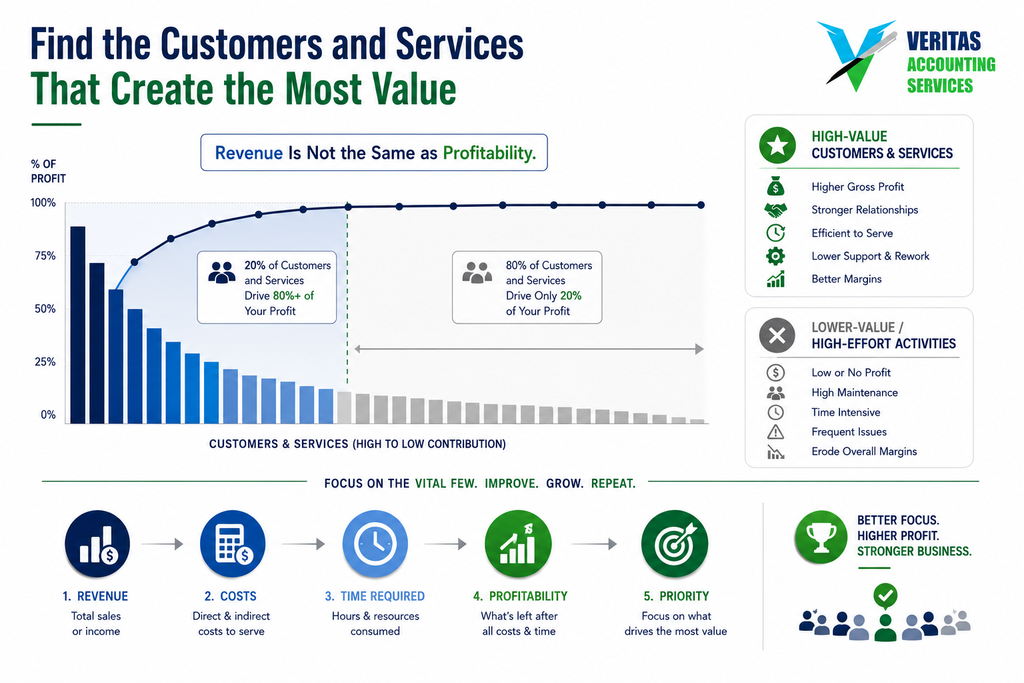
A relatively small number of factors may account for a disproportionately large share of results.
For example, a company might discover that:
- 20% of customers generate 75% of gross profit
- 15% of products generate 70% of sales
- 10% of activities consume 60% of management time
- A small number of recurring problems create most customer complaints
The numbers will differ from business to business.
The value comes from asking a better question:
Which activities, customers, products and decisions create the greatest impact?
Why It Matters to Business Owners
Many businesses try to improve everything at once.
They introduce more products, take on more customers, hold more meetings, add more processes and hire more people.
Growth, however, is not always about doing more.
Sometimes it is about doing more of what works and less of what does not.
The 80/20 rule encourages business owners to look beyond total revenue and examine where the underlying value actually comes from.
A business with $5 million in revenue is not necessarily healthier than one with $3 million.
The more useful questions are:
- Which customers generate the best margins?
- Which services are most profitable?
- Which activities create measurable results?
- Where is management spending its time?
- Which expenses produce meaningful returns?
- Which problems repeatedly consume resources?
The answers can reveal opportunities that are invisible in a traditional top-line revenue report.
Find Your Most Valuable Customers
Revenue alone does not tell you which customers are most valuable.
A customer generating $100,000 in annual revenue may require extensive support, frequent revisions, urgent service, and significant management attention.
Another customer generating $60,000 may be highly profitable, predictable and easy to serve.
That distinction matters.
Use the 80/20 rule to analyze your customer base by:
- Revenue
- Gross profit
- Net contribution
- Service hours
- Payment reliability
- Customer acquisition cost
- Support requirements
- Growth potential
Create a customer profitability report and rank customers from highest to lowest contribution.
You may discover that a relatively small group accounts for most of your profitable business.
That information can influence pricing, service levels, account management and future sales strategy.
It may also reveal customers who generate significant revenue but very little actual profit.
Identify Your Most Profitable Products and Services
The same analysis should be applied to what you sell.
Business owners sometimes continue offering products or services simply because customers have historically purchased them.
But revenue does not automatically equal value.
Analyze each offering based on:
Revenue → Direct Cost → Gross Profit → Delivery Time → Management Effort
Suppose a professional services firm offers five services.
One service produces 30% of total revenue but requires extensive customization and employee hours.
Another produces only 15% of revenue but generates much higher margins with a standardized process.
The second service may deserve more attention.
The 80/20 rule can help management identify which offerings deserve investment and which may need repricing, redesign, automation or discontinuation.
Look at Where Your Time Goes
Time is one of the most valuable resources a business owner has.
Yet it is often the least measured.
For two weeks, track how you spend your working hours.
Divide activities into categories such as:
- Sales
- Customer meetings
- Strategy
- Finance
- Administration
- Employee management
- Problem solving
- Operations
- Business development
Then ask:
Which activities actually create value?
You may discover that a large portion of your week is consumed by activities that could be delegated, automated or outsourced.
At the same time, the activities that could generate the greatest future growth may receive very little attention.
This is one of the most practical applications of the 80/20 rule.
The objective is not to work fewer hours simply for the sake of working fewer hours.
It is to spend more of those hours on activities where your involvement creates the greatest difference.
Identify High-Value Business Activities
Not every task deserves the same level of attention.
Consider a business owner who spends three hours every Monday reviewing routine bookkeeping transactions but only thirty minutes reviewing monthly profitability.
The time allocation may be backwards.
Routine accounting work is important, but it does not necessarily require the owner’s direct involvement.
A management report showing declining margins, increasing customer acquisition costs or deteriorating cash flow may require much more strategic attention.
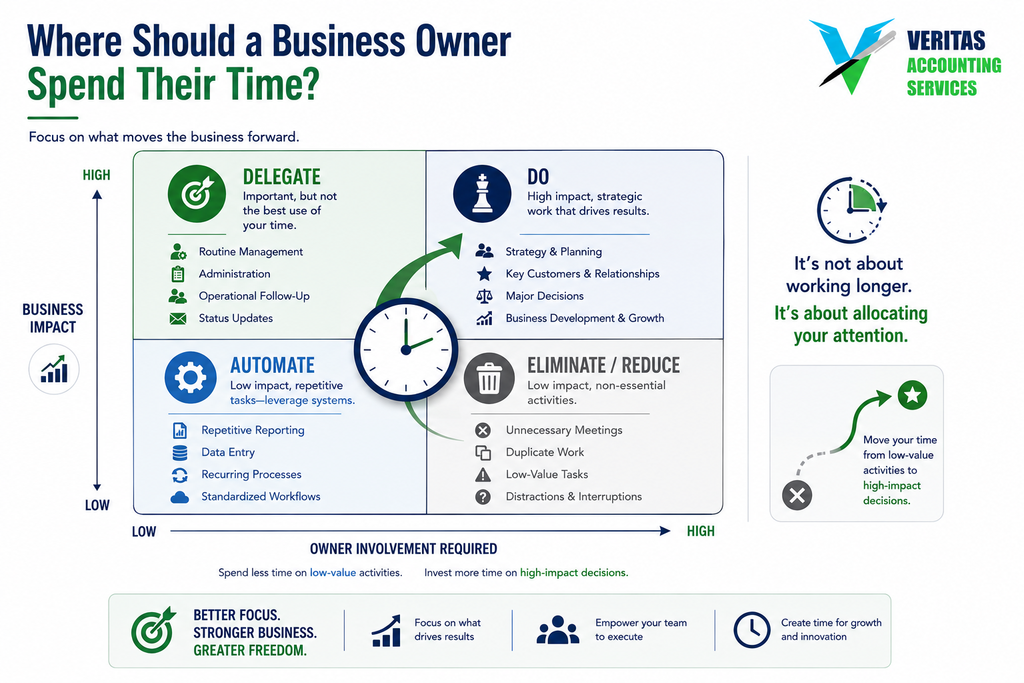
Business owners should therefore separate activities into four categories:
Do
Activities where the owner’s involvement creates significant value.
Delegate
Important work that someone else can perform effectively.
Automate
Repetitive activities that can be handled through technology and established processes.
Eliminate
Activities that add little or no meaningful value.
This simple framework can significantly improve management capacity.
Use Financial Data to Find the Vital Few
Good decisions require good information.
Accounting records are not only useful for tax compliance. They can help management identify where money, time and resources are producing results.
Useful reports include:
- Customer profitability
- Product or service profitability
- Gross margin analysis
- Expense trends
- Accounts receivable aging
- Cash-flow reports
- Budget versus actual
- Department performance
- Revenue by channel
- Customer concentration
The 80/20 rule becomes far more useful when it is supported by reliable financial data.
For example, a business owner may believe that its largest customer is its most valuable customer.
A profitability analysis may tell a different story.
The customer with the highest revenue may also have the highest service costs, lowest margin and slowest payment cycle.
Without proper financial analysis, management may optimize the wrong thing.
Apply the Principle to Employees and Teams
The goal is not to label certain employees as “valuable” and others as “less valuable.”
Instead, examine where the team’s effort produces the greatest business impact.
Some employees may spend considerable time handling repetitive administrative work.
Others may be involved in customer relationships, process improvement, sales, technical delivery or leadership activities that directly influence growth.
Management should ask:
- Which responsibilities have the greatest impact?
- Where are employees spending most of their time?
- Which activities can be standardized?
- Where do employees need additional training?
- Which processes create unnecessary rework?
- Where could technology or outsourcing free employees for higher-value work?
The objective is to improve the productivity of the entire organization, not simply increase everyone’s workload.
Focus on Cash Flow and Financial Resources
Money should also be allocated according to impact.
Businesses frequently have limited capital and must decide where to invest it.
Possible uses include:
- Marketing
- Hiring
- Technology
- Equipment
- Inventory
- Training
- Product development
- Customer acquisition
Instead of spreading resources evenly, compare the expected return from each investment.
For example, if one marketing channel consistently produces profitable customers while another produces large volumes of low-value leads, the company should investigate why.
Likewise, if a particular software system reduces hours of repetitive work every month, its value may be greater than an apparently cheaper alternative.
Financial discipline means understanding not only how much you spend, but what the spending produces.
Avoid the Wrong Use of the 80/20 Rule
The 80/20 rule is a framework for analysis, not a mathematical law that every business must follow exactly.
Do not force every situation into an 80/20 pattern.
There are also activities that may not generate immediate financial returns but remain essential.
Examples include:
- Compliance
- Internal controls
- Cybersecurity
- Employee development
- Financial reporting
- Quality assurance
- Risk management
A task may represent a small percentage of total activity but still be extremely important.
The right question is therefore not:
“Can we eliminate the other 80%?”
It is:
“Which activities deserve more attention, and which can be handled more efficiently?”
That distinction is critical.
How Accounting Professionals Can Help
Business owners cannot make effective 80/20 decisions if their financial information is incomplete or unreliable.
This is where an experienced accounting team can become more than a bookkeeping provider.
A professional team can help transform accounting data into management information.
For example, an outsourced accounting or CFO team can help prepare:
- Customer profitability reports
- Service-line margin analysis
- Cash-flow forecasts
- Budget versus actual reports
- Expense analysis
- Accounts receivable reports
- Management dashboards
- Key performance indicators
This allows business owners to see where resources are actually being consumed and where value is being created.
At Veritas Accounting Services, we support businesses and professional firms with bookkeeping, accounting, financial reporting, tax support, financial projections and CFO-related services.
Our role is not simply to record transactions.
The objective is to provide organized financial information that helps management make better decisions.
For example, if a business owner wants to determine which customers deserve greater attention, the analysis should go beyond revenue.
We can help management consider profitability, collection patterns, service requirements and other relevant financial indicators.
Likewise, when evaluating expenses, management should understand whether spending is supporting growth, protecting the business or simply continuing because it has always existed.
Reliable accounting data gives the 80/20 rule a stronger foundation.
A Practical 80/20 Exercise for Business Owners
Set aside two hours this month and perform a simple analysis.
Step 1: Rank Your Customers
List your top customers by revenue and then by gross profit.
Compare the two rankings.
Step 2: Rank Your Services
Identify which products or services generate the highest margins.
Step 3: Track Your Time
Record your activities for two weeks.
Highlight tasks that require your involvement but could be delegated or outsourced.
Step 4: Review Your Expenses
Identify the largest recurring expenses and determine what business outcome each expense supports.
Step 5: Review Your Decisions
Look at the major decisions made during the last six months.
Which decisions produced measurable results?
Step 6: Take Action
Choose three areas where you can shift more time, money or attention toward activities producing stronger results.
The exercise does not need to produce a perfect 80/20 ratio.
Its purpose is to make the business owner more conscious of where resources are actually creating value.
FAQ
What is the 80/20 rule in business?
The 80/20 rule is the idea that a relatively small proportion of customers, activities, products or resources may generate a disproportionately large share of business results.
How can business owners use the 80/20 rule?
Owners can analyze customers, services, time, employees, expenses and investments to identify where the greatest value is being created and then allocate resources accordingly.
Does the 80/20 rule always mean exactly 80% and 20%?
No. The ratio is a useful principle rather than a fixed mathematical requirement. The actual distribution may be 70/30, 90/10 or another pattern.
Can accounting data help identify the most valuable customers?
Yes. Revenue, gross margin, service costs, payment behavior and customer-level profitability can provide a much clearer picture of customer value than revenue alone.
How can an outsourced accounting team support this approach?
An experienced accounting team can organize financial data and prepare profitability reports, management reports, cash-flow forecasts and other analysis that helps business owners identify where resources are creating the greatest impact.
Conclusion
Business growth does not always require doing more.
Sometimes it requires identifying what matters most and allocating resources accordingly.
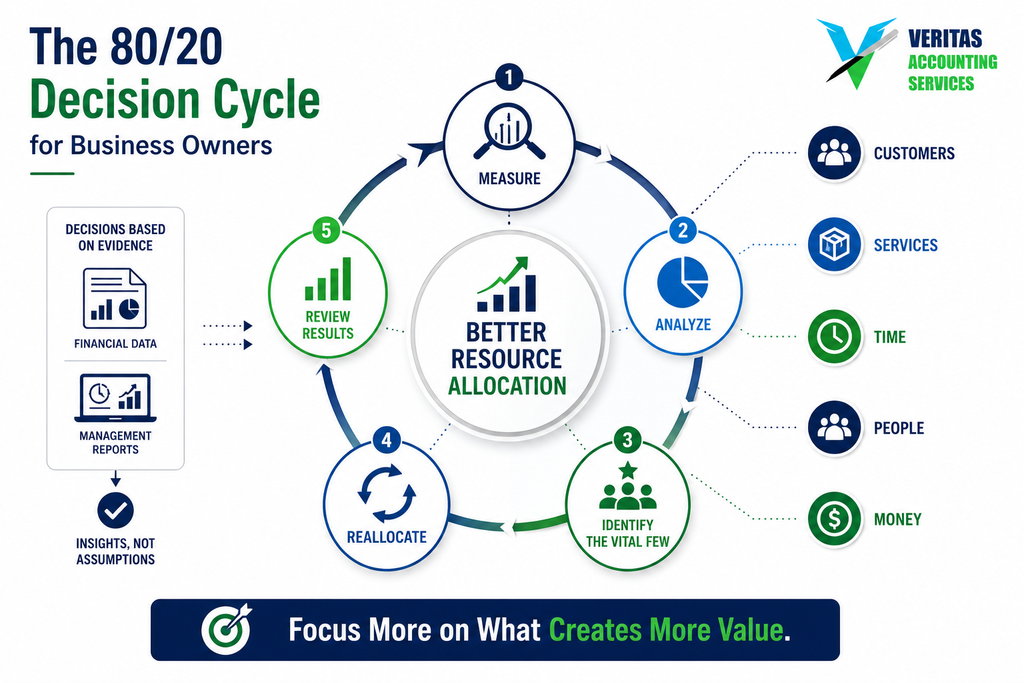
The 80/20 rule gives business owners a practical framework for examining customers, services, time, employees, expenses and investments.
The most important step is to move from assumptions to evidence.
Instead of assuming that the biggest customer is the most profitable, measure profitability.
Instead of assuming that a busy employee is productive, examine outcomes.
Instead of reviewing every expense equally, understand which investments contribute to growth, efficiency or risk reduction.
And instead of spending management time on every operational detail, identify the decisions where leadership involvement creates the greatest value.
At Veritas Accounting Services, we believe accounting should provide more than historical numbers. Well-organized financial information can help business owners understand profitability, cash flow, resource allocation and business performance.
The goal is simple: focus more of your time, money and attention on the activities that genuinely move your business forward.
That is where the real value of the 80/20 rule lies.
GET IN TOUCH
Schedule a FREE Call










Connect on our Socials!
