








Reimbursing Employee Expenses Without Turning Them Into Taxable Pay
An employee pays for a business trip, submits a receipt and asks the company for repayment. It sounds straightforward. Yet the way you approve, document and settle that payment can change its federal payroll treatment. An accountable plan helps qualifying reimbursements stay separate from wages when the arrangement and the employee’s actions satisfy the rules.
For a growing business, this is a practical control issue. Someone needs to establish what was purchased, why it served the business and whether an advance was fully accounted for. A clear process also helps employees recover legitimate costs without leaving finance staff to reconstruct transactions months later.
This guide addresses employee reimbursements under federal rules reviewed in October 2026. It does not assume that every owner is an employee, that every business-related purchase is deductible, or that state rules match federal treatment.
Table of contents
- What an accountable plan actually does
- The three conditions behind qualifying reimbursements
- A $1,200 advance and a $250 decision
- What reasonable timing means
- Five checks to put the policy into practice
- Frequently asked questions
- Conclusion
What an accountable plan actually does
An accountable plan is an employer reimbursement arrangement that ties payments to qualifying employee business expenses, requires timely substantiation and requires employees to return excess amounts. Substantiation means providing enough evidence to explain the expense rather than simply requesting a round-dollar payment.
When the requirements are met, qualifying payments generally are not wages for federal income-tax withholding, Social Security, Medicare or federal unemployment tax purposes. They are not a second salary payment. IRS Publication 15 explains this distinction for employers.
By contrast, a nonaccountable arrangement generally produces taxable wages. Paying a recurring allowance without requiring evidence or a return of excess money can create that result, even when the company calls it an expense payment.
The accountable plan label does not create a deduction for a personal purchase. Nor does it allow an employer to rename an existing salary as reimbursement. Keep reimbursement decisions separate from compensation decisions from the outset.
Corporate owner-employees should review their circumstances with their adviser before applying the process to themselves. Sole proprietors and partners should not assume employee reimbursement treatment applies to their own expenses. Your entity classification matters; our overview of S corporation accounting and taxation provides related context, rather than a substitute for an individual review.
The three conditions behind qualifying reimbursements
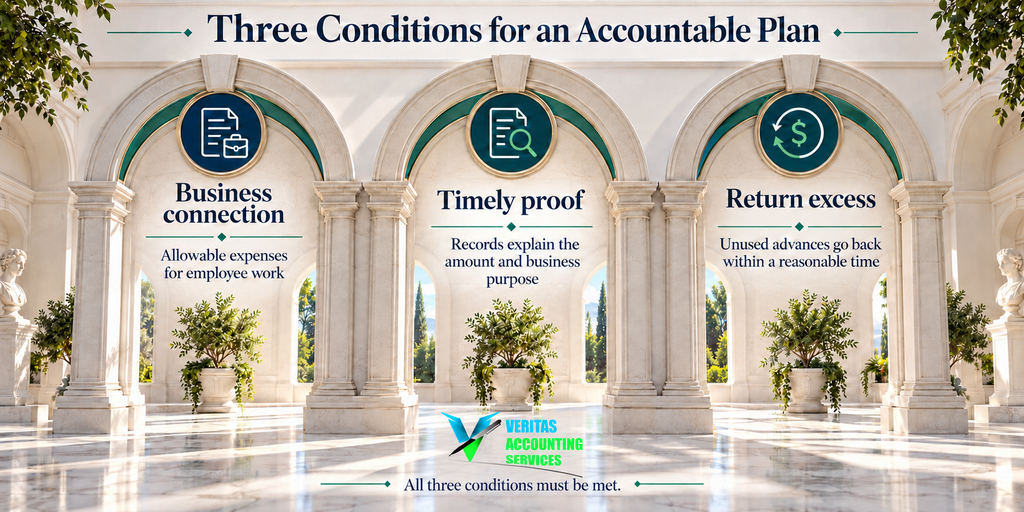
An accountable plan needs all three conditions working together. A folder of receipts is not enough if the business never resolves unused advances.
A genuine business connection
The expense must qualify under the applicable rules and arise from the employee’s work for the employer. A business purpose should be specific enough for another person to understand it. A hotel stay for an identified client meeting is easier to assess than an unexplained entry labeled travel.
Ask additional questions about mixed personal and business spending. Reimbursing an entire family trip because one afternoon involved business is not a sound starting assumption. Expense types can also have their own restrictions, so approval should involve more than spotting a company name on a receipt.
Adequate and timely evidence
Employees must account for their expenses within a reasonable period. Depending on the expense, relevant evidence may include the amount, date, location and business purpose, supported by receipts or other appropriate records.
For an accountable plan, evidence should explain the transaction, not merely confirm that money left an account. A credit-card total may need itemized support and a business explanation. IRS Publication 463 discusses adequate accounting and the records associated with travel and similar expenses.
Returning the excess
If an advance exceeds the amount properly supported, the employee must return the excess within a reasonable period. Treat the advance as something to settle, not something to forget after payment.
This is where the process can break down operationally. The employee may provide valid receipts but keep unused funds. Assigning responsibility for the remaining balance helps prevent that unfinished transaction from becoming a payroll problem.
A $1,200 advance and a $250 decision
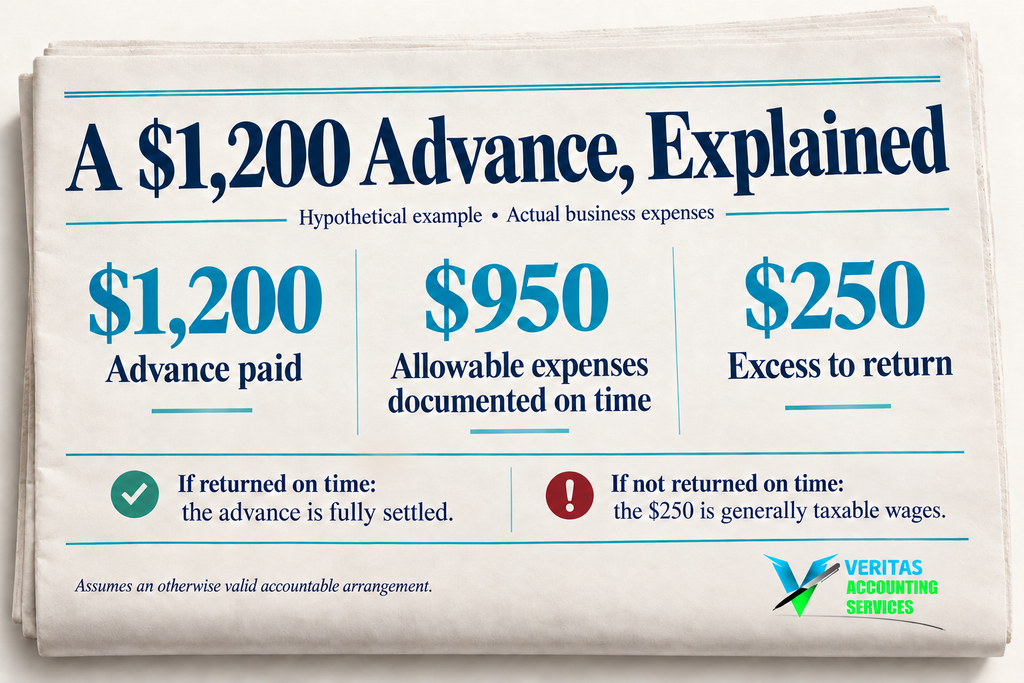
Consider a hypothetical US consulting company with an otherwise valid accountable plan. It advances $1,200 for an employee’s business trip. The employee later substantiates $950 of allowable actual expenses on time. Assume no special per-diem rules apply.
| Item | Amount |
|---|---|
| Business travel advance | $1,200 |
| Allowable expenses substantiated on time | $950 |
| Excess to return | $250 |
The company needs to settle the $250 difference. If it is returned on time, the advance is fully reconciled: $950 supports the business expenses and $250 returns to the company.
If the employee does not return that excess within a reasonable period, the $250 generally becomes taxable wages under these assumptions. It is not automatically tax-free because most of the advance was supported. Conversely, this example does not mean the entire $1,200 necessarily becomes wages merely because that employee leaves $250 unresolved.
The federal reimbursement regulation addresses how unsubstantiated or unreturned amounts are handled. Broader defects in an arrangement, including replacing wages with reimbursements, require a separate analysis.
From a cash-management perspective, the company also needs to know where that $250 sits. A monthly advance register makes the outstanding balance visible instead of burying it in a travel expense account. This makes reimbursement controls easier to administer and gives the bookkeeper a clear item to follow up. Keep that register accessible to the reviewer, bookkeeper and payroll contact throughout settlement.
What reasonable timing means
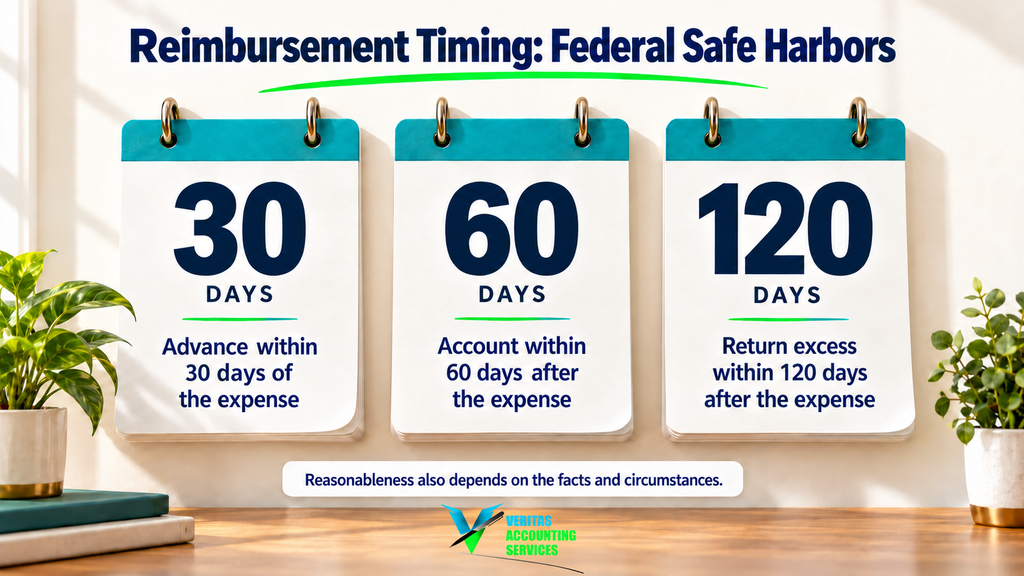
Reasonable timing depends on the facts and circumstances. Federal rules also provide timing safe harbors. Under the fixed-date method, they cover an advance within 30 days of an expense, accounting within 60 days after the expense, and returning excess within 120 days after the expense.
These are reimbursement timing safe harbors, not tax-return filing deadlines. Other approaches, including qualifying periodic statements, can apply. Missing a safe-harbor date needs assessment; do not replace that assessment with an unsupported assumption that every late report has identical consequences.
For an accountable plan, shorter internal submission targets can make the process easier to manage, provided the policy remains consistent with applicable rules. For example, a business might ask employees to submit reports promptly after travel so finance has time to resolve missing details. That is an operational choice, not a new IRS deadline.
IRS Publication 505 also describes expense allowances and reasonable-period rules. Verify current rates separately before using mileage or per-diem methods; the actual-expense example here deliberately does not rely on either rate.
Five checks to put the policy into practice
1. Define what employees can submit
Write down eligible expense types, required approvals and the information needed for review. Be clear about personal costs and mixed-use purchases. A written policy is a practical way to communicate the process, but the paperwork must match what the business actually does.
2. Make evidence easy to follow
Use one report for each trip or claim, attach support and record the business purpose while it is still clear. Ask employees to separate unlike costs rather than aggregate everything under miscellaneous expenses. Our guide to classifying business expenses explains why those distinctions also matter to bookkeeping.
3. Track the open balances
Keep an accountable plan register showing the employee, advance, supported expenses, excess amount and settlement status. Give one person responsibility for reminders. Review unresolved items before they become difficult to reconstruct, rather than waiting for year-end reporting to reveal them.
4. Connect finance and payroll
Decide who tells payroll when a payment needs wage treatment, and keep a record of the decision. An accountable plan should not leave payroll guessing about an unexplained transfer. Bring unusual or overdue cases to your adviser promptly so any required withholding and reporting can be handled correctly.
5. Review the process periodically
Sample a few settled claims, inspect unresolved advances and check whether employees understand the requirements. Compare the written policy with actual practice. An accountable plan that exists only in a document will not fix a process that routinely pays unsupported allowances. Good underlying records also support organized tax preparation.
Frequently asked questions
Does an accountable plan have to be written?
The federal qualification rules focus on the arrangement’s requirements and operation, rather than a universal signed-document requirement. A clear written policy is still a useful control because it tells employees and reviewers what to do. Your adviser can assess any additional documentation or entity-specific needs.
Can I use an accountable plan to replace part of salary?
No. An amount that would otherwise be paid as wages cannot become a qualifying reimbursement simply by changing its label. Keep genuine expense repayment separate from the employee’s compensation entitlement.
Does an accountable plan make every expense deductible?
No. The underlying expense must qualify, and reimbursement treatment does not remove category-specific limitations. A properly reimbursed cost and the employer’s deductible amount are separate questions. Do not assume identical treatment for travel, meals, personal costs and other categories.
Can an employee also deduct the reimbursed cost?
An employee cannot claim the same cost again simply because it appeared on a personal card first. Under an accountable plan, qualifying reimbursement and substantiation should be reconciled together. If a cost remains unreimbursed or a payment was reported incorrectly, ask your adviser to assess the applicable rules rather than assuming a personal deduction is available.
Conclusion
An accountable plan works best when business purpose, evidence and settlement form one connected process. Review the payment from start to finish: what it covered, how it was supported, whether anything remains outstanding and whether payroll needs to act.
Start with a small sample of recent claims. If someone else cannot follow them without a verbal explanation, improve the records and assign the next action. That review can strengthen both reimbursement controls and the reliability of the company’s accounts.
For help reviewing the bookkeeping and tax processes behind employee reimbursements, contact Veritas Accounting Services to discuss your business’s needs.
GET IN TOUCH
Schedule a FREE Call










Connect on our Socials!
