








How AI Is Reshaping Ecommerce—and Why Professionals Matter
Artificial intelligence is changing how people discover products, compare options, make purchases, and interact with online businesses. From personalized recommendations to automated customer support, technology is becoming an important part of modern ecommerce.
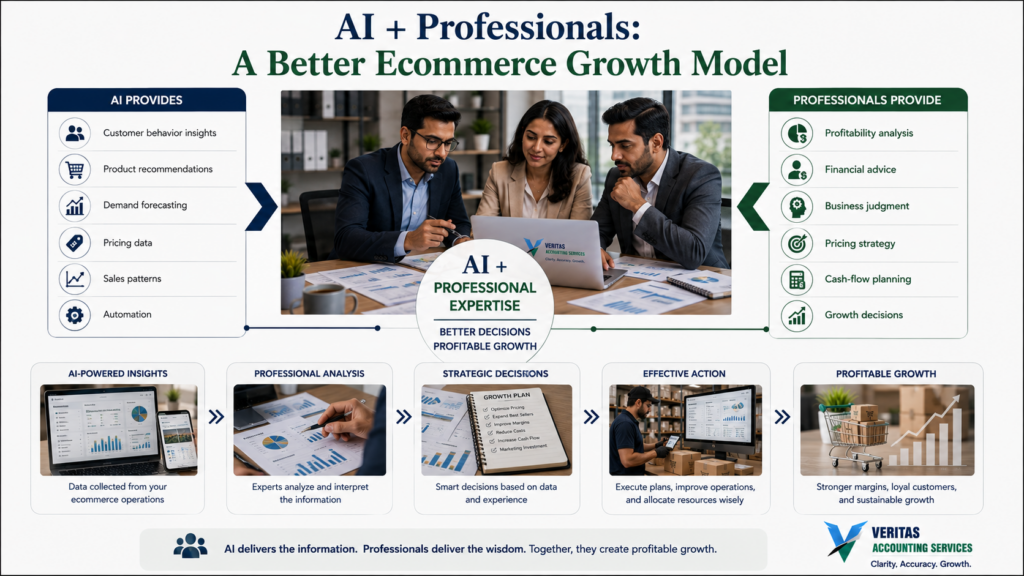
The growth of AI in ecommerce is not simply about adding new technology to an online store. The bigger opportunity is using technology to improve profitability, customer experience, operational efficiency, financial planning, and long-term business growth.
Understanding AI in ecommerce therefore requires more than understanding what AI can do. Businesses also need professionals who can determine where technology creates value, where it creates risk, and how it should be integrated into the broader business strategy.
How AI in Ecommerce Is Changing Online Shopping
Traditional online shopping required customers to search through categories, compare products, read descriptions, and make purchasing decisions largely on their own.
AI in ecommerce is changing this experience.
AI-powered platforms can analyze customer behavior and provide personalized product recommendations, smarter search results, automated assistance, and more relevant shopping experiences.
For example, a customer who frequently purchases office supplies may receive recommendations based on previous purchases, browsing behavior, and related products.
This can make shopping faster and more convenient.
However, businesses should not measure success simply by asking whether AI increased the number of recommendations.
They should ask whether AI in ecommerce is improving conversion rates, average order value, customer satisfaction, retention, and profitable revenue.
That is where professional analysis becomes valuable.
Personalization Can Increase Customer Value
One of the biggest opportunities created by AI in ecommerce is personalization.
Businesses can analyze information such as:
- Previous purchases
- Browsing behavior
- Product preferences
- Search activity
- Customer interactions
- Purchase frequency
- Shopping patterns
This information can help businesses present products that are more relevant to individual customers.
For example, an ecommerce store selling electronics may recognize that a customer who purchased a laptop could also need a laptop bag, docking station, or accessories.
The opportunity is not simply to sell more.
It is to understand customer needs and provide a more useful shopping experience.
Professionals can help businesses determine whether personalization is actually increasing customer value or simply increasing marketing and technology costs.
AI Can Support Better Pricing Decisions
Pricing is another area where AI in ecommerce can influence business decisions.
Businesses can analyze demand, historical sales, competitor activity, customer behavior, and product performance to identify potential pricing opportunities.
However, businesses should be careful about changing prices simply because an algorithm recommends doing so.
A higher price may increase revenue per transaction but reduce sales volume.
A discount may increase order volume but reduce profit margins.
A financial professional can help management evaluate the complete impact.
The important question is not:
“Will this increase sales?”
The better question is:
“Will this improve profitable growth?”
This distinction becomes particularly important when businesses use AI in ecommerce for pricing and promotional decisions.
Better Demand Forecasting and Inventory Management
Inventory is one of the biggest challenges for ecommerce businesses.
Too much inventory can tie up working capital.
Too little inventory can create stockouts, missed sales, and disappointed customers.
AI in ecommerce can help analyze historical sales, seasonal trends, customer behavior, and other available information to improve demand forecasting.
But forecasting is not only an operational issue.
It is also a financial issue.
Finance professionals can help businesses understand how inventory decisions affect:
- Cash flow
- Working capital
- Profit margins
- Storage costs
- Purchasing requirements
- Financing needs
For example, a product may generate strong sales but require substantial working capital.
Another product may have lower sales but significantly higher margins.
AI can identify patterns, while professionals can help management understand what those patterns mean financially.
AI Can Improve Customer Service
Customer service is another area where AI in ecommerce can provide practical benefits.
AI-powered chatbots and virtual assistants can handle many routine customer questions.
They can assist with:
- Product information
- Order status
- Shipping questions
- Returns
- Frequently asked questions
- Basic troubleshooting
This can reduce repetitive work for customer service teams and provide faster responses to customers.
However, businesses should evaluate more than the number of inquiries handled by AI.
They should also measure:
- Customer satisfaction
- Resolution rates
- Employee productivity
- Cost savings
- Customer retention
- Revenue impact
Professionals can help determine whether AI in ecommerce is actually creating measurable business value.
Understanding Customer Behavior Through Data
Modern ecommerce businesses generate enormous amounts of data.
Information can come from:
- Ecommerce platforms
- Payment processors
- Advertising platforms
- Customer relationship systems
- Websites
- Email campaigns
- Social media
AI in ecommerce can help identify patterns within this information.
For example, businesses may discover:
- Which products perform best
- Which customers purchase repeatedly
- Which campaigns generate profitable sales
- Which products are losing demand
- Which customers may stop purchasing
- Which channels produce better returns
But data alone does not create good decisions.
Professionals need to interpret the information and connect it with financial and strategic objectives.
How Professionals Contribute to AI-Driven Ecommerce Growth
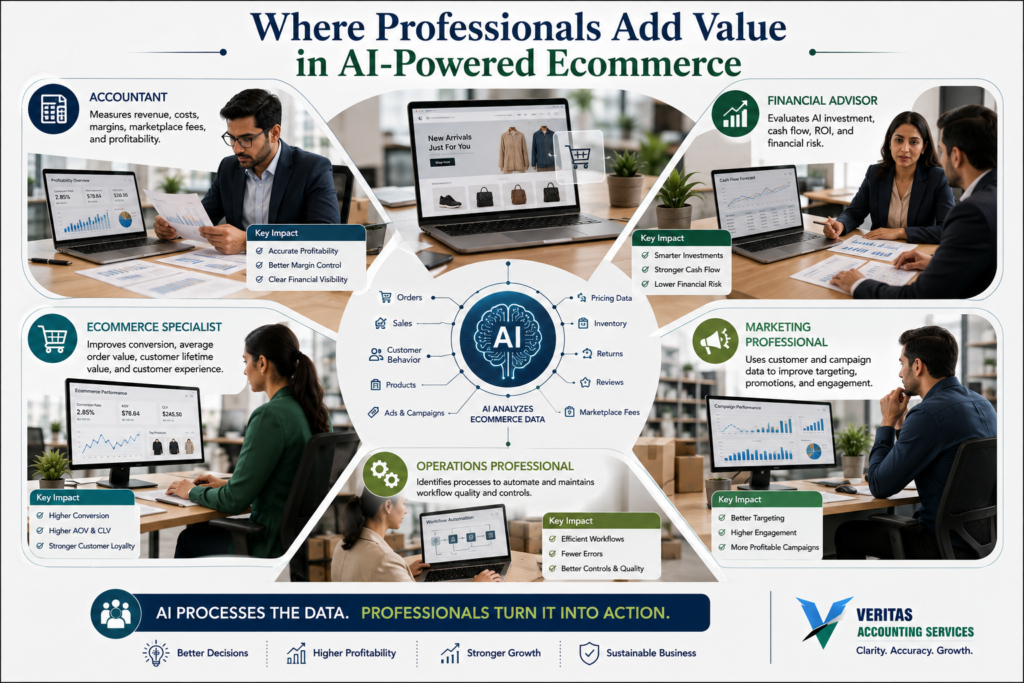
Technology can process information quickly, but professionals bring context, experience, judgment, and accountability.
This combination is where AI in ecommerce becomes much more powerful.
Accountants Help Measure Profitability
An ecommerce business can generate impressive sales and still struggle to produce healthy profits.
Accountants help businesses understand:
- Revenue
- Cost of goods sold
- Gross profit
- Operating expenses
- Marketplace fees
- Advertising costs
- Shipping expenses
- Refunds
- Returns
- Cash flow
This becomes especially important when businesses invest in AI tools.
AI software may reduce labor costs, improve conversion rates, or increase sales, but the business still needs to know whether the overall financial result justifies the investment.
Accounting provides that visibility.
Financial Professionals Help Evaluate AI Investments
The implementation of AI in ecommerce may require investments in software, integration, employee training, consulting, and ongoing subscriptions.
A financial professional can help management evaluate:
- Initial investment
- Expected revenue improvement
- Cost savings
- Payback period
- Return on investment
- Cash flow requirements
- Potential risks
For example, an AI solution might increase sales by 10%, but if implementation costs and operating expenses increase significantly, the actual financial benefit may be much smaller.
Professional financial analysis helps management look beyond headline revenue numbers.
Ecommerce Professionals Improve Commercial Performance
Ecommerce specialists understand the customer journey and commercial performance of an online store.
They can analyze:
- Conversion rates
- Average order value
- Customer acquisition cost
- Repeat purchases
- Customer lifetime value
- Cart abandonment
- Product performance
AI in ecommerce can provide additional insights, but ecommerce professionals help determine which insights should influence the customer experience.
Their role is to connect technology with actual commercial objectives.
Marketing Professionals Turn AI Data Into Action
AI can analyze large amounts of marketing data quickly.
Marketing professionals can use these insights to improve:
- Audience segmentation
- Advertising campaigns
- Email marketing
- Content strategy
- Product positioning
- Promotions
- Customer engagement
For businesses using AI in ecommerce, the professional’s role is to combine technological capabilities with market knowledge and brand strategy.
AI may identify that a particular customer segment responds strongly to a product.
A marketing professional can then determine how to communicate with that audience while protecting the company’s brand and profitability.
Operations Professionals Make AI Practical
AI implementation can fail when businesses focus on technology without redesigning their processes.
Operations professionals can help determine:
- Which tasks should be automated
- Which processes need human review
- Where employees should use AI
- How workflows should change
- How quality should be monitored
- How different systems should connect
The goal should not be to automate everything.
The goal should be to remove unnecessary manual work while maintaining quality and control.
This makes professional oversight an important part of successful AI in ecommerce implementation.
AI Should Support Judgment, Not Replace It
One of the biggest risks businesses face is assuming that an AI-generated recommendation must be correct.
AI depends heavily on the quality of the data and assumptions behind the analysis.
Poor data can produce poor recommendations.
Incomplete information can create misleading conclusions.
Professionals can challenge AI-generated results by asking:
- Is the data reliable?
- Are the assumptions reasonable?
- What information is missing?
- What risks have been overlooked?
- What happens under a different scenario?
- Does the recommendation make financial sense?
This human review remains important even as AI in ecommerce becomes more capable.
The Financial Side of AI Adoption
Before implementing AI in ecommerce, businesses should evaluate the complete financial picture.
Initial Costs
Consider software, implementation, integration, consulting, and employee training.
Ongoing Costs
Include subscriptions, maintenance, support, data storage, and system upgrades.
Productivity Gains
Measure how much employee time can actually be saved.
Revenue Opportunities
Evaluate potential improvements in conversion, average order value, repeat purchases, and customer retention.
Cost Reduction
Identify whether AI can reduce repetitive work, errors, or operating expenses.
Risk Reduction
Consider whether better forecasting, controls, and data analysis can reduce financial and operational risk.
A professional can help bring these factors together and determine whether the investment is justified.
AI in Ecommerce and Better Decision-Making
The strongest opportunity is not choosing between AI and professionals.
It is combining both.
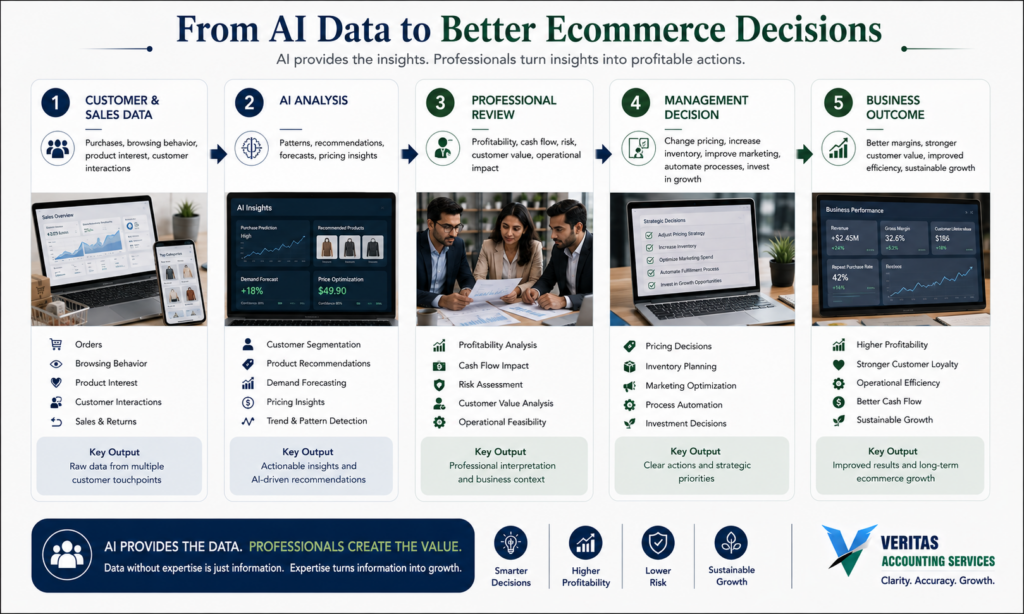
Think of the relationship this way:
AI → Processes information
Professionals → Interpret information
Management → Makes decisions
Business → Takes action
AI can make analysis faster and more scalable.
Professionals can make that analysis more meaningful.
Management can then use the combined information to decide where to invest, what to change, and how to grow.
This is the real business opportunity behind AI in ecommerce.
Start With Business Problems, Not Technology
Businesses do not need to implement every AI solution available.
Instead, begin with specific business problems.
Ask:
- Where are we losing time?
- Where are customers experiencing friction?
- Which processes are repetitive?
- Where do we lack useful information?
- Which products generate the strongest margins?
- Where could better forecasting help?
- Which decisions require better financial analysis?
Then determine whether AI in ecommerce can provide a practical solution.
This prevents technology from becoming the objective.
The objective should always be better business performance.
The Future of Ecommerce Will Be More Intelligent
Online shopping will continue to become more personalized, automated, and data-driven.
Customers will expect:
- Faster answers
- Better recommendations
- Easier purchasing
- More personalized experiences
- Faster service
Businesses will therefore need to adapt.
But successful adaptation does not mean adopting every new technology.
Companies need to understand profitability, processes, controls, customer behavior, and strategy before making major investments in AI in ecommerce.
That is why professional expertise continues to matter.
The Competitive Advantage of Combining AI and Expertise
AI can provide speed and scale.
Professionals provide experience and judgment.
Together, they can help ecommerce businesses:
- Improve profitability
- Understand customer value
- Reduce unnecessary costs
- Forecast demand
- Improve cash flow
- Make better pricing decisions
- Strengthen operations
- Evaluate investments
- Identify new growth opportunities
When AI in ecommerce is combined with the right professional expertise, technology becomes more than an automation tool.
It becomes a business decision-support system.
Final Thoughts
AI is reshaping ecommerce, but technology alone does not create sustainable growth.
The real advantage comes from combining AI capabilities with professional expertise.
Accountants can measure profitability.
Financial professionals can evaluate investments and cash flow.
Ecommerce professionals can improve customer value and commercial performance.
Marketing professionals can turn data into stronger campaigns.
Operations professionals can create more efficient workflows.
Business advisors can connect these areas to strategic decisions.
AI in ecommerce can provide speed, scale, and information.
Professionals provide context, judgment, and accountability.
Together, they can help ecommerce businesses move from simply adopting AI to using it intelligently for profitable growth.
The future of ecommerce is not AI versus professionals.
It is AI working with professionals to make better business decisions.
Frequently Asked Questions
How is AI in ecommerce changing online shopping?
AI in ecommerce is changing product recommendations, search, customer service, pricing analysis, demand forecasting, and personalization.
Can AI in ecommerce improve profitability?
Yes. AI can help identify opportunities involving pricing, inventory, marketing, customer value, and operational efficiency. Professionals should evaluate whether those improvements actually increase profitability.
Why do ecommerce businesses need accountants?
Accountants help businesses understand revenue, costs, margins, marketplace fees, cash flow, and overall financial performance. This information is essential when evaluating AI investments.
Should every ecommerce business invest heavily in AI?
No. Businesses should first identify specific problems and determine whether an AI solution can provide enough value to justify its cost and complexity.
How can professionals work with AI?
Professionals can use AI to analyze information faster while applying human judgment to evaluate results, identify risks, and make practical business recommendations.
GET IN TOUCH
Schedule a FREE Call










Connect on our Socials!
