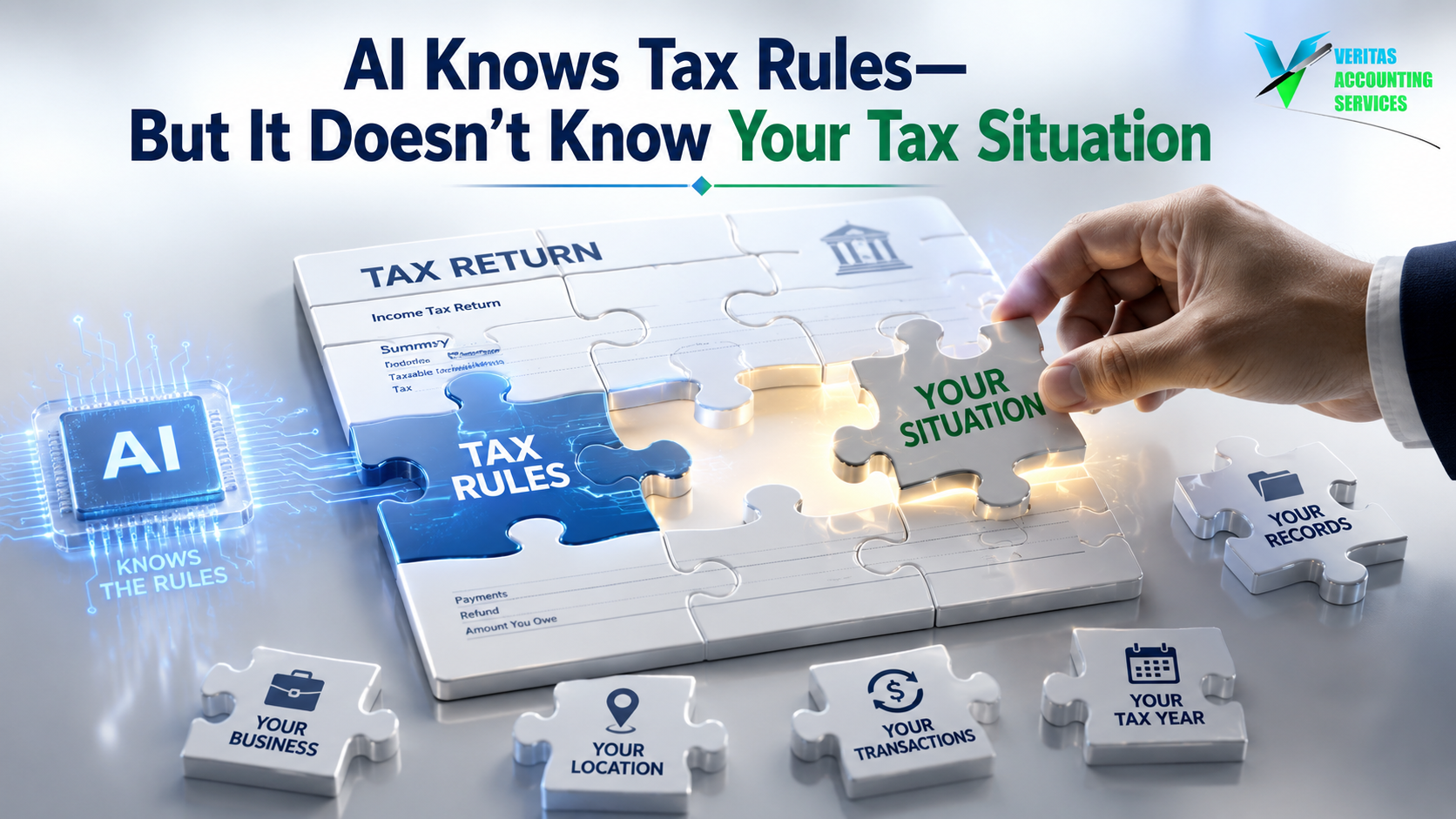
AI Knows Tax Rules—But It Doesn’t Know Your Tax Situation
Artificial intelligence can answer a tax question in seconds.
Ask whether an expense is deductible, how depreciation works, whether your business may need to collect sales tax, or what a complicated tax term means, and an AI tool can often provide a detailed explanation almost instantly.
That is impressive—and genuinely useful.
But there is a major difference between receiving general tax information and receiving advice that is appropriate for your specific circumstances.
AI tax advice can explain concepts, summarize general rules, help business owners understand terminology, and identify questions worth discussing with an accountant or tax professional. What it cannot safely assume is that a general tax rule applies exactly to your situation.
Tax outcomes depend heavily on context.
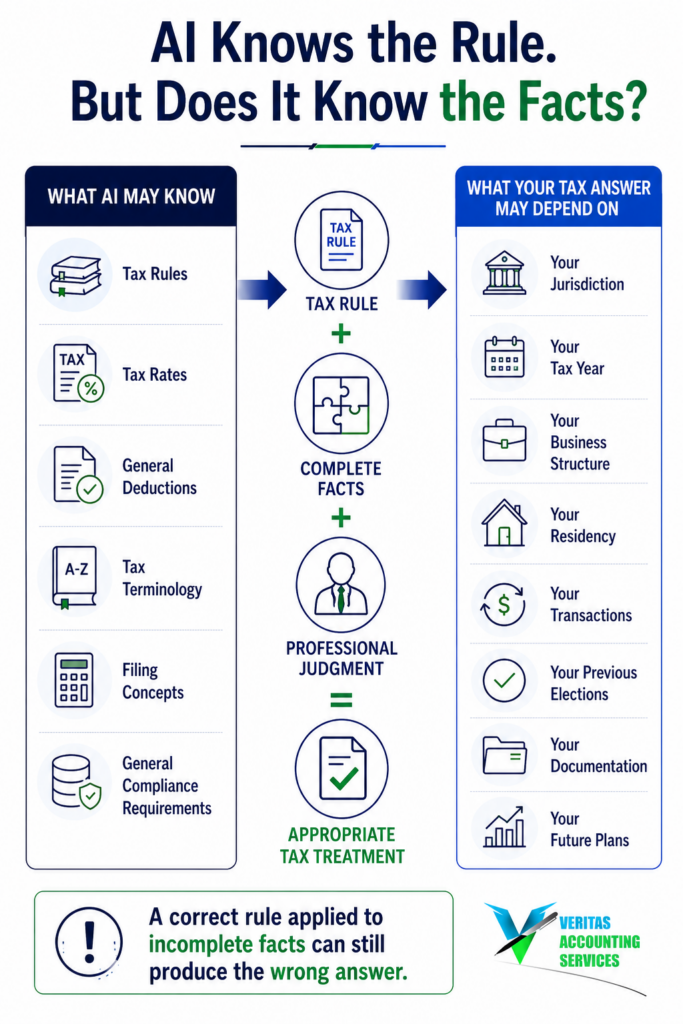
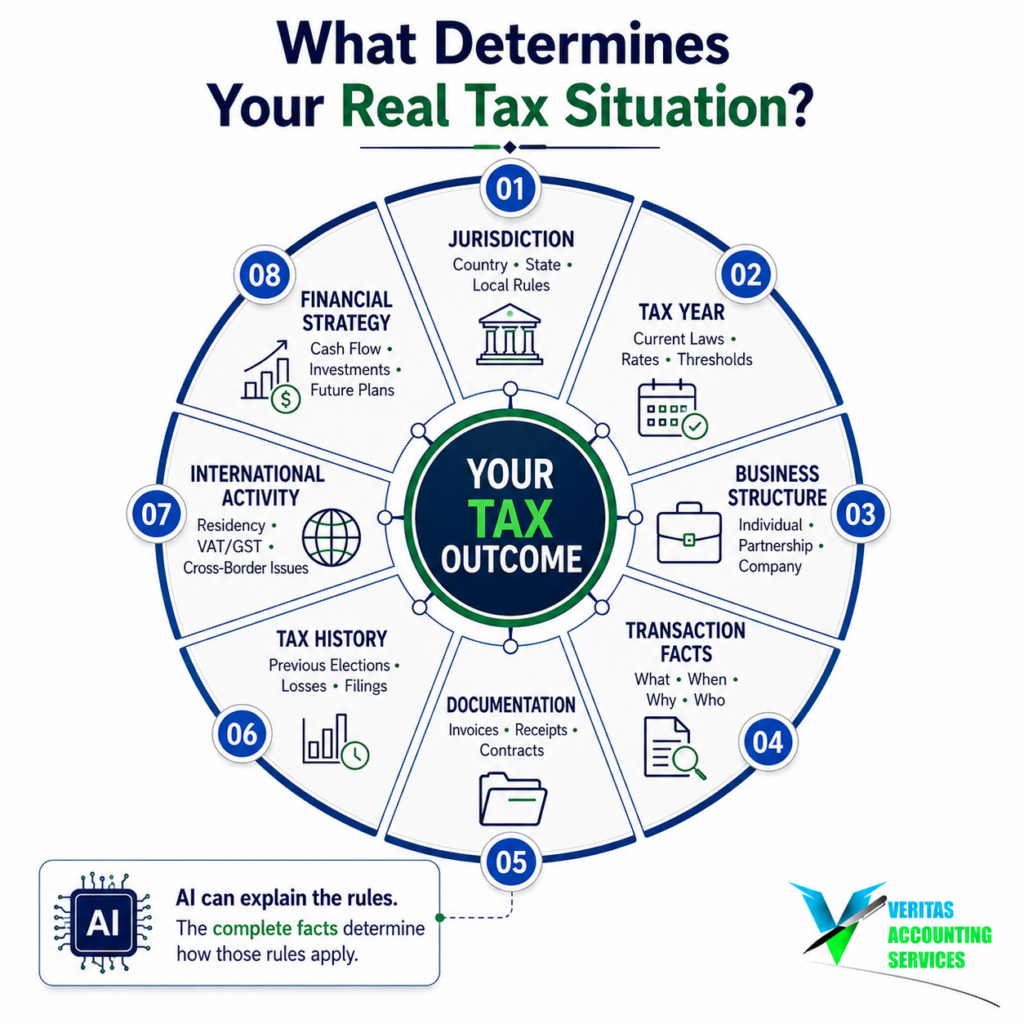
Your country. Your state or region. Your tax residency. Your business structure. Your income. Your transaction history. Your documentation. Your previous elections. Your filing status. The applicable tax year.
Sometimes one seemingly minor fact can completely change the answer.
That is why the biggest risk with AI and taxes is not necessarily that artificial intelligence knows nothing about taxation.
The bigger risk is that the answer can sound completely reasonable even when an important part of your situation is missing.
Before relying on AI tax advice for an important financial decision, business owners need to understand where technology is helpful—and where professional judgment still matters.
AI Tax Advice Is Very Good at Explaining Tax Concepts
Let’s start with what AI can do well.
Artificial intelligence can be an excellent educational tool.
For example, it can help explain:
The difference between a tax deduction and a tax credit
How depreciation generally works
What VAT or GST means
The basic concept of permanent establishment
Differences between common business structures
What estimated taxes are
Basic bookkeeping and accounting terminology
Questions to prepare before meeting your accountant
This can make complicated financial topics much easier for business owners to understand.
Used correctly, AI tax advice can help you become a better-informed client. You can understand the basic terminology before meeting your accountant and spend more time discussing how the rules actually apply to your business.
The problem begins when general information is treated as the final answer for a specific transaction.
Tax rules rarely operate in isolation.
Veritas Expert Insight
AI can help you understand a tax rule. Applying that rule correctly requires understanding the taxpayer, transaction, jurisdiction, timing, documentation, and surrounding facts.
1. AI Doesn’t Automatically Know Your Complete Tax Situation
Suppose you ask:
“Can I deduct this business expense?”
You may expect a simple yes-or-no answer.
But a tax professional may first ask several questions.
What was purchased?
Why was it purchased?
Who used it?
Was there any personal use?
Which business or individual paid for it?
When was it purchased?
Was it capital or revenue in nature?
Do you have supporting documentation?
Which country’s tax rules apply?
The answer can change depending on those facts.
AI tax advice is only as useful as the information and context available to the system. The difficulty is that business owners do not always know which details are important enough to mention.
You might provide what appears to be a complete explanation while unintentionally leaving out the one fact that changes the tax treatment.
This is one reason professional experience matters.
A good tax professional does not simply answer questions.
They ask questions first.
The quality of AI tax advice therefore depends not only on what the technology knows, but also on whether the person asking the question has supplied all the facts needed to reach a meaningful conclusion.
2. Tax Rules Depend on Where You Are
There is no single global tax system.
A business operating in the United States may face federal, state, and sometimes local tax requirements.
A UK business may need to consider corporation tax, VAT, PAYE, and other applicable requirements.
A company operating internationally may encounter several tax systems simultaneously.
Even a seemingly simple question can therefore produce different answers depending on location.
Consider:
“Do I need to charge tax on this sale?”
The answer may depend on:
Seller location
Customer location
Product or service
Customer type
Sales volume
Marketplace involvement
Registration status
Applicable thresholds
Local rules
For international businesses, AI tax advice becomes particularly sensitive to jurisdiction because a single transaction may involve more than one country.
A technically correct explanation based on one jurisdiction could be completely inappropriate for a business operating somewhere else.
Before acting on tax information, identify exactly which country’s—and, where applicable, which state or regional—rules apply.
3. The Tax Year Matters More Than You Think
Tax laws change.
Rates change.
Thresholds change.
Credits can be introduced or expire.
Temporary provisions may disappear.
Filing procedures can change.
New legislation can affect how existing rules operate.
An answer that was correct for one tax year may not necessarily be correct for another.
This creates another important limitation when relying on AI tax advice.
Imagine an AI tool correctly explains a deduction based on rules that applied previously. The response may sound professional and convincing, but if the law has subsequently changed, relying on that answer could lead to the wrong tax treatment.
Always identify the relevant tax year.
For important decisions, AI tax advice should also be checked against current guidance from the appropriate tax authority or another authoritative source.
This matters particularly when you are reading older online discussions, archived guidance, or articles that do not clearly identify the period to which the information relates.
In tax, an outdated answer can be just as problematic as an incorrect one.
4. Your Business Structure Can Completely Change the Answer
Two business owners can generate exactly the same amount of profit and still have very different tax situations.
Why?
Because structure matters.
A sole proprietor, partnership, corporation, LLC, limited company, or another type of entity may be subject to different rules depending on the jurisdiction.
Business structure can affect:
How profits are taxed
How owners receive compensation
Which tax returns are required
How losses are treated
Payroll obligations
Distribution treatment
Available elections
Compliance responsibilities
Reporting requirements
Consider someone asking:
“How much tax will I pay on $200,000 of business profit?”
There may simply not be enough information to provide a meaningful answer.
Which entity earned the profit?
Where is the business located?
Where does the owner live?
How is the owner compensated?
Does the owner have other income?
Are there applicable deductions, credits, losses, or elections?
Reliable AI tax advice requires much more context than a single revenue or profit number.
A professional advisor will normally establish the relevant structure and surrounding circumstances before attempting to calculate or explain the tax consequences.
5. AI May Miss the Importance of One Small Detail
Tax professionals learn to ask questions because small facts can have significant consequences.
Imagine a business owner says:
“I sold a property.”
That sounds straightforward.
But an advisor may need to know:
Was it personally owned or owned by a business?
Was it used in the business?
Was it rented?
How long was it held?
What was the original cost?
Were improvements made?
Was depreciation previously claimed?
Were there selling costs?
Were insurance proceeds involved?
Was there debt attached?
Was the property located in another jurisdiction?
The answers can materially influence the analysis.
The same principle applies to business vehicles, equipment, investments, employee benefits, owner distributions, international transactions, and many other areas.
AI tax advice can produce an answer based on the information supplied. The difficulty is recognizing which information has not been supplied.
Sometimes the most valuable part of professional tax advice is not immediately giving an answer.
It is knowing which questions must be answered first.
6. AI Cannot Create Missing Documentation
Tax compliance does not depend only on understanding rules.
It also depends on evidence.
A business may have incurred a legitimate expense, but that does not mean documentation becomes irrelevant.
Depending on the transaction and applicable requirements, businesses may need to maintain:
Invoices
Receipts
Contracts
Mileage records
Payroll documents
Bank statements
Asset records
Loan documents
Transaction records
Other supporting evidence
AI can remind you that documentation may be necessary.
It cannot make missing evidence exist.
This is another practical limitation of AI tax advice.
Good bookkeeping and record keeping remain essential because the quality of your financial records directly affects the quality of your tax reporting.
If hundreds of transactions have been incorrectly categorized during the year, asking an AI tool about deductions at year-end does not repair the underlying accounting records.
Technology can help organize information.
It cannot retroactively create reliable documentation for transactions that were never properly recorded or supported.
7. Tax Planning Requires More Than Finding Deductions
Ask AI how to reduce business taxes and you may receive a long list of potential ideas.
Buy equipment.
Contribute to retirement plans.
Accelerate certain expenses.
Defer income.
Review your business structure.
Consider available credits.
Some suggestions may be worth exploring.
But good tax planning should never be reduced to collecting as many deductions as possible.
A decision that reduces taxes could create a cash flow problem.
An asset purchase may generate a tax benefit but still be a poor business investment.
Changing a business structure may affect payroll, compliance, administration, financing, and future exit planning.
Deferring income may or may not make sense depending on what management expects next year.
This is where AI tax advice needs to be combined with financial judgment.
Good tax planning considers the wider financial picture, including:
Current cash flow
Future profitability
Business structure
Capital requirements
Investment plans
Owner objectives
Financing requirements
Expected future tax position
The objective is not simply to achieve the smallest possible tax bill this year.
The objective is to make financially sound decisions while managing tax efficiently and complying with applicable law.
AI tax advice may identify potential strategies, but deciding whether those strategies make sense requires understanding the entire financial situation.
8. Cross-Border Tax Makes Context Even More Important
International business adds another layer of complexity.
A company may be incorporated in one country, managed from another, employ people in a third, sell to customers in several others, and process payments through international platforms.
Now a seemingly simple tax question may involve:
Corporate residency
Permanent establishment
Withholding tax
VAT or GST
Sales tax
Transfer pricing
Tax treaties
Foreign tax credits
Payroll obligations
Intercompany transactions
AI can help explain each of these concepts individually.
Applying them to an actual international business can be considerably more complicated.
For cross-border businesses, AI tax advice should therefore be treated as a starting point for investigation rather than the final conclusion.
For example, imagine an online business asking whether selling to customers in another country creates a tax obligation.
The answer may depend on what is being sold, how it is delivered, where employees are located, whether inventory is stored locally, the type of customer, sales volume, and the rules of the countries involved.
There may not be one universal answer.
This is an area where AI tax advice can help businesses understand the questions involved, but jurisdiction-specific professional advice may still be necessary.
9. A Confident Answer Is Not the Same as a Correct Answer
This may be the most important point in the entire discussion.
People naturally associate confidence with expertise.
If an answer is detailed, organized, professionally written, and filled with technical terminology, it feels authoritative.
But presentation does not prove accuracy.
An AI system may misunderstand a question, overlook an exception, work with incomplete context, or provide information that needs to be verified against current guidance.
The danger becomes greater when the person asking the question does not know enough about taxation to recognize what might be missing.
When evaluating AI tax advice, distinguish between these two statements:
“Here is a general explanation of how this tax rule works.”
and:
“This is definitely how the rule applies to my tax return.”
Those are very different conclusions.
The first can be extremely useful.
The second may require significantly more information, documentation, research, and professional judgment.
Never assume that confidence of presentation guarantees correctness of conclusion.
10. AI Should Support Your Tax Professional, Not Replace Judgment
The strongest use of artificial intelligence in taxation may not be replacing accountants.
It may be helping accountants and clients work more efficiently.
AI can potentially assist with:
Research preparation
Summarizing documents
Organizing information
Identifying questions
Explaining terminology
Reviewing large datasets
Drafting routine communications
Improving administrative workflows
That can allow tax professionals to spend more time on areas requiring experience, analysis, and judgment.
Similarly, business owners can use AI tax advice to educate themselves before speaking with an advisor.
Instead of spending part of a meeting asking what depreciation means, for example, the business owner can arrive understanding the basic concept and use the meeting to discuss how depreciation applies to a particular asset and business situation.
That creates a much more productive relationship between technology and professional expertise.
AI handles information efficiently.
Professionals provide context, judgment, interpretation, and accountability.
A Better Way to Use AI Tax Advice
AI does not need to be avoided.
It needs to be used appropriately.
If you use AI for tax research, consider following this process.
1. Specify the Jurisdiction
Identify the country and, where relevant, the state, province, or region.
Do not simply ask:
“Is this deductible?”
Instead, explain where the taxpayer and business are located.
2. Specify the Tax Year
Do not assume that the same rule applies every year.
State the year clearly when asking the question.
3. Explain the Entity Structure
State whether the business operates as a sole proprietorship, partnership, corporation, LLC, limited company, or another structure.
4. Provide the Important Transaction Facts
Explain what actually happened rather than asking only a broad theoretical question.
5. Ask What Information Is Missing
One of the most useful questions you can ask is:
“What additional facts could change this answer?”
This can expose assumptions that were not obvious in the initial response.
6. Verify Important Information
AI tax advice should not be the only source used for a material decision.
Check significant conclusions against current guidance from the relevant tax authority or another authoritative source.
7. Confirm Significant Decisions Professionally
Before making material tax elections, restructuring a business, entering a major transaction, or filing a complicated position, consider obtaining professional advice appropriate to your circumstances.
AI tax advice becomes much more useful when it forms part of this process rather than becoming the entire process.
Use AI to understand.
Use authoritative information to verify.
Use professional judgment to decide.
What AI Cannot Know Unless You Tell It
There is another practical issue business owners should remember.
Artificial intelligence does not automatically know everything happening inside your business.
It may not know that:
You changed your business structure during the year.
An asset was partly used personally.
An owner took distributions.
A previous tax election was made.
You have operations in another state or country.
An employee works remotely from another jurisdiction.
You received income through another entity.
A transaction involved a related party.
Documentation is incomplete.
Your future business plans affect today’s decision.
Each of these details could potentially matter.
This is why personalized tax work usually begins by gathering information.
The quality of AI tax advice depends heavily on the quality and completeness of the facts provided.
If the facts are incomplete, the answer may also be incomplete—even when it sounds convincing.
AI Tax Advice Cannot See the Full Financial Picture
Tax decisions often interact with other areas of business finance.
Imagine an AI tool suggests purchasing equipment before year-end because a tax deduction may be available.
From a tax perspective, that might be worth considering.
But what if the company has limited cash?
What if it needs that cash to fund payroll in January?
What if the equipment is not actually required for another 18 months?
What if financing the purchase creates additional financial pressure?
A tax strategy should not be evaluated independently from the business itself.
Cash flow, profitability, debt, working capital, investment requirements, and future plans all matter.
This is another reason AI tax advice works best as part of a broader financial decision-making process.
Saving $20,000 in tax by making an unnecessary $100,000 expenditure does not automatically make the expenditure a good business decision.
Tax efficiency matters.
So does economic reality.
AI Tax Advice Still Needs Reliable Accounting Data
There is another issue that is sometimes overlooked.
Tax advice is only as good as the financial information behind it.
Suppose your accounting records contain:
Duplicate transactions
Unreconciled bank accounts
Incorrect loan balances
Personal expenses recorded as business expenses
Missing fixed assets
Incorrect payroll entries
Unrecorded liabilities
Even an excellent tax analysis based on those numbers could produce the wrong conclusion.
Before relying heavily on AI tax advice or professional tax planning, businesses should make sure their underlying bookkeeping is accurate.
This is why bookkeeping, accounting, and tax planning should not operate as completely separate functions.
Reliable financial statements support better tax planning.
And better information leads to better decisions.
AI + Accountant Is Stronger Than AI vs. Accountant
The conversation around artificial intelligence is often framed incorrectly.
People ask:
“Will AI replace accountants?”
A better question is:
“How can accountants and businesses use AI more effectively?”
An experienced professional using modern technology can potentially work faster, analyze more information, automate repetitive processes, and spend more time on higher-value advisory work.
Business owners benefit too.
They gain faster access to information while still having professional expertise available for complex decisions.
AI tax advice can therefore be valuable without becoming the final authority on every tax question.
Technology and professionals perform different roles.
AI can help retrieve, summarize, explain, and organize information.
A tax professional can evaluate facts, recognize exceptions, consider competing rules, ask follow-up questions, and apply professional judgment.
The combination can be considerably more powerful than treating the discussion as AI versus accountants.
Final Thoughts
Artificial intelligence is transforming accounting and taxation.
Businesses should not ignore it.
Used properly, AI can make tax information easier to understand, help business owners research unfamiliar concepts, improve administrative efficiency, and support professionals with routine work.
But taxes are highly dependent on facts.
Your location matters.
Your entity matters.
Your tax year matters.
Your documentation matters.
Your transactions matter.
Your previous decisions matter.
And your future plans may matter too.
That is why AI tax advice should be treated as a powerful information and research tool—not an automatic replacement for personalized professional advice.
AI tax advice can help you understand possibilities, identify questions, and prepare for a more productive conversation with your advisor. But important tax positions should still be evaluated using complete facts, current rules, reliable financial records, and appropriate professional judgment.
At Veritas Accounting Services, we believe technology works best when combined with accurate financial records, professional experience, and informed judgment.
The future of accounting and tax will undoubtedly involve more artificial intelligence.
But knowing the tax rule is only the beginning.
Knowing how that rule applies to your situation is where context and professional judgment still matter.
Frequently Asked Questions
Is AI tax advice reliable?
AI tax advice can be useful for understanding general tax concepts, but reliability depends on the accuracy and completeness of the information provided, the applicable jurisdiction, the tax year, and the complexity of the issue. Important conclusions should be verified against current authoritative guidance and, where appropriate, with a qualified professional.
Can I use AI instead of a tax accountant?
AI can help explain tax terminology, summarize general concepts, and prepare questions. However, it does not automatically have your complete financial history, documentation, previous elections, business objectives, or all the jurisdiction-specific facts required for every tax decision.
Can AI tax advice help with tax planning?
Yes. AI tax advice can help explain potential planning concepts and identify areas worth reviewing. However, an actual tax strategy should consider cash flow, business structure, financial objectives, applicable law, documentation, and the taxpayer’s complete circumstances.
Why can AI give the wrong tax answer?
An answer may be unreliable when information is incomplete, the wrong jurisdiction or tax year is assumed, an exception applies, the question is misunderstood, or current rules have not been adequately verified. AI tax advice should therefore be checked before being used for a significant decision.
What is the safest way to use AI for taxes?
Use AI tax advice for education, preliminary research, understanding terminology, and preparing better questions. Verify important information using current authoritative sources and obtain professional advice when a decision could have significant tax or financial consequences.
Using AI for Tax Questions? Use It Wisely.
AI can give you information in seconds.
But your tax situation is much more than a question entered into a prompt.
AI tax advice is most valuable when it helps you understand the issue, identify the right questions, and prepare for a better financial or tax decision—not when it is treated as unquestionable personalized advice.
Veritas Accounting Services combines technology with bookkeeping, accounting, tax support, and financial expertise to help businesses understand their numbers and make informed decisions.
Use AI to ask better questions. Use reliable information and professional judgment to make better decisions.