





Accounting Automation vs Outsourced Accounting: Which Saves More Money?
- Why Businesses Are Rethinking Their Finance Function
- What Accounting Automation Can Do Well
- Where Accounting Automation Falls Short
- What Outsourced Accounting Brings to the Table
- Comparing the Real Cost
- Which Option Is Best for Different Businesses?
- Why the Best Solution Isn’t Automation or Outsourcing
- Common Mistakes Businesses Make
- Frequently Asked Questions
- Conclusion
Why Businesses Are Rethinking Their Finance Function
Businesses today have more choices than ever when managing their accounting operations.
Cloud software, artificial intelligence, automated bookkeeping tools, and outsourced accounting services have transformed how financial work gets done.
As costs continue rising and finance teams are expected to deliver faster insights, many business owners ask the same question:
Should we automate our accounting, outsource it, or do both?
The answer isn’t always obvious.
While automation can reduce repetitive work, it cannot replace professional judgment. Likewise, outsourcing without modern technology may not deliver maximum efficiency.
Understanding how these two approaches complement each other is the key to making the right financial decision.
What Accounting Automation Can Do Well
Modern accounting software has dramatically reduced manual work.
Many routine accounting tasks can now be completed automatically.
These include:
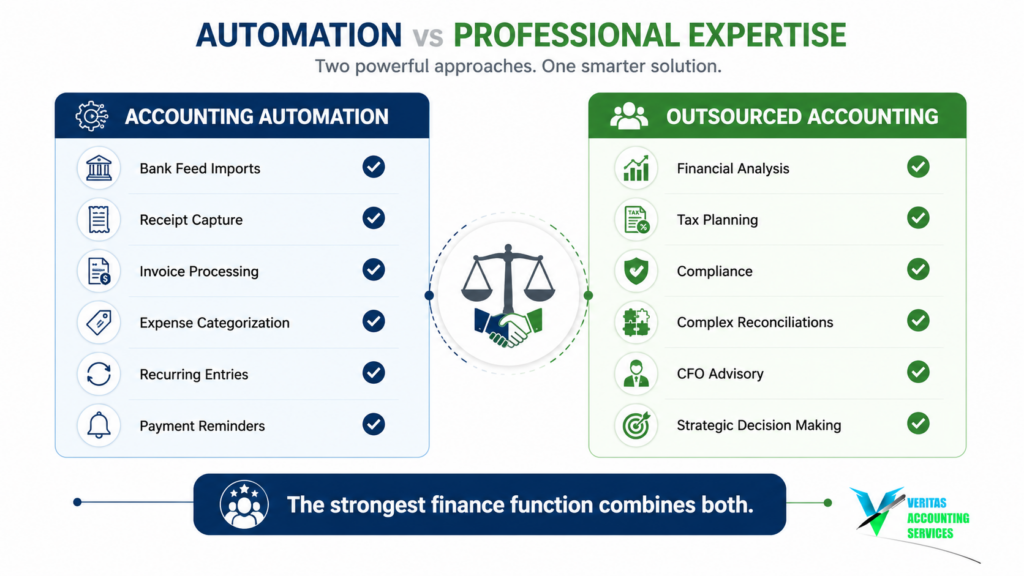
- Bank feed imports
- Invoice creation
- Receipt capture
- Expense categorization
- Recurring journal entries
- Payment reminders
- Basic financial dashboards
Software platforms like QuickBooks Online, Xero, Dext, Hubdoc, and Bill.com have made automation accessible even for small businesses.
The biggest advantages include:
Faster Processing
Transactions are recorded much faster than manual data entry.
Reduced Administrative Work
Automation minimizes repetitive bookkeeping tasks.
Better Record Organization
Digital records are easier to search, retrieve, and share.
Lower Data Entry Errors
When configured correctly, automation reduces manual input mistakes.
For businesses with high transaction volumes, these efficiencies can save considerable time.
Where Accounting Automation Falls Short
Although automation is powerful, it has limitations.
Software follows rules.
Experienced accountants apply judgment.
Automation cannot determine:
- whether a transaction has been classified correctly,
- whether revenue recognition rules have been applied properly,
- whether an unusual transaction needs investigation,
- or whether financial statements accurately reflect business performance.
Automation also struggles with:
- complex reconciliations,
- inventory adjustments,
- intercompany transactions,
- tax planning,
- audit preparation,
- multi-state compliance,
- international tax reporting.
An automated system can process incorrect information just as efficiently as correct information.
Without regular review, small errors can grow into significant financial problems.
What Outsourced Accounting Brings to the Table
Outsourced accounting goes beyond recording transactions.
An experienced accounting team helps businesses understand the numbers behind the business.
Typical outsourced accounting services include:
Monthly Bookkeeping
Maintaining accurate financial records.
Bank and Credit Card Reconciliations
Ensuring financial records match actual transactions.
Financial Reporting
Preparing timely:
- Profit and Loss Statements
- Balance Sheets
- Cash Flow Statements
Tax Compliance
Supporting federal, state, and international tax obligations.
Payroll Support
Managing payroll processing and reporting.
CFO Advisory
Providing strategic insights on:
- budgeting,
- cash flow,
- profitability,
- forecasting,
- business growth.
Unlike software, outsourced accountants identify risks, ask questions, and recommend improvements.
Comparing the Real Cost
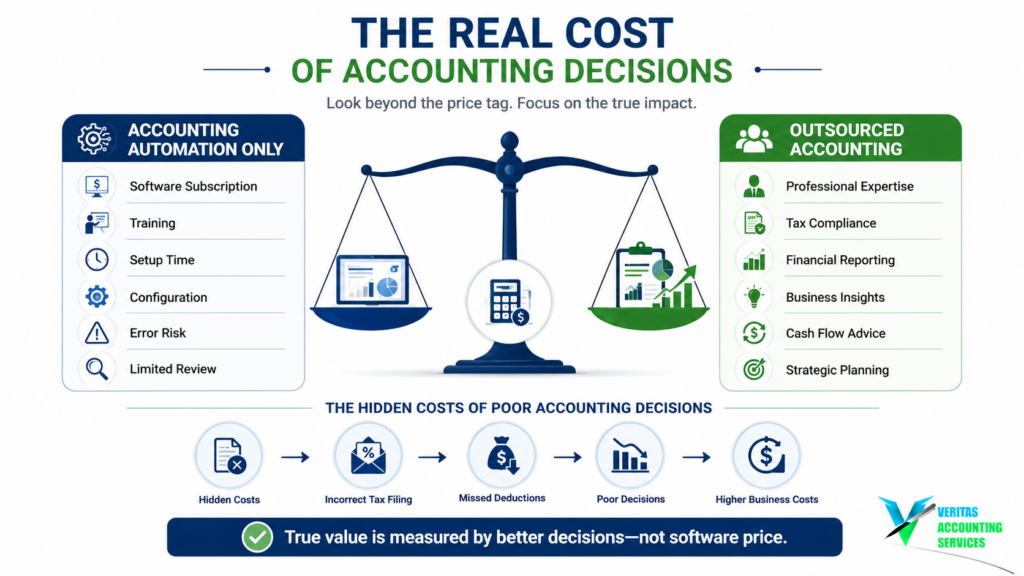
Many businesses compare only software subscription fees with accounting service fees.
That comparison tells only part of the story.
The real cost includes:
- employee time,
- training,
- software implementation,
- error correction,
- compliance risks,
- missed tax savings,
- poor financial decisions.
For example, spending $100 per month on automation software may seem inexpensive.
However, if inaccurate bookkeeping leads to:
- incorrect tax filings,
- missed deductions,
- poor inventory management,
- or delayed financial reporting,
the hidden costs can easily exceed the software savings.
Similarly, hiring a full in-house accounting team often involves:
- salaries,
- benefits,
- recruitment,
- office space,
- ongoing training.
For many growing businesses, outsourced accounting provides experienced professionals at a significantly lower overall cost.
Which Option Is Best for Different Businesses?
There is no single solution for every company.
The right approach depends on business size, complexity, and growth plans.
Startups
Often benefit from:
- cloud accounting software,
- automated bookkeeping,
- and outsourced accounting support.
This combination keeps costs manageable while maintaining financial accuracy.
E-Commerce Businesses
Businesses selling through Shopify, Amazon, Etsy, or WooCommerce often require:
- platform reconciliations,
- inventory accounting,
- sales tax management,
- financial reporting.
Automation helps process transactions, while outsourced accountants ensure the numbers are correct.
Professional Service Firms
Consulting firms, agencies, and legal practices usually benefit from:
- project profitability reporting,
- payroll management,
- budgeting,
- cash flow forecasting.
These services require professional financial expertise beyond automation.
Growing SMEs
As businesses expand, financial complexity increases.
Growing companies often require:
- management reporting,
- KPI dashboards,
- forecasting,
- budgeting,
- compliance support.
Outsourced accounting becomes increasingly valuable during this stage.
Why the Best Solution Isn’t Automation or Outsourcing
Many business owners assume they must choose between accounting automation and outsourced accounting.
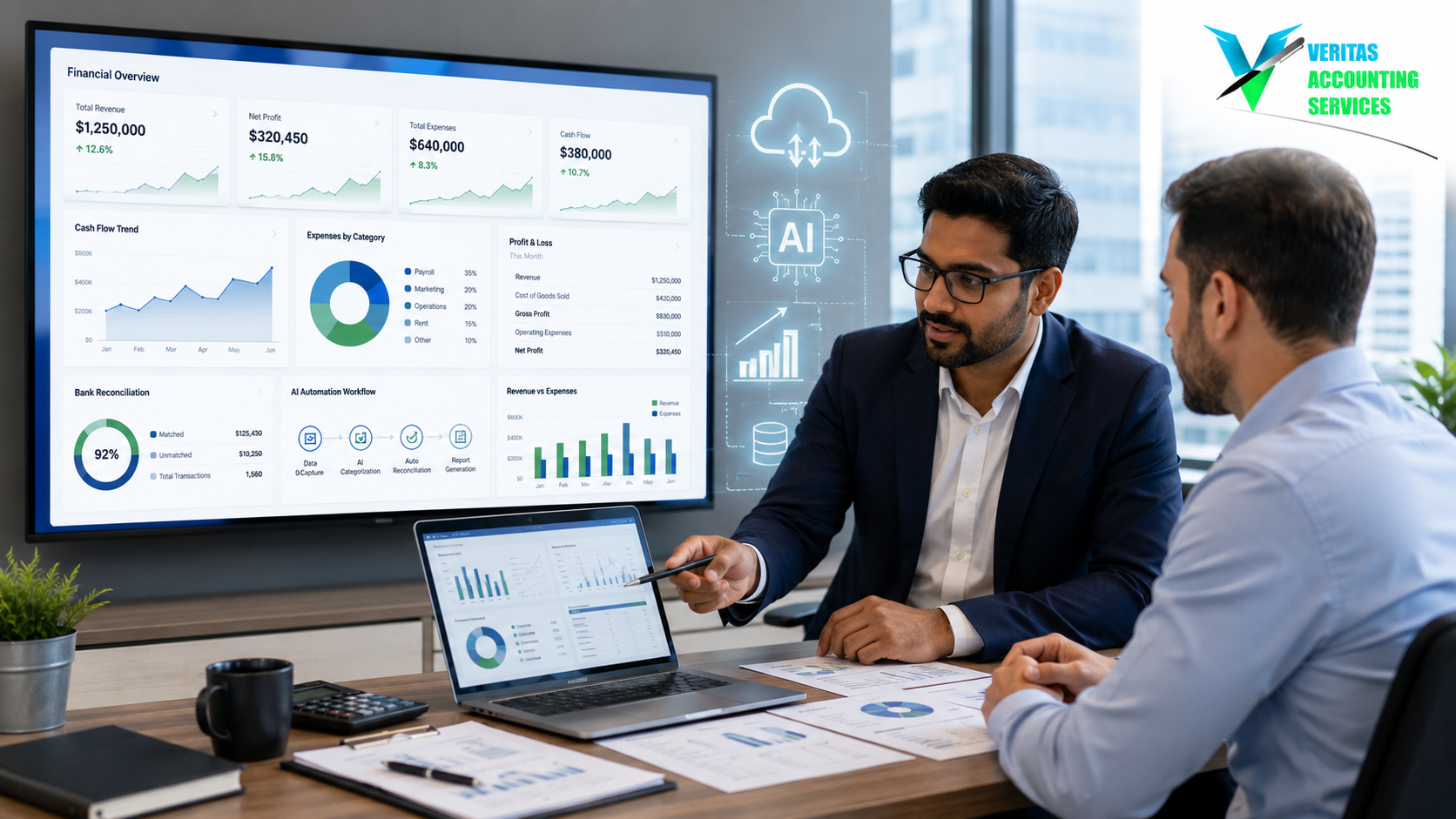
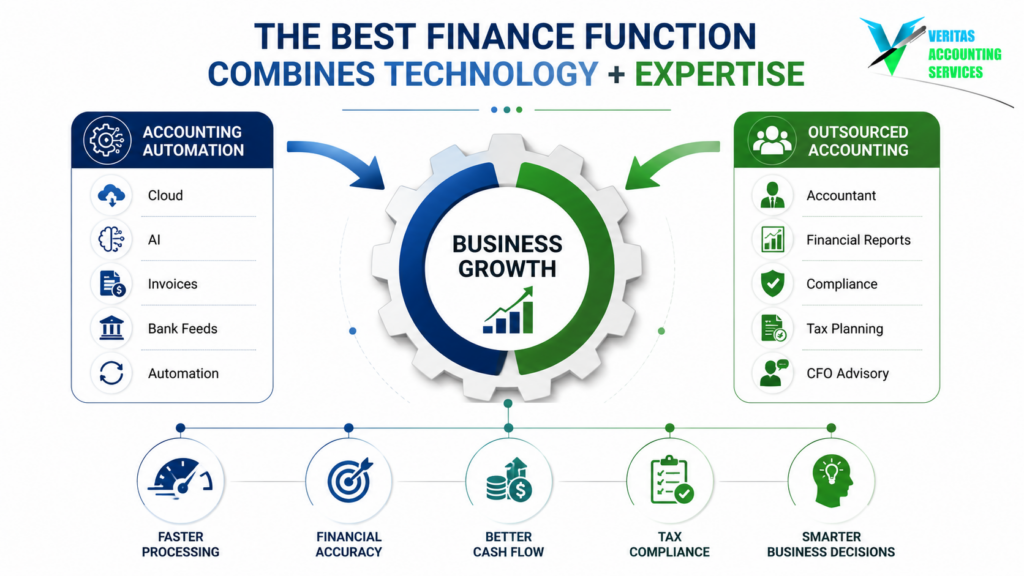
In reality, the strongest finance functions combine both.
Automation performs repetitive work quickly.
Outsourced accountants review the results, identify issues, interpret financial data, and provide business advice.
Think of automation as the engine.
Think of outsourced accounting as the experienced driver.
Technology makes accounting faster.
Professional expertise makes accounting smarter.
Together, they create a finance function that is efficient, accurate, and scalable.
Common Mistakes Businesses Make
Many organizations fail to maximize either automation or outsourcing.
Common mistakes include:
Buying Software Without Proper Setup
Technology only works when implemented correctly.
Assuming Automation Replaces Accountants
Software processes data.
It does not replace professional judgment.
Waiting Until Year-End
Many businesses delay bookkeeping until tax season, creating unnecessary pressure.
Ignoring Financial Reports
Generating reports is not enough.
Business owners must understand what those reports are saying.
Choosing Price Over Expertise
The cheapest solution is rarely the most cost-effective over the long term.
Frequently Asked Questions
Can accounting automation replace an accountant?
No.
Automation reduces manual work, but experienced accountants are still needed for analysis, compliance, tax planning, reconciliations, and financial advice.
Is outsourced accounting suitable for small businesses?
Yes.
Many startups and SMEs use outsourced accounting because it provides professional expertise without the cost of hiring a full in-house finance team.
Does automation reduce bookkeeping costs?
It can reduce administrative costs by eliminating repetitive manual tasks.
However, professional oversight remains essential.
Can automation and outsourced accounting work together?
Absolutely.
Many successful businesses combine cloud accounting software with outsourced accounting services to improve both efficiency and financial accuracy.
Which option saves more money?
For most growing businesses, combining automation with outsourced accounting provides the best balance of cost savings, compliance, efficiency, and financial insight.
Conclusion
Accounting automation has transformed the finance function by reducing manual work and improving operational efficiency.
However, technology alone cannot replace professional expertise.
Businesses still need experienced accountants to interpret financial information, ensure compliance, identify risks, and support strategic decision-making.
Rather than viewing automation and outsourcing as competing solutions, successful businesses recognize that they work best together.
Automation handles routine tasks.
Outsourced accounting delivers accuracy, insight, and confidence.
That combination not only saves money but also creates a stronger financial foundation for long-term business growth.
Call to Action
At Veritas Accounting Services, we combine modern accounting technology with experienced professionals to deliver accurate bookkeeping, timely financial reporting, tax compliance, and strategic financial support.
Whether you’re a startup, an e-commerce business, or a growing company, we can help you build a smarter, more efficient finance function.
Contact us today to discover how outsourced accounting and automation can work together for your business.
GET IN TOUCH
Schedule a FREE Call