








The Difference Between Being Busy and Being Productive: What Business Leaders Need to Know
Running a business can create a dangerous illusion: a full calendar looks like progress. Business productivity starts with asking what the activity achieves. Meetings are attended, emails answered, invoices chased, and problems solved. Yet the week ends with one question: what actually moved the business forward?
That is the difference between activity and business productivity. Understanding business productivity is essential when leadership wants growth without adding unnecessary complexity.
Business productivity is not about making people work longer hours. It is about directing time, money, people, and technology toward outcomes that improve revenue, profitability, cash flow, customer experience, and long-term value.
For business leaders, this distinction becomes more important as the company grows. A founder can personally solve problems in a small business. At scale, the same approach creates bottlenecks, delays decisions, and keeps senior management trapped in routine work.
Table of Contents
- What Does It Mean to Be Busy?
- What Does It Mean to Be Productive?
- Busy vs. Productive: The Key Difference
- Why Business Leaders Fall Into the Busy Trap
- How Financial Information Supports Business Productivity
- 7 Ways to Move From Busy to Productive
- How a CA or CFO Can Improve Business Productivity
- Questions Business Leaders Should Ask
- FAQ
- Conclusion
What Does It Mean to Be Busy?
Being busy usually means responding to whatever demands attention. A business owner may spend a day answering emails, approving expenses, checking bank balances, attending meetings, following up with customers, reviewing spreadsheets, and solving employee questions.
Those activities may be necessary. The problem is that necessity does not create value.
A business can have employees working hard while receivables remain overdue, monthly accounts stay late, or margins fall. Effort is not the issue.
What Does It Mean to Be Productive?
Productive work creates a measurable outcome. A productive finance team does not simply enter transactions; it closes the books accurately and on time. A productive sales team does not simply make calls; it generates qualified opportunities and revenue. A productive management meeting does not simply consume an hour; it produces decisions, owners, and deadlines.
This is the foundation of business productivity: connect activity to outcomes. Strong business productivity comes from choosing work that produces a measurable result.
For example, instead of asking an employee to “work on receivables,” management can define the outcome as reducing overdue invoices. For accounting, the objective can be accurate month-end financials by an agreed date.
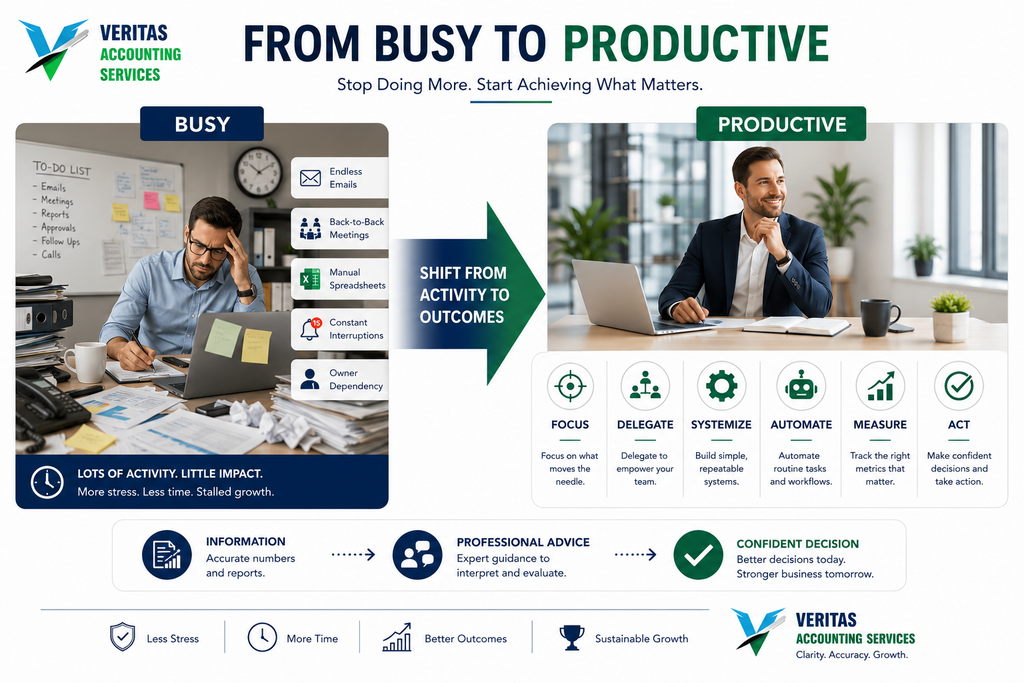
Busy vs. Productive: The Key Difference
The difference becomes clearer when management looks at results rather than hours.
Busy businesses often:
- React to every request immediately
- Keep the owner involved in routine decisions
- Measure effort rather than outcomes
- Rely heavily on spreadsheets and manual processes
- Discover financial problems after they become urgent
- Hold meetings without clear decisions
- Repeatedly solve the same operational problems
Productive businesses tend to:
- Prioritize high-value work
- Delegate responsibility with accountability
- Use measurable KPIs
- Standardize recurring processes
- Review financial information regularly
- Automate repetitive tasks
- Focus leadership attention on decisions that require judgment
A strong business does not eliminate activity. It makes activity purposeful. That is what sustainable business productivity looks like in practice.
Why Business Leaders Fall Into the Busy Trap
Owner Dependency
Many growing businesses depend heavily on the founder. The owner approves payments, answers customer questions, reviews every expense, resolves staff issues, and makes operational decisions.
This may work initially, but it becomes a constraint as the company grows.
If every decision has to reach the owner, employees wait, customers wait, and strategic work gets postponed. Improving business productivity often begins with identifying decisions that can be delegated. That creates room for leadership to focus on strategy.
Manual Processes
Manual work is another major source of wasted capacity.
Consider a business where employees download bank statements, enter transactions into spreadsheets, match payments manually, collect receipts by email, and prepare management reports from multiple files.
Each individual task may appear small. Together, they can consume hundreds of hours every year.
The solution is not always more employees. Better workflow design, accounting software, automation, and clear responsibilities can remove unnecessary work.
For businesses that are spending too much management time on routine bookkeeping, outsourcing can be an effective option. Veritas provides virtual bookkeeping services designed to help businesses maintain organized and accurate financial records while allowing management to focus on higher-value activities.
Delayed Financial Information
A business leader cannot make productive decisions without reliable financial information.
If management receives financial statements months after the period ends, the information has limited value for immediate decision-making. Timely bookkeeping and month-end reporting can reveal changes in revenue, gross margin, expenses, receivables, payables, and cash flow while there is still time to respond.
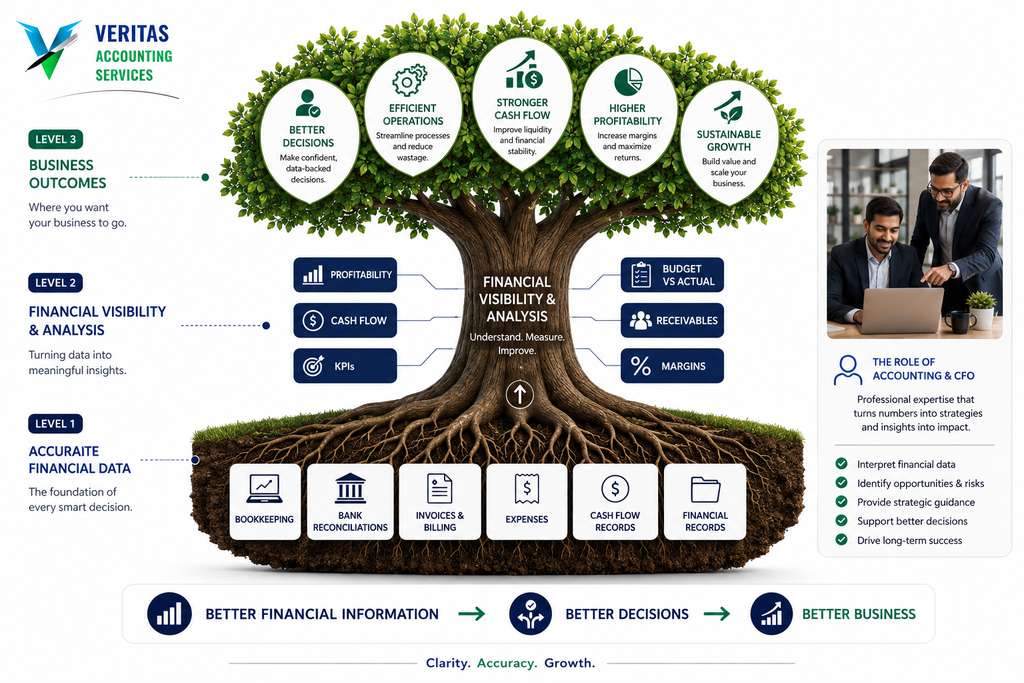
How Financial Information Supports Business Productivity
Financial reporting is not simply a compliance exercise. It is a management system.
The U.S. Small Business Administration notes that accounting for revenue and expenses can help a business operate smoothly, while a balance sheet provides a snapshot of financial position and supports financial management. Business owners can also refer to the SBA financial management guidance for additional information.
The IRS likewise explains that good business records help owners monitor progress, prepare financial statements, identify income sources, track expenses, and prepare tax returns. The IRS recordkeeping guidance provides additional detail.
This matters because leaders need more than a bank balance. They need to understand what the numbers are saying.
Useful measures may include:
- Revenue growth
- Gross profit margin
- Operating expense ratio
- Accounts receivable days
- Cash conversion cycle
- Revenue per employee
- Customer or product profitability
- Actual results versus budget
- Forecast versus actual cash flow
For example, revenue may increase while receivables rise sharply and gross margin declines. The company may be growing without improving its financial position.
Better business productivity comes from understanding these relationships. Financial visibility helps leaders measure whether effort is creating value.
7 Ways to Move From Busy to Productive
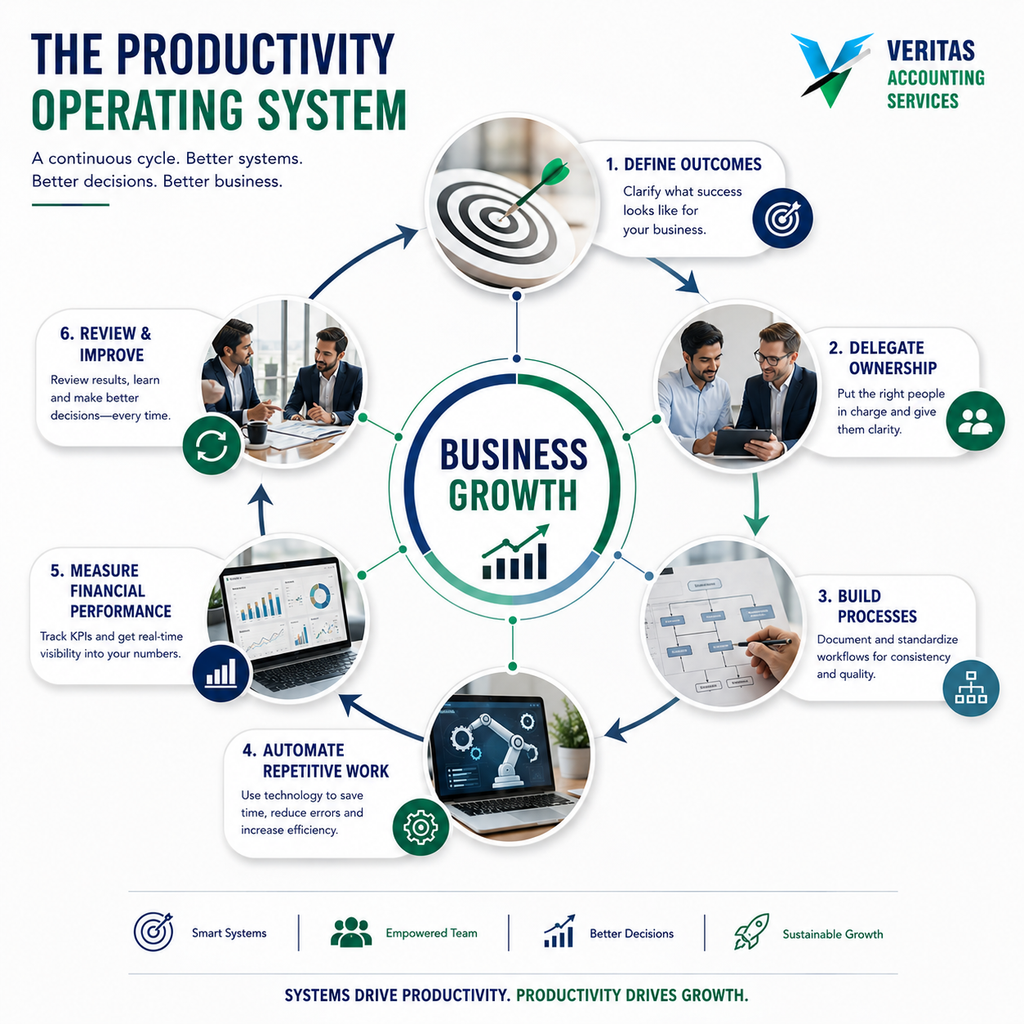
1. Define Outcomes Before Activities
Before adding a task to the calendar, ask what outcome it is expected to create.
Instead of “review expenses,” the goal might be “identify and remove recurring costs that do not support business priorities.”
Instead of “check cash,” the goal might be “maintain sufficient liquidity for the next 90 days.”
The question should always be:
What business result will this activity create?
2. Delegate Ownership, Not Just Tasks
Effective delegation means transferring responsibility for a result.
For example, an accounts receivable manager should not merely send reminder emails. The person should own the process of monitoring aging, following up with customers, identifying disputes, and escalating collection risks.
Clear ownership improves accountability and supports business productivity. It also reduces the number of routine decisions that return to the owner.
3. Create Repeatable Processes
If the same issue appears every month, do not rely on another reminder.
Build a process.
Document who performs the task, what information is needed, when it must be completed, what review is required, and what happens when something goes wrong.
Standard operating procedures reduce dependence on memory and make it easier to train new employees.
4. Close the Books on a Regular Schedule
A disciplined month-end close gives management a reliable view of performance.
A useful monthly close can include:
- Bank and credit-card reconciliations
- Accounts receivable review
- Accounts payable review
- Accruals and prepaid expenses
- Payroll review
- Fixed-asset updates
- Revenue reconciliation
- Management reporting
Accurate books make business productivity measurable because management can compare actual performance with targets. This makes financial reviews more useful.
5. Automate Repetitive Work
Technology should remove repetitive administration where practical.
Businesses can often automate or streamline:
- Bank feeds
- Invoice creation
- Payment reminders
- Receipt collection
- Recurring transactions
- Payroll workflows
- Management reports
- Data synchronization between platforms
Automation should not replace professional judgment. It should create more time for analysis and decision-making.
6. Use a Management Dashboard
A dashboard should answer the questions leadership actually cares about.
Depending on the business, it might include:
- How much did we sell?
- How profitable were those sales?
- How much cash do we have?
- What customers owe us?
- What bills are due?
- Which costs increased?
- Are we on budget?
- What is expected over the next three to six months?
A focused dashboard can improve business productivity by reducing the time required to locate and interpret information.
7. Review Performance and Take Action
Reporting has little value if no one acts on it.
A monthly management review should answer four questions:
What happened?
Why?
What happens next?
What action should we take?
This turns accounting information into action.
How a CA or CFO Can Improve Business Productivity
Business leaders do not need to perform every financial task themselves.
An experienced CA, accountant, controller, or outsourced CFO can build the financial infrastructure that supports better decisions.
A professional accounting partner can help with:
- Bookkeeping and transaction classification
- Bank and credit-card reconciliation
- Accounts payable and receivable
- Month-end closing
- Financial statement preparation
- Budgeting and forecasting
- Cash-flow planning
- KPI and ratio analysis
- Profitability analysis
- Tax compliance coordination
- Management reporting
- Financial projections
The value is not completing tasks. The goal is to create business productivity through reliable financial information.
The professional should help management understand what the numbers mean and what action is appropriate.
For example, if operating expenses increase, the right question is not simply, “Which expense increased?”
Management should also ask:
- Why did it increase?
- Is the increase temporary or recurring?
- Did it generate additional revenue?
- Is the return sufficient?
- Can the process be redesigned?
- Does the business need to change its budget or forecast?
That is where accounting becomes advisory rather than purely administrative.
For businesses working across borders, outsourced accounting can also create consistency across entities, currencies, accounting systems, and reporting requirements. A centralized finance process gives leadership a clearer view without requiring the owner to coordinate every transaction.
Businesses that need flexible financial support can also consider remote bookkeeping services as part of a broader outsourced accounting structure.
Questions Business Leaders Should Ask
To assess your current level of business productivity, ask:
- How much of my week is routine operational work?
- Which decisions still require my approval?
- Are our books closed on time?
- Can I see profitability by customer or service?
- Do I have a current cash-flow forecast?
- How quickly can I identify unusual expenses?
- Which processes still depend on spreadsheets?
- What recurring problems keep returning?
- Are employees measured by activity or outcomes?
- If revenue doubled, would our systems handle it?
If several answers concern you, the issue may not be a lack of effort. It may be a lack of systems. Improving business productivity often requires redesigning how information and decisions move through the company.
FAQ
What is the difference between being busy and being productive?
Being busy means completing many activities, while being productive means directing time and resources toward measurable outcomes that support business goals.
How does accounting support business productivity?
Accurate accounting provides timely information about revenue, expenses, margins, receivables, payables, cash flow, and profitability. This helps management make informed decisions.
Can an outsourced accountant improve business productivity?
Yes. An outsourced accountant can take responsibility for recurring financial processes, allowing business owners and internal teams to focus on customers, operations, strategy, and growth.
What financial metrics should business leaders monitor?
Common measures include revenue growth, gross margin, operating expenses, receivable days, cash flow, revenue per employee, customer profitability, and budget-to-actual performance.
When should a company consider CFO advisory services?
CFO advisory support can be useful when a company needs stronger forecasting, cash-flow planning, profitability analysis, budgeting, financial strategy, or management reporting without hiring a full-time CFO.
Conclusion
Being busy can feel productive because activity is visible. Business performance, however, is determined by outcomes.
A productive business creates systems, financial visibility, and accountability so work contributes to objectives.
For leaders, the first step is often financial clarity. When you understand where revenue comes from, where cash is going, which activities create value, and where inefficiencies exist, you can make better decisions.
This is where professional accounting and CFO support can make a meaningful difference.
Veritas Accounting Services helps business owners, CPA firms, and tax professionals with outsourced bookkeeping, accounting, financial reporting, CFO support, cash-flow management, financial projections, and related finance functions. Our goal is to help clients spend less time managing routine financial work and more time managing the business.
If your company is constantly busy but still struggling to achieve the results you expect, it may be time to examine the systems behind the work.
Build better processes. Measure meaningful outcomes. Protect business productivity by reviewing what actually creates value. Use your financial data. And make productivity a business strategy, not simply a personal goal.
GET IN TOUCH
Schedule a FREE Call










Connect on our Socials!
