








Choosing the Right Business Structure for Long-Term Tax Efficiency
Choosing how to organize a business is one of the earliest decisions an owner makes. But the consequences of that decision can continue for years.
A business structure can affect how income is reported, how owners are compensated, which tax returns must be filed, payroll and self-employment tax considerations, administrative costs, and how easily the company can adapt as it grows.
There is no single structure that is automatically right for every business. A structure that works for a new consultant may not be appropriate for a growing company with employees, multiple owners, significant profits, outside investors, or plans to retain earnings for expansion.
That is why long-term tax planning should look beyond the current year’s tax bill. The right business structure should fit the way the company operates today while remaining practical as the business changes.
The IRS identifies sole proprietorships, partnerships, corporations, S corporations and LLCs among the common business forms. It also notes that both legal and tax considerations are relevant when selecting a business structure. IRS
Why Business Structure Matters for Tax Efficiency
Your business structure influences how business income is reported for federal tax purposes.
A sole proprietorship generally reports business activity on the owner’s individual tax return. A partnership generally files an information return and passes applicable tax items through to its partners. An S corporation generally passes income, losses, deductions and credits through to shareholders. A C corporation generally files its own corporate income tax return. IRS
These differences can affect the overall tax picture.
Business owners may need to consider federal income tax, self-employment tax, employment taxes, state and local taxes, estimated payments, compensation, distributions and the cost of maintaining the entity.
This is why a business structure should be considered as part of a broader financial and tax strategy rather than as a one-time registration decision.
The goal is not simply to find the lowest tax number for one year. It is to understand how the structure interacts with expected profitability, ownership, compensation, growth and future plans.
Legal Structure and Tax Classification Are Not the Same
One of the most important concepts for business owners to understand is that a legal entity and its federal tax classification are not always the same thing.
An LLC is created under state law. For federal income tax purposes, the IRS may treat an LLC as a disregarded entity, partnership or corporation depending on the number of members and elections made by the LLC. IRS
For example, a domestic single-member LLC generally defaults to disregarded-entity treatment for federal income tax purposes unless it elects corporate treatment. A domestic LLC with two or more members generally defaults to partnership treatment unless it makes an election to be treated as a corporation. IRS
An eligible LLC may also elect S corporation status.
This means saying, “I have an LLC,” does not by itself explain how the business is taxed federally.
The tax classification can be just as important as the legal entity when evaluating long-term tax efficiency.
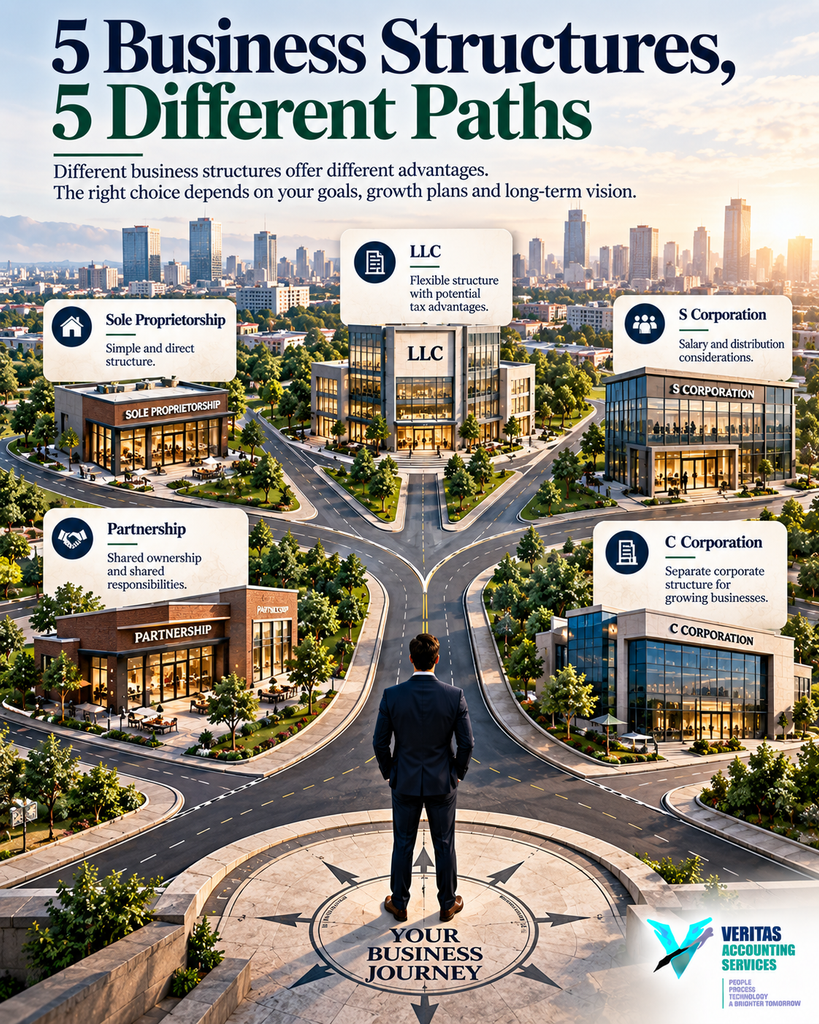
Sole Proprietorship: Simple but Not Always the Long-Term Answer
A sole proprietorship is an unincorporated business owned by one individual.
From a federal income-tax perspective, business activity is generally reported on the owner’s individual return. A sole proprietor may also be subject to self-employment tax on net earnings from self-employment. The IRS generally requires Schedule SE when the applicable self-employment earnings threshold is met. IRS
The simplicity can be attractive to a small business.
There may be fewer entity-level compliance requirements, and the tax reporting can be relatively straightforward.
However, simplicity should not automatically be confused with long-term tax efficiency.
As profits increase, the owner may want to review whether another structure or tax classification could make sense. The review should consider expected profits, owner compensation, state taxes, administrative costs and the owner’s broader financial situation.
A business structure that works well during the startup stage may need to be reconsidered as the company becomes more profitable.
Partnership: Multiple Owners, Different Tax Responsibilities
A partnership is generally used when two or more people operate a business together.
Partnership taxation generally involves the partnership filing an information return while applicable income, deductions and other tax items flow through to the partners.
Partners are generally treated as self-employed rather than employees when performing services for the partnership. The IRS states that partners should not generally be issued a W-2 for their partnership distributions or guaranteed payments. IRS
A partnership may also require careful planning around:
- Ownership percentages
- Capital contributions
- Profit and loss allocations
- Guaranteed payments
- Partner distributions
- Self-employment tax
- Estimated tax payments
For a growing multi-owner company, tax efficiency is therefore not simply a matter of choosing a lower tax rate.
The owners also need clear agreements, accurate accounting and a structure that reflects how profits and responsibilities are actually shared.
LLC: Flexibility Comes With Choices
The LLC is important because it combines a state-law legal structure with flexibility in federal tax classification.
A single-member LLC generally defaults to disregarded-entity treatment for federal income tax purposes. A domestic LLC with two or more members generally defaults to partnership treatment. An LLC can elect corporate classification, and an eligible LLC may elect S corporation status. IRS
That flexibility can be useful, but it also creates decisions.
An LLC does not automatically create tax savings.
Two businesses can both legally operate as LLCs while having different federal tax classifications and different compensation, payroll and reporting requirements.
The owner should consider profitability, ownership, expected growth, how the owner works in the business, cash distributions, reinvestment plans and compliance resources before changing the tax classification.
This is why business structure and tax classification should be reviewed together.
S Corporation: When Tax Planning Becomes More Complex
S corporation taxation is frequently discussed when small-business owners evaluate tax efficiency.
An S corporation generally passes corporate income, losses, deductions and credits through to shareholders for federal tax purposes. IRS
However, choosing S corporation treatment also introduces additional requirements.
One of the most important is owner compensation.
When a shareholder-employee performs services for an S corporation, the corporation generally must pay reasonable compensation before non-wage distributions may be made to that shareholder-employee. The IRS considers factors including duties, responsibilities, training, experience, time devoted to the business and comparable compensation. IRS
This means an owner should not simply choose an unusually low salary and classify the remaining money as distributions without reviewing the applicable rules.
An S corporation may be appropriate in certain circumstances, but the potential tax benefit should be compared with payroll costs, tax preparation, bookkeeping, state requirements and other compliance responsibilities.
The right business structure should be evaluated based on the complete financial picture rather than one tax calculation.
C Corporation: A Different Tax Model
A C corporation is generally a separate taxpayer for federal income tax purposes.
This creates a different model from a sole proprietorship, partnership or S corporation. Corporations generally report their income and expenses on a corporate tax return. IRS
A corporation may retain earnings for expansion, invest in equipment, hire employees, pursue outside investment or develop a long-term growth strategy.
However, owners also need to understand how corporate profits and payments to shareholders are treated.
For a business planning significant reinvestment, outside investment or future expansion, a C corporation may require a broader analysis than a simple comparison of current tax rates.
The question is not whether a C corporation is automatically better or worse.
The question is whether its tax and operational framework fits the company’s objectives.
Look Beyond the Current Year’s Tax Bill
One of the biggest mistakes owners make is comparing business structures only by the tax bill for the current year.
Imagine a company earning $150,000 today.
The owner may find that one option appears attractive based on the current numbers.
But what happens if profits increase to $300,000?
What happens if the company hires employees?
What happens if another owner joins?
What happens if the business opens another location?
What happens if the company retains profits to finance expansion?
What happens if outside investors become involved?
Those changes can alter the economics of the business structure.
Long-term tax efficiency should therefore consider the direction of the business, not just its current financial statements.
A structure that produces a modest tax benefit today may create additional payroll, accounting, legal or filing costs later.
This is particularly important for entrepreneurs who expect rapid growth.
A structure that was appropriate at startup may not remain appropriate when the business reaches a different level of revenue, profitability or complexity.
Consider How You Will Pay Yourself
How an owner receives money from a business can differ depending on the entity and federal tax classification.
Sole proprietors generally report business income on their individual return. Partners generally are not employees of the partnership when performing services for it. Corporate officers who perform services for a corporation are generally treated as employees for federal employment-tax purposes. IRS
For S corporations, shareholder-employees who provide services generally need appropriate reasonable compensation before non-wage distributions. IRS
Therefore, owners should ask:
How will I be paid?
Will compensation be treated as wages?
How will distributions be treated?
What payroll requirements apply?
What estimated tax payments may be required?
How much profit will remain in the business?
These questions can materially change the overall financial outcome.
A business structure is only useful when the owner understands how compensation, payroll and distributions work within that structure.
Don’t Ignore Compliance Costs
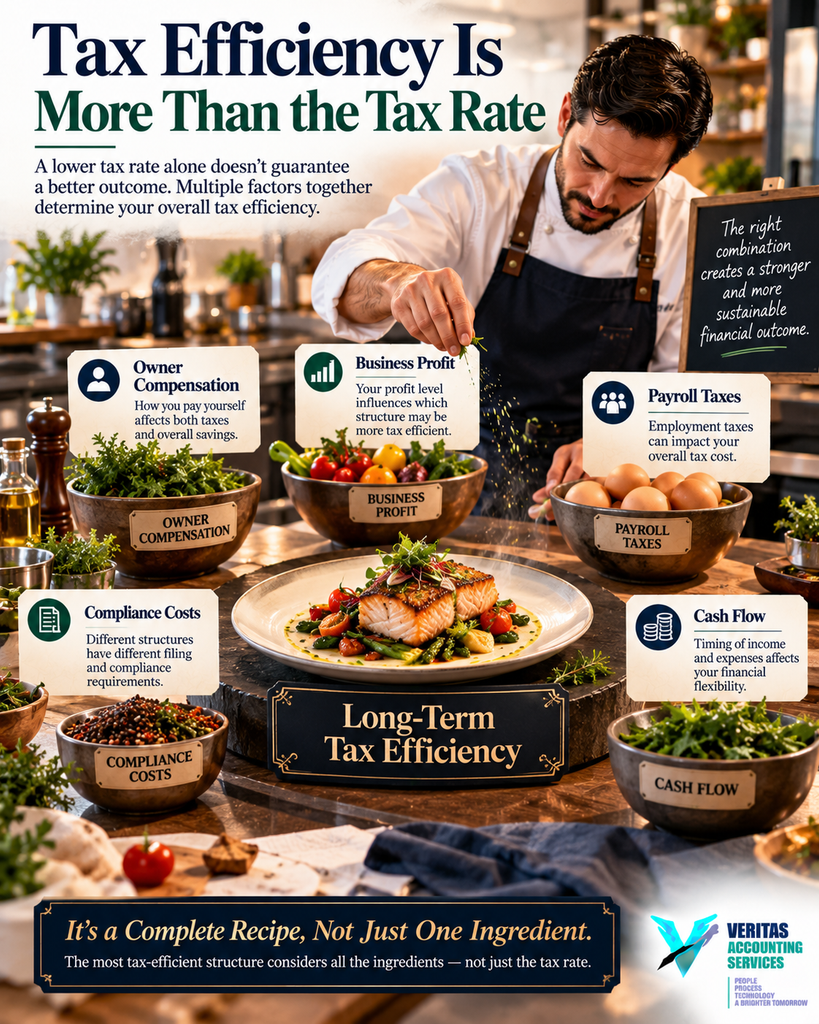
Tax efficiency is not the same as paying the lowest possible tax.
A structure can potentially produce a tax benefit while also creating additional costs for:
- Payroll processing
- Corporate tax returns
- State filings
- Accounting
- Tax preparation
- Legal services
- Annual reports
- Recordkeeping
- Compliance administration
For example, suppose a structural change produces an estimated $8,000 annual tax benefit but adds $6,000 of annual payroll, accounting and compliance costs.
The headline tax saving does not tell the entire story.
The business owner should consider the net financial impact.
For smaller companies, compliance costs can be particularly important. Owners should also consider the value of their own time because managing additional administrative requirements has an economic cost even if it does not appear separately on the income statement.
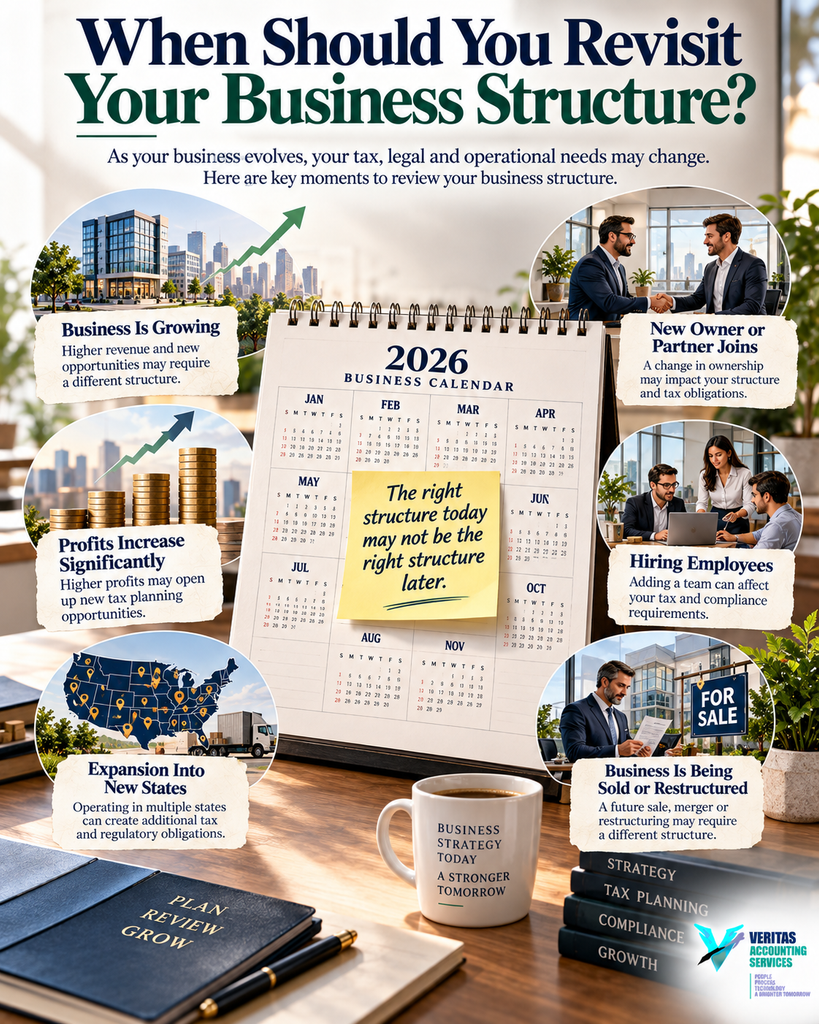
When Should You Review Your Structure?
A business structure should not necessarily remain unchanged forever.
A review may be appropriate when there is a significant change in the business.
Profits Increase Significantly
Higher profits can change the relative financial impact of different tax classifications.
New Owners or Investors Join
Changes in ownership can affect legal, tax and operational considerations.
The Business Begins Hiring Employees
Payroll and employment compliance can become more important as the company grows.
The Company Expands Into New States
Additional state filing and tax obligations may need to be considered.
The Business Retains More Profit
A company that reinvests a significant portion of earnings may have different planning considerations from one that distributes most profits.
Compensation Changes
How the owner is paid can be closely connected to the federal tax classification.
A Future Sale Becomes a Priority
The entity and tax classification can affect considerations surrounding a future transaction.
Tax Rules Change
Federal and state tax rules can change over time, making periodic reviews useful.
Reviewing a business structure does not automatically mean the entity should be changed. It means the current arrangement should be compared with the business’s present circumstances.
Questions to Ask Before Choosing or Changing
Before choosing or changing a business structure, ask these questions:
How profitable is the business today?
Current profitability provides an important starting point for evaluating the economics of different structures.
How quickly is the business expected to grow?
A structure should be considered in the context of future plans.
How many owners are involved?
Ownership can affect legal considerations and federal tax classification.
How will owners be compensated?
Salary, guaranteed payments, distributions and other forms of compensation can have different implications.
Will profits be distributed or reinvested?
The expected use of profits can influence the long-term analysis.
What federal tax classification applies?
An LLC’s legal form does not by itself determine its federal tax treatment.
What state and local taxes apply?
Federal tax treatment is only one part of the overall picture.
What compliance costs will the structure create?
Potential tax savings should be compared with the cost of payroll, accounting and filing requirements.
Will the company need outside investors?
Future financing plans can influence which structure is practical.
Could the business eventually be sold?
An exit strategy can be an important part of long-term planning.
A tax professional and legal adviser can help evaluate these questions based on the specific facts of the company.
Frequently Asked Questions
Is an LLC automatically more tax-efficient than a sole proprietorship?
No. An LLC is a state-law entity, while its federal tax classification can vary. A single-member LLC generally defaults to disregarded-entity treatment unless it elects otherwise. IRS
Can an LLC elect S corporation taxation?
An eligible LLC can generally elect S corporation treatment if it meets the applicable requirements and makes the required election. The legal entity and federal tax classification are separate concepts. IRS
Does an S corporation always reduce taxes?
No. Any potential benefit depends on the business’s circumstances. The company must also comply with payroll and reasonable-compensation requirements and may have additional administrative costs. IRS
Are partners employees?
Generally, partners are not employees when performing services for the partnership. Their compensation and tax reporting follow partnership rules. IRS
When should a business reconsider its structure?
A review can make sense when profits, ownership, compensation, growth plans, state operations or exit plans change.
Should taxes be the only reason to change a structure?
No. Legal protection, administration, financing, ownership, state requirements and long-term business objectives should also be considered.
Can a business change its tax classification later?
In many situations, an entity can make a different federal tax election, but the procedure, timing and consequences depend on the entity and circumstances. Changes should be reviewed before they are implemented. IRS
Final Thoughts
Choosing a business structure is not simply a decision about how much tax the business will pay this year.
It is a decision about how the company will operate, how owners will receive money, how profits will be taxed, how much compliance will be required and how easily the business can adapt as it grows.
The IRS notes that both legal and tax considerations matter when selecting a business structure. IRS
There is no universal answer.
A sole proprietorship may provide simplicity. A partnership can accommodate multiple owners. An LLC can provide legal flexibility with different federal tax classification possibilities. An S corporation can provide pass-through federal tax treatment with specific compensation requirements. A C corporation provides a separate corporate tax model that may fit certain growth and reinvestment strategies.
The important point is to compare these choices against the actual business.
Review current profitability, expected growth, owner compensation, distributions, reinvestment plans, state taxes and compliance costs. Then consider how each option may work not only this year, but several years from now.
Good tax planning is not simply about minimizing today’s tax bill. It is about creating a structure that remains financially and operationally sensible as the business grows.
If you are considering forming a business, changing your current tax classification, or reviewing whether your existing business structure still fits your business, Veritas Accounting Services can help with bookkeeping, accounting and U.S. tax support.
GET IN TOUCH
Schedule a FREE Call









Connect on our Socials!
