








The Hidden Tax Consequences of a Successful Business Year
A successful year in business is something worth celebrating. Revenue has increased, customers are spending more, operations are expanding, and the financial statements are finally showing the results of years of hard work.
But there is another side to business success that many owners overlook until it becomes an immediate concern: taxes.
Higher profits can create larger tax liabilities, unexpected estimated tax payments, additional payroll obligations, and pressure on working capital. In some cases, a business may report its strongest financial performance while struggling to find enough cash to meet its tax obligations.
This is why business tax planning becomes increasingly important as a company grows. A profitable year should create financial opportunities, not unexpected liabilities that weaken the business.
Understanding the tax consequences of success allows business owners to make better decisions before the year closes rather than reacting after the tax return is prepared.
Table of Contents
- Why a Successful Year Can Create Tax Problems
- Higher Profits Do Not Always Mean More Cash
- The Estimated Tax Payment Surprise
- How Growth Changes Your Tax Position
- Owner Distributions and Tax Liabilities
- The Tax Impact of Hiring and Expansion
- Why Tax Deductions Need Strategic Planning
- The Hidden Cost of Poor Financial Records
- Seven Steps to Prepare for Year-End Taxes
- Frequently Asked Questions
- Conclusion
Why a Successful Year Can Create Unexpected Tax Problems
When a business experiences a difficult year, owners naturally focus on controlling expenses, improving sales, and maintaining cash flow.
During a successful year, attention often shifts toward expansion, hiring, investments, and new opportunities.
Tax planning can become an afterthought.
The problem is that taxable income does not always move in the same direction as the cash available in the bank. A company may have significant accounting profits, but much of its cash could already be committed to inventory, equipment, loan repayments, or expansion.
Without business tax planning, owners may discover their tax liability only when their accountant prepares the annual return.
By that point, many opportunities to manage the timing of income, expenses, and other tax decisions may already have passed.
Successful businesses need to consider the financial consequences of growth throughout the year, not just during tax season.

1. Higher Profits Do Not Always Mean More Available Cash
One of the biggest misunderstandings among business owners is assuming that higher profits automatically mean more cash.
Profit and cash flow measure different things.
A business can generate strong profits while experiencing cash shortages because money is tied up in receivables, inventory, equipment purchases, or debt repayments.
Consider a business that reports $300,000 in taxable profit.
During the year, it may have used substantial cash to purchase inventory, repay loan principal, and fund expansion.
Those payments do not necessarily reduce taxable income dollar for dollar.
Loan principal repayments, for example, generally do not create a tax deduction. Inventory purchases may affect taxable income through cost of goods sold rather than simply when cash is spent. Equipment purchases may qualify for depreciation deductions, but the treatment depends on applicable tax rules.
The result can be a profitable business with limited available cash and a significant tax obligation.
Effective business tax planning requires owners to evaluate taxable income and cash flow separately.
A company should not wait until the tax return is completed to determine whether it has enough liquidity to meet its obligations.
2. The Estimated Tax Payment Surprise
Many business owners are familiar with annual tax filing deadlines but pay less attention to estimated tax obligations.
In the United States, federal income taxes generally operate on a pay-as-you-go basis.
Depending on the business structure, tax liabilities may need to be covered through withholding, estimated payments, or a combination of both.
For example, owners of partnerships and S corporations may need to make personal estimated tax payments because income generally passes through to their individual returns.
C corporations may have their own corporate estimated tax obligations.
A profitable year can increase the required payments, particularly when current income is significantly higher than the previous year.
Why estimated taxes become a problem
Imagine a business owner whose company earned $100,000 last year but is on track to earn $250,000 this year.
If the owner continues making estimated payments based on last year’s income, those payments may be insufficient to cover the current year’s total liability.
Depending on applicable safe-harbor rules, withholding, payment timing, and other circumstances, an estimated tax underpayment penalty may arise.
However, a higher current-year tax bill does not automatically mean a penalty. Federal safe-harbor provisions can protect qualifying taxpayers who meet the required payment thresholds.
This is where business tax planning becomes valuable.
Rather than guessing, owners should periodically project annual taxable income, review payments already made, and calculate whether additional payments are appropriate.
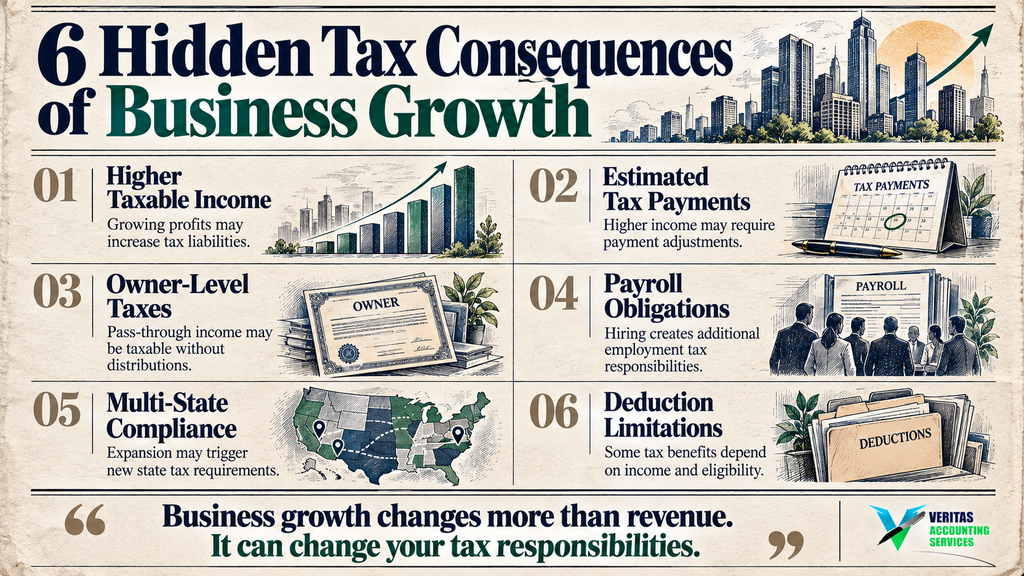
3. How Business Growth Can Change Your Tax Position
Growth can change more than a company’s revenue.
It may affect the business’s effective tax rate, available deductions, reporting requirements, and the suitability of its existing tax classification.
For pass-through businesses, increased taxable income can affect the owner’s individual tax position, including marginal tax brackets and the availability or limitations of certain deductions.
Some tax benefits depend on taxable income, wages, qualified property, or other eligibility requirements.
A deduction that was available in one year may be reduced or limited in another.
Business growth can also create new state and local tax responsibilities.
For example, selling products or services into additional states may create sales tax collection or income tax filing obligations, depending on the activities involved and the applicable state laws.
Hiring remote employees in different states can create additional payroll registration and withholding requirements.
A growing company should therefore review its tax position before expanding into new markets.
Business tax planning should account for where the company operates, how it earns income, and whether its existing structure remains appropriate.
4. Owner Distributions Can Create Unexpected Tax Liabilities
A common misconception is that business owners are taxed only on the money they withdraw from the company.
For many pass-through entities, that is not how federal income taxation works.
In a partnership or S corporation, owners may generally be taxed on their allocated share of taxable income even when some of that income remains in the business.
For example, suppose an S corporation generates $200,000 in taxable income that passes through to its sole shareholder.
The owner may have withdrawn only $70,000 during the year, yet the shareholder’s federal income tax obligations can reflect the allocated business income, subject to the applicable rules.
The tax treatment of distributions themselves depends on factors such as stock basis, accumulated earnings and profits, and the entity’s circumstances.
Similarly, partnership distributions and allocations are subject to separate basis and tax rules.
This creates an important cash flow consideration.
If the business retains most of its profits for growth, the owner may still need personal funds to cover the resulting tax liability.
Proper business tax planning should therefore include a review of expected owner-level taxes and an appropriate distribution or cash-reserve strategy.
Why owner compensation also matters
For S corporations, shareholder-employees who provide services generally must receive reasonable compensation before taking non-wage distributions.
Treating all payments as distributions without considering compensation requirements can create payroll tax exposure.
Owners should review compensation arrangements periodically, particularly when business profitability increases.
5. Hiring and Expansion Bring Additional Tax Responsibilities
Business expansion is often a sign of success.
New employees, additional offices, larger operations, and new markets can support future revenue.
However, each expansion decision can also create additional compliance responsibilities.
Hiring employees generally involves payroll tax withholding, employer payroll contributions, wage reporting, and employment-related filings.
Operating across multiple states can add registration and reporting requirements.
International expansion may introduce more complex issues involving cross-border transactions, withholding, foreign reporting, and transfer pricing.
The challenge is not simply paying more taxes. It is managing the growing number of obligations that accompany a larger organization.
Business tax planning should be integrated into expansion decisions rather than treated as a separate annual exercise.
Before hiring in a new state or establishing operations in another jurisdiction, owners should understand the potential tax and administrative consequences.
This allows the business to estimate the true cost of growth.
6. Why Tax Deductions Need Strategic Planning
When business owners realize they may face a larger tax bill, one common reaction is to start spending money before year-end.
They may purchase equipment, accelerate expenses, or make investments primarily to reduce taxable income.
However, spending money solely to obtain a deduction is not always a sound financial decision.
A deduction generally reduces taxable income; it does not reimburse the full amount spent.
For example, if a qualifying $20,000 expense produces a $20,000 deduction and the relevant marginal tax rate is 25%, the illustrative tax saving would be $5,000.
The business would still have spent $15,000 after considering that tax benefit.
The actual result depends on the deduction’s eligibility, timing, applicable tax rates, and other limitations.
Equipment purchases require additional consideration
Certain equipment purchases may qualify for Section 179 expensing or bonus depreciation.
However, eligibility, business-use requirements, placed-in-service timing, and applicable limitations must be evaluated.
Not every purchase automatically qualifies for an immediate full deduction.
A business should also consider whether the equipment is genuinely needed and whether the purchase will generate sufficient operational value.
Good business tax planning evaluates the financial benefit of a purchase alongside the potential tax deduction.
The objective is not simply to reduce taxable income. It is to improve the company’s overall financial position.
7. The Hidden Cost of Poor Financial Records
A successful year often means more transactions.
There may be additional customers, payment platforms, suppliers, employees, inventory purchases, and financing arrangements.
As transaction volume increases, bookkeeping errors can become more difficult to identify.
Revenue may be recorded incorrectly, expenses may be misclassified, and balance sheet accounts may contain unresolved differences.
For e-commerce businesses, payment processor settlements can create particular challenges when sales, refunds, fees, and transfers are not reconciled properly.
An inaccurate profit and loss statement can lead to an unreliable tax projection.
A business owner may believe taxable income is significantly higher or lower than the actual amount.
Business tax planning depends on reliable financial information.
Before making major year-end decisions, companies should reconcile bank accounts, review receivables and payables, verify inventory records, investigate unusual balances, and confirm that income and expenses are properly classified.
Clean books provide a foundation for accurate decisions.
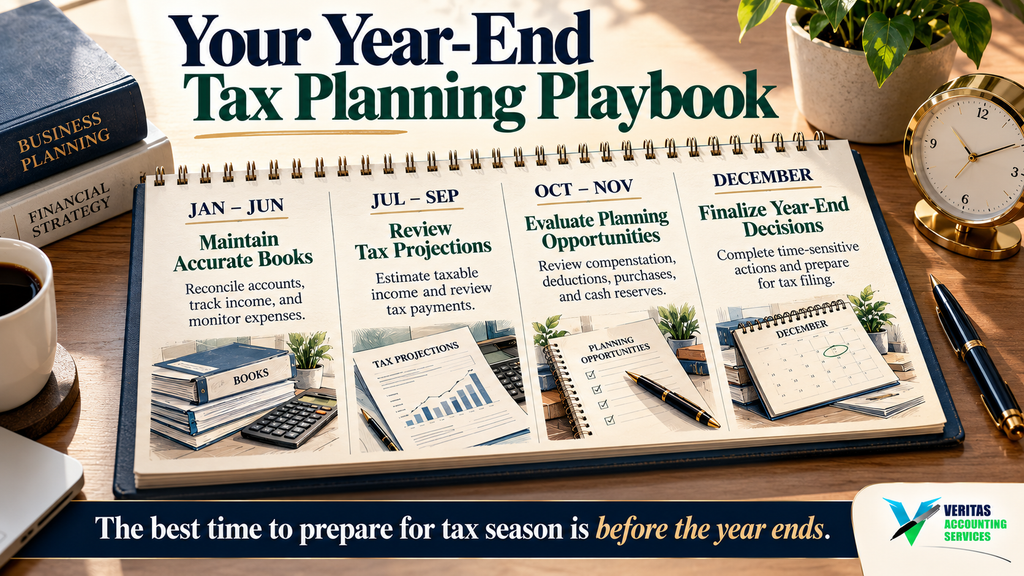
8. Seven Practical Steps to Prepare for Year-End Taxes
A successful business year should trigger a structured financial review well before the filing deadline.
The following steps can help owners prepare.
Step 1: Review Year-to-Date Financial Statements
Start with the profit and loss statement and balance sheet.
Compare current results with the prior year and identify major changes in revenue, expenses, margins, assets, and liabilities.
Investigate unusual movements rather than assuming the financial statements are accurate.
Step 2: Prepare a Taxable Income Projection
Accounting profit and taxable income are not necessarily the same.
A projection should consider relevant tax adjustments, depreciation, nondeductible expenses, available deductions, and other entity-specific items.
The purpose is to estimate the likely tax position before year-end.
Step 3: Review Estimated Tax Payments
Compare projected liabilities with taxes already paid or withheld.
Determine whether additional estimated payments or withholding adjustments may be appropriate.
Step 4: Evaluate Cash Reserves
Set aside cash for expected taxes rather than assuming future sales will cover the obligation.
This is particularly important when the business is investing heavily in inventory or expansion.
Step 5: Review Owner Compensation and Distributions
Evaluate how owners are being paid and whether the arrangements remain appropriate for the entity’s tax classification.
Consider the cash owners may need for personal taxes on pass-through income.
Step 6: Evaluate Planned Purchases and Investments
Review equipment purchases, retirement plan contributions, and other legitimate planning opportunities.
Decisions should be based on business needs, available cash, and the applicable tax treatment.
Step 7: Schedule a Year-End Tax Review
Do not wait until the return is due.
Meet with your accountant or tax adviser while there is still time to evaluate available options.
A proactive business tax planning review can help identify risks, improve cash flow preparation, and reduce last-minute surprises.
9. Why Tax Planning Should Be a Year-Round Process
Tax preparation and tax planning serve different purposes.
Tax preparation generally focuses on reporting transactions and calculating liabilities for a completed period.
Planning focuses on evaluating potential tax consequences before decisions are made.
A company that reviews taxes only once a year may miss opportunities to adjust estimated payments, evaluate entity elections, plan compensation, or manage cash reserves.
The most effective approach is to incorporate business tax planning into regular financial reviews.
Quarterly reviews are often a practical starting point for growing businesses, with additional reviews when major transactions or business changes occur.
For example, a company planning a substantial equipment purchase should evaluate the tax consequences before committing funds.
Similarly, an owner considering a new partner, business acquisition, or major expansion should understand the potential tax implications before completing the transaction.
Tax considerations should inform business decisions without becoming the only reason for making them.
10. Frequently Asked Questions
Does a profitable business always pay more taxes?
Not necessarily. Tax liabilities depend on taxable income, entity classification, applicable tax rates, deductions, credits, and other circumstances. Higher profits can increase taxes, but the relationship is not always proportional.
Can a business have high profits but insufficient cash to pay taxes?
Yes. Cash may be tied up in inventory, receivables, debt repayments, equipment, or expansion. This is why cash flow forecasting should accompany tax projections.
Do business owners pay tax only on distributions?
Not generally for pass-through entities. Owners may owe tax on allocated business income even when that income is retained by the company. Specific distribution rules depend on the entity and the owner’s tax basis.
Should a business purchase equipment to reduce taxes?
Only when the purchase makes commercial sense. Tax deductions can reduce the effective cost of qualifying equipment, but spending money solely for a deduction may weaken cash flow.
When should a business start year-end tax planning?
Ideally, tax planning should occur throughout the year. A detailed review during the final quarter is particularly useful because certain decisions must be implemented before year-end.
How can businesses avoid unexpected tax bills?
Maintain accurate financial records, prepare regular taxable income projections, review estimated payments, evaluate owner compensation, and maintain appropriate cash reserves.
Conclusion: Don’t Let a Great Year Turn Into a Tax Surprise
A profitable year should strengthen a business’s financial position.
However, increased revenue and higher profits can also bring larger tax obligations, additional compliance responsibilities, and new demands on cash flow.
Business owners who focus exclusively on sales and profitability may overlook these consequences until it is too late to make certain planning decisions.
The solution is not to avoid growth or spend unnecessarily to reduce taxable income.
It is to understand how business decisions affect taxes, liquidity, and long-term financial stability.
With accurate financial records, regular projections, and proactive business tax planning, owners can prepare for their obligations while continuing to invest in growth.
At Veritas Accounting Services, we help U.S. businesses maintain reliable financial records, understand their financial position, and prepare the information needed for informed tax decisions.
A successful year deserves more than a strong profit and loss statement. It deserves a financial strategy that helps the business retain the benefits of its success.
GET IN TOUCH
Schedule a FREE Call










Connect on our Socials!
