








Why Legal Documents Matter for Small Businesses
Running a small business is about more than generating revenue. Owners also need to protect the company, define relationships, manage financial obligations, and prepare for unexpected situations.
One of the most practical ways to create that foundation is by using appropriate legal documents.
Many businesses begin with informal arrangements. A customer agrees to work through email, business partners rely on verbal conversations, or an owner downloads a generic agreement from the internet. These approaches may work temporarily, but they can create uncertainty as the business grows.
Well-prepared legal documents establish clear expectations around ownership, responsibilities, payments, confidentiality, services, and other important business relationships.
They also help attorneys, CAs, accountants, advisors, and management work from the same information.
What Are Legal Documents?
Legal documents are formal records and agreements that establish or support important aspects of a company’s legal and business relationships.
Depending on the company, these may include:
- Business formation records
- Operating agreements
- Partnership agreements
- Customer contracts
- Vendor agreements
- Employment agreements
- Contractor agreements
- Non-disclosure agreements
- Lease agreements
- Privacy policies
- Terms and conditions
- Intellectual property agreements
- Insurance records
- Tax and financial documentation
Not every business requires the same documents.
The appropriate documentation depends on the business structure, industry, location, employees, customers, assets, and activities of the company.
Why Legal Documents Matter for Small Businesses
The purpose of legal documents goes beyond protecting a business during a dispute.
They can improve clarity, establish accountability, reduce misunderstandings, and support better financial and operational management.
1. They Clarify Ownership
Businesses with multiple owners should clearly document their ownership arrangements.
Important areas may include:
- Ownership percentages
- Capital contributions
- Profit distributions
- Voting rights
- Management responsibilities
- Owner compensation
- Transfer of ownership
- Withdrawal of an owner
- Business dissolution
Without written documentation, different owners may have completely different expectations.
An operating or partnership agreement can provide a common reference point.
2. They Define Responsibilities
Every business relationship has expectations.
A customer needs to know what will be delivered.
A vendor needs to understand its obligations.
An employee needs to understand their role.
A business partner needs to understand their responsibilities.
Written legal documents can establish these expectations before work begins.
This reduces the risk of disagreements based on different interpretations of verbal conversations.
3. They Reduce Business Disputes
A significant number of business disagreements arise from unclear expectations.
For example, a customer may believe additional work is included in a fixed fee. A supplier may expect payment earlier than anticipated. A partner may believe they have authority to make a decision that another owner believes requires approval.
Clear legal documents can provide evidence of what the parties agreed to.
They cannot prevent every disagreement, but they can create greater clarity when questions arise.
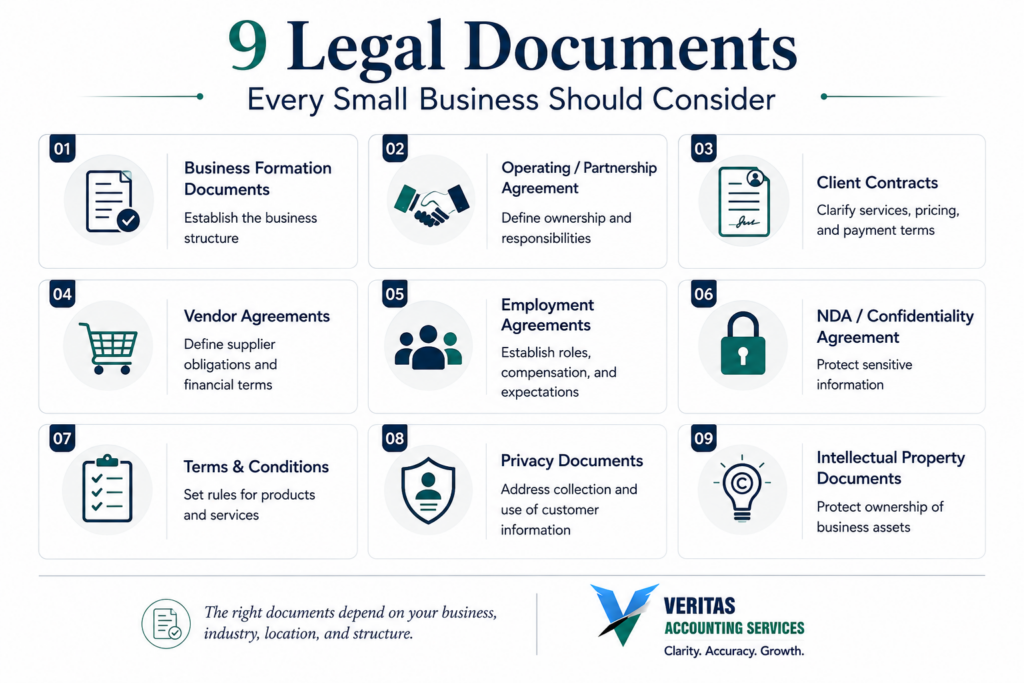
Important Legal Documents Every Small Business Should Consider
The documents a company needs will vary, but several categories are commonly important.
1. Business Formation Documents
When a company is established as an LLC, corporation, partnership, or another structure, formation records establish important information about the business.
Depending on the structure, these may include:
- Articles of incorporation
- Articles of organization
- Partnership agreements
- Operating agreements
- Ownership records
A CA can help explain accounting and tax considerations associated with a structure, while an attorney can advise on legal requirements.
2. Operating and Partnership Agreements
Multiple-owner businesses should carefully document how the company will operate.
These legal documents may address:
- Ownership percentages
- Capital contributions
- Profit and loss allocation
- Voting rights
- Management responsibilities
- Owner compensation
- Transfer restrictions
- Withdrawal procedures
- Dispute resolution
- Dissolution
Putting these matters in writing can prevent serious confusion later.
3. Customer Contracts
Customer contracts are particularly important for service businesses.
A customer agreement may define:
- Scope of work
- Services provided
- Pricing
- Payment terms
- Deadlines
- Deliverables
- Customer responsibilities
- Cancellation conditions
- Confidentiality
- Other applicable terms
A written agreement allows both parties to understand what they are accepting before work begins.
4. Vendor and Supplier Agreements
Businesses should also document important relationships with suppliers and service providers.
Vendor legal documents may establish:
- Pricing
- Payment schedules
- Delivery requirements
- Quality expectations
- Responsibilities
- Confidentiality
- Termination provisions
These arrangements can directly affect operating costs and cash flow.
A CA or financial professional can help evaluate the financial impact of these commitments.
5. Employment and Contractor Agreements
Employees and independent contractors may require different documentation.
Depending on the relationship, agreements can address:
- Compensation
- Responsibilities
- Working arrangements
- Confidentiality
- Intellectual property
- Benefits
- Termination
- Company policies
Employment classification and related requirements can be complex, so businesses should seek appropriate professional advice.
6. Non-Disclosure Agreements
Companies frequently share confidential information with employees, contractors, vendors, partners, and potential investors.
This information could include:
- Customer information
- Pricing
- Financial information
- Business plans
- Product designs
- Marketing strategies
- Proprietary processes
A non-disclosure agreement, commonly called an NDA, can establish expectations regarding confidential information.
7. Terms and Conditions
Businesses operating websites, ecommerce stores, or digital services may need appropriate terms and conditions.
These may cover:
- Payments
- Returns
- Cancellations
- Customer responsibilities
- Service limitations
- Website usage
- Dispute procedures
The appropriate terms depend on the company’s activities and applicable laws.
8. Privacy and Data Protection Documents
Modern businesses often collect customer information through websites, ecommerce platforms, applications, and other systems.
Appropriate privacy documentation can explain how information is:
- Collected
- Used
- Stored
- Shared
- Protected
Privacy requirements vary by location and industry, so professional legal advice may be appropriate.
9. Intellectual Property Documents
Businesses can own valuable intellectual property such as:
- Trademarks
- Copyrights
- Designs
- Software
- Written content
- Branding
- Proprietary processes
Documentation can establish ownership and licensing arrangements.
This becomes especially important when contractors or outside agencies create designs, software, marketing materials, or other assets for the company.

How a CA Can Help With Legal Documents
A CA or accounting professional does not replace an attorney.
However, a CA can provide valuable financial and tax support when legal documents have accounting or financial consequences.
Understanding Financial Impact
Agreements can affect:
- Revenue
- Expenses
- Cash flow
- Liabilities
- Profitability
- Tax considerations
A CA can help business owners understand these consequences before entering into important arrangements.
For example, a long-term supplier agreement may appear commercially attractive but create significant recurring financial commitments.
Evaluating Business Structure
Business structure can have accounting and tax consequences.
A CA can help owners evaluate:
- Tax treatment
- Owner compensation
- Profit distributions
- Capital contributions
- Financial reporting
- Payroll implications
The legal aspects of establishing a structure should be addressed by an appropriate attorney.
Reviewing Financial Terms
Many important business agreements contain financial provisions that deserve careful attention.
A financial professional can help evaluate:
- Payment schedules
- Deposits
- Retainers
- Pricing
- Revenue-sharing arrangements
- Refund obligations
- Late-payment terms
- Financial commitments
The CA’s role is to assess financial and accounting implications rather than provide legal interpretation.
Maintaining Supporting Records
A signed agreement is only part of good business documentation.
Companies should also maintain:
- Invoices
- Receipts
- Payment records
- Bank records
- Tax documents
- Amendments
- Financial schedules
- Supporting correspondence
Accountants can help maintain organized financial records that support these relationships.
How Other Professionals Can Help
Small businesses often benefit from having several professionals contribute to different areas.
Attorney
An attorney can provide legal advice, prepare or review agreements, interpret legal obligations, and assist with disputes.
CA or Accountant
A CA can evaluate accounting, tax, financial, and recordkeeping implications.
CFO or Business Advisor
A CFO or advisor can evaluate financial commitments, risks, profitability, and strategic consequences.
HR Professional
An HR professional can support employment-related processes and documentation.
Insurance Professional
An insurance professional can help assess appropriate business coverage and risk-management requirements.
Each specialist provides a different layer of protection.
Legal Documents and Financial Management Work Together
Legal and financial matters are closely connected.
Consider a simple customer agreement:
Service → Price → Payment Terms → Delivery → Refund Conditions
These terms can eventually affect:
- Revenue
- Accounts receivable
- Cash flow
- Financial reporting
- Tax calculations
- Profitability
A vendor agreement can similarly influence expenses, working capital, and budgeting.
This is why financial professionals should understand the financial implications of important agreements.
Common Mistakes Small Businesses Make
Relying on Verbal Agreements
Important business arrangements should not depend entirely on conversations.
Using Generic Templates
An online template may not reflect the company’s specific circumstances or jurisdiction.
Ignoring Financial Terms
Owners may focus on legal wording while overlooking payment obligations and financial commitments.
Failing to Update Agreements
A document created several years ago may no longer reflect the current business.
Poor Document Organization
Important records should be stored securely and remain accessible to authorized people.
Waiting Until a Dispute Occurs
It is better to establish clear documentation before a problem develops.
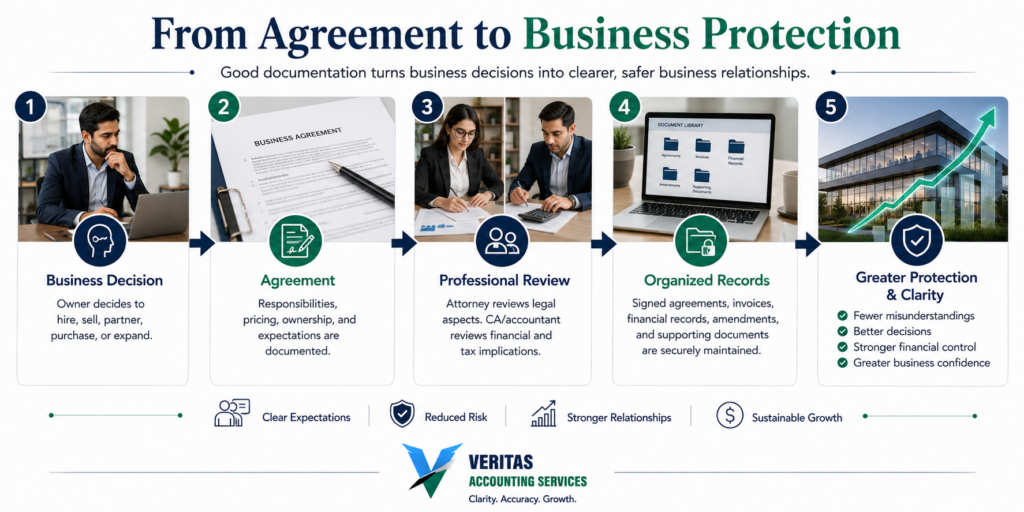
Create a Business Document Management System
Small businesses do not need a complicated system.
A practical digital structure can organize records into categories such as:
Corporate Records
Formation records, ownership information, and company agreements.
Customer Records
Contracts, proposals, service agreements, and amendments.
Vendor Records
Supplier contracts and service agreements.
Employee Records
Employment agreements, policies, and relevant documentation.
Financial Records
Tax documents, invoices, financial statements, and supporting records.
Insurance Records
Policies, certificates, and claims information.
A secure document management system makes it easier to locate important information when management, accountants, auditors, or attorneys need it.
When Should Businesses Review Legal Documents?
Companies should review important legal documents periodically and whenever major changes occur.
Examples include:
- A new owner joins
- An owner leaves
- Ownership percentages change
- The company enters a new market
- New employees are hired
- New services are introduced
- Major contracts are signed
- The company expands geographically
- Significant assets are acquired
- Regulations change
Regular reviews help identify outdated, incomplete, or missing documentation.
Legal Protection Is Part of Business Planning
Business owners naturally focus on revenue, customers, marketing, and profitability.
However, protecting the business is equally important.
Effective legal documents can establish:
Clear ownership
Clear responsibilities
Clear payment expectations
Clear business relationships
Clear financial obligations
Clear processes
This creates a stronger foundation for sustainable growth.
Building the Right Professional Team
A business owner should not expect one professional to handle every aspect of the company.
Instead, different specialists can work together.
The attorney focuses on legal matters.
The CA focuses on accounting and taxation.
The financial advisor focuses on financial planning.
The HR professional focuses on employment processes.
The business advisor focuses on strategy and risk.
When these professionals collaborate, business owners can make better-informed decisions.
The Bottom Line
Legal documents are not simply paperwork stored in a folder.
They help define relationships, clarify responsibilities, establish financial expectations, protect business interests, and reduce uncertainty.
Every small business should identify the documentation appropriate for its structure, industry, location, and operations.
A CA can provide valuable support by explaining accounting and tax implications, reviewing financial terms, organizing supporting records, and identifying situations where additional professional guidance may be appropriate.
Legal advice and legal drafting, however, should be handled by a qualified attorney.
The strongest approach is collaboration.
Legal professionals protect the legal side. Financial professionals protect the financial side. Business leaders bring the information together to make better decisions.
A strong documentation foundation can help a small business operate with greater clarity, confidence, and resilience.
Frequently Asked Questions
Why are legal documents important for a small business?
They help establish ownership, responsibilities, payment terms, business relationships, confidentiality, and other important obligations.
What legal documents should a small business consider?
Depending on the company, these may include formation records, operating agreements, customer contracts, vendor agreements, employment agreements, NDAs, privacy documents, and intellectual property agreements.
Can a CA prepare legal documents?
A CA can provide accounting, tax, and financial guidance, but legal drafting and legal advice should generally be handled by a qualified attorney.
How can a CA help with business agreements?
A CA can review financial provisions and explain their potential accounting, tax, cash-flow, and profitability implications.
How often should business documentation be reviewed?
It should be reviewed periodically and whenever there are significant changes in ownership, operations, contracts, employees, markets, or applicable requirements.
Are online templates enough?
Templates can provide a starting point, but important agreements should be reviewed by an appropriate professional to ensure they fit the company’s circumstances.
GET IN TOUCH
Schedule a FREE Call









Connect on our Socials!
