






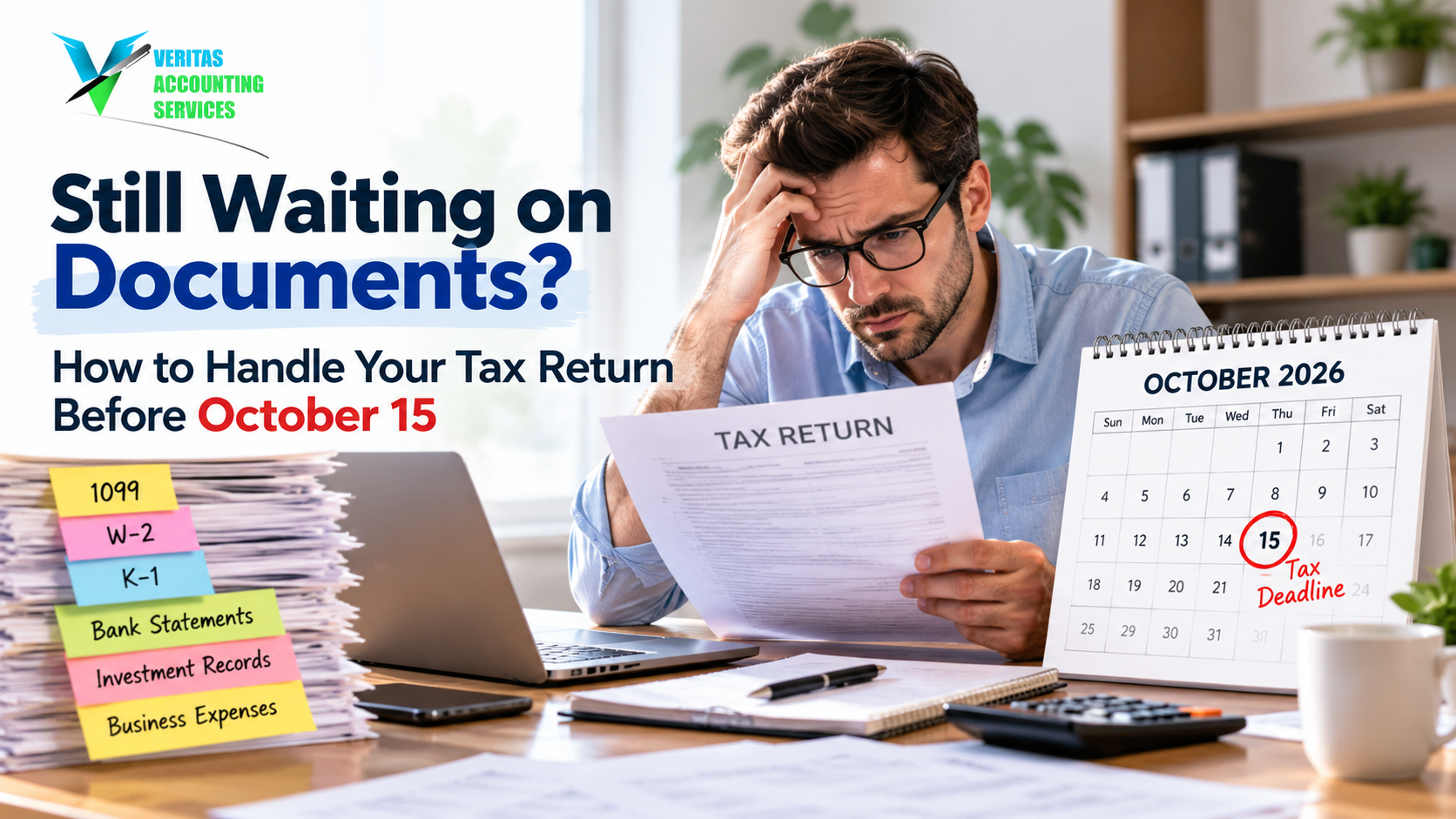

Still Waiting on Documents? How to Handle Your Tax Return Before October 15
Still waiting on tax documents? If you requested an extension for your 2025 U.S. federal income tax return, the October 15 tax deadline is approaching quickly. For many taxpayers, the biggest challenge at this stage is not understanding the filing requirement. It is getting all the information together in time.
A missing 1099, delayed K-1, incomplete bookkeeping, unreconciled bank account, or missing brokerage statement can make the final return difficult to complete. But waiting indefinitely for every document can create even more pressure.
The right approach is to identify what is missing, determine how important it is, obtain replacement information where possible, complete the records you already have, and work toward filing a complete and accurate return.
The October 15 tax deadline is not a reason to panic. It is a reason to organize your remaining work and establish a clear filing plan.
1. Start by Making a List of Every Missing Document
Before contacting anyone or making changes to your tax return, prepare a simple missing-document list.
Separate the items into three categories:
- Documents that are essential to calculate taxable income or deductions.
- Documents that are important but can be obtained from another source.
- Documents that are useful for your records but may not prevent the return from being completed.
Common missing documents include Forms W-2 and 1099, Schedule K-1, brokerage statements, retirement account information, mortgage interest statements, charitable contribution records, health insurance information, business expense records, bank statements, credit-card statements, payroll records, and prior-year tax documents.
For business owners, the list may be much longer. You may also need sales reports, payment processor statements, inventory records, fixed-asset information, loan statements, payroll reports, sales tax records, and details of owner distributions or contributions.
Do not simply tell your tax preparer that documents are missing. Create a specific list showing what is missing, who is expected to provide it, and when you requested it.
This makes the October 15 tax deadline much easier to manage because everyone involved can see exactly what remains outstanding.
A detailed document tracker can also help your tax preparer prioritize the items that have the greatest impact on the return.
2. Contact the Source of the Missing Document
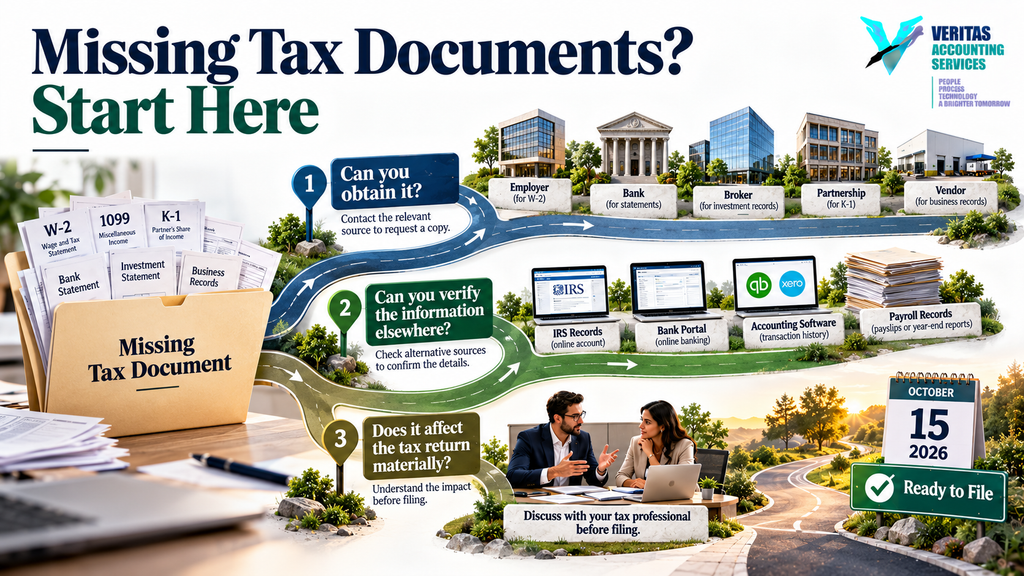
If a tax document has not arrived, contact the organization that should have issued it.
For example, a former employer may be able to provide a replacement W-2. A financial institution may provide a duplicate 1099 or year-end statement. A partnership or S corporation may provide a copy of a K-1. A brokerage firm may allow you to download tax documents directly from its online portal.
Do not assume that the original document is the only source of the information.
You may already have supporting information in your email, accounting system, payroll platform, bank portal, investment account, or prior correspondence.
When requesting a replacement, keep a record of the request. Note the date, person or department contacted, expected delivery date, and any reference number.
This documentation can also help your tax professional understand why a particular document is still unavailable as the October 15 tax deadline approaches.
If a document is still outstanding, communicate that fact clearly rather than allowing your tax preparer to assume that all records have been received.
3. Review Your Prior-Year Tax Return
Your previous tax return can be one of the most useful documents when preparing the current return.
Compare the prior-year return with the current year. Look for recurring sources of income, deductions, investment accounts, business activities, foreign accounts, retirement contributions, depreciation schedules, and other items that may still apply.
This does not mean copying the prior-year return. Tax situations change from year to year.
Instead, use the prior return as a checklist.
For example, if last year’s return included income from several businesses or investment accounts, confirm whether those activities continued during 2025. If a depreciation schedule existed, make sure current-year asset information is available. If a state return was filed, check whether the business or individual still has filing responsibilities in that state.
This review can uncover missing information before the return is finalized.
It is particularly useful when the October 15 tax deadline is approaching and there is limited time for a complete review.
The prior-year return can also help identify recurring forms that you may have overlooked this year.

4. If You Own a Business, Finish the Books Before the Tax Return
For business owners, tax preparation often depends on the quality of the underlying accounting records.
If the books are incomplete, your tax preparer may not be able to determine the correct income, expenses, assets, liabilities, or owner transactions.
Before final tax preparation, review the major accounting areas.
Bank accounts should be reconciled.
Credit-card accounts should be reconciled.
Accounts receivable and accounts payable should be reviewed.
Payroll transactions should agree with payroll reports.
Loan balances should be compared with lender statements.
Fixed assets and depreciation information should be reviewed.
Owner contributions and distributions should be identified correctly.
Sales tax and other tax liabilities should be reviewed.
Income from payment processors should be compared with accounting records.
For e-commerce businesses, sales from platforms such as Shopify, Amazon, Stripe, PayPal, Square, and other processors may need additional reconciliation.
A tax return prepared from incomplete books can create unnecessary questions later. Spending time on bookkeeping cleanup before filing can make the tax return more reliable.
If you are working toward the October 15 tax deadline, do not wait until the final few days to discover that your books are not ready.
For businesses with multiple bank accounts, locations, sales channels, employees, or entities, bookkeeping cleanup may require more time than expected. Starting the review immediately can prevent avoidable delays.
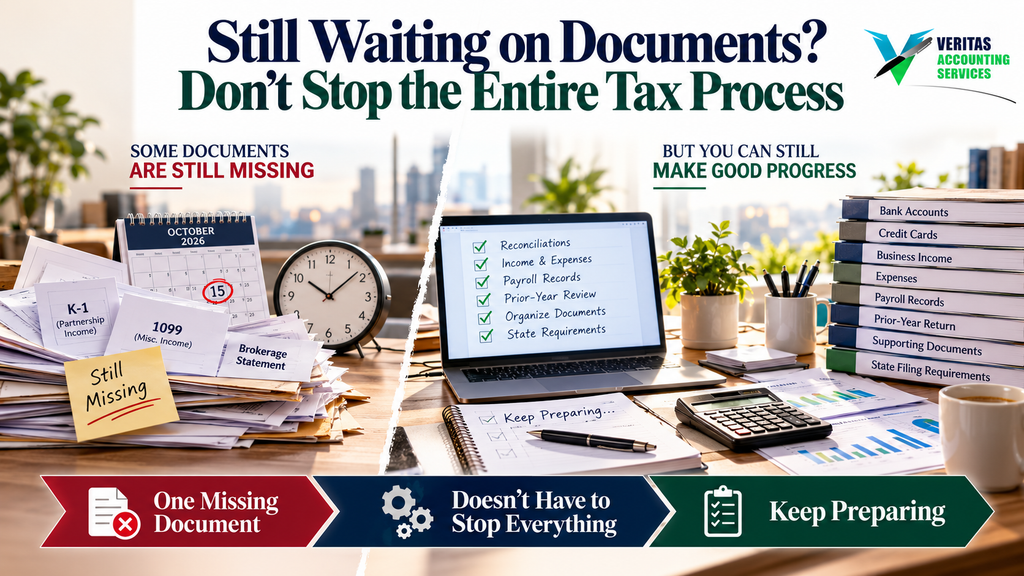
5. Missing Information Does Not Always Mean You Should Stop Everything
One common mistake is putting the entire tax return on hold because one document is missing.
Instead, separate the work that can be completed from the work that depends on the missing document.
For example, your tax preparer may be able to complete the business income statement, reconcile investment transactions already available, review deductions, prepare state information, and organize supporting schedules while waiting for one outstanding statement.
This approach keeps the process moving.
However, do not guess simply to meet a deadline.
If the missing document affects taxable income, basis, a deduction, a credit, or another material item, the correct treatment should be determined before filing.
The goal is not merely to file quickly. The goal is to file accurately and completely based on reliable information.
That distinction becomes especially important as the October 15 tax deadline gets closer.
A good tax preparation process should identify dependencies early. If one missing document affects several calculations, your preparer should know that immediately rather than discovering it during the final review.
6. Check Your IRS Account and Available Tax Records
For individual taxpayers, an IRS Online Account can provide useful information, including certain tax records, payment history, and other account information.
If you are missing a federal information document, checking what is available through IRS records may help your tax professional verify reported income or other information.
However, IRS records should not automatically replace the taxpayer’s own documentation.
You should still retain your supporting records and statements.
For business owners, bank statements, accounting records, payroll reports, payment processor reports, invoices, receipts, and other source documents remain important for establishing the accuracy of the return.
Use available IRS information as another verification tool, not as a substitute for maintaining proper records.
This can be particularly helpful when working under the October 15 tax deadline and trying to resolve discrepancies.
The IRS has also advised extension filers to complete their returns and file by October 15 when that is their applicable deadline. IRS Careers
Checking your tax account early can also help identify payments that may not have been reflected in your internal records.
7. Do Not Forget State Tax Requirements
Federal filing is only one part of the process.
Depending on where you live, where your business operates, and where you have tax obligations, a state income tax return or other state filing may also be required.
A taxpayer who moved during the year, owns a business operating in multiple states, or sells products to customers in different states may have additional compliance considerations.
State deadlines do not always follow the federal deadline in exactly the same way.
Before filing, confirm the state requirements that apply to your particular situation.
For business owners, also review state registrations, estimated payments, sales tax obligations, payroll tax filings, and other state requirements where applicable.
A complete filing plan should therefore consider both federal and state obligations as the October 15 tax deadline approaches.
This is particularly important for businesses that expanded into new states during the year. A business may have obligations in a state even when its owners do not physically live there.
8. Remember That an Extension Gives More Time to File, Not More Time to Pay
This is one of the most important points for anyone filing an extended return.
For most calendar-year individual taxpayers, an approved extension moves the federal filing deadline to October 15, 2026. The IRS makes clear that an extension of time to file does not generally extend the time to pay tax. IRS
If you owed tax and did not pay the balance by the original due date, interest and applicable penalties may continue to accrue.
Therefore, do not assume that having an extension means there is no financial consequence until October.
Review payments already made, including withholding and estimated tax payments. Then work with your tax professional to determine whether an additional payment is appropriate.
The IRS also provides electronic payment options for taxpayers who need to make a payment. Direct Pay
Understanding this distinction is critical when planning around the October 15 tax deadline.
If you are uncertain about your potential balance due, discuss the situation with your tax professional rather than waiting until the filing date.
9. What If One Document Still Does Not Arrive?
If a document remains unavailable, discuss the situation with your tax professional rather than making an unsupported estimate.
The appropriate response depends on the type of document and the information it contains.
Your tax professional may be able to determine the amount using other reliable records, obtain a replacement document, or identify another appropriate way to substantiate the information.
For example, bank records may help verify certain transactions, payroll records may help reconstruct compensation information, and accounting records may help establish business income and expenses.
The important point is that the supporting evidence should be reliable and sufficient for the tax position being reported.
If a correction is required later, an amended return may sometimes be appropriate. But an amended return should not be treated as a reason to knowingly file an inaccurate original return.
If the October 15 tax deadline is close and a significant document is still missing, escalate the issue immediately.
Your tax preparer can then determine whether the missing information can be obtained, reconstructed from reliable records, or requires another appropriate response.
10. Create a Final Filing Schedule
At this stage, your tax preparation should have a specific timetable.
Do not simply tell yourself that you will finish before October 15.
Set internal deadlines.
For example:
- Complete missing-document requests.
- Finish bookkeeping cleanup.
- Reconcile bank and credit-card accounts.
- Review income and expenses.
- Complete tax schedules.
- Review federal and state returns.
- Calculate the expected balance or refund.
- Perform a final quality review.
- Submit the return electronically or by the appropriate filing method.
Give yourself a buffer rather than treating October 15 as the day you intend to start filing.
This is especially important if your return is complicated or requires multiple schedules.
A practical internal target should be earlier than the October 15 tax deadline so that unexpected questions do not turn into a last-minute crisis.
11. What Should You Do If You Know You Cannot Finish?
If you have a valid extension but realize that the return still cannot be completed by October 15, do not simply ignore the situation.
Contact your tax professional immediately and determine the best course of action based on your circumstances.
For most taxpayers, October 15 is the end of the standard six-month extension period. Certain taxpayers may qualify for different deadlines because of special circumstances, such as certain disaster-related relief or other specific situations.
If the standard deadline applies to you, filing as soon as possible after the deadline is generally better than continuing to wait. The IRS advises taxpayers who miss a filing deadline to file as soon as possible and pay what they can to reduce additional interest and penalties. Taxpayer Advocate Service
The key lesson is simple: do not let an incomplete document become an excuse for inaction.
If you are approaching the October 15 tax deadline with unresolved issues, communicate with your tax professional immediately and document the steps being taken to complete the return.
Final Checklist Before Filing
Before submitting your return, confirm the following:
- All income sources have been identified.
- Missing tax documents have been obtained or appropriately addressed.
- Business books are complete and reconciled.
- Bank and credit-card accounts have been reviewed.
- Payroll information agrees with payroll records.
- Investment and brokerage information has been reviewed.
- Business deductions have supporting documentation.
- State filing requirements have been considered.
- Estimated tax payments and withholding have been verified.
- Any balance due has been reviewed.
- Federal and state returns have been reviewed for consistency.
- All required schedules and forms are included.
- The return is ready for electronic or paper filing.
Conclusion
Waiting for tax documents can be frustrating, especially when the filing deadline is approaching. But the solution is not to wait passively for every document to appear.
Start by identifying exactly what is missing. Contact the organizations that should provide the documents. Review prior-year information and available IRS records. Complete your bookkeeping and reconciliations. Separate work that can be completed now from work that depends on missing information.
Most importantly, communicate with your tax professional early.
The October 15 tax deadline should be treated as a firm planning target, not as a date to begin preparing your return. A structured process gives you more time to identify discrepancies, resolve missing information, review the final return, and address any balance due.
If your tax return is still incomplete because your bookkeeping is not finalized or important records are missing, getting professional help can prevent a last-minute rush.
Veritas Accounting Services helps U.S. businesses and individuals with bookkeeping, tax preparation support, reconciliations, financial records, and year-end tax readiness. If you are still waiting on documents and need help getting your records organized before the October 15 tax deadline, our team can help you identify what is missing, clean up the underlying records, and prepare the information your tax professional needs.
The best time to resolve missing records is before they become a filing problem. With a clear checklist, organized bookkeeping, timely communication, and professional review, you can approach the October 15 tax deadline with much greater confidence.
GET IN TOUCH
Schedule a FREE Call










Connect on our Socials!
