📩 Get A Quote : hello@veritasaccountingservices.com
Remote Company Culture

Beyond Zoom: How to Build a Strong Remote Company Culture

Remote work has changed where people work, but it has not changed what people expect from a good workplace.

Employees still want to feel trusted, supported, recognized, and connected to their team. The challenge is that remote companies cannot depend on office conversations, shared lunches, or quick chats at someone’s desk to create those connections.

That is why building a strong remote company culture requires more than scheduling regular video meetings.

A healthy remote company culture is created through everyday actions: how managers communicate, how employees are recognized, how decisions are made, how new people are welcomed, and how teams stay connected when they work from different locations.

What Is Remote Company Culture?

Remote company culture is the way people communicate, collaborate, make decisions, solve problems, and work together when they are not physically in the same workplace.

It is not simply a remote work policy.

A company’s culture shows up in questions such as:

  • Can employees ask questions comfortably?
  • Do managers trust their teams?
  • Are expectations clear?
  • Do people feel comfortable sharing ideas?
  • Is good work recognized?
  • Can employees easily find the information they need?
  • Do people understand what the company stands for?

A strong remote company culture makes employees feel like part of a team even when everyone is working from different places.


Remote Company Culture Doesn’t Happen Automatically

One of the biggest mistakes companies make is assuming that culture will naturally develop after hiring a remote team.

It usually doesn’t.

In a traditional office, employees have countless informal interactions throughout the day. They talk before meetings, walk over to a colleague’s desk, have lunch together, or simply exchange a few words while getting coffee.

Remote employees don’t have those same opportunities.

If a company doesn’t intentionally create opportunities for communication and connection, employees can gradually become disconnected from the wider team.

Building remote company culture therefore requires deliberate effort.


Start With Trust

A strong remote company culture starts with trust.

Remote employees don’t need someone constantly checking whether they are online. They need clear expectations and the freedom to complete their work.

Instead of focusing on:

“Are you online?”

managers should focus on:

“Are we on track to achieve the expected result?”

Trust becomes easier when employees clearly understand:

  • Their responsibilities
  • Deadlines
  • Expected outcomes
  • Communication standards
  • Availability requirements
  • Decision-making authority

When expectations are clear, employees can work independently without feeling constantly monitored.

That independence can become one of the biggest advantages of remote work.


Create Clear Communication Rules

Communication is one of the most important parts of remote company culture.

Without clear communication, employees may either receive too little information or become overwhelmed by messages and meetings.

Neither situation is productive.

Create simple rules for different types of communication.

Use Chat For:

  • Quick questions
  • Short updates
  • Urgent matters
  • Simple coordination

Use Email or Shared Documents For:

  • Important information
  • Formal communication
  • Decisions
  • Detailed instructions

Use Meetings For:

  • Discussions
  • Planning
  • Problem-solving
  • Topics that require real-time collaboration

The objective isn’t more communication.

The objective is better communication.


Don’t Make Every Meeting Mandatory

Video calls can help strengthen remote company culture, but too many meetings can have the opposite effect.

Employees can spend much of their day moving from one call to another while struggling to complete their actual work.

Before scheduling a meeting, ask:

“Does this really need to be a meeting?”

If not, consider using:

  • A written update
  • A shared document
  • A project management comment
  • A recorded video
  • A quick message

When meetings are necessary, give them a clear purpose and agenda.

A good remote company culture gives employees both opportunities for connection and enough uninterrupted time to work.


Create Space for Informal Conversations

Not every interaction should be about deadlines, projects, and performance.

People also need opportunities to talk about things that aren’t directly related to work.

Companies can create informal opportunities through:

  • Virtual coffee chats
  • Team celebrations
  • Informal group discussions
  • Birthday messages
  • Interest-based chat groups
  • Short team catch-ups
  • Online social activities

These activities should not feel forced.

The purpose is simply to give people opportunities to know the individuals behind the job titles.

Small conversations can make a remote company culture feel much more human.


Make New Employees Feel Included

Joining a remote company can feel very different from joining an office.

A new employee cannot simply look around and figure out who does what.

That makes onboarding especially important.

New employees should understand:

  • Who their manager is
  • Who they can approach with questions
  • How communication works
  • Which meetings they should attend
  • Where important information is stored
  • What their first priorities are
  • How their performance will be evaluated

Assigning an experienced team member as a point of contact can also help.

It gives new employees someone they can approach with smaller questions without feeling uncomfortable.

A thoughtful onboarding process is one of the first building blocks of a strong remote company culture.


Recognize Good Work

When employees work remotely, their contributions can sometimes become less visible.

A person who consistently solves problems or helps customers may not receive the same recognition they would naturally receive in an office.

Managers should therefore make recognition intentional.

For example:

  • Mention achievements during team meetings
  • Share wins in the team communication channel
  • Thank employees for solving difficult problems
  • Celebrate milestones
  • Recognize people who help colleagues

Recognition doesn’t always need to involve money.

A genuine and specific thank-you can have a meaningful impact.

Instead of saying:

“Great job.”

say:

“Thank you for identifying that reporting issue before it affected the client. That saved the team a lot of time.”

Specific recognition makes people feel seen.

Give Employees a Voice

A healthy remote company culture should not be created entirely from the top down.

Employees should have opportunities to share:

  • Ideas
  • Concerns
  • Suggestions
  • Process improvements
  • Feedback

Managers can use regular one-on-one meetings, surveys, or team discussions to collect feedback.

But asking for feedback is only useful when the company is willing to act on it.

If employees repeatedly share suggestions and never see any change, they may eventually stop speaking up.

Listening matters.

Acting on useful feedback matters even more.


Document How the Company Works

Remote teams depend heavily on shared information.

If important knowledge exists only in someone’s memory, private messages, or individual files, employees may struggle to find what they need.

Create a central place for important information such as:

  • SOPs
  • Policies
  • Training materials
  • Project information
  • Client procedures
  • Team responsibilities
  • Frequently asked questions

This becomes even more important as the company grows.

Good documentation supports remote company culture because employees don’t have to depend on one particular person for every answer.

It also protects valuable knowledge when employees leave.


Focus on Outcomes, Not Online Activity

One common mistake in remote management is confusing activity with productivity.

An employee can be online all day without producing meaningful results.

Another employee may complete important work efficiently while spending less time visibly online.

Managers should therefore focus on outcomes.

Set clear goals and measure whether expected work is being completed.

Ask:

  • What needs to be completed?
  • Who owns it?
  • When is it due?
  • What does success look like?
  • Are there obstacles?
  • What support is required?

This creates accountability without unnecessary micromanagement.

A remote company culture becomes healthier when employees know they are trusted to deliver results.


Build Culture Around Shared Values

Company values should be more than words on a website.

They should influence everyday decisions.

If a company says it values accountability, managers should take responsibility when something goes wrong.

If it values customer service, employees should see that reflected in decisions.

If it values learning, employees should receive opportunities to improve their skills.

If it values transparency, important information should not be unnecessarily hidden.

This is how remote company culture becomes real.

Values become meaningful when employees see them in action.

Don’t Forget the Human Side

Remote work can be flexible and productive, but it can also become isolating.

Some employees may spend most of their working day alone.

Managers should therefore create an environment where employees feel comfortable saying:

“I’m having trouble with this.”

without worrying that asking for help will be viewed negatively.

Managers should also pay attention to workload, communication problems, and signs of disengagement.

This does not mean constantly monitoring employees.

It means creating an environment where people know support is available when they need it.


Give Teams Opportunities to Meet

Remote doesn’t necessarily have to mean never meeting in person.

When practical, companies can organize:

  • Annual team events
  • Planning sessions
  • Training days
  • Department meetings
  • Company retreats

These gatherings aren’t essential for every remote business, but when possible, meeting face-to-face can strengthen relationships.

The purpose shouldn’t be to recreate the office.

It should be to create meaningful connections that make future remote collaboration easier.


Measure Your Culture

Company culture can seem difficult to measure, but employee feedback can provide useful signals.

Ask employees questions such as:

  • Do you understand what is expected from you?
  • Do you feel comfortable asking for help?
  • Do you feel connected to your team?
  • Do you receive useful feedback?
  • Do you feel recognized?
  • Do you have the information needed to do your job?
  • Do you trust your manager?
  • What is one thing we could improve?

You don’t need a complicated survey.

A few honest questions can reveal problems before they become bigger issues.

Regular feedback also shows employees that their experience matters.


Common Remote Culture Mistakes

Even companies with good intentions can make mistakes when building remote company culture.

Too Many Meetings

More meetings don’t automatically create stronger relationships.

Constant Monitoring

Tracking every online activity can reduce trust and increase stress.

Forced Social Activities

Not everyone enjoys virtual games or informal calls. Give employees choices.

Poor Documentation

If information is scattered across emails, chats, and individual files, employees will struggle to find answers.

Inconsistent Communication

If some employees receive important information while others don’t, teams can quickly become disconnected.

Ignoring Remote Employees

Remote employees should not feel like outsiders simply because they aren’t physically present.


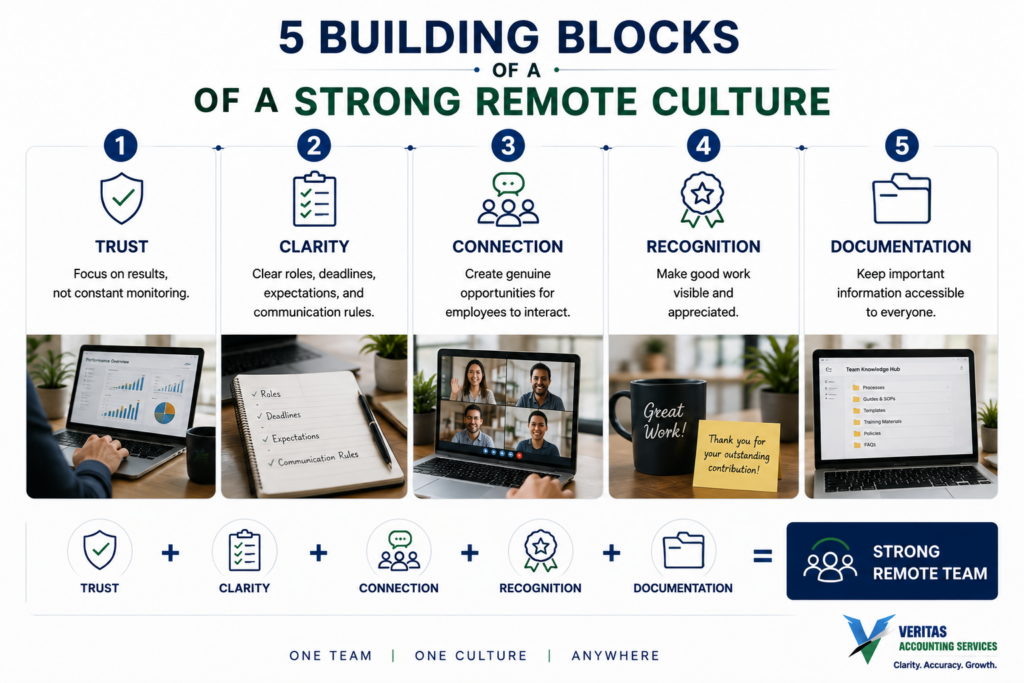
A Simple Framework for Remote Company Culture

If you’re building a remote team, start with five areas.

1. Trust

Give employees responsibility and judge performance based on results.

2. Clarity

Make roles, deadlines, expectations, and communication standards clear.

3. Connection

Create genuine opportunities for employees to interact beyond daily tasks.

4. Recognition

Make good work visible and appreciated.

5. Documentation

Make important information easy for everyone to find.

These five areas provide a practical foundation for remote company culture.


Culture Is Built Every Day

There is no single activity that creates a great remote workplace.

Culture is built through hundreds of small decisions.

How does a manager respond to a mistake?

How quickly does a new employee receive help?

Does someone’s contribution get recognized?

Do employees feel trusted?

Can people ask questions without hesitation?

Can everyone access important information?

These everyday experiences become the culture.

Technology can make remote work possible, but technology alone cannot create connection.

Video calls, chat platforms, project management software, and shared documents are simply tools.

The culture comes from how people use them.


Final Thoughts

Building a remote company culture isn’t about trying to recreate an office through video calls.

It is about creating an environment where people can communicate clearly, work independently, collaborate effectively, and feel connected to the organization.

Trust your employees.

Set clear expectations.

Document important processes.

Create space for human connection.

Recognize good work.

Listen to your team.

And make culture part of everyday management rather than treating it as a once-a-year initiative.

A strong remote company culture doesn’t happen because everyone attends the same Zoom meeting.

It happens when employees feel that they are part of something, even when they are working from different places.

That is the real goal of building remote company culture.

Schedule a FREE Call


GET IN TOUCH

What to Do When You Pay for Business Expenses Personally

A practical guide to documenting business purchases you paid for personally, matching any repayment…

When the Bank Balance and Your Books Disagree

A practical month-end walkthrough for comparing your bank statement and books, with a worked example…

Vendor Bills and a Simple Routine for Better Cash Planning

A practical weekly routine for checking supplier bills, planning the payment batch and matching what…

Tax Bracket Mistakes: A Simple Guide to Better Planning

The November 5 IRS inflation update is a prompt to review your planning assumptions. Learn how…

Your Simple Guide to PTIN Renewal Mistakes and Better Records

The November 4 IRS reminder is a timely prompt to check 2027 preparer renewals, separate enrolled…

Inventory Tax Mistakes: A Simple Guide to Better Records

Stock purchases do not automatically equal a tax deduction. Review the inventory method, quantities…

Payroll Deposit Mistakes: A Simple Guide to Better Records

A quarterly payroll return does not set every tax deposit deadline. Check the schedule, actual pay…

Your Simple Guide to Home Office Mistakes and Better Records

Working from home does not automatically create a deduction. Check eligibility, space, dates…

Your Simple Guide to Unpaid Invoice Mistakes and Better Records

An unpaid customer invoice is not automatically a tax deduction. Review the tax accounting method…

SOP vs Checklist

SOP vs Checklist: Which One Does Your Business Need?

As a business grows, work becomes harder to manage consistently. A small team can rely on verbal instructions, but a growing team needs documented processes.

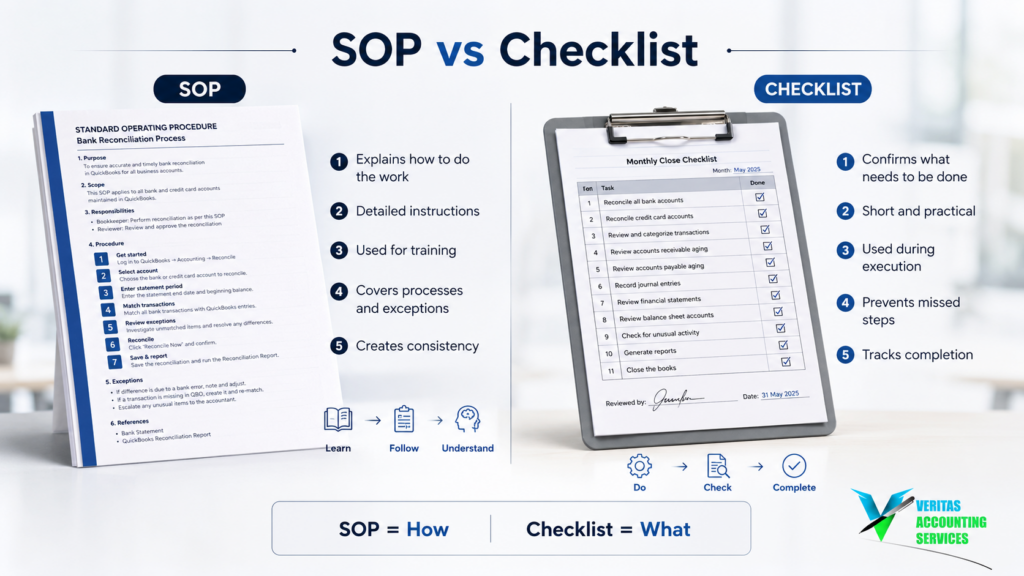
SOP vs Checklist is a useful distinction because the two tools solve different problems. An SOP explains how work should be performed. A checklist confirms that the required work was completed.

Understanding SOP vs Checklist can help your business reduce errors, train employees, and create repeatable processes.

What Is an SOP?

SOP stands for Standard Operating Procedure.

An SOP is a documented set of instructions explaining how a particular task or process should be performed.

A typical SOP may explain:

  • What needs to be done
  • Why the process is important
  • Who is responsible
  • When it should happen
  • What tools are required
  • What steps should be followed
  • What to do when something goes wrong
  • Who reviews the completed work

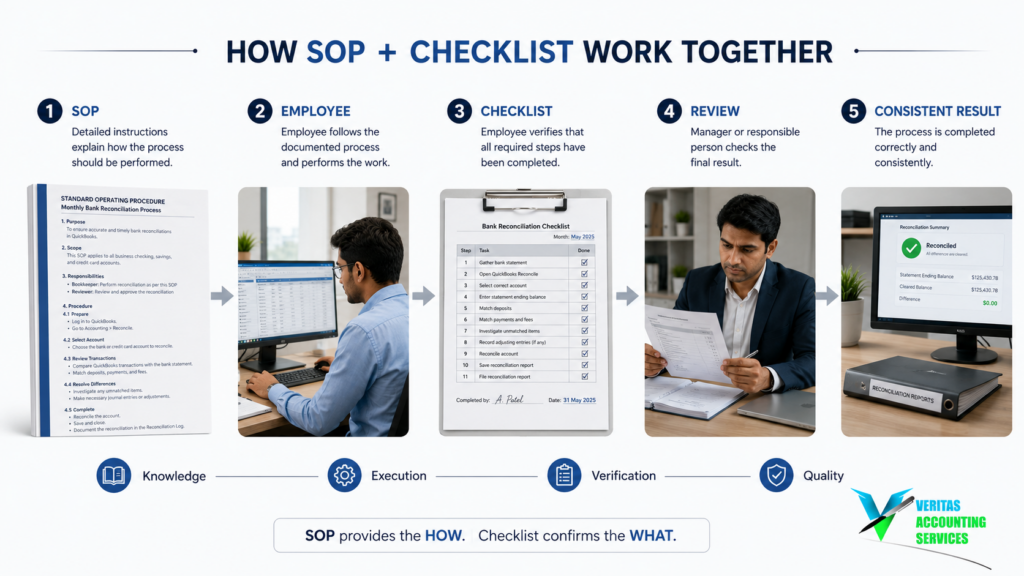
For example, a bookkeeping company might have an SOP for month-end accounting. It could explain how to review transactions, reconcile accounts, record adjustments, review financial statements, and complete the month-end closing process.

An SOP turns individual knowledge into a repeatable company process.

What Is a Checklist?

A checklist is a short list of actions that need to be completed.

A month-end checklist might include:

  • Bank accounts reconciled
  • Credit cards reconciled
  • Accounts receivable reviewed
  • Accounts payable reviewed
  • Payroll recorded
  • Financial statements reviewed
  • Reports completed

A checklist does not normally explain every detail. It reminds the employee what must be done.

SOP vs Checklist: The Main Difference

The simplest way to understand SOP vs Checklist is to think about two questions.

An SOP answers:

“How should I do this?”

A checklist answers:

“What do I need to complete?”

For example, a client onboarding SOP could explain how to collect information, create the client profile, obtain software access, assign responsibilities, and complete the first review.

The related checklist could confirm:

  • Agreement signed
  • Client information received
  • Documents received
  • Software access provided
  • Opening balances reviewed
  • First meeting completed

That is the core SOP vs Checklist difference.

SOP vs Checklist: Quick Comparison

SOPChecklist
Explains how to perform a processConfirms tasks are completed
Provides detailed instructionsProvides reminders
Useful for trainingUseful for execution
Helps standardize proceduresHelps prevent missed steps
Can explain exceptionsUsually follows defined steps
Best for complex workBest for repetitive work

The right choice depends on the process.

When Should You Use an SOP?

An SOP is useful when a process is complex, important, or difficult to learn.

Create one when:

  • A process has several steps
  • New employees need training
  • Several people perform the same task
  • Important decisions are involved
  • The process has exceptions
  • Errors could be costly
  • Only one employee knows how to perform it

Payroll, client onboarding, month-end accounting, and quality control are common examples.

In these situations, the detailed procedure provides the knowledge employees need.

When Is a Checklist Enough?

A checklist may be enough when employees already understand the process.

An office closing checklist, for example, might say:

  • Lock the entrance
  • Shut down equipment
  • Check meeting rooms
  • Secure documents
  • Check windows
  • Set the security system

There is little value in creating a long document for a simple task.

This is an important point in SOP vs Checklist: documentation should match the complexity of the work.

SOP vs Checklist in Accounting

Accounting is a good example of how the two tools can work together.

A month-end SOP could explain how to reconcile bank accounts, review credit cards, check receivables and payables, record adjustments, and review financial statements.

The checklist could then confirm:

  • Bank reconciliation completed
  • Credit card reconciliation completed
  • Receivables reviewed
  • Payables reviewed
  • Adjustments recorded
  • Financial statements reviewed
  • Reports finalized

The SOP explains the method. The checklist confirms completion.

This practical combination makes the SOP vs Checklist concept easier to apply in daily operations.

SOP vs Checklist for Employee Training

If the main goal is training, an SOP is usually more useful.

A checklist can tell a new employee what tasks exist, but it may not explain how the company expects those tasks to be performed.

For example, “Complete bank reconciliation” is a checklist item. An SOP can explain where to obtain the statement, how to investigate differences, how to handle outstanding items, and who reviews the work.

Once the employee understands the procedure, the checklist can support regular execution.

SOP vs Checklist for Reducing Errors

Both tools reduce errors, but they address different causes.

An SOP helps prevent mistakes caused by not knowing the correct process.

A checklist helps prevent mistakes caused by forgetting a required step.

If an employee does not know how to process a refund, better instructions are needed. If an experienced employee knows the process but sometimes forgets to document approval, a checklist may help.

This distinction is one of the most useful parts of SOP vs Checklist.

Why Growing Businesses Need SOPs

As a company grows, founders cannot personally explain every process to every employee.

With five employees, answering questions may be manageable. With 50 employees, it becomes inefficient.

SOPs document important knowledge so employees can refer to the same process instead of repeatedly asking the founder.

They can improve training, consistency, accountability, and independence.

Why Growing Businesses Need Checklists

More employees also mean more tasks, deadlines, and opportunities to miss small steps.

A checklist provides a simple control for repetitive work such as:

  • Month-end closing
  • Payroll
  • Client onboarding
  • Employee onboarding
  • Payment processing
  • Bank reconciliation
  • Quality control

Employees do not need to reread a long procedure every time they perform a familiar task. A checklist gives them a quick completion check.

When You Need Both

Some processes need both tools.

Consider employee onboarding. The SOP can explain how documents are collected, systems are created, access is approved, and training is completed.

The checklist can confirm:

  • Employment documents received
  • Payroll setup completed
  • Email created
  • Software access provided
  • Training scheduled
  • Manager assigned

The SOP provides instructions. The checklist provides execution control.

This is often the best answer when a business is deciding between SOP vs Checklist for an important recurring process.

Don’t Create an SOP for Everything

More documentation does not automatically mean better processes.

Before creating an SOP, ask:

  • Does the process require explanation?
  • Could someone make an expensive mistake without instructions?
  • Are several decisions involved?
  • Would a new employee need training?
  • Do different employees need to follow the same method?

If yes, an SOP may be appropriate.

If the process is simple and already understood, a checklist may be enough.

Don’t Use a Checklist When Employees Need Instructions

The opposite mistake is also common.

A business may create a checklist for a complicated process and expect employees to figure out the details.

For example:

  • Review payroll
  • Approve payroll
  • Process payroll
  • Record payroll

These items do not explain how the work should be performed.

If the process involves important decisions, financial information, compliance, or multiple systems, an SOP is more appropriate.

A checklist cannot replace proper instructions.

How to Create a Useful SOP

A practical SOP can include:

Purpose

Explain why the process exists.

Owner

Identify who is responsible.

Frequency

Explain when it should happen.

Tools

List the required software and documents.

Procedure

Explain the steps in order.

Exceptions

Explain what to do when something goes wrong.

Review

Identify who checks the completed work.

Keep it practical. Employees should be able to use it without unnecessary detail.

How to Create a Useful Checklist

A good checklist should be short and action-oriented.

For example, a weekly accounts receivable checklist could include:

  • Review outstanding invoices
  • Identify overdue accounts
  • Send payment reminders
  • Record received payments
  • Investigate unusual balances
  • Report significant issues

The employee should be able to understand the required action immediately.

SOP vs Checklist: A Simple Decision

Choose an SOP when the process is complex, employees need training, multiple people perform the task, important decisions are involved, or errors could be costly.

Choose a checklist when the process is simple, employees already understand it, tasks are repetitive, and the main risk is forgetting a step.

Use both when the process is important, recurring, and needs both clear instructions and completion control.

The best SOP vs Checklist choice depends on complexity, risk, and frequency.

Keep Your Documentation Updated

Creating documentation once is not enough.

Software changes. Employees change. Responsibilities change. Processes improve.

Review important SOPs and checklists periodically.

Ask:

  • Is the process still correct?
  • Are responsibilities accurate?
  • Are software instructions current?
  • Have steps changed?
  • Have new risks appeared?
  • Can anything be simplified?

Your documentation should evolve with the business.

SOP vs Checklist: The Best Approach

The goal is not to create more documents. The goal is to make important work repeatable.

An SOP gives employees the knowledge they need. A checklist gives them a practical way to execute that knowledge consistently.

Together, they can help businesses reduce errors, improve training, increase accountability, reduce founder dependency, and improve operational efficiency.

That is why SOP vs Checklist is an important conversation for growing businesses.

Final Thoughts

SOPs and checklists solve different problems.

An SOP answers:

“How should this process be performed?”

A checklist answers:

“Have we completed everything?”

If employees repeatedly ask how something should be done, create an SOP.

If employees know what to do but sometimes forget steps, create a checklist.

If the process is important, repetitive, and requires consistency, use both.

The real value is not the document itself. It is the consistency and independence those tools create.

For a growing business, that can mean fewer mistakes, faster training, better accountability, and less dependence on the founder.

Once you understand SOP vs Checklist, it becomes much easier to decide what each process actually needs.

Frequently Asked Questions

What is the difference between an SOP and a checklist?

An SOP explains how a process should be performed, while a checklist confirms that required tasks have been completed.

Is an SOP better than a checklist?

Not necessarily. An SOP is better for complex processes and training, while a checklist is useful for simple and repetitive tasks.

Can an SOP and checklist be used together?

Yes. Many businesses use an SOP for detailed instructions and a checklist for regular execution.

When should a small business create an SOP?

Create an SOP when a process is important, repeated frequently, difficult to learn, or dependent on one employee’s knowledge.

How long should an SOP be?

There is no fixed length. It should contain enough information for the employee to perform the process correctly without unnecessary detail.

Schedule a FREE Call


GET IN TOUCH

What to Do When You Pay for Business Expenses Personally

A practical guide to documenting business purchases you paid for personally, matching any repayment…

When the Bank Balance and Your Books Disagree

A practical month-end walkthrough for comparing your bank statement and books, with a worked example…

Vendor Bills and a Simple Routine for Better Cash Planning

A practical weekly routine for checking supplier bills, planning the payment batch and matching what…

Tax Bracket Mistakes: A Simple Guide to Better Planning

The November 5 IRS inflation update is a prompt to review your planning assumptions. Learn how…

Your Simple Guide to PTIN Renewal Mistakes and Better Records

The November 4 IRS reminder is a timely prompt to check 2027 preparer renewals, separate enrolled…

Inventory Tax Mistakes: A Simple Guide to Better Records

Stock purchases do not automatically equal a tax deduction. Review the inventory method, quantities…

Payroll Deposit Mistakes: A Simple Guide to Better Records

A quarterly payroll return does not set every tax deposit deadline. Check the schedule, actual pay…

Your Simple Guide to Home Office Mistakes and Better Records

Working from home does not automatically create a deduction. Check eligibility, space, dates…

Your Simple Guide to Unpaid Invoice Mistakes and Better Records

An unpaid customer invoice is not automatically a tax deduction. Review the tax accounting method…

business growth

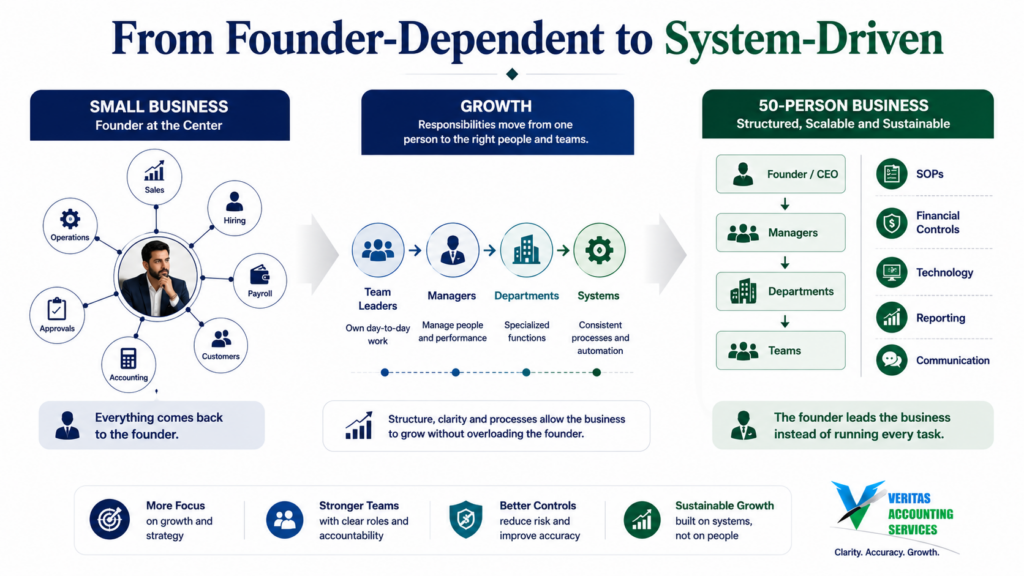
From 5 to 50 Employees: What Changes as Your Business Grows?

Going from 5 employees to 50 is a major milestone.

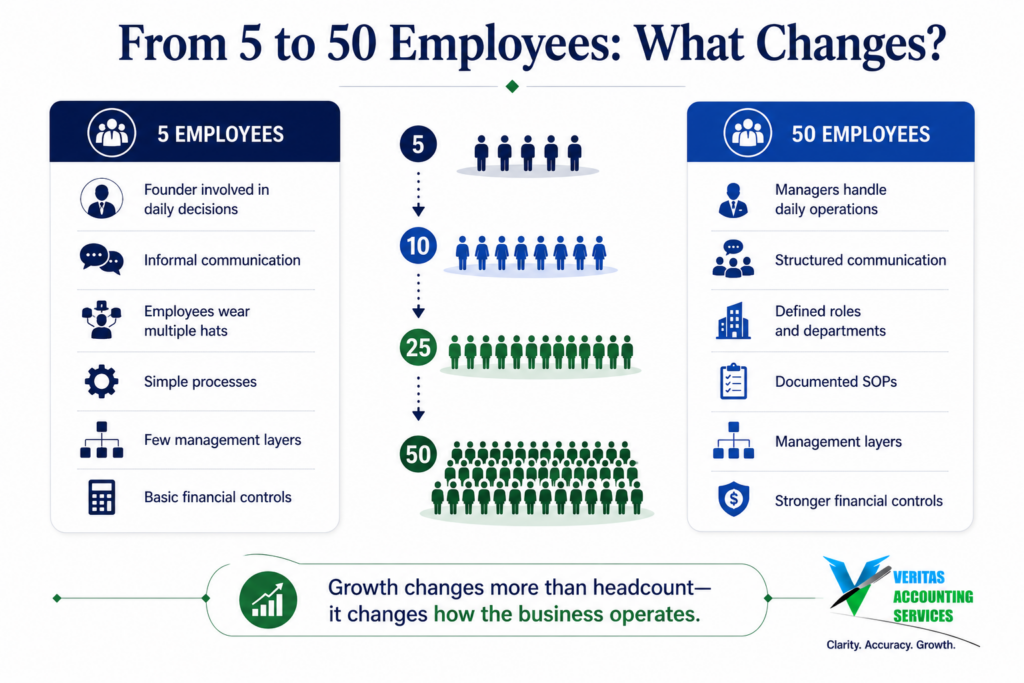
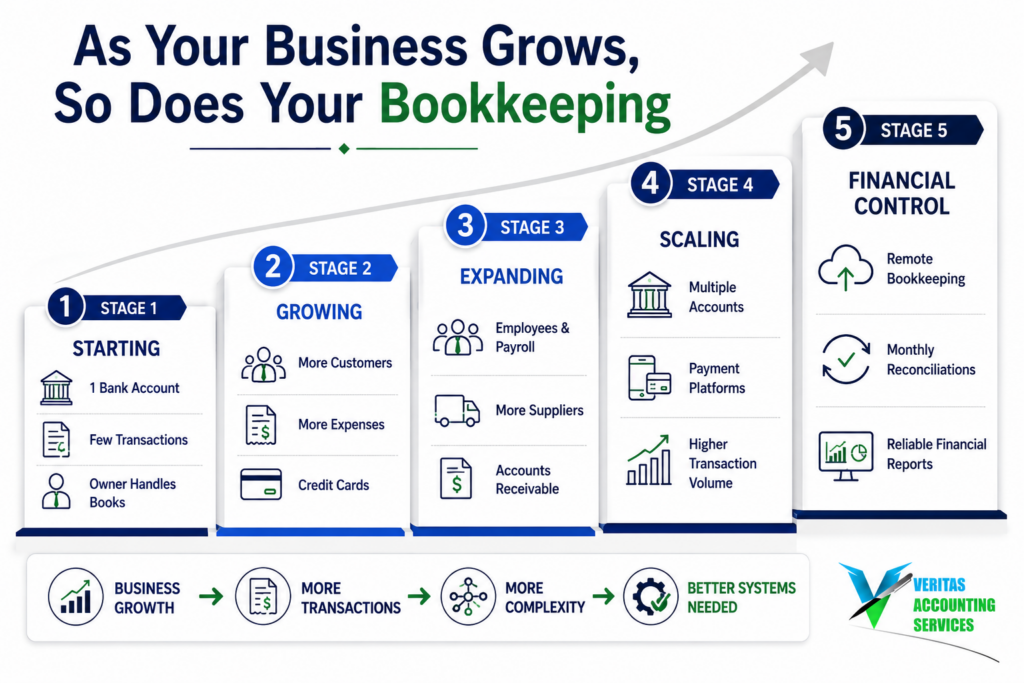
It means more customers, more revenue, more responsibilities, and usually more opportunities. But it also changes the way the business needs to operate.

The systems that worked perfectly when you had five people may start creating problems when you have 20. The informal communication that worked with 10 employees may become inefficient at 30. And the founder who could personally approve every decision may become a bottleneck at 50.

This is one of the less obvious challenges of business growth.

Adding employees is relatively straightforward. Building the structure needed to manage those employees effectively is much harder.

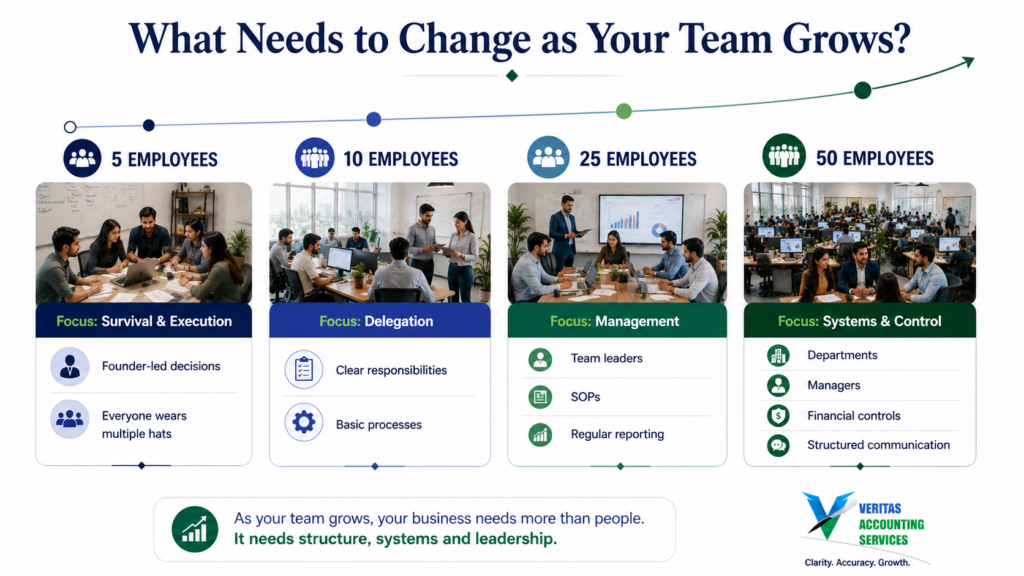
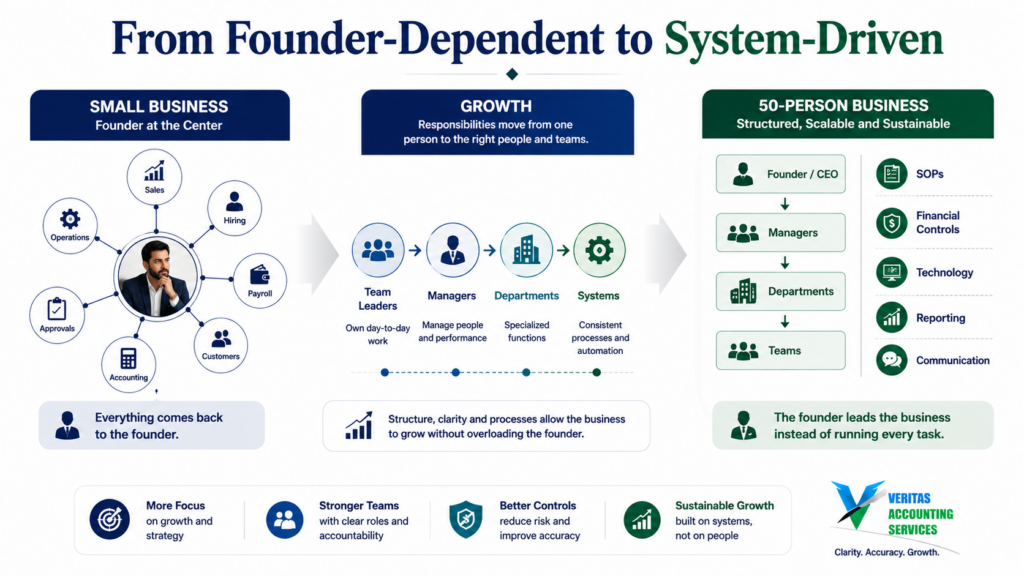
As business growth accelerates, companies need to evolve from founder-led operations toward organized systems, defined responsibilities, reliable financial controls, and management processes that can work without everything going through one person.

The transition from 5 to 50 employees is therefore not simply about hiring 45 additional people.

It is about building a different business.


What Works With 5 Employees May Not Work With 50

When a business has five employees, communication is usually simple.

Everyone knows what everyone else is doing.

The founder may speak directly with every team member.

Questions can be answered quickly.

Approvals can happen informally.

Financial information may exist in a few spreadsheets.

Processes may live in the founder’s head.

That can work at a small scale

But as business growth continues, these informal systems begin to break down.

At 50 employees, there are more people, more decisions, more transactions, more customers, and more opportunities for mistakes.

The business needs structure.

That doesn’t mean creating unnecessary bureaucracy.

It means creating enough structure to allow the business to operate consistently as complexity increases as business growth continues.


1. The Founder Cannot Manage Everything Personally

One of the first major changes is delegation.

With five employees, a founder might personally handle:

  • Hiring
  • Customer complaints
  • Payments
  • Financial approvals
  • Sales decisions
  • Vendor relationships
  • Employee questions

At 50 employees, this approach becomes difficult to sustain.

If every decision requires the founder’s involvement, growth eventually slows down.

Employees wait for approvals.

Managers cannot move quickly.

The founder spends more time solving small operational issues and less time working on strategy.

Business growth requires founders to move from doing everything to building people and systems that can do things without them.

The goal isn’t to lose control.

The goal is to create appropriate levels of responsibility.


2. Management Layers Become More Important

A five-person business may not need formal management layers.

A 50-person company probably does.

You may need:

  • Team leaders
  • Department managers
  • Operations managers
  • Finance leadership
  • HR responsibility
  • Senior operational roles

This creates a management structure between the founder and individual employees.

The founder should increasingly focus on questions such as:

Where is the company going?

What markets should we enter?

What investments should we make?

What risks should we manage?

Meanwhile, managers can focus on executing those priorities.

Without delegation and management structure, business growth can create a situation where the founder becomes the approval point for almost everything.

That’s not scalable.


3. Informal Processes Need to Become SOPs

When there are five employees, someone can simply explain how something works.

“Just ask me if you have a question.”

At 50 employees, that approach creates inconsistency.

What happens when the person who knows the process leaves?

What happens when a new employee joins?

What happens when the business opens another location?

This is where Standard Operating Procedures become valuable.

Document processes for important activities such as:

  • Client onboarding
  • Invoicing
  • Expense approvals
  • Purchasing
  • Payroll
  • Customer service
  • Employee onboarding
  • Bank reconciliations
  • Month-end closing
  • Sales processes

Good SOPs don’t need to be complicated.

They simply need to explain what should happen, who is responsible, and what standards need to be followed.

Business growth becomes easier to manage when important knowledge isn’t stored only in people’s heads.


4. Financial Controls Need to Become Stronger

Financial controls that are acceptable for a five-person business may not be appropriate for a 50-person company.

As transaction volume increases, the opportunity for mistakes also increases.

You may now have:

  • Multiple bank accounts
  • More credit cards
  • Larger payroll
  • More vendors
  • Higher customer balances
  • More purchasing activity
  • Larger expense volumes
  • More financial approvals

At this stage, businesses should consider controls such as:

  • Separation of responsibilities
  • Approval limits
  • Bank reconciliation procedures
  • Credit card reviews
  • Vendor approval processes
  • Payment authorization
  • Regular financial reporting

The objective is not to make the business slower.

Good controls should make the business safer while allowing routine decisions to happen efficiently.


5. Payroll Becomes a Bigger Part of Financial Management

Going from five employees to 50 dramatically changes the financial importance of payroll.

Payroll is no longer simply a recurring administrative payment.

It becomes one of the company’s largest operating costs.

Management needs to understand:

  • Total payroll cost
  • Benefits
  • Overtime
  • Payroll taxes
  • Hiring costs
  • Department-level staffing costs
  • Revenue generated per team or department

This information can help answer important questions.

Is the company hiring faster than revenue is growing?

Which departments are becoming more expensive?

Can the business support additional employees?

Are certain teams understaffed or overstaffed?

As business growth continues, payroll data becomes increasingly important for financial planning.
The culture that helped create early business growth should evolve without losing the principles that made the company successful.


6. Financial Reporting Needs to Become More Regular

A small business owner may look at the bank balance and have a reasonable understanding of the company’s financial position.

That becomes much harder as the organization grows.

At 50 employees, management should have regular access to financial reports.

Depending on the business, these may include:

  • Profit and loss statement
  • Balance sheet
  • Cash-flow report
  • Accounts receivable aging
  • Accounts payable aging
  • Budget vs. actual
  • Department performance
  • Key performance indicators

The goal is not to create dozens of reports.

The goal is to provide management with the information required to make decisions.

Accurate and timely financial reporting gives leadership a clearer view of whether growth is actually creating profitability.


7. Cash Flow Becomes More Important as the Business Gets Larger

Growth can consume cash.

You may need to hire employees before receiving customer payments.

You may need to purchase inventory before generating sales.

You may extend credit to customers.

You may invest in equipment, software, offices, or additional locations.

This means a profitable business can still experience cash-flow pressure.

As business growth accelerates, cash-flow forecasting becomes increasingly valuable.

Management should understand expected:

Cash Inflows

  • Customer collections
  • Financing
  • Other operating receipts

Cash Outflows

  • Payroll
  • Suppliers
  • Taxes
  • Loans
  • Rent
  • Capital expenditures
  • Other operating expenses

A forward-looking cash-flow forecast can help management identify potential shortages before they become emergencies.


8. Technology Should Replace Manual Work Where Practical

A five-person business can survive with spreadsheets and manual processes.

A 50-person business may find those same processes increasingly difficult to manage.

This is where technology becomes important.

Depending on the business, systems may be needed for:

  • Accounting
  • Payroll
  • CRM
  • Project management
  • Expense management
  • Inventory
  • Customer support
  • Document management
  • Reporting

The purpose isn’t to buy software simply because the business is growing.

The purpose is to reduce repetitive work, improve accuracy, and give employees access to consistent information.

The right technology can allow a 50-person company to operate more efficiently than a much smaller company relying entirely on manual processes.


9. Communication Needs Structure

With five employees, communication can happen naturally.

People talk across desks.

The founder can call everyone into a quick meeting.

Everyone generally knows what’s happening.

At 50 employees, communication requires more structure.

Consider:

  • Regular team meetings
  • Department meetings
  • Management meetings
  • Written procedures
  • Project management tools
  • Company-wide updates
  • Clear reporting lines

Employees should know:

Who do I report to?

Who approves my work?

Where do I find information?

Who handles this type of problem?

Clear communication reduces confusion and prevents the founder from becoming the central information hub.


10. Hiring Needs to Become More Strategic

When a company has five employees, one poor hiring decision can still create problems.

At 50 employees, hiring mistakes can become significantly more expensive.

Recruitment should therefore become more structured.

Businesses should define:

  • Job responsibilities
  • Required skills
  • Reporting structure
  • Performance expectations
  • Compensation structure
  • Onboarding process
  • Training requirements

You should also think about the skills the company will need six or twelve months from now—not only the skills required today.

Business growth creates new roles.

A company that once needed generalists may eventually need specialists in finance, HR, operations, marketing, technology, or compliance.


11. The Founder Needs Better Financial Visibility

As the company grows, the founder should spend less time entering transactions and more time understanding what the numbers are saying.

Important questions may include:

  • Which departments are profitable?
  • What is our cash position?
  • Are margins improving?
  • How much does each new employee cost?
  • How quickly are customers paying?
  • Are operating expenses growing too quickly?
  • Can we afford another location?
  • How much cash will expansion require?

This is where accounting moves beyond bookkeeping.

Reliable accounting data becomes a management tool.

Business growth becomes easier to manage when founders have accurate financial information before making major decisions.


12. Your Organizational Structure Must Catch Up With Your Growth

A company with five employees can often operate around personalities.

A company with 50 employees needs roles.

People need to know who is responsible for what.

A simple organizational structure can clarify:

Founder / CEO

↓

Department Heads

↓

Managers / Team Leaders

↓

Employees

The exact structure will vary by company.

The important point is that responsibility should be clear.

When nobody clearly owns a task, problems are often passed between departments.

When too many people own the same task, accountability can disappear.

Clear responsibility supports efficient business growth.


13. Culture Needs to Be Intentional

Culture can happen naturally when a company is small.

As the company grows, culture needs more deliberate attention.

New employees don’t automatically understand how the founders think.

They need to understand:

  • Company values
  • Expectations
  • Communication standards
  • Customer service principles
  • Decision-making approach
  • Performance expectations

This doesn’t mean creating a long list of corporate slogans.

It means making expectations clear and reinforcing them through hiring, onboarding, management, and leadership behavior.

The culture that helped create early business growth should evolve without losing the principles that made the company successful.


The 5-to-50 Transition Is About Systems, Not Just People

It is tempting to think:

“We need more employees because we’re growing.”

But adding employees without improving systems can create more complexity rather than solving it.

If five people use a confusing process, adding 45 more people doesn’t fix the process.

It magnifies the problem.

That is why businesses approaching 50 employees should review:

  • Organizational structure
  • SOPs
  • Technology
  • Financial controls
  • Reporting
  • Communication
  • Hiring
  • Management
  • Cash-flow planning

The objective is to make the organization capable of handling greater complexity.


A Simple 5-to-50 Business Growth Checklist

As your team expands, ask:

People

Do employees have clearly defined responsibilities?

Management

Do managers have enough authority to make routine decisions?

Processes

Are important workflows documented?

Finance

Are financial records current and reconciled?

Reporting

Does management receive useful financial reports regularly?

Cash Flow

Do you have a forward-looking cash-flow forecast?

Technology

Are employees still relying heavily on spreadsheets and manual processes?

Controls

Are payments, expenses, and financial responsibilities appropriately controlled?

Communication

Do employees know where to go for information and decisions?

Strategy

Is the founder spending enough time on the future rather than solving daily operational problems?

If several answers are “no,” the business may be growing faster than its infrastructure.


Final Thoughts

Going from 5 to 50 employees is an exciting achievement.

But business growth business growth changes almost everything.

The founder’s role changes.

Management becomes more important.

Processes need to be documented.

Financial controls become more critical.

Technology becomes more valuable.

Communication needs structure.

Financial reporting needs to become more sophisticated.

And decisions increasingly need to be made through systems rather than personal involvement.

The goal isn’t to make a growing company feel like a large corporation.

The goal is to create enough structure that the business can continue growing without becoming increasingly dependent on the founder.

At Veritas Accounting Services, we help business growth strengthen their bookkeeping, accounting, financial reporting, and financial management processes as their operations become more complex.

Because the best time to build scalable systems isn’t after growth creates problems.

It is before those problems become expensive.


Frequently Asked Questions

What changes when a business grows from 5 to 50 employees?

The business typically needs stronger management structures, documented processes, financial controls, technology, communication systems, business growth, payroll processes, and regular financial reporting.

Why do small-business systems stop working as companies grow?

Small-business systems often depend on informal communication and founder involvement. As employee numbers and transaction volumes increase, those methods become difficult to manage consistently. business growth. The culture that helped create early business growth should evolve without losing the principles that made the company successful.

When should a business start documenting its processes?

Important processes should be documented before they become difficult to manage. Businesses experiencing rapid growth should prioritize SOPs for financial, operational, HR, customer, and administrative processes.

Does a growing business- business growth need a finance team?

Not necessarily a large internal team. Depending on complexity, a business may use a combination of internal employees, outsourced accounting support, and specialized financial professionals.

Why is cash-flow forecasting important during business growth?

Growth can require cash before revenue is collected. Hiring employees, purchasing inventory, expanding facilities, and investing in equipment can all create cash requirements that may not be obvious from the profit and loss statement alone.

Schedule a FREE Call


GET IN TOUCH

What to Do When You Pay for Business Expenses Personally

A practical guide to documenting business purchases you paid for personally, matching any repayment…

When the Bank Balance and Your Books Disagree

A practical month-end walkthrough for comparing your bank statement and books, with a worked example…

Vendor Bills and a Simple Routine for Better Cash Planning

A practical weekly routine for checking supplier bills, planning the payment batch and matching what…

Tax Bracket Mistakes: A Simple Guide to Better Planning

The November 5 IRS inflation update is a prompt to review your planning assumptions. Learn how…

Your Simple Guide to PTIN Renewal Mistakes and Better Records

The November 4 IRS reminder is a timely prompt to check 2027 preparer renewals, separate enrolled…

Inventory Tax Mistakes: A Simple Guide to Better Records

Stock purchases do not automatically equal a tax deduction. Review the inventory method, quantities…

Payroll Deposit Mistakes: A Simple Guide to Better Records

A quarterly payroll return does not set every tax deposit deadline. Check the schedule, actual pay…

Your Simple Guide to Home Office Mistakes and Better Records

Working from home does not automatically create a deduction. Check eligibility, space, dates…

Your Simple Guide to Unpaid Invoice Mistakes and Better Records

An unpaid customer invoice is not automatically a tax deduction. Review the tax accounting method…

Business Intelligence

Your Books Are More Than Records—They’re Business Intelligence

Most business owners think of accounting as a process that happens in the background.

Sales are recorded. Expenses are categorized. Bank accounts are reconciled. Financial statements are prepared. Tax returns are filed.

Then the books are closed and everyone moves on.

But your accounting records contain far more information than what is needed for tax compliance.

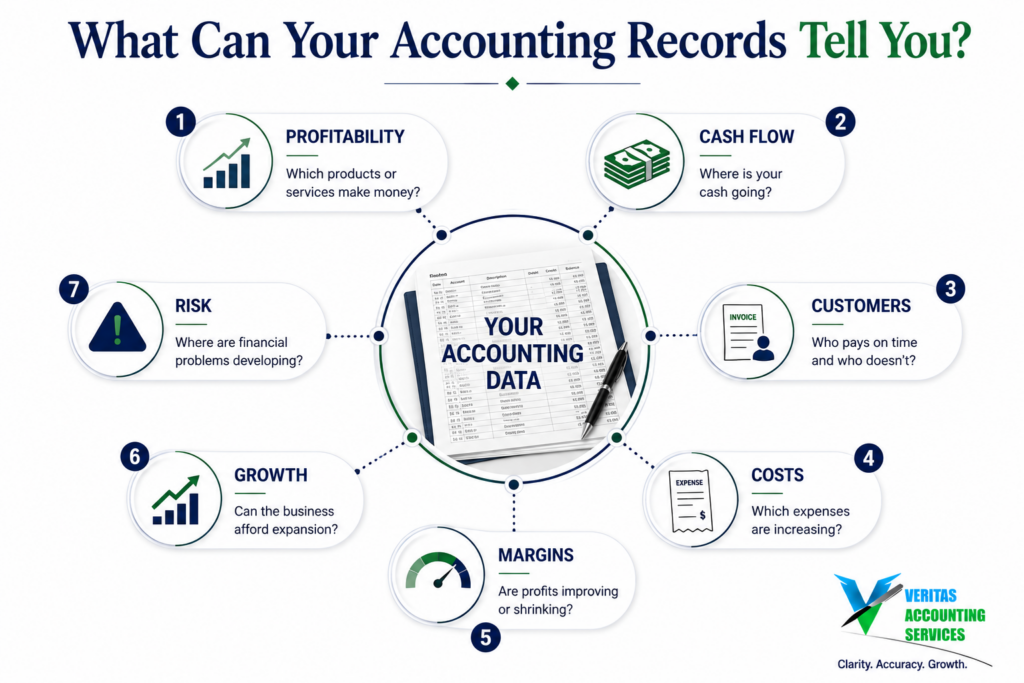
They can tell you which products are profitable, where your cash is going, which expenses are increasing, whether customers are paying on time, whether margins are improving, and whether your current growth is actually creating value.

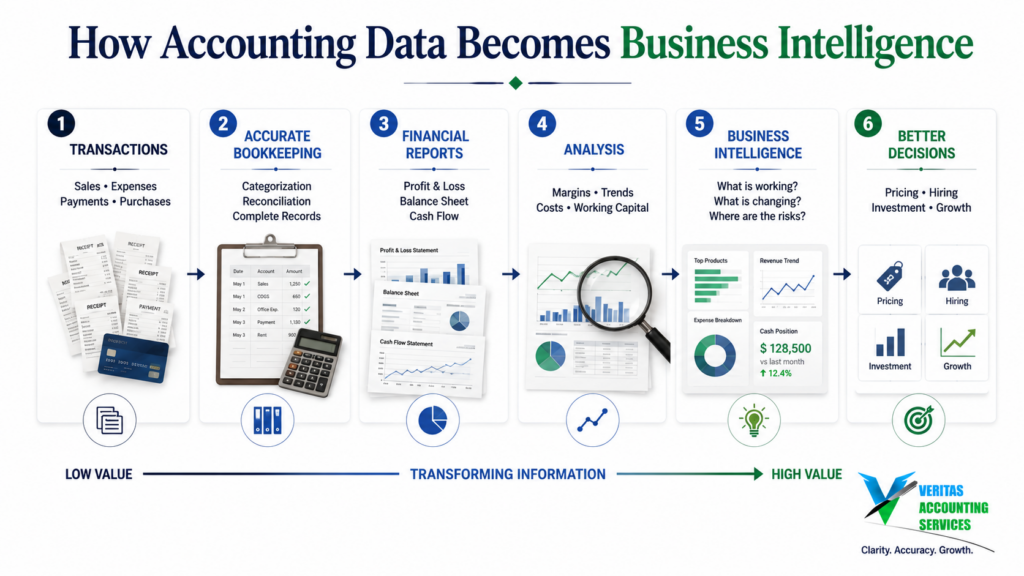
In other words, your books can become a source of business intelligence.

The difference is what you do with the information.

Accurate accounting tells you what happened.

Analysis helps you understand why it happened.

Business intelligence helps you use that information to make better decisions about what happens next.

For growing businesses, that difference can be significant.


Accounting Is More Than Recording Transactions

Bookkeeping begins with individual transactions.

A customer makes a payment.

A supplier sends an invoice.

An employee is paid.

A business purchases equipment.

A bank charges a fee.

Each transaction is recorded in the accounting system.

Individually, these transactions may not tell you much.

But once thousands of transactions are organized and categorized correctly, patterns begin to appear.

You can see:

  • Revenue trends
  • Expense trends
  • Profit margins
  • Cash-flow movements
  • Customer balances
  • Supplier obligations
  • Asset growth
  • Debt levels
  • Operating costs

This is where business intelligence begins to emerge from accounting.

The accounting system is not just storing historical information.

It is creating the financial data needed to understand how the business operates.


1. Your Books Can Show Where Your Profit Is Coming From

A business can have strong revenue and weak profitability.

Imagine a company generates $2 million in annual sales.

That sounds impressive.

But suppose its gross margin has fallen from 40% to 28%.

Revenue increased, but the economics of the business became less attractive.

Without regular financial analysis, management may focus on the revenue increase and miss the declining margin.

Business intelligence can help identify this change.

By comparing revenue, direct costs, gross profit, and operating expenses over time, management can determine whether growth is actually improving profitability.

This becomes even more valuable when you analyze profitability by:

  • Product
  • Service
  • Customer
  • Location
  • Sales channel
  • Business division

Total revenue tells only part of the story.

Understanding where the profit is actually being generated tells you much more.


2. Your Accounting Data Can Explain Where Cash Is Going

Profit and cash are not the same thing.

A profitable company can still experience cash-flow problems.

Why?

Because money may be tied up in:

  • Accounts receivable
  • Inventory
  • Prepaid expenses
  • Equipment
  • Debt repayments
  • Other working capital requirements

Your accounting records can help explain these movements.

For example, suppose sales have increased by 30%, but accounts receivable has increased by 60%.

That could indicate that customers are taking longer to pay.

Revenue is growing, but cash may not be arriving at the same speed.

That is valuable information.

Business intelligence helps management look beyond the income statement and understand how profitability connects with cash flow.


3. Your Financial Statements Can Become Management Tools

Many businesses prepare financial statements because their accountant requires them.

That is understandable.

But financial statements can be much more useful when management reviews them regularly.

A monthly profit and loss statement can help answer:

  • Is revenue increasing?
  • Are gross margins changing?
  • Which expenses are rising?
  • Are operating costs growing faster than revenue?
  • Is the business becoming more profitable?

A balance sheet can answer different questions:

  • How much cash do we have?
  • How much do customers owe us?
  • How much do we owe suppliers?
  • How much debt do we carry?
  • Is working capital improving?

A cash-flow report can help explain:

  • Where cash came from
  • Where cash went
  • Whether operations are generating cash
  • Whether financing is supporting the business

When these reports are reviewed together, business intelligence becomes much more useful.


4. Find Out Which Products and Services Actually Make Money

One of the most useful applications of accounting data is profitability analysis.

Suppose a company sells ten different products.

Three products generate 60% of total revenue.

It would be easy to assume those three products are the most valuable.

But what if two of them have very low margins?

The business could be investing significant time, inventory, advertising, and customer service resources into products that generate relatively little contribution.

Accounting data can help management investigate these differences.

You can compare:

Revenue → Direct Costs → Gross Profit → Variable Costs → Contribution

This can reveal which products deserve more attention and which may need pricing changes, cost reductions, or even discontinuation.

Business intelligence becomes especially powerful when financial information is combined with operational data.


5. Your Customers May Not Be Equally Valuable

Revenue by customer can also reveal important information.

Imagine two customers each generate $100,000 in annual revenue.

At first glance, they appear equally valuable.

But Customer A pays on time, requires little support, and purchases high-margin services.

Customer B regularly pays late, requires significant support, negotiates heavily on price, and generates lower margins.

The revenue is identical.

The business value is not.

Accounting data can help identify differences in:

  • Revenue
  • Gross margin
  • Payment behavior
  • Outstanding balances
  • Discounts
  • Service costs

This gives management a more complete picture of customer profitability.

Not every large customer is necessarily a great customer.


6. Watch Your Key Business Numbers

Business intelligence does not require hundreds of complicated metrics.

In many cases, a small set of carefully selected KPIs can provide excellent visibility.

Depending on the business, useful financial KPIs may include:

Revenue Growth

Shows how quickly sales are increasing or decreasing.

Gross Profit Margin

Shows how much revenue remains after direct costs.

Net Profit Margin

Shows the percentage of revenue remaining after operating expenses and other costs.

Accounts Receivable Days

Helps management understand how quickly customers are paying.

Operating Expense Ratio

Shows how operating expenses compare with revenue.

Cash Balance

Provides a basic view of available liquidity.

Working Capital

Helps management understand short-term financial strength.

The right KPIs depend on the business model.

A trucking company may monitor fuel costs and revenue per mile.

An e-commerce company may focus on contribution margin, advertising costs, inventory turnover, and marketplace expenses.

A professional services firm may track utilization, billable hours, realization, and client profitability.

Business intelligence becomes useful when the numbers being monitored actually connect with how the business operates.

business intelligence

7. Accounting Data Can Improve Forecasting

Historical financial information provides the foundation for forecasting.

If you know how revenue, payroll, rent, marketing, inventory, and other expenses have behaved over the past several months, you have a starting point for planning the future.

Forecasting can help answer questions such as:

  • How much cash might we have three months from now?
  • Can we afford another employee?
  • How much inventory can we purchase?
  • Can we take on additional debt?
  • What happens if revenue falls by 10%?
  • What happens if revenue grows by 20%?

Business intelligence turns historical accounting data into a resource for forward-looking planning.

Of course, historical trends do not guarantee future results.

But making decisions with historical data, assumptions, and scenarios is generally more useful than relying entirely on intuition.


8. Better Accounting Data Can Improve Pricing Decisions

Pricing is one of the most important decisions a business makes.

Yet many businesses set prices based on competitors, market expectations, or simple cost-plus calculations without fully understanding their own economics.

Your accounting records can provide a better foundation.

You can analyze:

  • Direct product costs
  • Labor costs
  • Overhead
  • Payment fees
  • Shipping
  • Advertising
  • Discounts
  • Returns
  • Customer acquisition costs

This helps management understand the actual cost of delivering a product or service.

You may discover that one service is significantly more profitable than another.

Or you may discover that a product that appears profitable becomes unprofitable after advertising, fulfillment, returns, and other variable costs are included.

That information can support better pricing decisions.


9. Accounting Can Help You Identify Problems Earlier

Financial problems often appear in the numbers before they become obvious operationally.

For example:

Revenue is rising, but margins are falling.

That could indicate increasing product costs, discounting, pricing problems, or an unfavorable sales mix.

Accounts receivable is increasing faster than sales.

That could indicate slower collections or changing customer payment behavior.

Operating expenses are growing faster than revenue.

That could signal that the business is becoming less efficient.

Cash is falling despite reported profits.

That may indicate working capital pressure, debt payments, inventory investment, or other cash-flow issues.

Business intelligence helps management notice these patterns early.

The earlier a problem is identified, the more options management usually has to address it.


10. Business Intelligence Is Only as Good as Your Accounting

This is one of the most important principles to understand.

You cannot build reliable analysis from unreliable accounting data.

If your books contain:

  • Unreconciled bank accounts
  • Duplicate transactions
  • Incorrect classifications
  • Missing expenses
  • Incorrect customer balances
  • Old outstanding items
  • Unrecorded liabilities
  • Incorrect inventory values

then your reports may not accurately represent the business.

And if the underlying numbers are wrong, the conclusions drawn from those numbers may also be wrong.

This is why business intelligence begins with accounting.

Before investing heavily in dashboards, advanced analytics, or complicated reporting systems, businesses should make sure the underlying accounting records are accurate and current.

Good intelligence requires good data.


From Bookkeeping to Business Intelligence

Think of your financial system as a progression:

Transactions

↓

Accurate Bookkeeping

↓

Reconciled Accounts

↓

Financial Statements

↓

Financial Analysis

↓

Business Intelligence

↓

Better Business Decisions

Each stage depends on the previous one.

If transactions are recorded incorrectly, the financial statements may be wrong.

If financial statements are wrong, analysis becomes unreliable.

If analysis is unreliable, management decisions can suffer.

The technology used to display information is therefore only one part of the equation.

The quality of the underlying accounting data matters just as much.


You Don’t Need a Complicated Dashboard

Some business owners hear the phrase business intelligence and immediately think of expensive software, complicated dashboards, and data analysts.

That isn’t always necessary.

For many small and medium-sized businesses, useful business intelligence can begin with a well-maintained accounting system and a handful of meaningful reports.

For example, management may only need a monthly dashboard showing:

  • Revenue
  • Gross profit
  • Net profit
  • Cash balance
  • Accounts receivable
  • Accounts payable
  • Major expenses
  • Key business KPIs

The objective is not to collect as much information as possible.

The objective is to identify the information that actually helps management make better decisions.

A simple report that gets reviewed every month can be more valuable than an impressive dashboard that nobody uses.


What Business Owners Should Ask Their Accounting Data

Instead of only asking:

“How much did we make?”

Start asking:

“Why did profit change?”

“Which products generate the best margins?”

“Which customers are most profitable?”

“Where is our cash tied up?”

“Which expenses are increasing fastest?”

“Are we collecting customer balances quickly enough?”

“Can we afford our next growth initiative?”

“What could happen to cash flow if revenue declines?”

These questions transform accounting from a record-keeping function into a decision-making resource.


The Role of Technology

Modern accounting software has made financial information much more accessible.

Cloud accounting platforms can connect with:

  • Banks
  • Payment processors
  • Payroll systems
  • E-commerce platforms
  • Expense-management tools
  • Inventory systems
  • Reporting applications

This can reduce manual work and improve the speed at which financial information becomes available.

But technology alone does not create business intelligence.

A software system can process thousands of transactions.

It cannot automatically understand which numbers matter most to your business strategy.

That requires appropriate accounting structure, accurate records, meaningful KPIs, and management interpretation.

Technology makes information easier to access.

Good accounting makes that information trustworthy.


From Numbers to Decisions

The real value of accounting appears when financial information changes a business decision.

Perhaps the numbers show that one product line has declining margins.

Management changes pricing.

Perhaps accounts receivable is increasing.

The company improves its collection process.

Perhaps a particular expense category is growing too quickly.

Management reviews the underlying costs.

Perhaps cash flow forecasts show that expansion would create a temporary funding gap.

The company arranges financing before the problem occurs.

This is the difference between simply looking at numbers and using them.

Business intelligence turns accounting information into action.


Final Thoughts

Your accounting records are not simply a history of what happened.

They are a source of information about how your business works.

When the books are accurate and current, they can reveal profitability trends, cash-flow pressure, customer behavior, cost increases, pricing opportunities, and areas that deserve management attention.

That is why business intelligence begins long before the dashboard.

It begins with accurate transactions.

It begins with reconciled accounts.

It begins with reliable financial statements.

And it begins with accounting.

At Veritas Accounting Services, we believe bookkeeping should do more than keep your records organized.

Your financial information should help you understand the business, identify opportunities, recognize risks, and make better decisions.

Your books already contain valuable information.

The question is whether you’re using it.


Frequently Asked Questions

How does accounting support business intelligence?

Accounting provides structured financial data about revenue, expenses, assets, liabilities, cash flow, customers, and other business activities. When that information is analyzed, it can help management identify trends and make better decisions.

What accounting data is useful for business intelligence?

Useful information can include revenue, gross profit, operating expenses, accounts receivable, accounts payable, cash flow, inventory, customer balances, product profitability, and other business-specific KPIs.

Why is accurate bookkeeping important for business intelligence?

Accurate bookkeeping creates reliable financial data. If transactions are missing, incorrectly categorized, or unreconciled, the financial reports and analysis built from those records may also be unreliable.

Can small businesses use business intelligence?

Absolutely. Small businesses do not necessarily need complicated technology. Regular financial reporting, a few meaningful KPIs, accurate bookkeeping, and consistent analysis can provide valuable business intelligence.

How can financial reports help business owners?

Financial reports help owners understand profitability, cash flow, expenses, liabilities, and financial trends. Reviewing these reports regularly can support decisions about pricing, hiring, investment, cost control, and growth.


Better Books. Better Information. Better Decisions.

Accounting shouldn’t simply tell you what happened last month.

It should help you understand why it happened—and what you should do next.

When accurate accounting is combined with meaningful analysis, your books can become one of the most valuable sources of business intelligence your company has.

Schedule a FREE Call


GET IN TOUCH

What to Do When You Pay for Business Expenses Personally

A practical guide to documenting business purchases you paid for personally, matching any repayment…

When the Bank Balance and Your Books Disagree

A practical month-end walkthrough for comparing your bank statement and books, with a worked example…

Vendor Bills and a Simple Routine for Better Cash Planning

A practical weekly routine for checking supplier bills, planning the payment batch and matching what…

Tax Bracket Mistakes: A Simple Guide to Better Planning

The November 5 IRS inflation update is a prompt to review your planning assumptions. Learn how…

Your Simple Guide to PTIN Renewal Mistakes and Better Records

The November 4 IRS reminder is a timely prompt to check 2027 preparer renewals, separate enrolled…

Inventory Tax Mistakes: A Simple Guide to Better Records

Stock purchases do not automatically equal a tax deduction. Review the inventory method, quantities…

Payroll Deposit Mistakes: A Simple Guide to Better Records

A quarterly payroll return does not set every tax deposit deadline. Check the schedule, actual pay…

Your Simple Guide to Home Office Mistakes and Better Records

Working from home does not automatically create a deduction. Check eligibility, space, dates…

Your Simple Guide to Unpaid Invoice Mistakes and Better Records

An unpaid customer invoice is not automatically a tax deduction. Review the tax accounting method…

marketplace fees

Are Marketplace Fees Quietly Destroying Your Profit Margins?

Selling on an online marketplace can make a business look extremely successful.

Orders are coming in. Revenue is increasing. Sales reports show impressive numbers. Products are reaching customers across different cities and countries.

But there is a question many e-commerce sellers don’t ask often enough:

How much are we actually making after every cost is taken out?

A product that sells for $100 may not generate anything close to $100 of profit.

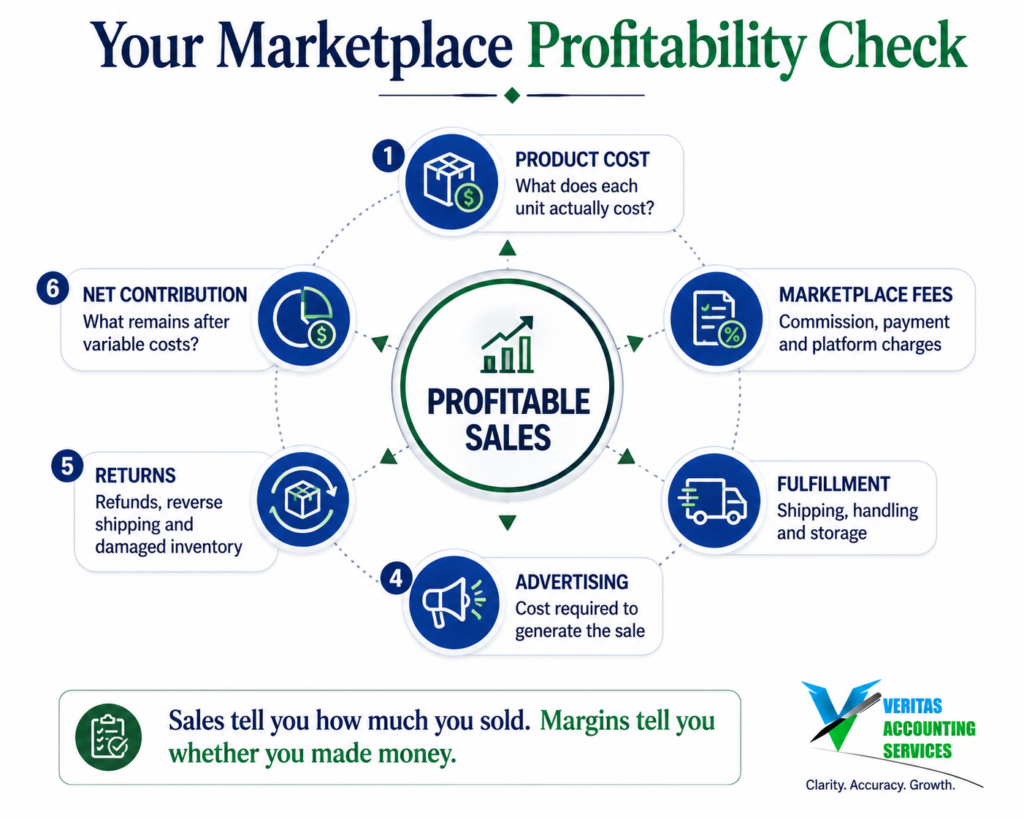
Between marketplace commissions, payment processing, fulfillment, storage, advertising, returns, refunds, product costs, and other operating expenses, the amount left for the business can be surprisingly small.

This is why marketplace fees deserve much more attention than they usually receive.

The problem is not necessarily that marketplace fees are too high. The bigger problem is that sellers often look at them individually rather than understanding their combined impact on profitability.

You can increase sales and still see your margins decline.

You can have a product that sells extremely well and still lose money on every order.

And you can grow revenue while quietly making the business financially weaker.

For e-commerce businesses, profitable growth requires looking beyond sales volume and understanding what each order actually contributes to the bottom line.


Revenue Is Not the Same as Profit

One of the easiest mistakes in e-commerce is confusing revenue with profitability.

Imagine your marketplace shows $100,000 in monthly sales.

That sounds impressive.

But now consider what happens before that money becomes business profit.

You may have:

  • Product costs
  • Marketplace commissions
  • Payment processing fees
  • Fulfillment charges
  • Storage costs
  • Advertising
  • Shipping
  • Returns
  • Refunds
  • Packaging
  • Software
  • Customer service
  • Payroll
  • Other operating expenses

After all those costs, your actual profit could be significantly lower.

This is why marketplace fees should be analyzed as part of the complete cost structure rather than viewed as isolated deductions from marketplace statements.

Revenue tells you how much customers spent.

Profit tells you what the business actually kept.

Those are very different numbers.


What Are Marketplace Fees?

Marketplace fees are the charges a seller pays to an online platform for using its marketplace, payment infrastructure, fulfillment services, advertising tools, or other services.

Depending on the platform and selling arrangement, marketplace fees may include:

  • Referral or commission fees
  • Payment processing charges
  • Listing fees
  • Subscription fees
  • Fulfillment fees
  • Storage fees
  • Advertising charges
  • Return-related fees
  • Refund administration charges
  • Currency conversion charges
  • Other service fees

Not every marketplace charges all of these.

The important point is that sellers need to understand the complete fee structure associated with each platform they use.

A product may appear profitable when you look only at its selling price and product cost.

Once all marketplace-related costs are included, the picture may change considerably.

marketplace revenue

1. Commission Fees Can Take a Significant Share of Sales

Most marketplaces charge sellers some form of commission or referral fee.

The percentage may vary depending on:

  • Product category
  • Selling price
  • Marketplace
  • Seller plan
  • Customer location
  • Promotional arrangements

A percentage-based fee can become substantial as sales increase.

For example, suppose you sell $200,000 of products in a month and the applicable marketplace commission averages 15%.

That represents:

$200,000 × 15% = $30,000

The business generated $200,000 in sales, but $30,000 has already gone toward one category of marketplace cost.

That doesn’t necessarily mean the marketplace is charging too much.

The platform may be providing access to millions of customers, payment processing, infrastructure, trust, logistics, or other valuable services.

The real question is whether your pricing and product economics are designed to support those costs.


2. Fulfillment Costs Can Change the Economics

For businesses using marketplace fulfillment services, fulfillment costs can become another major component of the cost per order.

Depending on the arrangement, sellers may pay for:

  • Picking
  • Packing
  • Shipping
  • Handling
  • Returns
  • Storage
  • Special handling

These costs can vary significantly depending on product size, weight, destination, and fulfillment method.

A product with a healthy margin before fulfillment may become much less attractive after fulfillment costs are included.

This is particularly important for businesses selling products with:

  • Large dimensions
  • Heavy weight
  • Low selling prices
  • Low unit margins
  • High return rates

A seller should therefore calculate profitability using the actual fulfillment cost rather than relying solely on the product’s selling price and purchase cost.


3. Advertising Can Quietly Reduce Your Margin

Advertising is another area where e-commerce sellers can lose sight of profitability.

Advertising can be extremely valuable.

It can help products reach customers, increase sales, launch new products, and improve visibility.

But higher sales do not automatically mean higher profits.

Suppose a product generates $50,000 in marketplace sales.

That sounds strong.

But what if $10,000 was spent on advertising to generate those sales?

Now the economics look different.

This is why looking only at advertising metrics such as revenue generated or return on ad spend may not provide the complete picture.

You also need to consider:

Product Cost + Marketplace Fees + Fulfillment + Advertising + Other Variable Costs

Only then can you understand how much the sale actually contributes to the business.


4. Returns and Refunds Can Distort Your Numbers

Returns are particularly important for businesses selling online.

A marketplace report may show a large number of orders and strong gross sales, while refunds and returns reduce the amount the business actually keeps.

Returns can also create additional costs.

For example:

  • Return shipping
  • Restocking
  • Damaged inventory
  • Refund processing
  • Customer service
  • Lost selling fees
  • Unsellable inventory

If returns are consistently high for a particular product, simply looking at gross sales can make the product appear more profitable than it really is.

Businesses should therefore monitor profitability after returns and refunds rather than evaluating products solely on completed orders.


5. Payment Processing and Other Small Charges Add Up

Not every cost is large enough to immediately attract attention.

A payment processing charge here.

A currency conversion fee there.

A small storage charge.

A return-related adjustment.

A software fee.

A marketplace subscription.

Individually, these amounts may seem insignificant.

Collectively, they can have a meaningful impact on margins.

This is one reason marketplace fees should be reviewed regularly rather than only when something appears unusually expensive.

Small percentages applied to large sales volumes can create significant annual costs.

marketplace fees

The Product That Sells the Most May Not Be Your Most Profitable Product

This is one of the most important lessons for marketplace businesses.

Imagine you sell two products.

Product A

Sales: $100,000
Gross profit before marketplace costs: $30,000
Total marketplace and variable costs: $20,000
Contribution: $10,000

Product B

Sales: $60,000
Gross profit before marketplace costs: $25,000
Total marketplace and variable costs: $8,000
Contribution: $17,000

Product A generates more revenue.

But Product B generates more contribution.

If management focuses only on sales volume, Product A may look like the clear winner.

If management focuses on profitability, Product B tells a different story.

This is why marketplace sellers should analyze profitability at the product or SKU level whenever practical.


Calculate Your Real Profit Per Order

A simple order-level calculation can reveal problems quickly.

Imagine a product sells for $100.

CostAmount
Selling Price$100
Product Cost$40
Marketplace Commission$15
Payment Processing$3
Fulfillment$12
Advertising$8
Other Variable Costs$5
Contribution$17

The product appears to generate $100 in sales.

But after the major variable costs, only $17 remains.

And that $17 may still need to contribute toward fixed business costs such as salaries, software, rent, professional fees, and other overhead.

That means the product’s true net profit may be considerably lower.

This calculation should be performed regularly for important products rather than relying only on the marketplace’s headline sales figures.


Why Marketplace Fees Can Be Difficult to Track

One reason marketplace profitability is difficult to analyze is that the money doesn’t always flow through the accounting system in a simple way.

A marketplace may combine:

  • Sales
  • Refunds
  • Commissions
  • Advertising
  • Shipping
  • Fulfillment
  • Taxes
  • Other adjustments

into statements or settlement reports.

The amount deposited into the bank may therefore be very different from the gross sales reported by the marketplace.

For example:

Marketplace Sales: $50,000

Less:

Marketplace Fees: $7,500

Less:

Advertising: $4,000

Less:

Refunds: $2,500

Less:

Other Adjustments: $1,000

Net Settlement: $35,000

If the accounting records simply record the $35,000 bank deposit as sales, management may lose visibility into the actual economics of the marketplace.

This is why proper marketplace reconciliation matters.


Your Bookkeeping Needs to Reflect the Real Marketplace Activity

Accurate bookkeeping is especially important for e-commerce businesses because marketplace settlements can contain many different types of transactions.

A good accounting process should help separate and identify:

  • Gross sales
  • Marketplace commissions
  • Payment fees
  • Fulfillment costs
  • Advertising
  • Refunds
  • Returns
  • Taxes
  • Other marketplace adjustments

This creates better financial reporting.

It also makes it easier to understand where money is actually going.

Remote bookkeeping services can be particularly useful for growing e-commerce businesses that have multiple marketplaces, payment processors, currencies, or high transaction volumes.

Accurate books aren’t just useful for tax preparation.

They help management understand profitability.

marketplace profitability

Don’t Look at ROAS Without Looking at Margin

Return on ad spend, or ROAS, is commonly used by e-commerce businesses to evaluate advertising performance.

But ROAS alone can be misleading.

Imagine an advertising campaign generates $10,000 of revenue from $2,000 of advertising.

The ROAS is 5x.

That sounds excellent.

But suppose the product has:

  • $4,000 product cost
  • $1,500 marketplace fees
  • $1,000 fulfillment
  • $500 other variable costs

The business may have only a small amount left after all those expenses.

A strong advertising metric does not automatically mean a strong financial result.

The better question is:

How much profit did the advertising actually help generate?

This is where product-level margin analysis becomes much more valuable than looking at advertising metrics in isolation.


How to Protect Your Marketplace Margins

Marketplace fees are often unavoidable.

The goal is not necessarily to eliminate them.

The goal is to understand them and manage the economics of your business around them.

Here are several practical strategies.

Review Fees Regularly

Don’t assume your fee structure has remained unchanged.

Review marketplace statements and fee schedules periodically.

Track Profitability by Product

Know which products generate healthy contribution margins and which products are consuming cash.

Include Advertising in Your Product Economics

Don’t evaluate products without considering the marketing spend required to generate sales.

Monitor Returns

A high-return product may have a very different margin from what the original sale suggests.

Review Fulfillment Costs

Look for products where shipping, handling, or storage costs are disproportionately high.

Revisit Pricing

If your costs have increased but prices haven’t changed, your margin may be shrinking.

Reconcile Marketplace Statements

Make sure marketplace activity is properly reflected in your accounting records.

Compare Marketplaces

A product that is profitable on one platform may not produce the same economics on another.


More Sales Can Sometimes Mean Less Profit

This sounds strange, but it happens.

Imagine you make $5 of contribution on every order.

Selling 1,000 units generates $5,000 of contribution.

Selling 10,000 units generates $50,000.

That sounds great.

But what if the increased sales require:

  • Heavy discounting
  • Higher advertising
  • Expensive fulfillment
  • Additional customer service
  • Higher return rates
  • More storage

Your contribution per order may fall significantly.

If the business focuses only on revenue growth, management may not notice the deterioration until it becomes serious.

This is why profitable growth is more important than revenue growth alone.

The goal isn’t simply to sell more.

The goal is to sell more while preserving healthy economics.


When Should You Review Your Marketplace Profitability?

Don’t wait until profits disappear.

A profitability review is particularly important when:

  • Sales are growing rapidly
  • Marketplace fees have changed
  • Advertising spend is increasing
  • Product prices have changed
  • Fulfillment costs have increased
  • Return rates are rising
  • You launch a new marketplace
  • You add new products
  • Your gross margin is declining
  • Cash flow doesn’t seem to match sales growth

Regular analysis helps identify problems while there is still time to correct them.


Final Thoughts

Marketplace selling can create tremendous opportunities for e-commerce businesses.

You can reach customers at scale without building the entire sales infrastructure yourself.

But that convenience comes at a cost.

Marketplace fees, fulfillment, advertising, payment processing, returns, storage, and other selling expenses can gradually reduce the amount your business actually keeps from each sale.

The important thing is not to avoid marketplaces.

It’s to understand the economics.

Know your real cost per order.

Know your contribution margin.

Know which products are profitable.

Know how much advertising is required to generate each sale.

And make sure your accounting records reflect the complete marketplace activity rather than only the deposits reaching your bank account.

Revenue tells you how much you sold.

Your margins tell you whether those sales are actually building a profitable business.

At Veritas Accounting Services, we help e-commerce businesses organize marketplace transactions, reconcile sales and fees, and turn financial data into information that management can use.

Because selling more is good.

Selling more profitably is better.


Frequently Asked Questions

What are marketplace fees?

Marketplace fees are charges that online selling platforms may apply for services such as commissions, payment processing, fulfillment, storage, advertising, listings, subscriptions, returns, and other seller services. marketplace fees

How do marketplace fees affect profit margins?

Marketplace fees reduce the amount of revenue remaining after a sale. When combined with product costs, advertising, fulfillment, returns, and other variable expenses, they can significantly reduce the contribution margin of an order.

Why are my marketplace sales increasing but profits decreasing?

Growing sales do not automatically mean growing profits. Higher advertising costs, marketplace fees, fulfillment expenses, discounts, returns, marketplace fees and product costs can increase faster than revenue.

How can I reduce marketplace costs?

Start by identifying every major cost associated with each marketplace. Review product-level profitability, advertising spend, fulfillment costs, returns, pricing, and marketplace fees structures. Some costs can potentially be reduced through operational or pricing changes.

Should marketplace fees be recorded separately in accounting?

In many cases, separating major marketplace-related expenses provides better visibility into the economics of the business. The exact accounting treatment should be determined based on the business, applicable accounting framework, and tax requirements.

How often should I review marketplace profitability?

Growing e-commerce businesses should review profitability regularly rather than waiting until year-end. Monthly analysis is often useful for identifying changes in marketplace fees, advertising costs, returns, fulfillment expenses, and product margins.

Schedule a FREE Call


GET IN TOUCH

What to Do When You Pay for Business Expenses Personally

A practical guide to documenting business purchases you paid for personally, matching any repayment…

When the Bank Balance and Your Books Disagree

A practical month-end walkthrough for comparing your bank statement and books, with a worked example…

Vendor Bills and a Simple Routine for Better Cash Planning

A practical weekly routine for checking supplier bills, planning the payment batch and matching what…

Tax Bracket Mistakes: A Simple Guide to Better Planning

The November 5 IRS inflation update is a prompt to review your planning assumptions. Learn how…

Your Simple Guide to PTIN Renewal Mistakes and Better Records

The November 4 IRS reminder is a timely prompt to check 2027 preparer renewals, separate enrolled…

Inventory Tax Mistakes: A Simple Guide to Better Records

Stock purchases do not automatically equal a tax deduction. Review the inventory method, quantities…

Payroll Deposit Mistakes: A Simple Guide to Better Records

A quarterly payroll return does not set every tax deposit deadline. Check the schedule, actual pay…

Your Simple Guide to Home Office Mistakes and Better Records

Working from home does not automatically create a deduction. Check eligibility, space, dates…

Your Simple Guide to Unpaid Invoice Mistakes and Better Records

An unpaid customer invoice is not automatically a tax deduction. Review the tax accounting method…

financial experts

Still Doing Everything Yourself? Here’s Why Founders Need Financial Experts

When most businesses are just getting started, founders wear every hat imaginable.

You’re the CEO, salesperson, marketer, customer support representative, operations manager, recruiter—and somewhere between all of that, you’re also trying to manage the finances.

At first, this makes perfect sense.

There may not be enough revenue to hire specialists, and understanding every part of the business helps you make better decisions during the early stages.

But success changes everything.

More customers bring more invoices.

More employees mean payroll.

More suppliers create more bills.

More sales generate more bank transactions.

New products, software subscriptions, taxes, compliance requirements, and reporting obligations all begin demanding your attention.

The financial side of the business becomes significantly more complicated.

Yet many founders continue trying to manage everything themselves.

Not because they enjoy bookkeeping or financial reporting—but because they believe hiring financial experts is something they can postpone until the business becomes “much bigger.”

Unfortunately, delaying financial expertise often costs far more than hiring it.

Financial mistakes rarely happen because business owners don’t work hard.

They happen because growing businesses eventually become too complex for one person to manage effectively.

The earlier founders recognize this, the easier it becomes to build a business that can grow without financial confusion.


Why Founders Delay Hiring Financial Experts

Almost every founder has said one of these things:

“I’ll hire someone after we grow a little more.”

“I’ll organize the books next month.”

“I know roughly where the money is.”

“We’re too small to need financial experts.”

“I’ll deal with taxes when filing season comes.”

These thoughts are understandable.

In the early stages, every dollar matters.

Hiring financial experts can feel like an expense rather than an investment.

But here’s the reality.

The longer a growing business operates without reliable financial systems, the more expensive the cleanup usually becomes.

Late bookkeeping.

Incorrect tax treatment.

Cash flow surprises.

Missed deductions.

Poor pricing decisions.

Unreconciled bank accounts.

Delayed financial reports.

These problems rarely appear overnight.

They develop gradually while the founder is focused on serving customers and growing revenue.

By the time the problems become visible, they are often affecting profitability, cash flow, and business decisions.


Veritas Expert Insight

Successful founders don’t wait until financial problems appear before involving financial experts. They build reliable financial systems early so they can make confident decisions as the business grows.


1. You No Longer Know Your Real Cash Position

Many founders check the bank balance before making a decision.

While this works in the earliest stages, the bank balance alone rarely tells the complete story.

Money sitting in the account may already be committed to:

  • Payroll
  • Supplier payments
  • Loan repayments
  • Tax liabilities
  • Rent
  • Software subscriptions
  • Upcoming inventory purchases

Without accurate bookkeeping and cash flow reporting, it’s easy to believe the business has more available cash than it actually does.

Financial experts help business owners understand not only how much cash is available today, but also how much cash the business will need next week, next month, and next quarter.

That level of visibility supports better business decisions and reduces financial surprises.


2. Your Bookkeeping Is Always Behind

Many growing businesses experience the same pattern.

Receipts accumulate.

Bank reconciliations are delayed.

Transactions remain uncategorized.

Questions about expenses are postponed.

Financial statements become several months out of date.

When bookkeeping falls behind, management gradually loses visibility over the business.

Business owners begin making decisions based on estimates rather than reliable numbers.

Financial experts help establish consistent bookkeeping processes so financial information stays current throughout the year instead of being reconstructed at tax time.

Accurate bookkeeping also makes tax preparation, budgeting, forecasting, and financing significantly easier.


3. Tax Planning Happens Only Once a Year

Many founders think about taxes only when filing deadlines approach.

By then, many opportunities may already have passed.

Good tax planning happens throughout the year.

Business purchases.

Entity structure.

Timing of income.

Investment decisions.

Owner compensation.

Capital expenditure.

Expansion plans.

These decisions often have tax consequences long before returns are prepared.

Financial experts don’t simply prepare tax information.

They help businesses understand how today’s decisions may affect future tax obligations.

That proactive approach often provides far greater value than trying to reduce taxes after the financial year has already ended.


4. You’re Making Important Decisions Without Reliable Numbers

Growing businesses make important decisions constantly.

Should we hire another employee?

Can we afford a larger office?

Is this product profitable?

Should we increase prices?

Can we expand internationally?

Can we purchase new equipment?

Should we invest in marketing?

Without reliable financial information, these decisions often become educated guesses.

Financial experts help convert accounting records into meaningful business information.

Instead of relying on instinct alone, founders gain access to reports that explain:

  • Profitability
  • Cash flow
  • Gross margins
  • Customer performance
  • Operating costs
  • Financial trends
  • Working capital

Better information generally leads to better business decisions.


5. You’re Spending Too Much Time Managing the Numbers

Founders should understand their numbers.

That doesn’t necessarily mean they should personally maintain every accounting record.

Imagine spending several hours every week:

  • Downloading bank statements
  • Categorizing transactions
  • Reconciling accounts
  • Following up for invoices
  • Searching for receipts
  • Correcting bookkeeping errors
  • Preparing spreadsheets

Now multiply that across an entire year.

That is time no longer available for:

  • Building customer relationships
  • Improving products
  • Developing strategy
  • Hiring employees
  • Increasing sales
  • Growing the business

Financial experts allow founders to remain informed about the financial health of the business without becoming responsible for every bookkeeping task themselves.

The goal is not to remove the founder from the numbers.

The goal is to remove the founder from routine administrative work while providing better financial information than they could realistically produce alone.


The Cost of Waiting Is Often Invisible

One of the biggest challenges is that delaying financial experts rarely creates an immediate crisis.

Instead, the cost appears gradually.

Perhaps invoices are sent a little later than they should be.

Bank reconciliations remain unfinished.

Tax planning opportunities are missed.

Expenses are categorized incorrectly.

Cash flow becomes harder to predict.

Management reports arrive weeks late.

None of these issues seem catastrophic on their own.

Together, however, they create uncertainty.

And uncertainty makes it harder for founders to make confident decisions.

The irony is that many businesses hire financial experts only after problems become visible.

In reality, their greatest value comes from preventing those problems from developing in the first place.


Financial Experts Do More Than Keep the Books

Many founders assume financial experts simply record transactions.

Modern financial support goes much further.

Depending on the stage of the business, financial experts may assist with:

  • Bookkeeping
  • Financial reporting
  • Cash flow management
  • Budgeting
  • Forecasting
  • Payroll support
  • Business performance analysis
  • Tax planning
  • Internal controls
  • Virtual CFO services
  • Financial strategy

The role evolves as the business grows.

Early on, accurate bookkeeping may be enough.

Later, management reporting, forecasting, KPI analysis, and strategic financial advice become increasingly valuable.

The objective isn’t simply maintaining accounting records.

It’s helping founders make better business decisions with reliable financial information.
6. Growth Has Increased Your Financial Complexity

Growth is a positive sign.

But every stage of growth introduces additional financial responsibilities.

What once involved one bank account and a few monthly transactions may now include:

  • Multiple bank accounts
  • Business credit cards
  • Payroll
  • Loans
  • Inventory
  • Fixed assets
  • Online payment platforms
  • Multiple revenue streams
  • Sales tax or VAT obligations
  • Foreign currency transactions
  • More suppliers and customers

Each of these adds another layer of complexity.

Many founders continue using the same financial processes that worked when the business was much smaller.

Unfortunately, the business has outgrown those systems.

Financial experts help growing companies adapt their financial processes before complexity turns into confusion.

Rather than reacting to problems later, they build systems that continue supporting the business as it expands.


7. You’re Always Reacting Instead of Planning

One question separates growing businesses from mature businesses:

Are you making financial decisions before problems happen—or after?

Many founders spend most of their time reacting.

A supplier payment is overdue.

Cash is unexpectedly tight.

Tax deadlines arrive suddenly.

Payroll becomes stressful.

Profit margins start shrinking.

These situations often develop because management lacks forward-looking financial information.

Financial experts help shift businesses from reactive management to proactive planning.

Instead of asking:

“Can we afford this today?”

Founders begin asking:

“How will this decision affect cash flow over the next six months?”

That change in thinking often leads to stronger, more sustainable growth.

Planning becomes easier when management has reliable numbers instead of assumptions.


8. Investors and Lenders Expect Better Financial Information

If you plan to raise investment, apply for financing, or expand into larger markets, your financial records become increasingly important.

Banks, investors, and lenders rarely make decisions based on estimates.

They want reliable financial information.

This often includes:

  • Current financial statements
  • Cash flow reports
  • Balance sheets
  • Profit and loss statements
  • Business forecasts
  • Supporting schedules
  • Tax records

If your bookkeeping is several months behind or financial reports are inconsistent, obtaining funding can become much more difficult.

Financial experts help ensure the information required by lenders, investors, and other stakeholders is available when needed—not created in a rush after a request arrives.

Good financial reporting builds credibility.


9. You Need Better Advice, Not Just Better Accounting

Bookkeeping records what has already happened.

Growing businesses also need help deciding what should happen next.

Questions like these become more common:

  • Can we afford another employee?
  • Should we increase prices?
  • Is this product profitable?
  • Which customers generate the highest margins?
  • Can we expand internationally?
  • Should we lease or purchase equipment?
  • How much working capital do we need?

These questions require more than bookkeeping.

They require financial analysis.

Financial experts help transform accounting data into useful business insights.

Instead of simply reporting the past, they help management understand the future implications of today’s decisions.

That is where financial expertise creates real business value.


When Should You Hire Financial Experts?

Many founders ask this question too late.

A better question is:

What financial challenges am I already facing today?

You should seriously consider hiring financial experts when:

  • Bookkeeping regularly falls behind.
  • Financial reports are delayed.
  • You don’t know your true cash position.
  • Payroll and tax obligations are becoming more complex.
  • You’re spending several hours each week managing accounting tasks.
  • The business is growing faster than your financial systems.
  • You’re making important decisions without reliable financial information.
  • You need budgeting, forecasting, or cash flow planning.
  • You’re preparing for expansion, investment, or financing.

Waiting until problems become serious often makes the transition more difficult.

Building financial systems before they are urgently needed usually produces better long-term results.


Do You Need a Full-Time Finance Team?

Not necessarily.

Many founders assume the only alternative to doing everything themselves is hiring full-time accounting employees.

Today, there are more flexible options.

Many businesses successfully work with outsourced financial experts who provide support based on the company’s actual needs.

Depending on the stage of growth, this may include:

  • Monthly bookkeeping
  • Accounts payable
  • Accounts receivable
  • Payroll support
  • Financial reporting
  • Budget preparation
  • Cash flow forecasting
  • Management reporting
  • Virtual CFO services

This approach allows businesses to access professional financial expertise without immediately building a larger internal finance department.

As the business grows, the level of support can grow alongside it.


Why Outsourced Financial Experts Make Sense

For many growing businesses, outsourced financial experts provide an effective balance between cost, flexibility, and experience.

Instead of hiring multiple specialists immediately, businesses gain access to experienced professionals who already understand accounting systems, reporting processes, and financial controls.

Some of the advantages include:

  • Flexible support as the business grows
  • Access to experienced professionals
  • Better financial reporting
  • Improved bookkeeping accuracy
  • Stronger internal processes
  • Reduced administrative workload
  • More time for founders to focus on customers and growth

Most importantly, founders gain reliable financial information that supports better decision-making.

The objective is not simply outsourcing accounting work.

It is building a stronger financial foundation for future growth.


Common Mistakes Founders Make Before Hiring Financial Experts

Many businesses delay financial support because they believe they can manage “just a little longer.”

Some common mistakes include:

  • Waiting until tax season to organize the books.
  • Making hiring decisions without reviewing cash flow.
  • Assuming the bank balance equals available cash.
  • Ignoring small bookkeeping errors until they become major cleanup projects.
  • Delaying financial reporting because “nothing has changed.”

These habits can gradually reduce visibility into the business.

Financial experts help create consistent financial processes that reduce these risks before they become expensive problems.


Why Financial Systems Matter More as You Grow

Growth is exciting.

But growth without financial systems can become stressful.

The more customers, employees, suppliers, and transactions your business has, the more important reliable financial information becomes.

Accurate bookkeeping supports:

  • Better cash flow management
  • Stronger budgeting
  • More reliable forecasting
  • Better tax planning
  • Faster decision-making
  • Greater confidence during expansion

Financial experts don’t slow growth.

They help businesses grow with better financial control.


Final Thoughts

Every founder starts by doing more than one job.

That determination often helps build the business in the early days.

But there comes a point where continuing to manage every financial task personally begins limiting growth rather than supporting it.

Hiring financial experts isn’t about giving up control.

It’s about gaining better information, stronger financial systems, and more time to focus on leading the business.

The earlier reliable financial processes are established, the easier it becomes to manage growth, improve profitability, and make confident business decisions.

At Veritas Accounting Services, we help businesses build that financial foundation through bookkeeping, accounting, tax support, management reporting, and Virtual CFO services tailored to each stage of growth.

The goal isn’t simply to keep your books updated.

It’s to help you make smarter business decisions with financial information you can trust.


Frequently Asked Questions

When should a founder hire financial experts?

A founder should consider hiring financial experts when bookkeeping starts falling behind, financial reports are delayed, cash flow becomes difficult to manage, or business growth creates more financial complexity than one person can comfortably handle.

What do financial experts do?

Financial experts may provide bookkeeping, accounting, financial reporting, budgeting, forecasting, cash flow management, tax planning support, business analysis, and Virtual CFO services depending on the needs of the business.

Are financial experts only for large businesses?

No. Small and growing businesses often benefit the most because they gain access to professional financial support before financial problems become larger and more expensive to resolve.

Can outsourced financial experts replace an in-house finance team?

For many small and medium-sized businesses, outsourced financial experts can provide the level of support needed without immediately hiring a full internal finance department. As the business grows, the support can be expanded accordingly.

Why do founders delay hiring financial experts?

Many founders believe they can manage the finances themselves for a little longer, want to reduce costs, or feel the business is still too small. However, delaying financial expertise often leads to missed opportunities, outdated financial records, and decisions based on incomplete information.


Focus on Growing Your Business—Not Every Financial Task

You don’t have to do everything yourself forever.

The right financial support gives you accurate books, meaningful reports, stronger cash flow visibility, and more confidence when making important business decisions.

At Veritas Accounting Services, we help growing businesses with bookkeeping, accounting, tax support, and Virtual CFO services so founders can spend less time managing spreadsheets—and more time building their business.

Schedule a FREE Call


GET IN TOUCH

What to Do When You Pay for Business Expenses Personally

A practical guide to documenting business purchases you paid for personally, matching any repayment…

When the Bank Balance and Your Books Disagree

A practical month-end walkthrough for comparing your bank statement and books, with a worked example…

Vendor Bills and a Simple Routine for Better Cash Planning

A practical weekly routine for checking supplier bills, planning the payment batch and matching what…

Tax Bracket Mistakes: A Simple Guide to Better Planning

The November 5 IRS inflation update is a prompt to review your planning assumptions. Learn how…

Your Simple Guide to PTIN Renewal Mistakes and Better Records

The November 4 IRS reminder is a timely prompt to check 2027 preparer renewals, separate enrolled…

Inventory Tax Mistakes: A Simple Guide to Better Records

Stock purchases do not automatically equal a tax deduction. Review the inventory method, quantities…

Payroll Deposit Mistakes: A Simple Guide to Better Records

A quarterly payroll return does not set every tax deposit deadline. Check the schedule, actual pay…

Your Simple Guide to Home Office Mistakes and Better Records

Working from home does not automatically create a deduction. Check eligibility, space, dates…

Your Simple Guide to Unpaid Invoice Mistakes and Better Records

An unpaid customer invoice is not automatically a tax deduction. Review the tax accounting method…

remote bookkeeping services

Why Remote Bookkeeping Makes Sense for Growing Businesses

Growth is exciting, but it also creates more financial work.

More customers mean more invoices. More sales often mean more payment platforms. More employees bring payroll and expense management. More suppliers create additional bills. New locations or markets may introduce new bank accounts, currencies, tax requirements, and reporting needs.

At some point, bookkeeping that once took a few hours each month can become a significant operational responsibility.

For many growing companies, hiring another full-time employee is not necessarily the first or best solution. Remote bookkeeping services can provide access to experienced accounting support without requiring the business to build a larger in-house finance department immediately.

Modern cloud accounting platforms have made this approach increasingly practical. Bank transactions, invoices, receipts, bills, payroll information, and financial reports can all be managed securely through digital systems.

But remote bookkeeping is not simply about moving bookkeeping outside the office.

When implemented properly, it can help a growing business build better financial records, stronger processes, and clearer financial visibility.

So, when do remote bookkeeping services make sense—and what should business owners consider before making the move?


What Are Remote Bookkeeping Services?

Remote bookkeeping services allow bookkeeping professionals to manage some or all of a company’s accounting records without working physically from the client’s office.

Instead of exchanging paper files, businesses generally use cloud-based accounting and document-management systems.

A remote bookkeeping team may handle tasks such as:

  • Recording and categorizing transactions
  • Bank and credit card reconciliations
  • Accounts payable
  • Accounts receivable
  • Maintaining supporting schedules
  • Month-end bookkeeping
  • Financial reporting
  • Payroll-related bookkeeping
  • Bookkeeping cleanup
  • Management reporting support

The exact scope depends on the business.

Some companies need only monthly reconciliations and financial statements. Others require ongoing support across multiple bank accounts, payment platforms, entities, or locations.

That flexibility is one reason remote bookkeeping services can work particularly well for businesses whose financial operations are becoming more complex as they grow.


Why Growing Businesses Often Outgrow Their Bookkeeping

In the early stages of a business, bookkeeping can look relatively simple.

There may be one bank account, a few customers, limited expenses, and perhaps one owner managing most financial activity.

Growth changes that quickly.

Imagine a business that expands from $500,000 to $3 million in annual revenue.

It may now have:

  • Multiple bank and credit card accounts
  • More customer invoices
  • Higher transaction volumes
  • Additional suppliers
  • Payroll
  • Loans
  • Fixed assets
  • Online payment processors
  • Inventory
  • New tax obligations
  • More complicated month-end reporting

The bookkeeping process that worked when the company was small may no longer provide management with reliable information.

This is usually the point where business owners need to make a decision:

Should we continue managing bookkeeping internally, hire another employee, or outsource some of the accounting function?

For many businesses, remote bookkeeping services offer a practical middle ground.


1. Remote Bookkeeping Can Reduce the Need for Additional Fixed Overhead

Hiring an in-house bookkeeper involves more than salary.

Depending on the location and employment arrangement, the total cost may also include payroll-related costs, employee benefits, recruitment, training, equipment, software, office resources, and management time.

A growing company may need 30 or 50 hours of bookkeeping support each month but not enough work to justify another full-time employee.

Remote bookkeeping services can allow the business to purchase the level of support it actually requires.

This does not mean outsourcing is automatically cheaper in every situation.

A large company requiring continuous daily accounting support may find that an internal team makes more sense.

The important question is whether the company’s current workload genuinely requires another full-time position.

If not, remote support can provide additional financial capacity without immediately adding another permanent layer of overhead.


2. You Are No Longer Limited to Your Local Hiring Market

Traditional hiring restricts businesses largely to professionals available within commuting distance.

Remote work changes that.

A company can potentially work with bookkeeping professionals who understand its accounting platform, industry, and reporting requirements regardless of physical location.

This can be particularly valuable when the business requires experience with systems such as:

  • QuickBooks Online
  • Xero
  • Hubdoc
  • E-commerce platforms
  • Payment processors
  • Cloud payroll systems
  • Expense-management applications

Good bookkeeping requires more than entering transactions.

A bookkeeper needs to understand how transactions flow through the business, how accounts should reconcile, what supporting documentation is needed, and how financial information should ultimately appear in reports.

Remote bookkeeping services can broaden the pool of professionals available to the business rather than limiting hiring to one geographic area.


3. Your Books Can Stay More Consistently Updated

One common problem in growing businesses is that bookkeeping gradually falls behind.

The owner is busy.

The internal administrator has other responsibilities.

Bank reconciliations are postponed.

Uncategorized transactions accumulate.

Accounts receivable is not reviewed regularly.

By the time management receives financial statements, the information may already be several weeks or months old.

That reduces the usefulness of the numbers.

A structured remote bookkeeping process can establish clear recurring responsibilities.

For example:

Weekly

  • Review transactions
  • Update accounts payable
  • Review accounts receivable
  • Identify missing information

Monthly

  • Reconcile bank accounts
  • Reconcile credit cards
  • Review balance sheet accounts
  • Record adjustments
  • Prepare financial reports

Consistency matters.

A perfectly prepared profit and loss statement three months late may be far less useful than reliable monthly reporting delivered on time.

This is where remote bookkeeping services can provide more than administrative support—they can help establish financial discipline.


4. Remote Bookkeeping Services Can Scale With the Business

Bookkeeping requirements rarely remain constant.

A company may begin with one bank account and later have five.

An e-commerce business may add Amazon, Shopify, Stripe, PayPal, or additional marketplaces.

A service company may hire employees and introduce payroll.

A business may expand internationally and begin dealing with foreign currencies.

Transaction volume can increase dramatically without management noticing how much additional accounting work has been created.

Remote bookkeeping services can often scale alongside these changes.

The scope may initially cover basic monthly bookkeeping and later expand to include:

  • Accounts payable
  • Accounts receivable
  • Payroll coordination
  • Multi-currency bookkeeping
  • Inventory-related accounting
  • Management reports
  • Cash flow reporting
  • Month-end closing support

This flexibility can be particularly useful during periods of rapid growth when building a complete internal finance department immediately may not be practical.


5. Cloud Technology Makes Remote Bookkeeping Practical

Remote bookkeeping would have been far more difficult when accounting depended heavily on paper files and desktop systems stored on one office computer.

Cloud technology changed that.

Modern accounting platforms allow authorized users to access financial information securely from different locations.

Bank feeds can import transactions.

Invoices can be issued electronically.

Receipts can be uploaded digitally.

Bills can move through approval workflows.

Reports can be generated without waiting for physical files to reach an accountant.

Remote bookkeeping services can therefore become part of a connected financial workflow rather than simply an external person entering data.

A typical system might connect:

Bank → Accounting Software → Bookkeeping → Reconciliation → Financial Reporting

The objective is not to use technology simply because it exists.

The objective is to reduce unnecessary manual work while improving the accuracy and availability of financial information.


6. Better Bookkeeping Creates Better Financial Visibility

This is perhaps the most important benefit.

Business owners sometimes view bookkeeping primarily as a compliance requirement.

But accurate bookkeeping should also help management understand the business.

Reliable monthly accounts can help answer questions such as:

  • Is revenue actually translating into profit?
  • Which expenses are increasing?
  • How much cash is available?
  • Which customers owe money?
  • How much does the business owe suppliers?
  • Are margins improving or declining?
  • Can the business afford another employee?
  • Is the company generating enough cash to fund growth?

Remote bookkeeping services should therefore not be evaluated only by how many transactions are entered.

The real value comes from the quality of the financial information produced.

If management receives accurate and timely financial statements, bookkeeping becomes part of the decision-making process.

Growth becomes easier to manage when owners can see what is happening financially rather than relying primarily on the bank balance.


Veritas Expert Insight

Good bookkeeping does more than record what happened. It gives management reliable financial information to understand what is happening now and make better decisions about what comes next.


7. Business Owners Get More Time to Run the Business

Many business owners start by doing their own bookkeeping.

Initially, this makes sense.

There may not be enough activity to justify outsourcing or hiring.

But the owner eventually becomes one of the most expensive people in the company to perform routine bookkeeping work.

Consider an owner spending five hours every week:

  • Categorizing transactions
  • Finding receipts
  • Reconciling accounts
  • Following up on invoices
  • Correcting bookkeeping errors

That is more than 250 hours per year.

The question is not only what bookkeeping costs.

It is also:

What else could the owner accomplish with those 250 hours?

Remote bookkeeping services can help shift routine financial administration away from the owner while still keeping management informed about the numbers.

The owner does not lose financial control.

Ideally, they gain better financial visibility while spending less time maintaining the underlying records.

remote bookkeeping services

What Can a Remote Bookkeeper Actually Handle?

The responsibilities of a remote bookkeeper vary according to the company’s needs.

Common services can include:

Bank and Credit Card Reconciliations

Matching accounting records against financial institution statements and investigating differences.

Transaction Categorization

Recording transactions consistently within the appropriate chart of accounts.

Accounts Payable

Recording bills, maintaining supplier balances, and supporting payment processes.

Accounts Receivable

Recording invoices, tracking customer balances, and helping management identify overdue receivables.

Month-End Bookkeeping

Reviewing accounts and completing recurring procedures before financial reports are prepared.

Financial Statements

Preparing or supporting reports such as the profit and loss statement and balance sheet.

Supporting Schedules

Maintaining records for items such as loans, fixed assets, prepaid expenses, and other balance sheet accounts where appropriate.

The strongest remote bookkeeping services generally operate through a clearly defined scope rather than an informal arrangement where responsibilities are unclear.


Is Remote Bookkeeping Secure?

This is an important question.

Remote bookkeeping is not automatically secure simply because cloud software is being used.

Security depends on the systems, controls, and people involved.

Businesses should consider measures such as:

  • Multi-factor authentication
  • Individual user access
  • Appropriate permission levels
  • Secure document-sharing systems
  • Strong password practices
  • Controlled access to banking information
  • Regular review of authorized users
  • Clear internal approval procedures

Whenever possible, bookkeeping professionals should receive the level of access necessary to perform their work rather than unrestricted access to everything.

For example, viewing bank transactions for reconciliation does not necessarily mean a bookkeeper needs unrestricted authority to initiate payments.

Remote bookkeeping services should therefore be supported by sensible internal controls and clearly defined responsibilities.


Remote Bookkeeping vs. In-House Bookkeeping

Neither model is automatically right for every business.

AreaRemote BookkeepingIn-House Bookkeeping
LocationWorks remotelyWorks from the business location
Talent poolBroader geographic accessPrimarily local hiring
StaffingCan often scale with workloadUsually requires hiring
InfrastructureTypically cloud-basedInternal or cloud-based
Cost structureOften service-basedSalary and employment costs
CommunicationOnline meetings and digital workflowsDirect in-person access
FlexibilityOften easier to adjust scopeDepends on team capacity
Best fitDigital and growing businessesBusinesses needing substantial on-site support

The right choice depends on transaction volume, complexity, management needs, internal resources, and how much day-to-day physical presence the role requires.


When Remote Bookkeeping May Not Be the Best Choice

Despite the advantages, remote bookkeeping services are not right for every company.

An in-house role may make more sense when:

  • The business handles significant physical paperwork every day
  • The bookkeeper must perform substantial on-site administrative duties
  • Management requires continuous face-to-face interaction
  • Accounting processes depend heavily on physical inventory or documentation
  • The organization is large enough to support a full internal accounting department

Some businesses also use a hybrid model.

For example, an internal employee may handle day-to-day administrative activities while a remote accounting team handles reconciliations, month-end closing, reporting, or specialist work.

The objective should not be to outsource for the sake of outsourcing.

It should be to design a finance function that fits the business.


How to Choose a Remote Bookkeeping Provider

Price should not be the only consideration.

Before selecting a provider, ask:

What accounting systems do they use?

The provider should understand your existing software or be able to recommend an appropriate workflow.

What exactly is included?

Clarify whether the engagement covers reconciliations, AP, AR, payroll-related bookkeeping, financial reports, cleanup, or other tasks.

How often will the books be updated?

Weekly and monthly expectations should be clear.

Who reviews the work?

Understanding the review process can be just as important as knowing who enters transactions.

How will questions be handled?

There should be an organized process for resolving unclear transactions and requesting documents.

What financial reports will you receive?

Good remote bookkeeping services should ultimately provide useful financial information—not simply a completed transaction register.

How is financial information protected?

Ask about access controls, document sharing, passwords, permissions, and other security procedures.

A strong provider should be able to explain the workflow

clearly before the engagement begins.


Why Growing Businesses Work With Veritas Accounting Services

As a business grows, bookkeeping requirements often evolve from basic transaction recording into a broader financial management process.

Veritas Accounting Services supports businesses with remote bookkeeping services designed around their accounting needs and existing financial systems.

Depending on the engagement, support may include bookkeeping, reconciliations, accounts payable and receivable, financial reporting, cleanup work, and management accounting support.

We work with cloud accounting platforms such as QuickBooks Online and Xero and support businesses operating across different industries and markets.

Our objective is not simply to maintain accounting records.

It is to help businesses build reliable financial information that management can actually use.

As financial needs become more sophisticated, bookkeeping can also connect with budgeting, cash flow forecasting, management reporting, and Virtual CFO support.

That allows the finance function to evolve alongside the business.


Final Thoughts

Growth creates complexity.

The bookkeeping process that worked when a business was small may not work once transaction volumes, employees, customers, bank accounts, payment platforms, and reporting requirements increase.

That does not always mean the next step is another full-time employee.

Remote bookkeeping services can give growing companies access to experienced accounting support, scalable processes, modern cloud technology, and more consistent financial reporting without immediately building a larger internal finance department.

The greatest benefit, however, is not simply outsourcing bookkeeping work.

It is creating financial records that management can trust.

When the books are current, reconciliations are complete, balance sheet accounts are understood, and financial reports are available on time, business owners can make decisions with greater confidence.

Remote bookkeeping services make the most sense when they do more than save time.

They should help create a stronger financial foundation for the next stage of growth.


Frequently Asked Questions

What are remote bookkeeping services?

Remote bookkeeping services allow professional bookkeepers to maintain a company’s accounting records from another location using cloud accounting software, digital documents, online banking information, and secure communication systems.

What does a remote bookkeeper do?

A remote bookkeeper may handle transaction categorization, bank and credit card reconciliations, accounts payable, accounts receivable, supporting schedules, month-end bookkeeping, and financial reporting depending on the agreed scope.

Are remote bookkeeping services suitable for small businesses?

Yes, they can be particularly useful for small and growing businesses that require professional bookkeeping support but may not need another full-time accounting employee.

Are remote bookkeeping services secure?

They can be operated securely when appropriate controls are used, including multi-factor authentication, controlled permissions, secure document sharing, individual user accounts, and appropriate internal approval procedures.

When should a business consider remote bookkeeping services?

A business may consider remote bookkeeping when transaction volume is increasing, bookkeeping is falling behind, owners are spending too much time maintaining records, financial reports are delayed, or the company needs additional accounting expertise without immediately expanding its internal team.


Ready to Spend Less Time Managing the Books?

Your bookkeeping should become more organized as your business grows—not more stressful.

With the right systems and accounting support, you can keep your records current, improve financial visibility, and spend more time focusing on customers, operations, and growth.

Veritas Accounting Services provides remote bookkeeping services to businesses looking for reliable accounting support and stronger financial processes.

Better books. Better visibility. Better business decisions.

Schedule a FREE Call


GET IN TOUCH

What to Do When You Pay for Business Expenses Personally

A practical guide to documenting business purchases you paid for personally, matching any repayment…

When the Bank Balance and Your Books Disagree

A practical month-end walkthrough for comparing your bank statement and books, with a worked example…

Vendor Bills and a Simple Routine for Better Cash Planning

A practical weekly routine for checking supplier bills, planning the payment batch and matching what…

Tax Bracket Mistakes: A Simple Guide to Better Planning

The November 5 IRS inflation update is a prompt to review your planning assumptions. Learn how…

Your Simple Guide to PTIN Renewal Mistakes and Better Records

The November 4 IRS reminder is a timely prompt to check 2027 preparer renewals, separate enrolled…

Inventory Tax Mistakes: A Simple Guide to Better Records

Stock purchases do not automatically equal a tax deduction. Review the inventory method, quantities…

Payroll Deposit Mistakes: A Simple Guide to Better Records

A quarterly payroll return does not set every tax deposit deadline. Check the schedule, actual pay…

Your Simple Guide to Home Office Mistakes and Better Records

Working from home does not automatically create a deduction. Check eligibility, space, dates…

Your Simple Guide to Unpaid Invoice Mistakes and Better Records

An unpaid customer invoice is not automatically a tax deduction. Review the tax accounting method…

cross-border expansion

Before You Expand Overseas, Make Sure These 10 Things Are Ready

Expanding into another country can be one of the most exciting stages of business growth.

A new market can bring new customers, larger revenue opportunities, access to talent, stronger supplier relationships, and greater geographic diversification.

But international growth also introduces complexity.

Taxes may work differently. Banking becomes more complicated. Employees may create local obligations. Customers may pay in different currencies. Accounting systems must handle foreign transactions, and regulatory requirements can vary significantly between countries.

This is why cross-border expansion should never begin with sales alone.

Before entering another market, businesses need to understand whether their financial, tax, accounting, and operational infrastructure is ready to support international growth.

A successful cross-border expansion requires much more than registering a company and opening a bank account. It requires planning how money will move, how transactions will be recorded, where taxes may arise, how employees will be managed, and how management will maintain financial visibility across multiple countries.

Before your business takes the next international step, make sure these 10 areas are ready.


Why Cross-Border Expansion Requires More Than a Growth Plan

International expansion often begins with an opportunity.

Perhaps customers from another country are already buying from you.

Maybe you have identified a promising new market.

Perhaps you want to establish an overseas team, distribution center, subsidiary, or e-commerce presence.

The commercial opportunity may be clear.

The financial consequences may not be.

Cross-border expansion can introduce questions involving corporate structure, taxation, VAT or GST, payroll, banking, foreign currencies, transfer pricing, financial reporting, and regulatory compliance.

Ignoring these issues does not make them disappear.

It simply means they may surface later—when fixing them becomes more expensive.

That is why financial planning should begin before the first major international transaction.


Veritas Expert Insight

International growth should not be planned around sales alone. Before entering a new country, understand how the expansion will affect tax, cash flow, accounting, compliance, and profitability.

Cross-Border Expansion

1. Choose the Right Legal and Business Structure

One of the first cross-border expansion decisions is how your business will operate in the new country.

Depending on the jurisdiction and business model, options might include operating directly from the existing company, establishing a branch, forming a subsidiary, working through a local entity, or using independent distributors or service providers.

The structure you choose can affect:

  • Corporate taxation
  • Legal liability
  • Banking
  • Local registrations
  • Profit repatriation
  • Payroll
  • Financial reporting
  • Compliance obligations

Do not choose a structure simply because it is easy to establish.

The cheapest structure to register may not be the most appropriate structure for long-term operations.

Before making the decision, consider what the business expects to look like in that market three or five years from now—not just during the first few months.

Professional legal and tax advice in the relevant jurisdictions is essential because requirements vary significantly between countries.


2. Understand Where Your Business May Owe Tax

Cross-border expansion can change where a business becomes subject to tax.

A company may begin operating internationally without realizing that its activities could create tax obligations in another jurisdiction.

Depending on applicable laws and tax treaties, factors such as physical presence, employees, offices, management activities, agents, warehouses, or other business operations can become relevant.

Businesses should understand:

  • Corporate income tax requirements
  • Permanent establishment considerations
  • Withholding taxes
  • Tax treaties
  • Local registration requirements
  • Tax filing deadlines
  • Rules affecting the movement of profits between countries

International tax rules can be complex, and they vary by jurisdiction.

The important point is to investigate potential tax exposure before establishing significant operations.

Tax planning after the structure has already been created provides fewer options than planning before cross-border expansion begins.


3. Check VAT, GST and Sales Tax Requirements

Corporate income tax is only one part of international taxation.

Depending on where you sell and what you sell, your business may also face VAT, GST, sales tax, or similar indirect tax obligations.

This is particularly important for:

  • E-commerce businesses
  • SaaS companies
  • Digital service providers
  • International retailers
  • Importers
  • Exporters
  • Businesses selling through online marketplaces

Registration requirements may depend on sales levels, customer location, product type, business presence, or other jurisdiction-specific rules.

Do not assume that having no physical office means there are no indirect tax responsibilities.

As part of cross-border expansion, businesses should identify where registrations may be required, how taxes should be collected, what documentation needs to be maintained, and when returns and payments are due.

Getting this right from the beginning is considerably easier than correcting several years of inaccurate treatment later.


4. Set Up International Banking and Payment Systems

International growth changes how money moves through your business.

You may begin receiving customer payments in several currencies while paying overseas suppliers, employees, contractors, and tax authorities from different accounts.

Before cross-border expansion, map the entire movement of funds.

Ask:

  • Which currencies will customers use?
  • Do we need local bank accounts?
  • Which payment gateways will be used?
  • How will foreign suppliers be paid?
  • What banking fees will arise?
  • How long will international settlements take?
  • How will funds move between entities?
  • Who will approve international payments?

A poor banking structure can create unnecessary fees, delays, reconciliation problems, and cash flow uncertainty.

Your banking arrangements should therefore be designed around the actual operating model rather than added piece by piece after expansion begins.


5. Build a Multi-Currency Accounting System

Once a business begins operating in multiple currencies, bookkeeping becomes more complicated.

A $10,000 invoice does not necessarily remain worth the same amount in your reporting currency between the invoice date and payment date.

Exchange rates move.

That can create realized and unrealized foreign exchange gains or losses.

Your accounting system may need to manage:

  • Foreign currency invoices
  • Foreign bank accounts
  • Exchange rates
  • Supplier payments
  • Customer receipts
  • Currency conversion fees
  • Intercompany transactions
  • Foreign exchange gains and losses

Multi-currency accounting should be designed before transaction volume becomes significant.

This part of cross-border expansion is frequently underestimated because individual foreign transactions initially appear simple.

Complexity increases quickly when several currencies, payment gateways, bank accounts, and legal entities become involved.

Accurate bookkeeping is therefore essential for maintaining reliable consolidated financial information.


6. Understand Payroll and Employment Requirements

Hiring employees in another country introduces another major area of responsibility.

Employment rules vary significantly between jurisdictions.

Businesses may need to understand:

  • Payroll registration
  • Employer taxes
  • Employee withholding
  • Social security obligations
  • Employment contracts
  • Benefits
  • Leave requirements
  • Pension or retirement obligations
  • Employee classification

Using contractors instead of employees does not automatically remove these concerns.

Worker classification rules can also vary between jurisdictions.

Workforce planning should therefore be part of the cross-border expansion strategy from the beginning.

Before hiring internationally, understand both the full financial cost of the employee and the compliance infrastructure required to support them.


7. Review Transfer Pricing and Intercompany Transactions

As international businesses create multiple entities, transactions often begin moving between related companies.

One entity may provide management services to another.

A parent company may lend money to a subsidiary.

One entity may own intellectual property used by another.

Inventory may move between related companies.

These transactions cannot simply be recorded at arbitrary values.

Transfer pricing rules generally require related-party transactions to follow appropriate pricing principles, subject to the rules applicable in the relevant jurisdictions.

Businesses involved in cross-border expansion should therefore maintain clear documentation for intercompany arrangements.

This can include:

  • Management fees
  • Intercompany loans
  • Royalties
  • Inventory transfers
  • Shared expenses
  • Service charges

The more countries and entities involved, the more important consistent intercompany accounting becomes.

Poorly managed intercompany transactions can create reconciliation differences, inaccurate financial reporting, and tax compliance risks.


8. Forecast Cash Flow and Working Capital

International growth consumes cash.

Businesses may need to invest in inventory, employees, marketing, legal advice, registrations, technology, warehouses, offices, and professional services before the new market generates meaningful revenue.

Payment cycles may also be different.

Customers in one country may pay within 15 days while customers elsewhere routinely take 60 days.

Suppliers may require deposits.

International transfers may take longer.

Taxes may need to be paid before cash is received from customers.

A cross-border expansion forecast should therefore consider:

  • Initial setup costs
  • Monthly operating expenses
  • Hiring costs
  • Inventory requirements
  • Customer payment terms
  • Supplier payment terms
  • Tax payments
  • Foreign exchange movements
  • Minimum cash reserves

Revenue growth does not automatically mean healthy cash flow.

A new international market can be profitable on paper while still creating serious working capital pressure.


9. Build Reliable Financial Reporting and Internal Controls

As operations become international, management can lose visibility surprisingly quickly.

One entity uses one accounting system.

Another uses a spreadsheet.

A foreign subsidiary closes its books two weeks later.

Different teams categorize expenses differently.

Intercompany balances do not reconcile.

Suddenly, management cannot answer a simple question:

How profitable is each market?

Strong financial reporting should be part of cross-border expansion from day one.

Businesses should establish:

  • Consistent chart of accounts
  • Monthly closing procedures
  • Standard accounting policies
  • Intercompany reconciliation
  • Management reporting
  • Approval controls
  • Expense policies
  • Cash controls
  • KPI reporting

Management should be able to view both local performance and consolidated group performance.

Without consistent reporting, international growth can increase revenue while reducing financial visibility.


10. Create a Calendar for Ongoing Compliance

Registering in a new country is only the beginning.

International businesses may face recurring filing obligations throughout the year.

Depending on the jurisdiction and structure, these could involve:

  • Corporate tax returns
  • VAT or GST returns
  • Payroll filings
  • Annual accounts
  • Company filings
  • Estimated tax payments
  • Regulatory reports
  • License renewals
  • Transfer pricing documentation

One missed deadline may result in penalties.

Multiple jurisdictions multiply that risk.

Every cross-border expansion plan should therefore include a centralized compliance calendar showing what must be filed, where, when, and by whom.

Assign responsibility clearly.

Do not rely on someone remembering a deadline.


The Cross-Border Expansion Checklist

Before entering another country, management should be able to answer yes to these questions:

  • Have we selected an appropriate legal structure?
  • Do we understand potential corporate tax exposure?
  • Have we reviewed VAT, GST, or sales tax obligations?
  • Is our banking and payment structure ready?
  • Can our accounting system handle multiple currencies?
  • Do we understand local employment and payroll requirements?
  • Are intercompany transactions properly structured?
  • Have we forecast cash flow and working capital?
  • Can we produce reliable financial reports by country?
  • Do we have a compliance calendar and clear responsibilities?

If several answers are still uncertain, the business may not yet be financially ready for cross-border expansion.

That does not mean abandoning the opportunity.

It means doing the preparation before committing significant capital.


Where a Virtual CFO Can Help

International growth creates decisions that cross several financial disciplines.

Management must understand not only tax and accounting, but also cash flow, profitability, foreign exchange exposure, investment requirements, and financial risk.

A Virtual CFO can help connect these areas.

For example, before cross-border expansion, a Virtual CFO can help management:

  • Build financial projections
  • Estimate expansion costs
  • Forecast cash requirements
  • Develop market-level KPIs
  • Analyze profitability
  • Compare expansion scenarios
  • Establish management reporting
  • Coordinate financial information across entities

Tax advisors, lawyers, accountants, payroll professionals, and local specialists may still be required.

The CFO perspective helps ensure those individual decisions fit within the company’s broader financial strategy.


Don’t Measure International Success by Revenue Alone

Imagine a company enters a new country and generates $1 million in additional sales.

That sounds successful.

But what if the new market also creates:

  • $500,000 of direct costs
  • $250,000 of additional overhead
  • $80,000 of logistics expenses
  • $50,000 of foreign exchange losses
  • $60,000 of additional compliance and professional costs

The revenue number alone tells you very little.

Management should evaluate cross-border expansion using measures such as:

  • Gross margin by market
  • Contribution margin
  • Customer acquisition cost
  • Operating profit
  • Working capital
  • Cash conversion cycle
  • Foreign exchange impact
  • Return on invested capital

The objective is not simply to become international.

The objective is to build profitable and sustainable international operations.


Final Thoughts

Cross-border expansion can create enormous opportunities for a growing business.

But international growth also introduces financial complexity that should not be underestimated.

The businesses that manage expansion well usually prepare their financial infrastructure before transaction volumes increase.

They understand tax exposure.

They establish appropriate banking.

They implement multi-currency accounting.

They prepare for payroll and employment obligations.

They document intercompany transactions.

They forecast cash requirements.

And they build reporting systems capable of showing whether international operations are actually profitable.

Successful cross-border expansion is therefore not simply about entering another country.

It is about building a financial structure capable of supporting the business once it gets there.

At Veritas Accounting Services, we support businesses with bookkeeping, accounting, multi-currency financial management, financial reporting, and Virtual CFO services to help management maintain financial clarity as operations become more complex.

International growth creates opportunity.

Good financial planning helps ensure that opportunity translates into sustainable business value.


Frequently Asked Questions

What is cross-border expansion?

Cross-border expansion occurs when a business extends its commercial operations into another country through activities such as international sales, employees, subsidiaries, branches, distribution, or other forms of market presence.

What should a business consider before expanding internationally?

Businesses should review legal structure, taxation, indirect taxes, banking, currencies, payroll, transfer pricing, cash flow, financial reporting, and ongoing compliance before entering a new market.

Why is multi-currency accounting important for international businesses?

Multi-currency accounting helps businesses correctly record foreign currency transactions, bank balances, customer invoices, supplier payments, and foreign exchange gains or losses.

Does international expansion create additional tax obligations?

It can. Tax obligations depend on the countries involved, business activities, legal structure, tax treaties, and applicable local rules. Businesses should obtain jurisdiction-specific professional advice before establishing operations.

How can a Virtual CFO support cross-border expansion?

A Virtual CFO can help with financial forecasting, cash flow planning, profitability analysis, KPI development, management reporting, scenario analysis, and evaluating the financial impact of international growth.


Planning Your Next International Move?

Cross-border expansion should create growth—not financial confusion.

Before committing significant resources to a new country, make sure your accounting, cash flow, reporting, tax coordination, and financial systems are ready for the additional complexity.

Veritas Accounting Services helps growing businesses build stronger financial systems and gain the financial visibility needed to make informed international expansion decisions.

Plan before you expand. Build the financial foundation first, and let international growth follow.

Schedule a FREE Call


GET IN TOUCH

What to Do When You Pay for Business Expenses Personally

A practical guide to documenting business purchases you paid for personally, matching any repayment…

When the Bank Balance and Your Books Disagree

A practical month-end walkthrough for comparing your bank statement and books, with a worked example…

Vendor Bills and a Simple Routine for Better Cash Planning

A practical weekly routine for checking supplier bills, planning the payment batch and matching what…

Tax Bracket Mistakes: A Simple Guide to Better Planning

The November 5 IRS inflation update is a prompt to review your planning assumptions. Learn how…

Your Simple Guide to PTIN Renewal Mistakes and Better Records

The November 4 IRS reminder is a timely prompt to check 2027 preparer renewals, separate enrolled…

Inventory Tax Mistakes: A Simple Guide to Better Records

Stock purchases do not automatically equal a tax deduction. Review the inventory method, quantities…

Payroll Deposit Mistakes: A Simple Guide to Better Records

A quarterly payroll return does not set every tax deposit deadline. Check the schedule, actual pay…

Your Simple Guide to Home Office Mistakes and Better Records

Working from home does not automatically create a deduction. Check eligibility, space, dates…

Your Simple Guide to Unpaid Invoice Mistakes and Better Records

An unpaid customer invoice is not automatically a tax deduction. Review the tax accounting method…

hiring employees

Should You Hire Another Employee or Improve Your Systems First?

Growth often creates a familiar problem for small business owners.

Sales are increasing. Customers need more attention. Administrative work keeps piling up. Employees are working longer hours, and the owner feels pulled in every direction.

The immediate reaction is often simple:

“We need another person.”

Sometimes that is exactly right. But hiring employees too quickly can also add permanent costs without fixing the real reason your team is overwhelmed.

Before adding another salary to payroll, ask a more important question:

Do we actually need another employee, or do we need better systems?

This distinction matters. An inefficient process does not automatically become efficient because another person is added to it. In many cases, improving workflows, eliminating unnecessary tasks, using automation, and creating clearer responsibilities can unlock significant capacity within the existing team.

For a growing company, hiring employees should therefore be an investment decision—not an automatic response to everyone feeling busy.

Here is how to decide whether your next investment should be another employee or a better way of working.


Being Busy Does Not Always Mean You Need More People

A busy team can certainly indicate a capacity problem.

But it can also indicate a process problem.

Consider how much time employees may spend every week:

  • Entering the same information into multiple systems
  • Searching emails for documents
  • Preparing repetitive spreadsheets
  • Following up manually for approvals
  • Correcting avoidable errors
  • Producing reports nobody uses
  • Copying information between applications
  • Attending unnecessary meetings

If this is happening across your organization, hiring employees may temporarily reduce pressure, but it will not remove the inefficiency.

The new employee enters the same broken workflow.

Soon, that person becomes overloaded too.

Then management begins considering another hire.

Payroll grows faster than productivity.

Before hiring employees, understand exactly where your team’s time is going and which activities genuinely create value.


Veritas Expert Insight

Headcount should solve a genuine capacity shortage, not hide inefficient processes. Understand why your team is overloaded before committing to another permanent payroll cost.

hiring employees

Before Hiring Employees, Find the Real Bottleneck

Every growing business eventually develops bottlenecks.

The challenge is identifying them correctly.

Imagine your accounting department cannot complete month-end reporting on time.

Management may conclude that another accountant is required.

But look deeper.

Perhaps employees are waiting for bank statements. Receipts arrive through emails, messaging apps, and paper files. Sales information must be exported manually. Invoices require several approvals. Reconciliations are delayed because transactions have not been categorized correctly.

In this situation, hiring employees may address the symptom rather than the cause.

Centralized document management, integrated software, automated transaction feeds, clearer approval procedures, and standardized month-end processes could save many hours.

Once the workflow has been improved, you may discover that the existing team has enough capacity.

If the workload remains too high even after those improvements, you now have stronger evidence that another employee is genuinely needed.


Understand the True Cost of Hiring Employees

Salary is only one part of employment cost.

Depending on your location and circumstances, additional costs can include:

  • Employer payroll taxes
  • Employee benefits
  • Insurance
  • Recruitment
  • Training
  • Equipment
  • Software subscriptions
  • Workspace
  • Bonuses
  • Paid leave
  • Management and supervision

Suppose a business plans to hire someone at an annual salary of $60,000.

The real financial commitment can be considerably higher after these additional costs are included.

That does not make hiring a bad decision.

It simply means management should evaluate the full investment.

Before hiring employees, prepare a realistic 12-month cost estimate and determine what additional revenue, capacity, savings, or strategic value the position is expected to create.


Ask What the New Employee Will Actually Do

Before approving a position, write down what that employee will do during a normal week.

Then separate those responsibilities into three groups.

Work That Requires Human Expertise

This may include customer relationships, leadership, negotiations, professional judgment, creative work, complex problem-solving, and strategic decision-making.

These activities often justify additional talent.

Work That Could Be Automated

Routine data entry, recurring reports, document collection, scheduling, reminders, transaction matching, and basic approval workflows may be candidates for automation.

Work That Could Be Eliminated

Some tasks exist only because nobody has questioned them.

If a report is produced every Friday but nobody uses it, stop producing it.

If the same information is entered into three applications, redesign the workflow.

If five people approve a routine transaction when two approvals provide adequate control, reconsider the process.

This exercise should happen before hiring employees because it reveals how much of the apparent workload is actually necessary.


Improve Business Systems Before Hiring Employees

Good systems allow talented employees to spend more time doing valuable work.

A system does not have to mean expensive software.

It could be:

  • A documented Standard Operating Procedure
  • A standardized template
  • A clear approval workflow
  • An automated reminder
  • Integrated applications
  • A centralized document system
  • A management dashboard
  • Clearly assigned responsibilities

Small improvements can produce substantial results.

Imagine ten employees each save five hours per week through better workflows.

That creates 50 hours of additional weekly capacity.

You have effectively recovered more than one full-time working week without immediately increasing headcount.

This is why improving systems before hiring employees can have such a powerful financial impact.


Automation Should Improve Productivity, Not Simply Reduce Headcount

Automation is sometimes presented as a way to replace employees.

That misses much of its value.

The better objective is to remove repetitive work so employees can spend more time on activities requiring experience, judgment, and relationships.

Suppose an employee spends 15 hours every week manually compiling management reports.

Better integrations and automated reporting reduce that work to three hours.

The company has recovered 12 hours of productive capacity every week.

Those hours could now support:

  • Customers
  • Sales
  • Financial analysis
  • Quality control
  • Business development
  • Strategic projects

When considering hiring employees, first identify whether technology can free your existing team to perform higher-value work.

Automation should make good employees more productive, not simply make the organization smaller.


When Hiring Employees Is the Right Decision

Improving systems does not mean avoiding recruitment.

Sometimes the business genuinely needs additional people.

Hiring employees makes sense when:

  • Existing processes are already efficient.
  • The workload cannot reasonably be automated.
  • Customer demand is sustainable.
  • Existing employees consistently operate near practical capacity.
  • Service quality is beginning to suffer.
  • The new role supports revenue or essential operations.
  • The business can comfortably absorb the cost.
  • Responsibilities for the position are clearly defined.

Consider a professional services firm whose consultants are fully utilized and regularly turning away profitable client work.

If its workflows are efficient and demand is sustainable, adding another consultant may generate significantly more value than the employment cost.

In this situation, hiring is not fixing inefficiency.

It is expanding productive capacity.


Use Financial KPIs Before Making the Decision

Hiring decisions should not be based solely on how busy everyone feels.

Financial and operational data can provide a clearer picture.

One useful metric is revenue per employee:

Revenue ÷ Number of Employees

If revenue rises 10% while headcount increases 30%, management should understand why.

Other useful measures include:

  • Gross profit per employee
  • Payroll cost as a percentage of revenue
  • Employee utilization
  • Revenue per billable employee
  • Overtime hours
  • Customer response times
  • Output per employee
  • Gross margin

No single metric should decide whether hiring employees is appropriate.

Together, however, these measures can show whether the company has a genuine capacity shortage or simply needs better productivity.


Consider the Cash Flow Impact Before Hiring Employees

A new employee creates a recurring financial commitment.

That distinction is important.

A software implementation may involve an upfront investment, but salary and employment costs continue every month.

Prepare a cash flow forecast before hiring employees and ask:

  • What will the role cost over the next 12 months?
  • When will the employee become fully productive?
  • How much additional revenue can the position support?
  • What happens if revenue falls below forecast?
  • Do we have enough working capital?
  • How long can the business support the position without additional revenue?

A company can be profitable and still experience cash flow pressure.

Expanding payroll faster than sustainable revenue growth can turn an exciting period of expansion into financial stress.


Outsourcing Can Be the Third Option

The choice is not always between improving systems and hiring employees.

There may be a third option: outsourcing.

Businesses can outsource functions such as bookkeeping, accounting, payroll, IT, marketing, HR, and financial management.

This can be particularly useful when specialist expertise is required but there is not enough ongoing work to justify a full-time position.

For example, a growing business may need sophisticated budgeting, forecasting, KPI analysis, and cash flow management.

That does not necessarily mean it needs a full-time CFO.

Virtual CFO services can provide strategic financial support without adding a full executive salary to payroll.

Before hiring employees for specialized roles, compare the cost, flexibility, expertise, and control offered by both employment and outsourcing.


Follow This Framework: Eliminate, Simplify, Automate, Hire

Before increasing headcount, work through four stages.

1. Eliminate

Remove activities that no longer create meaningful value.

2. Simplify

Reduce unnecessary steps, approvals, reports, and handoffs.

3. Automate

Use technology for repetitive, rules-based activities where it genuinely saves time and reduces errors.

4. Hire

After completing the first three stages, evaluate the remaining workload.

If your team is still operating at sustainable maximum capacity, hiring employees becomes much easier to justify.

The order matters.

Hiring first can lock inefficient processes into the organization.

Improving the system first ensures that new employees enter an environment where they can become productive faster.


The CFO Perspective on Hiring Employees

Business owners often ask:

“Can we afford another employee?”

A CFO asks a broader set of questions.

What return should the position generate?

How will it affect gross and net margins?

How much revenue is needed to cover the total employment cost?

When will the employee reach full productivity?

How will the additional payroll affect cash flow?

Could outsourcing provide the same expertise more efficiently?

Could automation eliminate enough work to postpone recruitment?

What happens if expected revenue growth does not materialize?

This approach turns hiring employees from an emotional reaction into a financial investment decision.

For growing companies, that distinction can be extremely valuable.


Final Thoughts

When everyone is overloaded, another employee can feel like the obvious answer.

But more people do not automatically create a more productive business.

Before hiring employees, identify where the workload is coming from.

Eliminate unnecessary tasks.

Simplify complicated processes.

Automate repetitive work.

Improve accountability.

Consider outsourcing where specialist expertise is needed.

Then evaluate the remaining capacity.

If your team is still stretched and customer demand is sustainable, hiring employees may be exactly the right investment.

At Veritas Accounting Services, we help growing businesses evaluate decisions such as recruitment, outsourcing, budgeting, automation, and expansion using accurate financial information and Virtual CFO support.

The objective is not to avoid hiring.

It is to make sure every new hire strengthens the business rather than adding another person to an inefficient process.


Frequently Asked Questions

Should a small business improve systems before hiring employees?

In many cases, yes. Reviewing workflows before hiring employees can reveal unnecessary tasks, inefficient processes, and opportunities for automation. If the workload remains after those improvements, additional headcount may be justified.

How do I know when my business needs another employee?

Look for sustainable customer demand, efficient existing processes, high employee utilization, declining service capacity, and a clear financial return from the new position.

What costs should I consider when hiring employees?

Consider salary, payroll taxes, benefits, recruitment, training, equipment, software, insurance, workspace, paid leave, and management time when calculating the true cost.

Should I outsource instead of hiring?

Outsourcing can be attractive when the business needs specialist expertise or flexible capacity but does not require a full-time role. Compare cost, control, workload, expertise, and long-term requirements before deciding.

How can a Virtual CFO support hiring decisions?

A Virtual CFO can forecast payroll costs, analyze cash flow, calculate revenue requirements, evaluate workforce KPIs, compare outsourcing alternatives, and assess whether hiring employees is financially sustainable.


Before You Add Another Salary, Look at the Numbers

Hiring employees can accelerate growth when the timing is right. But adding permanent payroll costs to inefficient processes can make a growing business less profitable rather than more productive.

Veritas Accounting Services helps businesses evaluate hiring, outsourcing, automation, and growth decisions through accurate accounting, financial reporting, and Virtual CFO services.

Schedule a FREE Call


GET IN TOUCH

What to Do When You Pay for Business Expenses Personally

A practical guide to documenting business purchases you paid for personally, matching any repayment…

When the Bank Balance and Your Books Disagree

A practical month-end walkthrough for comparing your bank statement and books, with a worked example…

Vendor Bills and a Simple Routine for Better Cash Planning

A practical weekly routine for checking supplier bills, planning the payment batch and matching what…

Tax Bracket Mistakes: A Simple Guide to Better Planning

The November 5 IRS inflation update is a prompt to review your planning assumptions. Learn how…

Your Simple Guide to PTIN Renewal Mistakes and Better Records

The November 4 IRS reminder is a timely prompt to check 2027 preparer renewals, separate enrolled…

Inventory Tax Mistakes: A Simple Guide to Better Records

Stock purchases do not automatically equal a tax deduction. Review the inventory method, quantities…

Payroll Deposit Mistakes: A Simple Guide to Better Records

A quarterly payroll return does not set every tax deposit deadline. Check the schedule, actual pay…

Your Simple Guide to Home Office Mistakes and Better Records

Working from home does not automatically create a deduction. Check eligibility, space, dates…

Your Simple Guide to Unpaid Invoice Mistakes and Better Records

An unpaid customer invoice is not automatically a tax deduction. Review the tax accounting method…

small business financial team

Who Should Be on Your Small Business Financial Team?

Running a small business often means wearing several hats at once. You may be responsible for sales in the morning, operations in the afternoon, and reviewing cash flow before the day ends.

But as a business grows, one area becomes increasingly difficult to manage alone: finance.

Accurate bookkeeping, payroll, taxes, financial reporting, budgeting, cash flow management, and strategic planning require different skills. Expecting one person—or the business owner—to handle everything can eventually create gaps.

That is why building the right small business financial team matters.

The good news is that you do not necessarily need a large finance department or several full-time employees. Modern businesses can combine internal staff with outsourced specialists and Virtual CFO services to access the expertise they need at each stage of growth.

The real question is not whether you need financial support but small business financial team.

It is: who should be on your financial team, and what should each person actually do?


Why One Accountant Cannot Always Do Everything

Many small business owners use the word “accountant” to describe almost every financial role.

But bookkeeping, accounting, taxation, payroll, and financial strategy are different responsibilities.

A bookkeeper may be excellent at maintaining accurate records but may not provide advanced tax strategy.

A tax professional may prepare an accurate return but may not monitor weekly cash flow.

And an accountant who prepares monthly financial statements may not necessarily provide the forecasting and strategic advice expected from a CFO.

An effective small business financial team brings these different responsibilities together.

Think about it like building a management team. You would not expect your marketing manager to also manage IT, operations, and legal matters simply because all of those functions support the same company.

Finance works the same way.

Understanding each role helps you avoid both unnecessary costs and dangerous gaps in financial management.


Veritas Expert Insight

A strong financial team is not about hiring more people. It is about making sure every important financial responsibility has the right person accountable for it.


The Bookkeeper: Building the Financial Foundation

Every strong financial system starts with accurate bookkeeping.

Your bookkeeper is responsible for keeping day-to-day financial records organized and reliable.

Depending on the business, responsibilities may include:

  • Recording and categorizing transactions
  • Reconciling bank and credit card accounts
  • Maintaining accounts payable and receivable
  • Recording loans and fixed assets
  • Supporting month-end closing
  • Maintaining supporting documentation
  • Helping keep accounting software accurate

Bookkeeping may appear operational, but its impact reaches much further.

If transactions are incorrectly categorized, reconciliations are incomplete, or balances are unreliable, every report produced afterward may also be unreliable.

That affects tax preparation, financial analysis, cash flow forecasting, and management decisions.

For this reason, the bookkeeper is often the foundation of the small business financial team.

Good bookkeeping does not simply tell you where money was spent. It creates trustworthy financial data that everyone else can use. That is why building the right small business financial team matters.


The Accountant: Turning Records Into Financial Information

If the bookkeeper maintains the financial engine, the accountant helps make sense of what it produces.

An accountant generally works at a higher reporting and review level.

Responsibilities can include:

  • Reviewing financial records
  • Preparing or reviewing financial statements
  • Making adjusting entries
  • Reviewing balance sheet accounts
  • Managing accruals and prepayments
  • Monitoring accounting policies
  • Supporting year-end closing
  • Coordinating with tax professionals

A growing business needs more than a Profit & Loss Statement generated directly from accounting software.

Management needs confidence that the numbers are complete, properly classified, and meaningful.

The accountant helps provide that confidence.

Within a small business financial team, this role creates an important bridge between transactional bookkeeping and higher-level financial decision-making.


The Tax Advisor: Planning Before the Deadline

Tax professionals are often contacted only when a return needs to be filed.

That approach misses much of their potential value.

A good tax advisor should help the business understand not only what it owes, but also how current business decisions may affect future tax liabilities.

Depending on the jurisdiction and circumstances, this may involve reviewing:

  • Business structure
  • Estimated tax obligations
  • Available deductions and credits
  • Capital expenditure decisions
  • Owner compensation
  • Tax payment timing
  • Business expansion
  • Year-end planning opportunities

The key word is planning.

Tax compliance looks backward. Tax planning looks forward.

Your small business financial team should therefore involve the tax advisor before major decisions are finalized—not months afterward when the tax return is being prepared.

Proactive communication between your accountant, CFO, and tax professional can prevent situations where a financially sensible decision creates an unexpected tax consequence.


The Payroll Specialist: Getting a Sensitive Area Right

Payroll can appear straightforward until something goes wrong.

Businesses must calculate compensation accurately, maintain employee information, process deductions, meet filing requirements, and make payments on time.

Errors can affect employees directly and may also create compliance problems.

A payroll specialist or reliable payroll provider helps manage this process consistently.

Depending on the business, the role may cover:

  • Payroll processing
  • Employee and contractor records
  • Payroll tax calculations
  • Required filings
  • Deductions and benefits
  • Year-end payroll reporting

As the number of employees increases, payroll becomes an increasingly important part of the small business financial team.

It should also connect properly with bookkeeping.

Payroll reports need to reconcile with accounting records, payroll liabilities should be reviewed, and payments should match what actually leaves the bank.

Treating payroll as an isolated system can create unnecessary reconciliation problems later. That is why building the right small business financial team matters.


The Virtual CFO: Looking Beyond Today’s Numbers

Bookkeeping tells you what happened.

Accounting helps explain what happened.

A CFO asks what should happen next.

This is where financial management moves from record keeping into strategy.

A Virtual CFO may help management with:

  • Cash flow forecasting
  • Budgeting
  • KPI development
  • Profitability analysis
  • Scenario planning
  • Pricing decisions
  • Working capital management
  • Financing decisions
  • Expansion planning
  • Management reporting

This role becomes particularly valuable as the company grows and financial decisions become more complicated.

For example, suppose revenue is increasing rapidly.

The business owner sees growth.

The Virtual CFO may see something else: gross margins are declining, receivables are taking longer to collect, inventory is increasing, and available cash will become tight within four months.

That perspective can change management decisions before a problem develops.

Adding strategic financial leadership can therefore transform a small business financial team from a reporting function into a decision-support function.


Your Banker and Lender Also Matter

Not every member of your financial network works inside your accounting system.

A strong banking relationship can become important when a company needs working capital, equipment financing, credit facilities, or funding for expansion.

The worst time to build that relationship is when the business urgently needs money.

Keeping your banker informed about the company’s progress and maintaining reliable financial statements can make future financing conversations easier.

Your accountant and CFO can also help prepare the financial information lenders typically want to understand.

This is another reason financial records should remain current throughout the year rather than being cleaned up only when someone requests them.


small business financial team

Do You Need All These People as Employees?

Usually, no.

This is one of the biggest misconceptions about building a small business financial team.

A company might need bookkeeping support every week but tax advice only periodically. It may need payroll processing each pay cycle and CFO guidance several hours each month.

Hiring full-time specialists for every function would be unnecessary for many SMEs.

Instead, businesses can build a hybrid model.

For example, you might have an internal administrator working with an outsourced bookkeeping team, an external tax advisor, a payroll platform or provider, and a Virtual CFO who joins management meetings monthly.

The objective is not to create the largest finance department.

It is to create the right one.


When Should Your Financial Team Expand?

The financial support needed by a two-person startup is very different from what a growing multi-million-dollar company requires.

Your small business financial team should evolve with the business.

Some warning signs that additional financial expertise may be needed include:

  • Financial statements are consistently late.
  • Bank accounts are not reconciled regularly.
  • Tax bills frequently come as a surprise.
  • You cannot confidently forecast cash flow.
  • Revenue is growing but cash remains tight.
  • Management does not know which products or services are most profitable.
  • Major decisions are being made without financial analysis.
  • The owner spends too much time handling accounting tasks.
  • Lenders or investors are requesting better reporting.

These are not simply accounting problems.

They often indicate that the financial infrastructure has not kept pace with business growth. That is why building the right small business financial team matters.


How the Financial Team Should Work Together

Having the right professionals is only half the solution.

They also need to communicate.

Your bookkeeper may notice unusual transactions.

Your accountant may identify declining margins.

Your tax advisor may see a planning opportunity.

Your CFO may recognize that the company needs additional working capital.

When these professionals operate independently, valuable information can remain fragmented.

A connected small business financial team creates a continuous flow:

Accurate records → Reliable reports → Financial analysis → Tax planning → Strategic decisions

This is where technology can help.

Cloud accounting platforms, document management systems, integrated payroll applications, and real-time reporting can allow different professionals to work from consistent financial information.

But technology does not replace responsibility.

Someone still needs to review the information, challenge unusual results, and ensure decisions are being made from accurate data.


What Should the Business Owner Do?

small business financial team

The business owner remains one of the most important members of the financial team.

You do not need to become an accountant.

But you should understand the financial drivers of your business.

At minimum, owners should regularly understand:

  • Revenue trends
  • Gross margin
  • Operating profit
  • Cash position
  • Accounts receivable
  • Accounts payable
  • Debt obligations
  • Working capital
  • Tax obligations
  • Key business KPIs

Your advisors can explain the numbers, but management must ultimately make the decisions.

The strongest small business financial team therefore does not remove the owner from finance.

It gives the owner better information with which to lead.


Final Thoughts

As a business grows, financial management becomes too important to depend on one person doing everything.

Bookkeepers maintain accurate records.

Accountants strengthen reporting.

Tax advisors support compliance and planning.

Payroll specialists manage an important employee and compliance function.

Bankers provide access to financial resources.

And Virtual CFOs turn financial information into forward-looking strategy.

Together, these professionals create a small business financial team capable of supporting better decisions and sustainable growth.

But remember: building the right team does not mean putting everyone on payroll.

For many small and medium-sized businesses, outsourced and fractional expertise provides a more flexible way to access experienced professionals while controlling costs.

At Veritas Accounting Services, we help businesses connect accurate bookkeeping and accounting with meaningful financial reporting and strategic Virtual CFO support.

Because as your business grows, your financial support should grow with it.


Frequently Asked Questions

Who should be on a small business financial team?

A small business financial team commonly includes a bookkeeper, accountant, tax advisor, payroll specialist, and, as the business becomes more complex, a CFO or Virtual CFO. Banking and other specialist advisors may also play important roles.

Does a small business really need a CFO?

Not every small business needs a full-time CFO but a small business financial team. However, growing businesses can benefit from Virtual CFO support when they need cash flow forecasting, budgeting, KPI analysis, profitability reviews, financing support, or strategic financial guidance.

What is the difference between a bookkeeper and an accountant?

A bookkeeper primarily maintains day-to-day financial records, while an accountant typically reviews those records, handles adjustments, supports financial reporting, and helps ensure the accounts accurately represent the business.

Can accounting and bookkeeping be outsourced?

Yes. Many businesses outsource bookkeeping, accounting, payroll, and CFO functions instead of employing separate full-time professionals. The appropriate model depends on transaction volume, complexity, internal resources, and management needs.

When should I expand my small business financial team?

Consider expanding your financial support when reporting becomes delayed, cash flow is difficult to predict, tax liabilities regularly surprise you, accounting takes too much management time, or business decisions require more sophisticated financial analysis with small business financial team


Build the Financial Team Your Business Actually Needs

Your business does not need more financial reports sitting unread in an inbox. It needs accurate information, clear responsibilities, and experienced professionals who can turn the numbers into better decisions.

Veritas Accounting Services supports growing businesses with bookkeeping, accounting, financial reporting, and Virtual CFO services designed to provide the financial clarity management needs.


GET IN TOUCH

Schedule a FREE Call

What to Do When You Pay for Business Expenses Personally

A practical guide to documenting business purchases you paid for personally, matching any repayment…

When the Bank Balance and Your Books Disagree

A practical month-end walkthrough for comparing your bank statement and books, with a worked example…

Vendor Bills and a Simple Routine for Better Cash Planning

A practical weekly routine for checking supplier bills, planning the payment batch and matching what…

Tax Bracket Mistakes: A Simple Guide to Better Planning

The November 5 IRS inflation update is a prompt to review your planning assumptions. Learn how…

Your Simple Guide to PTIN Renewal Mistakes and Better Records

The November 4 IRS reminder is a timely prompt to check 2027 preparer renewals, separate enrolled…

Inventory Tax Mistakes: A Simple Guide to Better Records

Stock purchases do not automatically equal a tax deduction. Review the inventory method, quantities…

Payroll Deposit Mistakes: A Simple Guide to Better Records

A quarterly payroll return does not set every tax deposit deadline. Check the schedule, actual pay…

Your Simple Guide to Home Office Mistakes and Better Records

Working from home does not automatically create a deduction. Check eligibility, space, dates…

Your Simple Guide to Unpaid Invoice Mistakes and Better Records

An unpaid customer invoice is not automatically a tax deduction. Review the tax accounting method…