📩 Get A Quote : hello@veritasaccountingservices.com
startup hiring generalists versus specialists

Startup Hiring: Generalists or Specialists? How to Make the Right Choice

Building a startup team is rarely about finding the most impressive person for every position. In the early stages, founders usually work with limited cash, changing priorities, and more responsibilities than the team can comfortably handle.

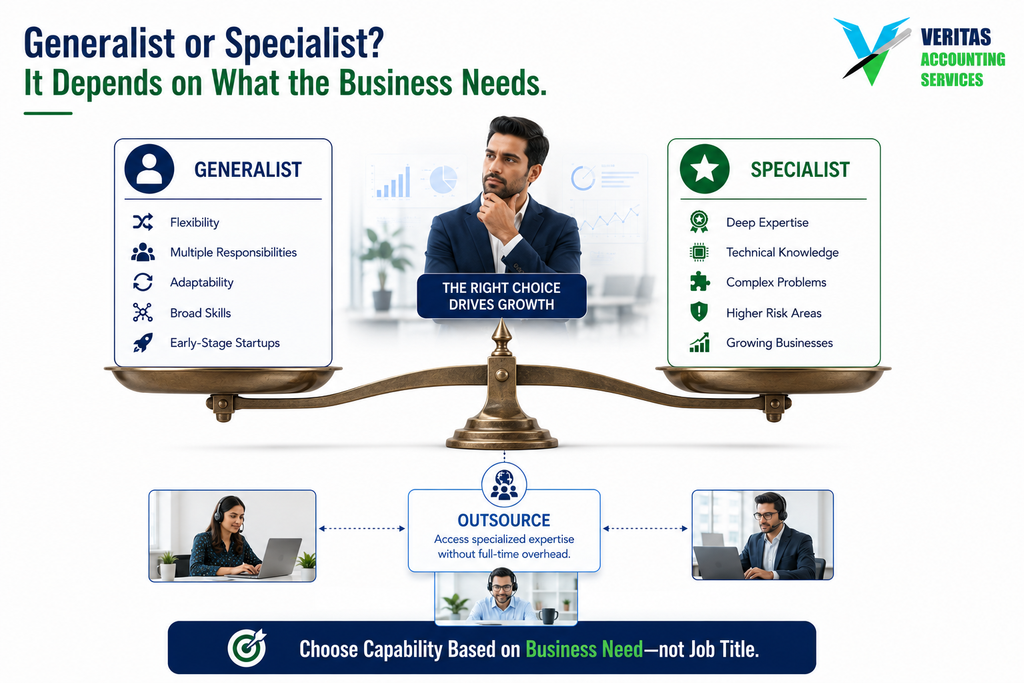
That makes startup hiring a strategic decision. A generalist may be able to manage several functions and adapt quickly. A specialist may bring the depth required to solve a complex problem that cannot be handled effectively by someone wearing several hats.

The right choice depends on what the business needs now, what it expects to need next, and whether the role requires broad adaptability or deep expertise.

For many founders, the answer may also involve a third option: outsourcing specialized functions until the business is ready for a full-time hire.

Table of Contents

  1. What Is a Generalist?
  2. What Is a Specialist?
  3. Generalists vs. Specialists: What Should Founders Consider?
  4. When a Startup Needs Generalists
  5. When a Specialist Makes More Sense
  6. The Cost Factor
  7. Consider Outsourcing Before Hiring Full-Time
  8. Accounting and Tax as a Practical Example
  9. Hire, Outsource, Automate or Delegate?
  10. How the Right Mix Changes as You Grow
  11. Common Hiring Mistakes
  12. A Practical Decision Framework
  13. FAQ
  14. Conclusion

What Is a Generalist?

A generalist is someone who can contribute across multiple areas rather than being narrowly focused on one technical discipline.

In a startup, that might mean an operations employee who can coordinate vendors, support customers, prepare reports, and help improve internal processes.

Generalists are particularly valuable when priorities change frequently. They can move between responsibilities without requiring a separate hire for every new requirement.

This flexibility can be important when the business is still testing its market, refining its business model, or building its internal processes.

However, flexibility has a limit. A generalist may be capable of handling many tasks but may not have the depth required for highly technical, regulated, or specialized work.
What Is a Specialist?

A specialist brings deep knowledge to a particular function.

Examples include a tax professional, software engineer, cybersecurity expert, financial controller, legal professional, or performance marketing specialist.

Specialists become increasingly valuable when a business reaches a point where mistakes are expensive, complexity is increasing, or a function requires expertise that cannot be developed quickly internally.

The trade-off is cost and flexibility. A specialist may be highly effective in one area but may have less value when priorities change or the workload is inconsistent.

For founders, startup hiring is therefore not simply about choosing between two types of employees. It is about matching capability with the business problem.

Generalists vs. Specialists: What Should Founders Consider?

There is no universal formula, but several factors can guide the decision.

1. Business Stage

An early-stage startup often benefits from people who can wear multiple hats.

A later-stage company may need specialists as departments become more complex.

2. Nature of the Work

If the work involves changing priorities, coordination, and problem-solving across departments, a generalist may be effective.

If it involves technical knowledge, regulatory requirements, or high-risk decisions, a specialist may be more appropriate.

3. Frequency of the Work

A role that requires expertise every day may justify a full-time specialist.

A specialized task needed only a few hours a month may not.

4. Cost of Mistakes

Some errors are inconvenient. Others can result in tax penalties, compliance issues, security problems, lost customers, or financial losses.

The higher the potential cost of an error, the more important appropriate expertise becomes.

When a Startup Needs Generalists

Generalists can be especially useful during the early stages of a company.

They can help founders build processes while learning what the business actually needs.

A strong generalist may:

  • Take ownership of multiple operational tasks
  • Adapt to changing priorities
  • Work across departments
  • Identify process improvements
  • Communicate with different stakeholders
  • Help founders reduce operational bottlenecks

For example, an operations generalist might coordinate customer onboarding, maintain internal documentation, assist with vendor management, and prepare basic management reports.

The value is not that the employee does everything.

The value is that the startup does not need to create a separate position for every responsibility.

This makes startup hiring particularly important during the early stage because founders are often buying flexibility, not just labor.

When a Specialist Makes More Sense

As a startup grows, some functions become too important or complex to manage through broad generalist skills alone.

Consider areas such as:

  • Tax compliance
  • Cybersecurity
  • Software architecture
  • Legal matters
  • Financial controls
  • Regulatory compliance
  • Advanced digital marketing
  • Complex financial reporting

In these areas, experience can prevent expensive mistakes and improve the quality of decisions.

A specialist is particularly valuable when the business has reached sufficient scale to keep the person productive.

That last point is important.

Hiring a specialist simply because the function is important does not necessarily make financial sense. The company must also have enough recurring work to justify the cost.

A startup may need expert knowledge without needing an expert sitting on its payroll eight hours a day.

The Cost Factor

Founders often compare salaries when evaluating a hire.

That is only part of the calculation.

The actual cost of an employee can include:

  • Salary
  • Payroll taxes
  • Benefits
  • Recruitment costs
  • Training
  • Software
  • Equipment
  • Office costs
  • Management time
  • Paid leave

A full-time specialist can therefore represent a substantial fixed commitment.

This does not mean specialists are too expensive. It means the business should compare the expected value of the role with the total cost of maintaining it.

Cash flow is particularly important for startups. A business can be profitable on paper and still struggle if it commits too much cash to fixed costs before revenue becomes predictable.

A disciplined startup hiring strategy should therefore consider total employment cost, not just the advertised salary.
Consider Outsourcing Before Hiring Full-Time

One option that founders sometimes overlook is outsourcing.

Not every business function needs to be performed by an internal employee.

Outsourcing can make sense when a function requires specialized expertise but does not require full-time attention.

Common examples include:

  • Bookkeeping
  • Tax preparation and support
  • Payroll processing
  • Financial reporting
  • IT support
  • Legal services
  • HR administration
  • Digital marketing

The advantage is access to expertise without immediately creating another full-time position.

This can give a startup greater flexibility while it validates demand and builds predictable revenue.

However, outsourcing works best when the external provider has clear responsibilities, defined deliverables, reliable communication, and appropriate controls.

The cheapest provider is not necessarily the best choice.

For functions involving financial records, tax compliance, or sensitive business information, experience, security, responsiveness, and quality should be part of the evaluation.

This is why startup hiring should not be viewed as an automatic answer to every capability gap.

Sometimes the smarter decision is to buy expertise as a service.

Accounting and Tax as a Practical Example

Accounting is a good example of why the generalist-versus-specialist decision needs careful thought.

A founder may be able to record basic transactions or manage simple bookkeeping during the earliest stage.

But as the company grows, financial requirements usually become more complex.

The business may need:

  • Monthly closing procedures
  • Bank and credit card reconciliations
  • Accounts receivable and payable management
  • Cash-flow forecasting
  • Management reporting
  • Budgeting
  • Tax coordination
  • Payroll support
  • Financial controls

At that point, the question is not simply whether to hire an accountant.

The founder should ask what level of financial support is actually required.

A startup may not need a full-time controller or CFO immediately. It may benefit more from an experienced outsourced accounting team that manages the recurring work and provides financial insight as needed.

For example, Veritas Accounting Services can support bookkeeping, accounting, financial reporting, tax support, budgeting, forecasting, and CFO-related requirements without requiring the startup to build an entire finance department internally.

That can allow founders to access experienced professionals while keeping their internal structure lean.

For a founder, the result can be better financial visibility without adding unnecessary fixed overhead.

Hire, Outsource, Automate or Delegate?

A useful approach is to evaluate every recurring function through four options.

Hire

Hire internally when the workload is substantial, continuous, strategically important, and requires close daily collaboration.

Outsource

Outsource when specialized expertise is needed but a full-time position is not yet justified.

Automate

Automate repetitive, rule-based processes where technology can deliver reliable results.

Delegate

Delegate tasks that are important but do not require the founder’s direct involvement.

These options are not permanent decisions.

A function can move from outsource to hire as the company grows. Similarly, a manual task can become automated after the process becomes standardized.

This flexible approach makes startup hiring more closely aligned with actual business needs rather than assumptions about what a “proper” company should look like.

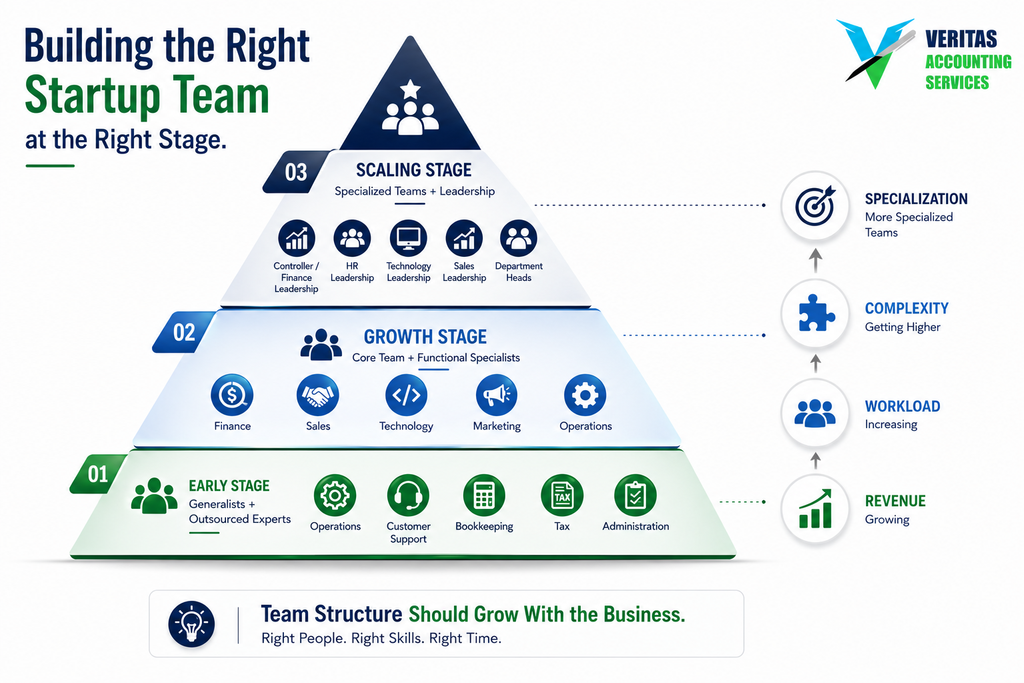
How the Right Mix Changes as You Grow

The ideal team structure at $500,000 of annual revenue may look very different from the structure needed at $5 million.

Early-stage businesses often need adaptable people who can work across functions.

As revenue, customers, employees, and operational complexity increase, specialization usually becomes more valuable.

A common progression might look like this:

Early Stage → Generalists + Outsourced Specialists

Growth Stage → Core Internal Team + Functional Specialists

Scaling Stage → Dedicated Departments + Specialized Leadership

This is not a fixed formula.

Some startups will specialize earlier because their industry requires it. Others may remain lean for longer because their operating model is highly standardized.

The important point is to avoid building organizational complexity faster than the business can support.

A good startup hiring plan should evolve with revenue, workload, risk, and management capacity.

Common Hiring Mistakes

Hiring for a Title Instead of a Problem

Do not start with:

“We need a CFO.”

Start with:

“What problem are we trying to solve?”

The second question produces a much better hiring decision.

Hiring Too Early

A position can be strategically important without requiring a full-time employee today.

If the workload is inconsistent, outsourcing may be more practical.

Choosing Only on Salary

The lowest-cost candidate may create higher costs through errors, rework, supervision, or turnover.

Look at the total value of the role.

Expecting One Person to Do Everything

Generalists are valuable, but expecting one employee to perform accounting, tax, HR, technology, sales, and operations at a professional level is unrealistic.

Ignoring Scalability

A role should be evaluated not only for today’s needs but also for how it fits the company’s expected growth.

A Practical Decision Framework

Before making a hiring decision, founders can ask seven questions:

  1. How frequently is this work required?
  2. How specialized is the knowledge?
  3. What happens if the work is done incorrectly?
  4. Can the responsibility be automated?
  5. Can an existing employee handle it with training?
  6. Would outsourcing provide better expertise at the current stage?
  7. At what workload would a full-time hire become financially justified?

The answers can make the decision much clearer.

For example, if a task is highly specialized, performed occasionally, and carries significant risk, outsourcing may be more sensible than hiring.

If the work is continuous, central to operations, and requires daily collaboration, an internal hire may be the better long-term choice.

The strongest startup hiring decisions are usually based on workload, risk, economics, and business strategy rather than simply following what other startups are doing.

FAQ

Should startups hire generalists or specialists first?

There is no single answer. Early-stage companies often benefit from adaptable generalists, while specialized expertise can be brought in through targeted hiring or outsourcing when the need arises.

When should a startup hire a specialist?

A specialist becomes more attractive when the workload is recurring, the function is business-critical, mistakes are costly, and the company can support the role financially.

Is outsourcing better than hiring?

Neither is automatically better. Outsourcing can be effective when a startup needs expertise without enough full-time workload to justify an internal employee.

Should startups outsource accounting?

Many startups can benefit from outsourcing accounting and bookkeeping, particularly when they need reliable financial records, reporting, tax coordination, and cash-flow visibility but do not yet need a full internal finance department.

How should founders decide whom to hire?

Start with the business problem, determine the capability required, estimate the workload and risk, and compare hiring, outsourcing, automation, and delegation before deciding.

Conclusion

Startup hiring should not be driven by titles or trends.

The better question is:

What capability does the business need right now, and what is the most effective way to obtain it?

Generalists can provide flexibility when priorities are changing. Specialists can provide depth when complexity and risk increase. Outsourcing can bridge the gap when a startup needs expertise without enough workload to justify a full-time position.

The smartest approach is often a combination.

Keep critical, high-frequency work close to the business. Use specialists where expertise genuinely matters. Outsource functions that require professional knowledge but do not justify full-time capacity. Automate repetitive work wherever practical.

For finance and accounting, this approach can be particularly valuable. A reliable external team can maintain the books, prepare management reports, support tax requirements, and provide financial insight while founders remain focused on customers, products, and growth.

At Veritas Accounting Services, we help businesses and professional firms access bookkeeping, accounting, tax support, financial reporting, budgeting, forecasting, and CFO-related expertise without automatically building a large internal finance function.

The right team is not necessarily the biggest team.

It is the team with the right capabilities, at the right time, in the right structure.

GET IN TOUCH

Schedule a FREE Call

What to Do When You Pay for Business Expenses Personally

A practical guide to documenting business purchases you paid for personally, matching any repayment…

When the Bank Balance and Your Books Disagree

A practical month-end walkthrough for comparing your bank statement and books, with a worked example…

Vendor Bills and a Simple Routine for Better Cash Planning

A practical weekly routine for checking supplier bills, planning the payment batch and matching what…

Tax Bracket Mistakes: A Simple Guide to Better Planning

The November 5 IRS inflation update is a prompt to review your planning assumptions. Learn how…

Your Simple Guide to PTIN Renewal Mistakes and Better Records

The November 4 IRS reminder is a timely prompt to check 2027 preparer renewals, separate enrolled…

Inventory Tax Mistakes: A Simple Guide to Better Records

Stock purchases do not automatically equal a tax deduction. Review the inventory method, quantities…

Payroll Deposit Mistakes: A Simple Guide to Better Records

A quarterly payroll return does not set every tax deposit deadline. Check the schedule, actual pay…

Your Simple Guide to Home Office Mistakes and Better Records

Working from home does not automatically create a deduction. Check eligibility, space, dates…

Your Simple Guide to Unpaid Invoice Mistakes and Better Records

An unpaid customer invoice is not automatically a tax deduction. Review the tax accounting method…
80/20 rule for business owners and resource allocation

The 80/20 Rule for Business Owners: How to Identify Your Most Valuable Customers, Tasks and Decisions

80/20 rule for business owners and resource allocation

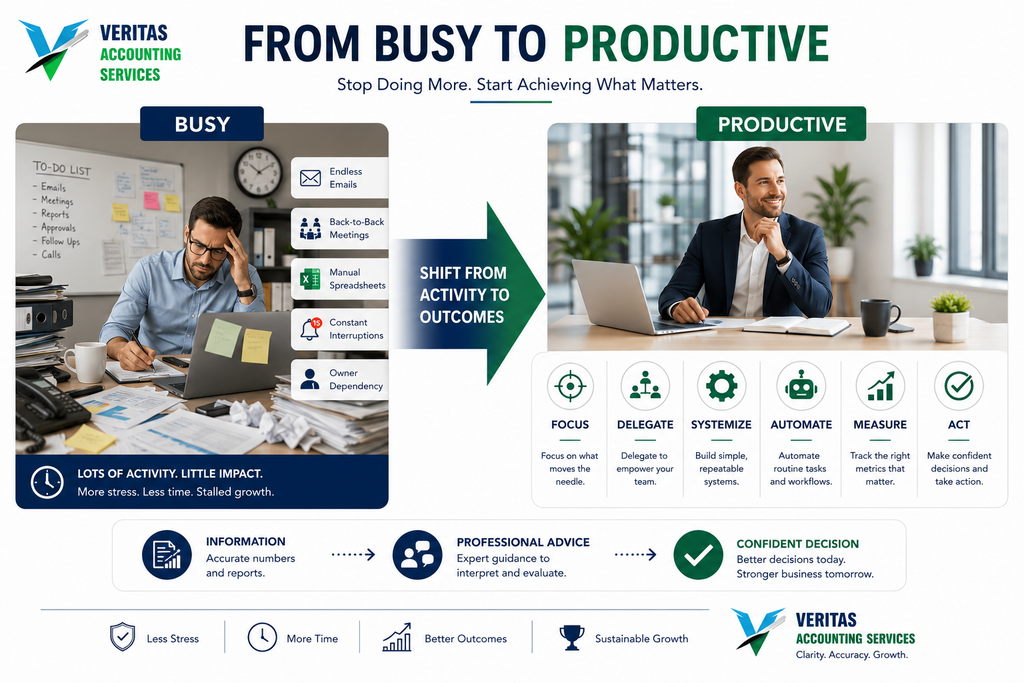
Most business owners have the same problem: there is never enough time to do everything.

There are customers to serve, employees to manage, invoices to review, emails to answer, suppliers to negotiate with, financial reports to understand, and decisions waiting for attention.

Yet not every activity contributes equally to business growth.

Some customers generate significantly more profit than others. Some services create stronger margins. Some meetings produce important decisions, while others consume time without moving the business forward. Some employees spend their time on activities that have a much greater impact than others.

This is where the 80/20 rule becomes useful.

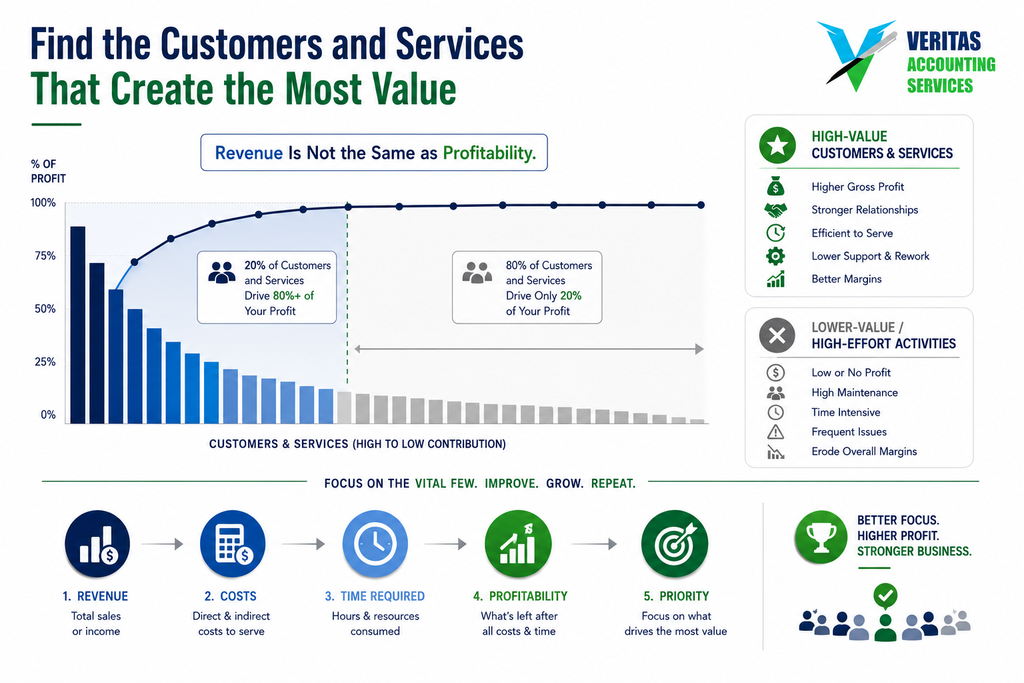
The principle suggests that a relatively small portion of inputs can often generate a disproportionately large portion of results. The exact ratio does not need to be 80/20 in every business. The important idea is to identify where the greatest value is being created and allocate resources accordingly.

For business owners, this is not simply a productivity technique.

It is a way of thinking about customers, profitability, time, people, cash flow and strategic decisions.

Table of Contents

  1. What Is the 80/20 Rule?
  2. Why It Matters to Business Owners
  3. Find Your Most Valuable Customers
  4. Identify Your Most Profitable Products and Services
  5. Look at Where Your Time Goes
  6. Identify High-Value Business Activities
  7. Use Financial Data to Find the Vital Few
  8. Apply the Principle to Employees and Teams
  9. Focus on Cash Flow and Financial Resources
  10. Avoid the Wrong Use of the 80/20 Rule
  11. How Accounting Professionals Can Helpfgbfgb
  12. A Practical 80/20 Exercise
  13. FAQ
  14. Conclusion

What Is the20 Rule?

The 80/20 rule is commonly associated with economist Vilfredo Pareto, who observed an unequal distribution of wealth and ownership in nineteenth-century Italy.

Over time, the idea became widely used in business and management.

The principle is simple:

A relatively small number of factors may account for a disproportionately large share of results.

For example, a company might discover that:

  • 20% of customers generate 75% of gross profit
  • 15% of products generate 70% of sales
  • 10% of activities consume 60% of management time
  • A small number of recurring problems create most customer complaints

The numbers will differ from business to business.

The value comes from asking a better question:

Which activities, customers, products and decisions create the greatest impact?

Why It Matters to Business Owners

Many businesses try to improve everything at once.

They introduce more products, take on more customers, hold more meetings, add more processes and hire more people.

Growth, however, is not always about doing more.

Sometimes it is about doing more of what works and less of what does not.

The 80/20 rule encourages business owners to look beyond total revenue and examine where the underlying value actually comes from.

A business with $5 million in revenue is not necessarily healthier than one with $3 million.

The more useful questions are:

  • Which customers generate the best margins?
  • Which services are most profitable?
  • Which activities create measurable results?
  • Where is management spending its time?
  • Which expenses produce meaningful returns?
  • Which problems repeatedly consume resources?

The answers can reveal opportunities that are invisible in a traditional top-line revenue report.

Find Your Most Valuable Customers

Revenue alone does not tell you which customers are most valuable.

A customer generating $100,000 in annual revenue may require extensive support, frequent revisions, urgent service, and significant management attention.

Another customer generating $60,000 may be highly profitable, predictable and easy to serve.

That distinction matters.

Use the 80/20 rule to analyze your customer base by:

  • Revenue
  • Gross profit
  • Net contribution
  • Service hours
  • Payment reliability
  • Customer acquisition cost
  • Support requirements
  • Growth potential

Create a customer profitability report and rank customers from highest to lowest contribution.

You may discover that a relatively small group accounts for most of your profitable business.

That information can influence pricing, service levels, account management and future sales strategy.

It may also reveal customers who generate significant revenue but very little actual profit.

Identify Your Most Profitable Products and Services

The same analysis should be applied to what you sell.

Business owners sometimes continue offering products or services simply because customers have historically purchased them.

But revenue does not automatically equal value.

Analyze each offering based on:

Revenue → Direct Cost → Gross Profit → Delivery Time → Management Effort

Suppose a professional services firm offers five services.

One service produces 30% of total revenue but requires extensive customization and employee hours.

Another produces only 15% of revenue but generates much higher margins with a standardized process.

The second service may deserve more attention.

The 80/20 rule can help management identify which offerings deserve investment and which may need repricing, redesign, automation or discontinuation.

Look at Where Your Time Goes

Time is one of the most valuable resources a business owner has.

Yet it is often the least measured.

For two weeks, track how you spend your working hours.

Divide activities into categories such as:

  • Sales
  • Customer meetings
  • Strategy
  • Finance
  • Administration
  • Employee management
  • Problem solving
  • Email
  • Operations
  • Business development

Then ask:

Which activities actually create value?

You may discover that a large portion of your week is consumed by activities that could be delegated, automated or outsourced.

At the same time, the activities that could generate the greatest future growth may receive very little attention.

This is one of the most practical applications of the 80/20 rule.

The objective is not to work fewer hours simply for the sake of working fewer hours.

It is to spend more of those hours on activities where your involvement creates the greatest difference.

Identify High-Value Business Activities

Not every task deserves the same level of attention.

Consider a business owner who spends three hours every Monday reviewing routine bookkeeping transactions but only thirty minutes reviewing monthly profitability.

The time allocation may be backwards.

Routine accounting work is important, but it does not necessarily require the owner’s direct involvement.

A management report showing declining margins, increasing customer acquisition costs or deteriorating cash flow may require much more strategic attention.

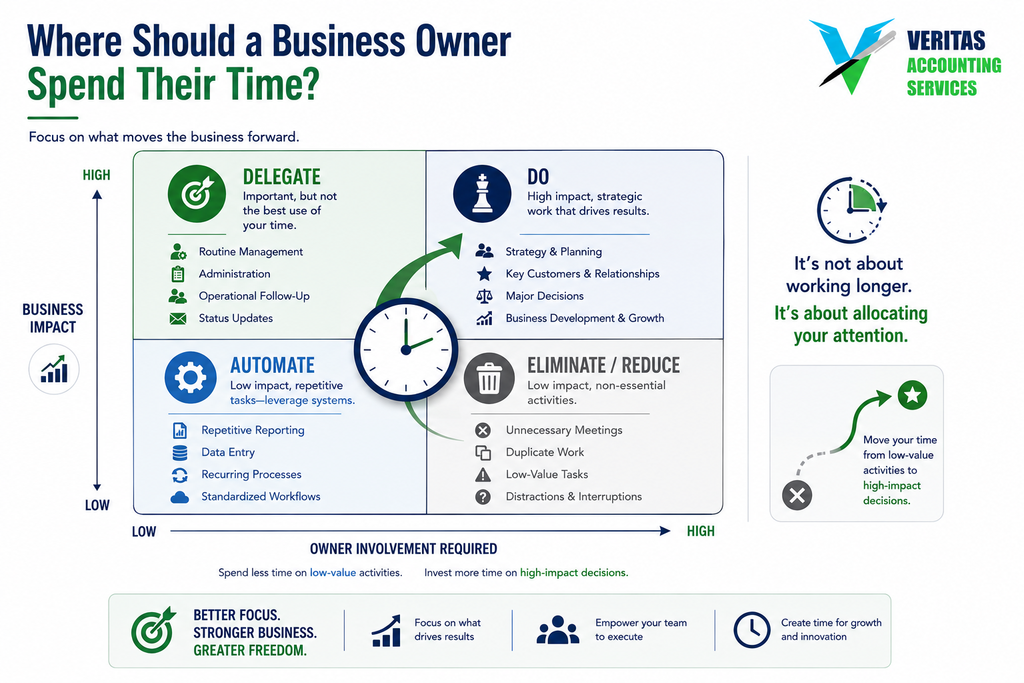
Business owners should therefore separate activities into four categories:

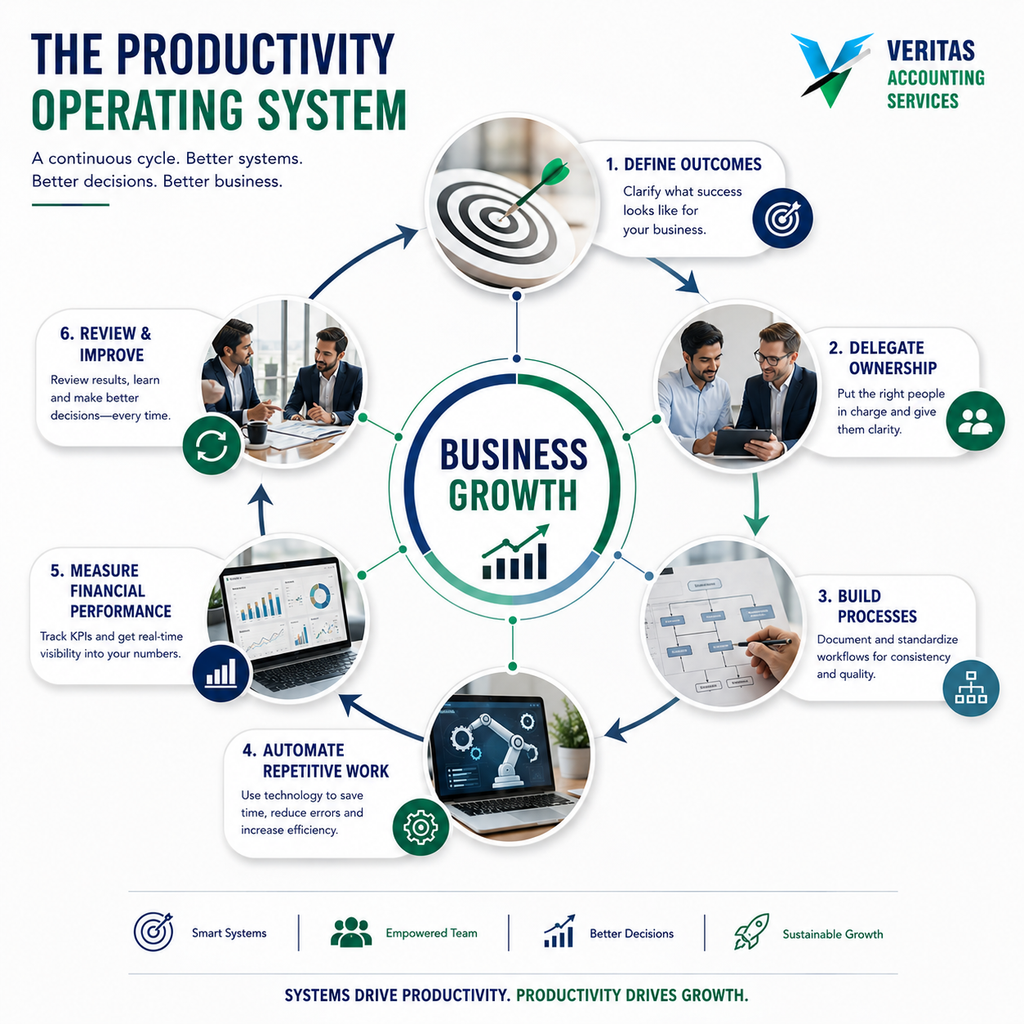
Do

Activities where the owner’s involvement creates significant value.

Delegate

Important work that someone else can perform effectively.

Automate

Repetitive activities that can be handled through technology and established processes.

Eliminate

Activities that add little or no meaningful value.

This simple framework can significantly improve management capacity.

Use Financial Data to Find the Vital Few

Good decisions require good information.

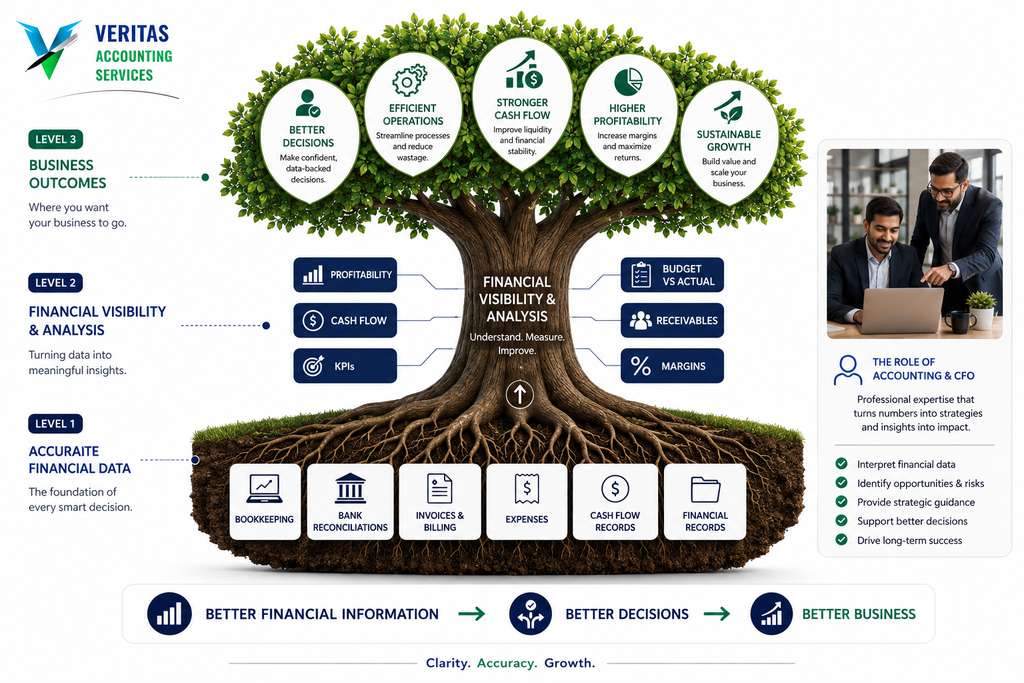
Accounting records are not only useful for tax compliance. They can help management identify where money, time and resources are producing results.

Useful reports include:

  • Customer profitability
  • Product or service profitability
  • Gross margin analysis
  • Expense trends
  • Accounts receivable aging
  • Cash-flow reports
  • Budget versus actual
  • Department performance
  • Revenue by channel
  • Customer concentration

The 80/20 rule becomes far more useful when it is supported by reliable financial data.

For example, a business owner may believe that its largest customer is its most valuable customer.

A profitability analysis may tell a different story.

The customer with the highest revenue may also have the highest service costs, lowest margin and slowest payment cycle.

Without proper financial analysis, management may optimize the wrong thing.

Apply the Principle to Employees and Teams

The goal is not to label certain employees as “valuable” and others as “less valuable.”

Instead, examine where the team’s effort produces the greatest business impact.

Some employees may spend considerable time handling repetitive administrative work.

Others may be involved in customer relationships, process improvement, sales, technical delivery or leadership activities that directly influence growth.

Management should ask:

  • Which responsibilities have the greatest impact?
  • Where are employees spending most of their time?
  • Which activities can be standardized?
  • Where do employees need additional training?
  • Which processes create unnecessary rework?
  • Where could technology or outsourcing free employees for higher-value work?

The objective is to improve the productivity of the entire organization, not simply increase everyone’s workload.

Focus on Cash Flow and Financial Resources

Money should also be allocated according to impact.

Businesses frequently have limited capital and must decide where to invest it.

Possible uses include:

  • Marketing
  • Hiring
  • Technology
  • Equipment
  • Inventory
  • Training
  • Product development
  • Customer acquisition

Instead of spreading resources evenly, compare the expected return from each investment.

For example, if one marketing channel consistently produces profitable customers while another produces large volumes of low-value leads, the company should investigate why.

Likewise, if a particular software system reduces hours of repetitive work every month, its value may be greater than an apparently cheaper alternative.

Financial discipline means understanding not only how much you spend, but what the spending produces.

Avoid the Wrong Use of the 80/20 Rule

The 80/20 rule is a framework for analysis, not a mathematical law that every business must follow exactly.

Do not force every situation into an 80/20 pattern.

There are also activities that may not generate immediate financial returns but remain essential.

Examples include:

  • Compliance
  • Internal controls
  • Cybersecurity
  • Employee development
  • Financial reporting
  • Quality assurance
  • Risk management

A task may represent a small percentage of total activity but still be extremely important.

The right question is therefore not:

“Can we eliminate the other 80%?”

It is:

“Which activities deserve more attention, and which can be handled more efficiently?”

That distinction is critical.

How Accounting Professionals Can Help

Business owners cannot make effective 80/20 decisions if their financial information is incomplete or unreliable.

This is where an experienced accounting team can become more than a bookkeeping provider.

A professional team can help transform accounting data into management information.

For example, an outsourced accounting or CFO team can help prepare:

  • Customer profitability reports
  • Service-line margin analysis
  • Cash-flow forecasts
  • Budget versus actual reports
  • Expense analysis
  • Accounts receivable reports
  • Management dashboards
  • Key performance indicators

This allows business owners to see where resources are actually being consumed and where value is being created.

At Veritas Accounting Services, we support businesses and professional firms with bookkeeping, accounting, financial reporting, tax support, financial projections and CFO-related services.

Our role is not simply to record transactions.

The objective is to provide organized financial information that helps management make better decisions.

For example, if a business owner wants to determine which customers deserve greater attention, the analysis should go beyond revenue.

We can help management consider profitability, collection patterns, service requirements and other relevant financial indicators.

Likewise, when evaluating expenses, management should understand whether spending is supporting growth, protecting the business or simply continuing because it has always existed.

Reliable accounting data gives the 80/20 rule a stronger foundation.

A Practical 80/20 Exercise for Business Owners

Set aside two hours this month and perform a simple analysis.

Step 1: Rank Your Customers

List your top customers by revenue and then by gross profit.

Compare the two rankings.

Step 2: Rank Your Services

Identify which products or services generate the highest margins.

Step 3: Track Your Time

Record your activities for two weeks.

Highlight tasks that require your involvement but could be delegated or outsourced.

Step 4: Review Your Expenses

Identify the largest recurring expenses and determine what business outcome each expense supports.

Step 5: Review Your Decisions

Look at the major decisions made during the last six months.

Which decisions produced measurable results?

Step 6: Take Action

Choose three areas where you can shift more time, money or attention toward activities producing stronger results.

The exercise does not need to produce a perfect 80/20 ratio.

Its purpose is to make the business owner more conscious of where resources are actually creating value.

FAQ

What is the 80/20 rule in business?

The 80/20 rule is the idea that a relatively small proportion of customers, activities, products or resources may generate a disproportionately large share of business results.

How can business owners use the 80/20 rule?

Owners can analyze customers, services, time, employees, expenses and investments to identify where the greatest value is being created and then allocate resources accordingly.

Does the 80/20 rule always mean exactly 80% and 20%?

No. The ratio is a useful principle rather than a fixed mathematical requirement. The actual distribution may be 70/30, 90/10 or another pattern.

Can accounting data help identify the most valuable customers?

Yes. Revenue, gross margin, service costs, payment behavior and customer-level profitability can provide a much clearer picture of customer value than revenue alone.

How can an outsourced accounting team support this approach?

An experienced accounting team can organize financial data and prepare profitability reports, management reports, cash-flow forecasts and other analysis that helps business owners identify where resources are creating the greatest impact.

Conclusion

Business growth does not always require doing more.

Sometimes it requires identifying what matters most and allocating resources accordingly.

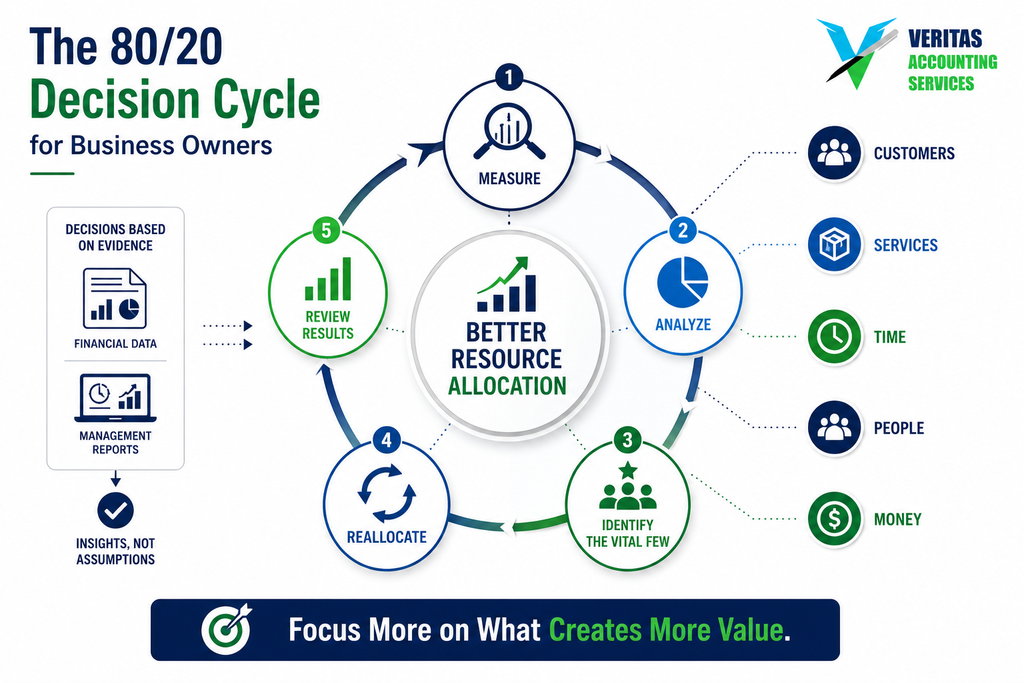
The 80/20 rule gives business owners a practical framework for examining customers, services, time, employees, expenses and investments.

The most important step is to move from assumptions to evidence.

Instead of assuming that the biggest customer is the most profitable, measure profitability.

Instead of assuming that a busy employee is productive, examine outcomes.

Instead of reviewing every expense equally, understand which investments contribute to growth, efficiency or risk reduction.

And instead of spending management time on every operational detail, identify the decisions where leadership involvement creates the greatest value.

At Veritas Accounting Services, we believe accounting should provide more than historical numbers. Well-organized financial information can help business owners understand profitability, cash flow, resource allocation and business performance.

The goal is simple: focus more of your time, money and attention on the activities that genuinely move your business forward.

That is where the real value of the 80/20 rule lies.

GET IN TOUCH

Schedule a FREE Call

What to Do When You Pay for Business Expenses Personally

A practical guide to documenting business purchases you paid for personally, matching any repayment…

When the Bank Balance and Your Books Disagree

A practical month-end walkthrough for comparing your bank statement and books, with a worked example…

Vendor Bills and a Simple Routine for Better Cash Planning

A practical weekly routine for checking supplier bills, planning the payment batch and matching what…

Tax Bracket Mistakes: A Simple Guide to Better Planning

The November 5 IRS inflation update is a prompt to review your planning assumptions. Learn how…

Your Simple Guide to PTIN Renewal Mistakes and Better Records

The November 4 IRS reminder is a timely prompt to check 2027 preparer renewals, separate enrolled…

Inventory Tax Mistakes: A Simple Guide to Better Records

Stock purchases do not automatically equal a tax deduction. Review the inventory method, quantities…

Payroll Deposit Mistakes: A Simple Guide to Better Records

A quarterly payroll return does not set every tax deposit deadline. Check the schedule, actual pay…

Your Simple Guide to Home Office Mistakes and Better Records

Working from home does not automatically create a deduction. Check eligibility, space, dates…

Your Simple Guide to Unpaid Invoice Mistakes and Better Records

An unpaid customer invoice is not automatically a tax deduction. Review the tax accounting method…

Connect on our Socials!

compliance calendar

Business Compliance Calendar: How to Organize Your Tax, Payroll and Filing Deadlines

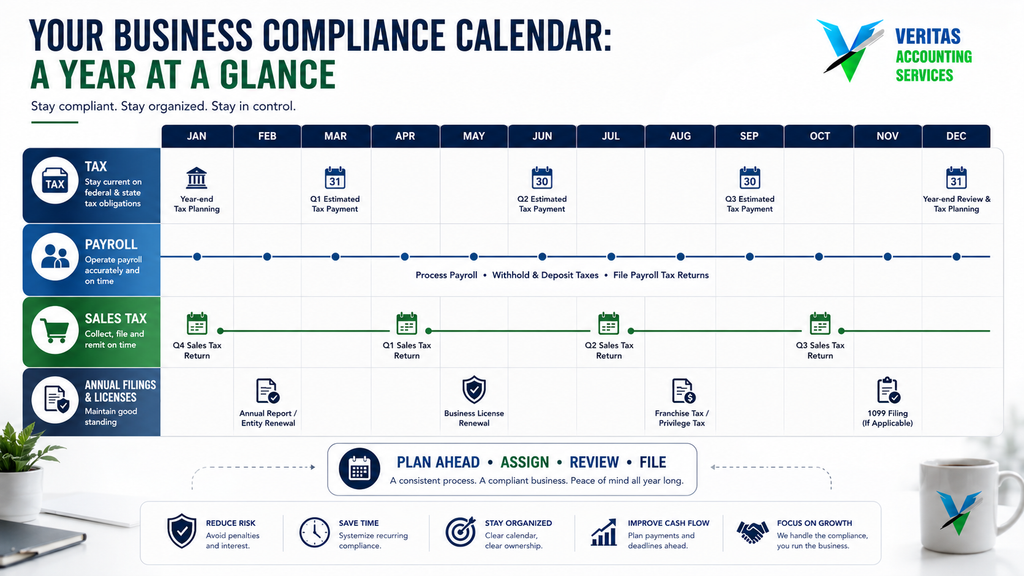
Running a business involves more than generating revenue and managing customers. Every company has recurring obligations that must be completed on time—tax filings, payroll reports, sales tax returns, annual registrations, licenses, information returns, and other regulatory requirements.

The challenge is that these obligations rarely follow one simple schedule.

Some are monthly. Others are quarterly or annual. Certain requirements depend on the state where the business operates, the type of entity, the number of employees, or the nature of its transactions.

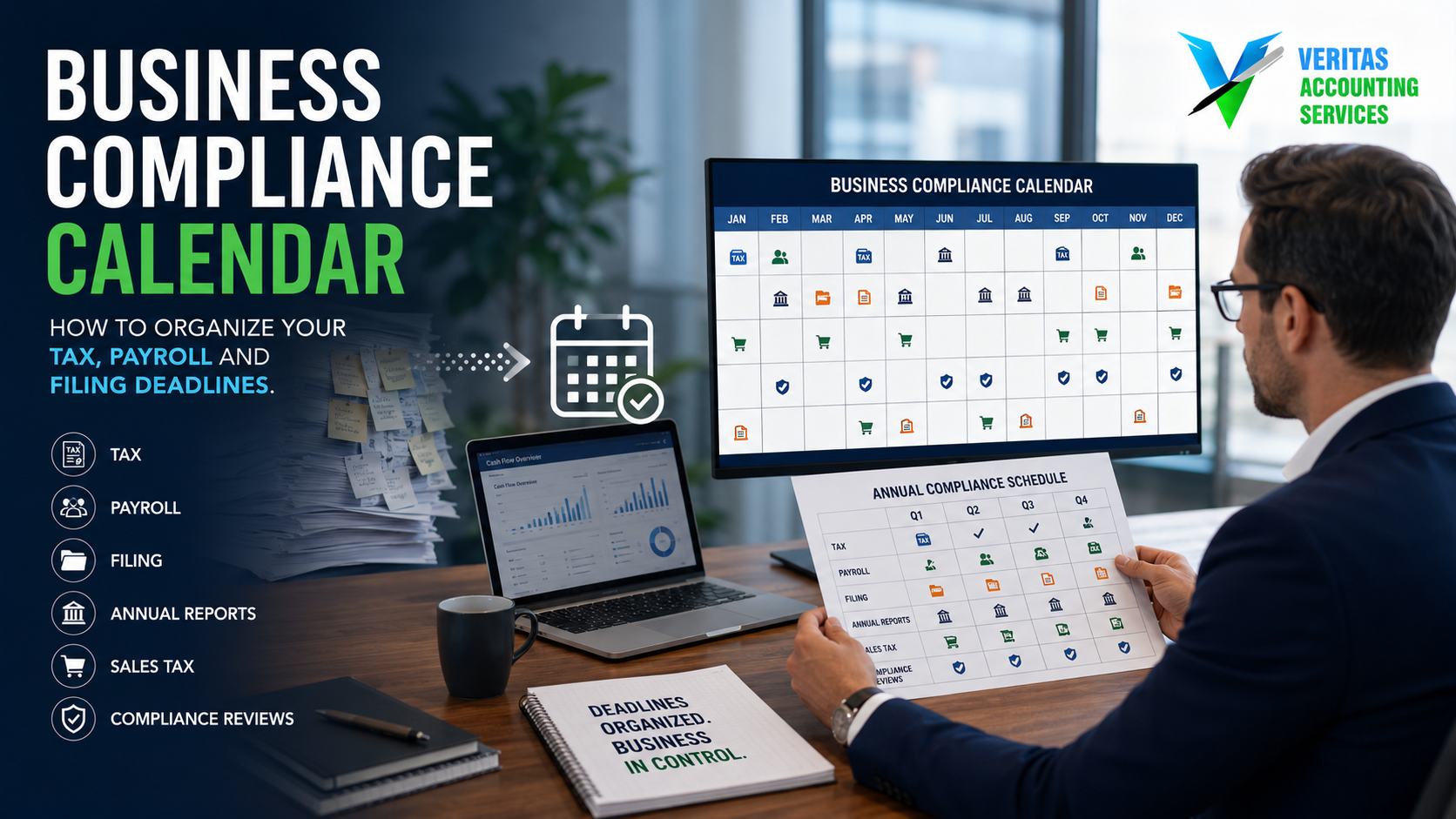
A well-designed compliance calendar turns these scattered obligations into a structured management process. Instead of relying on memory or reacting to approaching deadlines, business leaders can see what needs to be done, who is responsible, and when each task must be completed.

For growing businesses, this is particularly important. As operations expand across states, entities, employees, and tax jurisdictions, compliance becomes more complex.

The goal is not simply to remember deadlines. It is to create a system that makes compliance predictable, accountable, and manageable.

Table of Contents

  1. Why Every Business Needs a Compliance Calendar
  2. What Should Be Included?
  3. Organizing Tax Deadlines
  4. Managing Payroll and Employment Tax Obligations
  5. Tracking Sales Tax and Other Indirect Taxes
  6. Annual Reports, Licenses and Registrations
  7. Organizing Information Returns
  8. Assigning Responsibility for Every Deadline
  9. Building an Effective Reminder System
  10. Common Compliance Calendar Mistakes
  11. How Accounting Professionals Can Help
  12. FAQ
  13. Conclusion

Why Every Business Needs a Compliance Calendar

A compliance calendar is essentially a central schedule containing the recurring filings, payments, renewals, reports, and other obligations applicable to a business.

Without one, businesses often manage deadlines through disconnected emails, spreadsheets, accounting software reminders, and individual employees’ calendars.

That approach can work when a company is very small.

It becomes risky as the business grows.

A structured compliance calendar helps management answer five basic questions:

  • What needs to be filed or paid?
  • When is it due?
  • Who is responsible?
  • Which documents or information are required?
  • Has the obligation been completed and reviewed?

This creates accountability.

It also reduces the risk of a common problem: everyone assumes someone else is handling the filing.

What Should Be Included?

A good compliance calendar should be customized to the company’s actual obligations.

For a U.S. business, this may include federal, state, and local requirements.

Depending on the business, consider including:

  • Federal income tax filings
  • Estimated tax payments
  • State income or franchise tax filings
  • Payroll tax filings
  • Sales and use tax returns
  • Annual reports
  • Business license renewals
  • Information returns
  • Property tax obligations
  • Foreign-related information reporting
  • Registered-agent requirements
  • Insurance renewals
  • Employee-related filings
  • Financial reporting deadlines

Not every business will have every obligation.

The objective is to identify the requirements that actually apply and place them into one controlled system.

A compliance calendar should also record the frequency of each obligation. Categorizing tasks as monthly, quarterly, annual, or event-based makes the schedule easier to manage.

Organizing Tax Deadlines

Tax obligations are usually among the most important items on the schedule.

However, businesses should avoid treating “tax filing” as one single category.

Depending on the entity and circumstances, the calendar may need to distinguish between:

  • Federal income tax
  • State income or franchise taxes
  • Estimated tax payments
  • Sales and use taxes
  • Payroll taxes
  • Excise taxes
  • Information reporting
  • Local taxes

A business operating in multiple states may have several different filing calendars.

For example, a company could have employees in one state, customers creating sales tax obligations in another, and an entity registration in a third.

That means the finance team should maintain a jurisdiction-by-jurisdiction view rather than relying on one generic tax deadline list.

The calendar should also identify whether each obligation requires a return, payment, or both.

This distinction matters because filing and payment requirements do not always operate in exactly the same way.

Managing Payroll and Employment Tax Obligations

Payroll compliance deserves its own section because payroll mistakes can affect both the business and its employees.

Depending on the business and jurisdiction, responsibilities may include:

  • Federal payroll tax deposits
  • Federal payroll tax returns
  • State payroll tax filings
  • State unemployment filings
  • Local payroll requirements
  • Employee wage reporting
  • Year-end employee forms
  • New-hire reporting

The appropriate frequency can depend on factors such as payroll size, tax liability, jurisdiction, and employer status.

A compliance calendar should therefore identify the exact requirement rather than simply creating a generic “payroll filing” reminder.

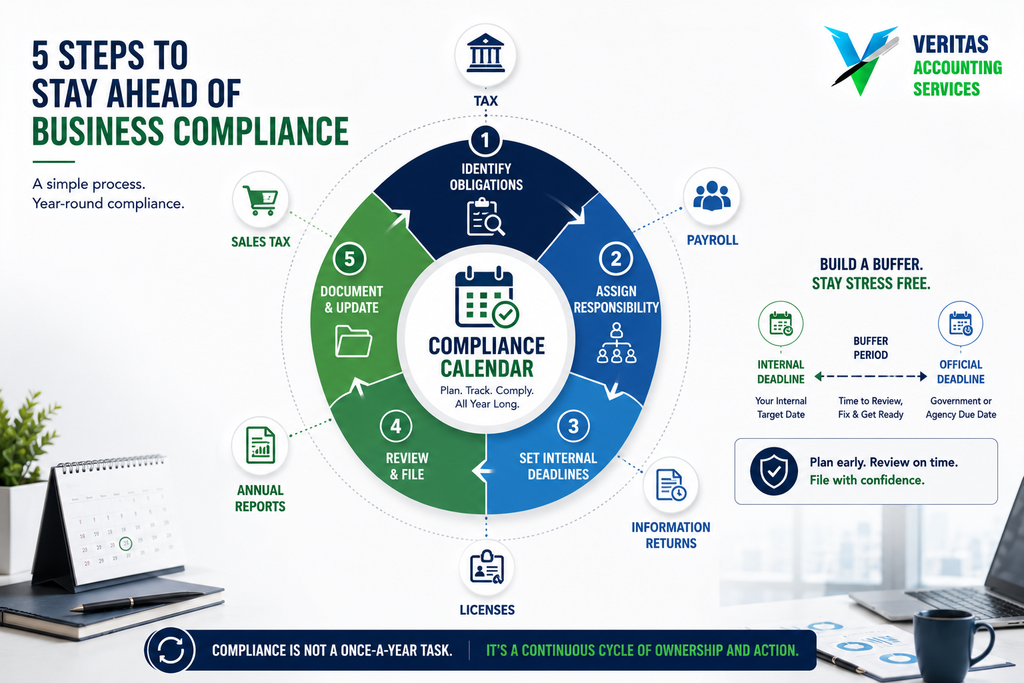
It is also useful to schedule internal deadlines before the official due date.

For example, if a filing is due on a particular date, the business might require payroll information to be reviewed several business days earlier.

That buffer gives the accounting team time to identify missing information or resolve discrepancies.

Tracking Sales Tax and Other Indirect Taxes

Sales tax can become complicated quickly when a business sells across multiple jurisdictions.

Requirements can depend on factors such as:

  • Location of customers
  • Nexus
  • Product or service type
  • Registration status
  • Filing frequency
  • State and local requirements

A growing e-commerce business, for example, may have customers across many states while using several sales channels.

Its compliance calendar should identify the jurisdictions where registration and filing obligations exist and track each requirement separately.

The same principle applies to other indirect taxes.

Instead of one row labeled “sales tax,” create a clear record showing the jurisdiction, filing frequency, responsible person, filing requirement, payment requirement, and completion status.

Annual Reports, Licenses and Registrations

Tax filings are not the only deadlines businesses need to manage.

Companies may also have annual or periodic requirements involving:

  • Secretary of State filings
  • Business registrations
  • Professional licenses
  • Local business licenses
  • Registered-agent information
  • Foreign qualifications
  • Industry-specific registrations

These deadlines are particularly easy to overlook because they may occur only once a year.

A compliance calendar should therefore include annual renewals well in advance.

The business should also record the consequences of missing a requirement.

Some missed filings may result in penalties or late fees. Others can affect a company’s good standing or ability to operate.

Organizing Information Returns

Information reporting is another area that should be considered separately.

Depending on the business, information returns may relate to:

  • Payments to independent contractors
  • Payments to certain vendors
  • Interest
  • Dividends
  • Foreign transactions
  • Employee compensation
  • Other reportable payments

The finance team should identify which forms apply to the business and establish internal deadlines for collecting the necessary information.

This is where organized bookkeeping becomes extremely valuable.

If vendor information, payment classifications, and supporting documentation are incomplete throughout the year, preparing information returns at the last minute becomes much more difficult.

compliance calendar for business tax payroll and filing deadlines

Assigning Responsibility for Every Deadline

Creating a compliance calendar is only the first step.

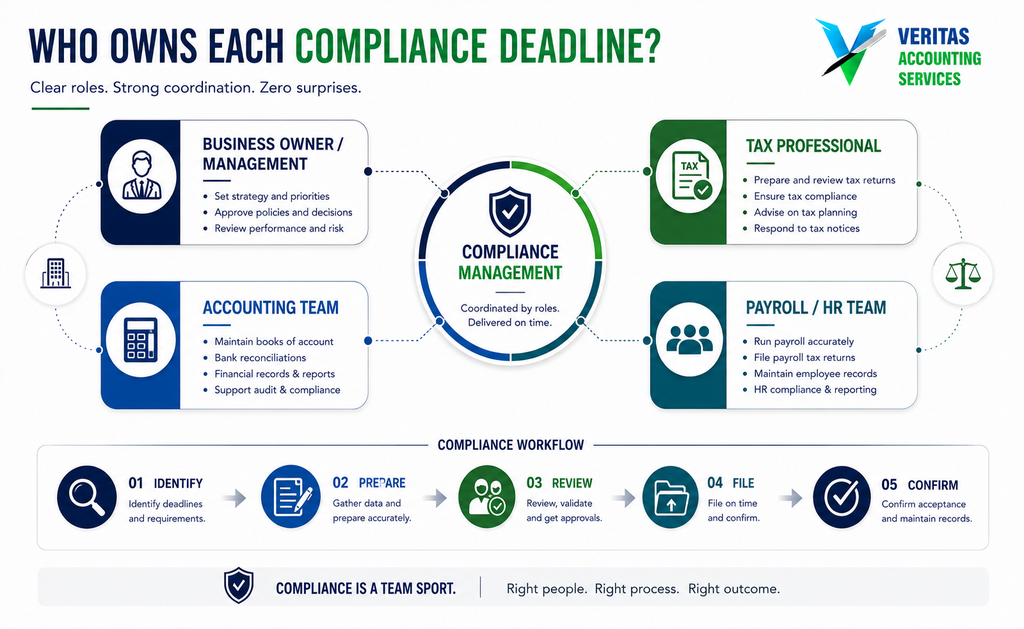
Someone must own each task.

For every obligation, identify:

Task → Jurisdiction → Due Date → Responsible Person → Reviewer → Status

For example:

Compliance ItemFrequencyOwnerReviewerStatus
Payroll filingMonthly/QuarterlyPayroll TeamFinance ManagerPending
Sales taxMonthly/QuarterlyAccounting TeamSenior AccountantComplete
Annual reportAnnualCorporate AdminManagementUpcoming
Income taxAnnual/EstimatedTax ProfessionalManagementPending

The exact responsibilities will vary by business.

The important principle is that every deadline should have a clearly identified owner.

A backup person should also be identified for critical obligations.

This prevents compliance from becoming dependent on one employee.

Building an Effective Reminder System

A good compliance calendar should not simply show due dates.

It should create a workflow.

For each task, consider having reminders at several stages:

30 Days Before

Confirm that the requirement still applies and identify the documents needed.

15 Days Before

Collect supporting information and begin preparation.

5–7 Days Before

Complete review and resolve outstanding questions.

Due Date

Confirm filing and payment.

After Filing

Save confirmation, payment evidence, and final documents.

This approach creates an audit trail and makes it easier to prove that the obligation was completed.

Digital calendar tools, accounting software, workflow systems, and shared spreadsheets can all be used. The technology matters less than having a consistent process.

Common Compliance Calendar Mistakes

Even businesses that maintain a calendar can make mistakes.

Mistake 1: Using a Generic Deadline List

A generic tax calendar does not automatically reflect the company’s actual obligations.

The calendar should be customized by entity, jurisdiction, tax type, and business activity.

Mistake 2: Tracking Filing but Not Payment

A business may submit a return but forget that a separate payment is required.

Track both.

Mistake 3: No Internal Deadline

Using the government deadline as the team’s internal deadline leaves little room for correction.

Build a buffer.

Mistake 4: No Review Process

A preparer should not necessarily be the only person responsible for reviewing important filings.

Define appropriate review procedures.

Mistake 5: Not Updating the Calendar

Business circumstances change.

New employees, additional states, new entities, acquisitions, new products, or changes in business structure can create new obligations.

The calendar should be reviewed whenever the business changes materially.

How Accounting Professionals Can Help

Managing compliance becomes more difficult when business owners are responsible for both running the company and monitoring every financial obligation.

This is where experienced accounting and tax professionals can provide significant value.

A professional team can help businesses:

  • Identify recurring accounting requirements
  • Organize financial records
  • Track filing deadlines
  • Prepare supporting schedules
  • Coordinate tax filings
  • Reconcile accounts before filing
  • Maintain documentation
  • Monitor outstanding obligations
  • Prepare management reports
  • Coordinate with tax professionals
  • Maintain a centralized compliance calendar

For international businesses and companies operating across multiple jurisdictions, professional support can be particularly useful because requirements may vary between federal, state, and local authorities.

Outsourcing does not mean giving up management control.

A well-structured arrangement can actually improve control because responsibilities, deadlines, documentation, and review procedures are clearly defined.

For example, an outsourced accounting team can maintain the bookkeeping and supporting records while the company’s tax professional reviews and files the appropriate returns.

This creates a clear division of responsibility.

compliance calendar for business tax payroll and filing deadlines

FAQ

What is a compliance calendar?

A compliance calendar is a centralized schedule that tracks a business’s tax, payroll, regulatory, licensing, reporting, and other recurring obligations.

How often should a compliance calendar be reviewed?

It should be reviewed regularly and whenever the business experiences significant changes, such as entering a new state, hiring employees, forming an entity, or changing its operations.

Should payroll deadlines be included?

Yes. Payroll tax deposits, payroll returns, unemployment filings, employee reporting, and year-end payroll forms should be included when applicable.

Should a small business have a compliance calendar?

Yes. A smaller business may have fewer obligations, but missed deadlines can still result in penalties, additional costs, or administrative problems. Starting with a simple calendar makes it easier to scale the process.

Can an outsourced accounting firm maintain a compliance calendar?

Yes. An experienced accounting team can maintain deadlines, collect supporting information, prepare accounting records, coordinate with tax professionals, and track completion while management retains oversight.

Conclusion

Compliance should not be managed as a collection of isolated deadlines.

It should be treated as a business process.

A well-maintained compliance calendar gives business leaders visibility into upcoming obligations, assigns responsibility, creates internal review points, and reduces dependence on memory.

The process becomes even more important as a business expands into new states, hires employees, adds entities, or increases transaction volume.

The most effective approach is to identify every applicable obligation, assign an owner, establish internal deadlines, maintain supporting documentation, and review the schedule regularly.

Professional accounting and tax teams can also play an important role by maintaining organized financial records, coordinating recurring requirements, and helping management stay ahead of upcoming obligations.

At Veritas Accounting Services, we support businesses and professional firms with bookkeeping, accounting, tax support, financial reporting, and CFO-related services. Our role is not simply to record transactions. We help clients build organized financial processes that give management better visibility and control.

A missed deadline can create unnecessary cost and stress.

A well-managed compliance calendar turns those deadlines into a predictable process.

Know what is due. Know when it is due. Know who owns it. And review it before the deadline—not after it.

GET IN TOUCH

Schedule a FREE Call

What to Do When You Pay for Business Expenses Personally

A practical guide to documenting business purchases you paid for personally, matching any repayment…

When the Bank Balance and Your Books Disagree

A practical month-end walkthrough for comparing your bank statement and books, with a worked example…

Vendor Bills and a Simple Routine for Better Cash Planning

A practical weekly routine for checking supplier bills, planning the payment batch and matching what…

Tax Bracket Mistakes: A Simple Guide to Better Planning

The November 5 IRS inflation update is a prompt to review your planning assumptions. Learn how…

Your Simple Guide to PTIN Renewal Mistakes and Better Records

The November 4 IRS reminder is a timely prompt to check 2027 preparer renewals, separate enrolled…

Inventory Tax Mistakes: A Simple Guide to Better Records

Stock purchases do not automatically equal a tax deduction. Review the inventory method, quantities…

Payroll Deposit Mistakes: A Simple Guide to Better Records

A quarterly payroll return does not set every tax deposit deadline. Check the schedule, actual pay…

Your Simple Guide to Home Office Mistakes and Better Records

Working from home does not automatically create a deduction. Check eligibility, space, dates…

Your Simple Guide to Unpaid Invoice Mistakes and Better Records

An unpaid customer invoice is not automatically a tax deduction. Review the tax accounting method…

Connect on our Socials!

disaster recovery plan

Disaster Recovery for Businesses: How to Prepare for the Unexpected

A disaster does not have to destroy a building to disrupt a business. A cyberattack, ransomware incident, prolonged power outage, critical software failure, severe weather event, supplier disruption, or sudden loss of key personnel can interrupt operations just as effectively.

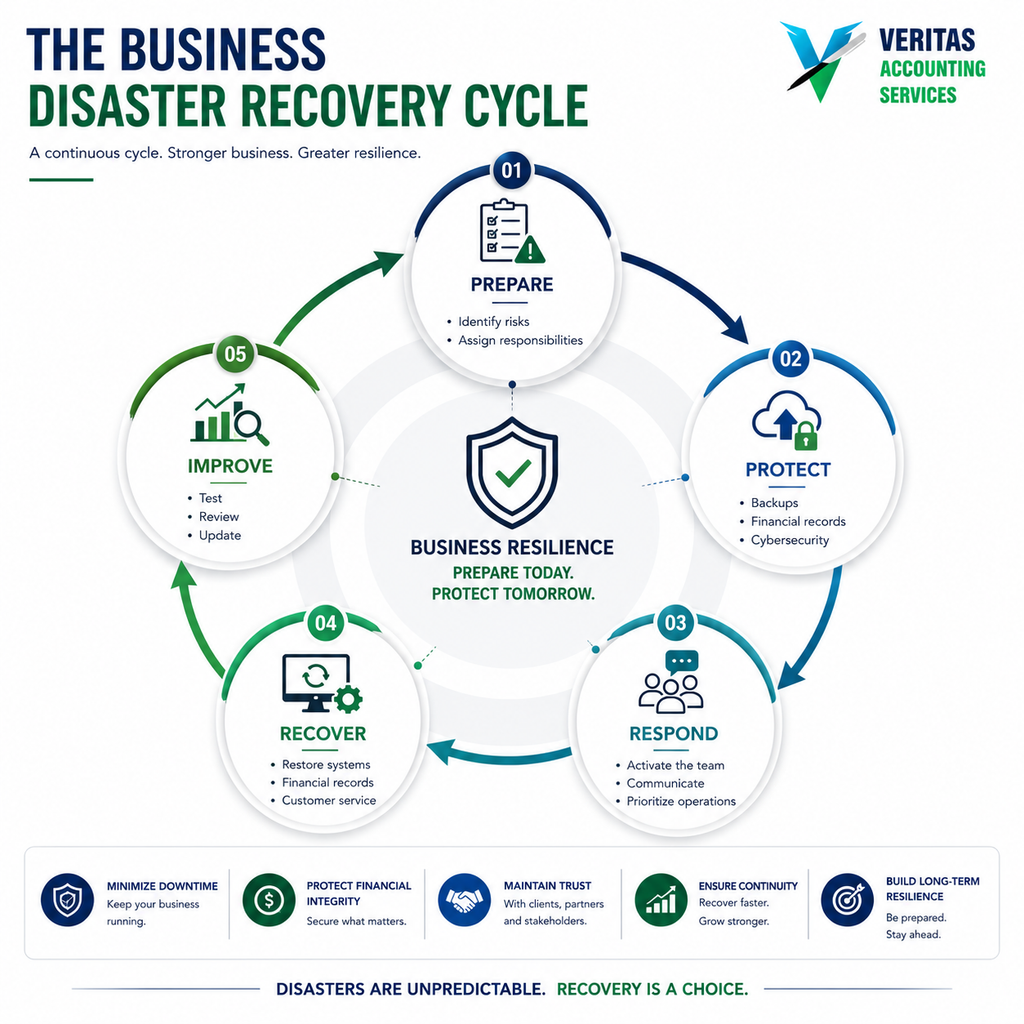
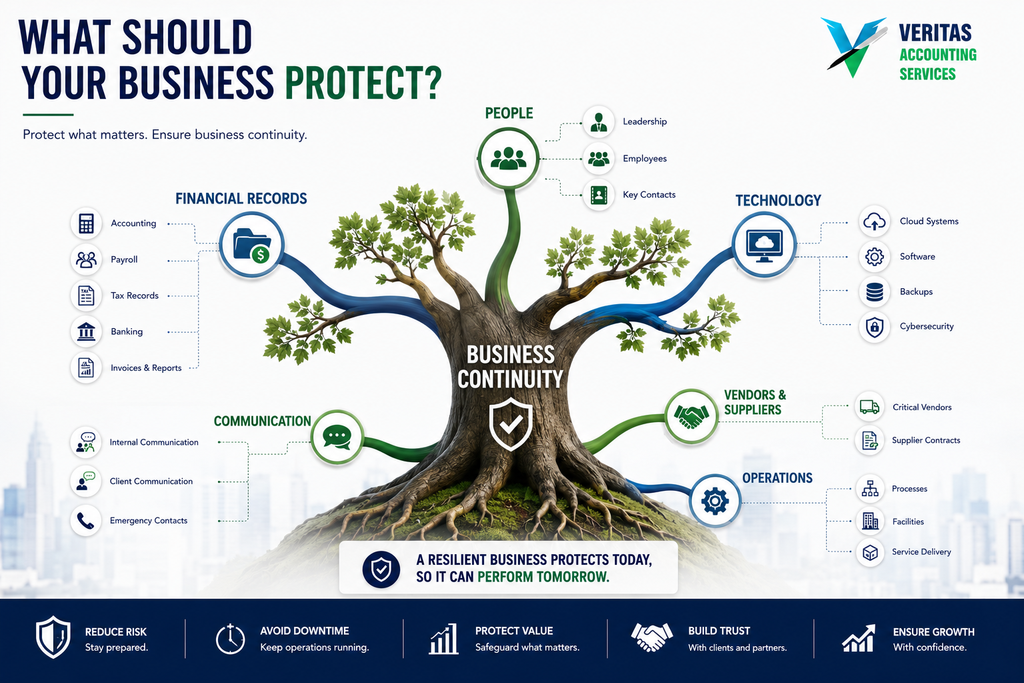
A well-designed disaster recovery plan helps a business determine what happens when normal operations are no longer possible. It identifies critical systems, protects important information, establishes responsibilities, and provides a practical path toward restoring operations.

For business leaders, preparation is not simply an IT responsibility. Financial records, payroll information, customer data, tax documents, bank access, accounting systems, invoices, contracts, and management reports are all part of the business’s ability to recover.

The objective is not to predict every possible disaster. It is to make sure the company can continue functioning when something unexpected happens.

Table of Contents

  1. What Is a Disaster Recovery Plan?
  2. Why Businesses Should Prepare Before a Crisis
  3. Identify the Risks That Matter Most
  4. Protect Financial and Business Records
  5. Build a Reliable Backup Strategy
  6. Protect Accounting and Tax Information
  7. Plan for People and Communication
  8. Prepare for Cybersecurity Incidents
  9. Consider Vendors and Third Parties
  10. Establish Financial Continuity
  11. Test and Update the Plan
  12. How Professional Accounting Teams Can Help
  13. FAQ
  14. Conclusion

What Is a Disaster Recovery Plan?

A disaster recovery plan is a documented framework explaining how a business will respond to a serious disruption and restore critical operations.

It should answer practical questions such as:

  • What are our most important business processes?
  • Which systems must be restored first?
  • Where are our critical records stored?
  • Who is responsible for each recovery activity?
  • How will employees communicate during an emergency?
  • How will customers and suppliers be informed?
  • How will we access cash and banking services?
  • How will accounting and payroll continue?
  • What happens if our primary office or technology becomes unavailable?

A disaster recovery plan should be practical rather than theoretical. Employees should be able to understand it and use it under pressure.

The U.S. Small Business Administration recommends that businesses assess their risks, create a tailored response plan, and practice the plan with employees.

Why Businesses Should Prepare Before a Crisis

The worst time to decide how your business will recover is after the disruption has already occurred.

A disaster recovery plan gives management the opportunity to make important decisions while there is still time to think clearly.

Without preparation, different people may make different assumptions about what should happen. Employees may not know who has authority to approve emergency payments. Management may not know where backup records are stored. Customers may receive conflicting information.

Preparation creates structure.

The IRS specifically encourages businesses to safeguard financial and tax records, back up computer data systems, establish communication procedures, and review emergency plans regularly.

Preparation also protects management time. Instead of inventing a response during a crisis, leadership can follow a framework that has already been discussed and tested.

Identify the Risks That Matter Most

Not every business faces the same threats.

A retailer may be highly exposed to physical property damage and supply-chain interruptions. A professional services firm may be more dependent on cloud systems, internet access, and employee availability. An e-commerce company may face significant risks if its payment platform, website, or fulfillment partner becomes unavailable.

Start by identifying the events that could materially interrupt operations.

Consider:

  • Natural disasters
  • Fire or building damage
  • Cyberattacks and ransomware
  • Extended power or internet outages
  • Cloud or software failures
  • Loss of critical employees
  • Supplier failure
  • Banking or payment disruptions
  • Theft or physical loss of records
  • Major equipment failure

The goal is not to create a hundred-page document covering every theoretical scenario.

Focus on realistic risks and the consequences they could create.

Protect Financial and Business Records

Financial information is one of the most important assets to protect.

A business may need access to:

  • Bank statements
  • Accounting records
  • Invoices
  • Customer balances
  • Vendor records
  • Payroll information
  • Tax returns
  • Sales tax records
  • Contracts
  • Insurance documents
  • Fixed-asset records
  • Financial statements
  • Budgets and forecasts

A disaster recovery plan should identify where these records are maintained, who can access them, and how they can be recovered if the primary system becomes unavailable.

The IRS recommends paperless recordkeeping, electronic backups, and storing duplicate records in a separate location.

This is particularly important for businesses that depend heavily on accounting software and cloud-based applications.

Cloud software can reduce certain risks, but simply using cloud software does not mean every recovery risk has disappeared. Businesses still need appropriate access controls, backups, authentication procedures, and documented recovery processes.

Build a Reliable Backup Strategy

A backup is useful only if the business can actually restore the information when required.

Companies should identify their critical data and establish a regular backup process.

Consider:

What needs to be backed up?

Identify essential accounting, customer, operational, HR, tax, and management information.

How frequently should it be backed up?

Critical information may require more frequent protection than less important records.

Where should backups be stored?

Avoid relying entirely on a single physical location or device.

Who can restore the information?

The recovery process should not depend on one employee who may be unavailable.

Has the backup actually been tested?

A backup that has never been restored is an assumption, not a proven recovery solution.

Testing should be part of the disaster recovery plan because recovery procedures can fail even when backups exist.

Protect Accounting and Tax Information

Accounting and tax records deserve special attention because losing them can affect more than day-to-day operations.

A business may need historical financial information for:

  • Tax filings
  • Insurance claims
  • Financing
  • Audit support
  • Customer or vendor disputes
  • Government requirements
  • Management analysis
  • Reconstructing financial records after a loss

The IRS notes that businesses may need to reconstruct records after a disaster to support tax purposes, insurance reimbursement, or applications for assistance.

A disaster recovery plan should therefore include a financial records section.

That section can identify where accounting files are maintained, how bank records are accessed, who has administrative permissions, how payroll information is recovered, and who is responsible for communicating with accountants and tax professionals.

Plan for People and Communication

Technology is only one part of recovery.

People need to know what to do.

Employees should understand:

  • Who makes emergency decisions
  • Who communicates with customers
  • Who communicates with suppliers
  • Who handles payroll
  • Who contacts banks and insurers
  • Who manages technology recovery
  • Where emergency procedures are stored
  • How employees will receive updates

A communication tree can be useful.

For example:

Leadership → Department Managers → Employees → Customers/Suppliers

The business should also identify alternative communication methods if its primary email, phone, office, or internet connection becomes unavailable.

A disaster recovery plan should be accessible when normal systems are unavailable. Keeping the only copy of the plan inside the system that may be affected by the disaster defeats the purpose.

Prepare for Cybersecurity Incidents

Cyber incidents deserve specific attention because the business may have no physical warning before losing access to systems or data.

A ransomware attack, compromised account, phishing incident, or stolen credentials can interrupt operations quickly.

Businesses should consider:

  • Multi-factor authentication
  • Strong password management
  • Restricted administrative access
  • Employee security training
  • Regular software updates
  • Endpoint protection
  • Secure backups
  • Incident-response procedures
  • Vendor access controls

The recovery process should also identify who has authority to isolate systems, contact technology providers, communicate with employees, and involve appropriate legal or cybersecurity professionals.

The purpose of a disaster recovery plan is not to replace cybersecurity. It is to ensure the organization has a structured response when preventive controls are unsuccessful.

Consider Vendors and Third Parties

Many businesses cannot operate without external providers.

A company may depend on:

  • Banks
  • Payment processors
  • Payroll providers
  • Cloud accounting platforms
  • Shipping companies
  • IT providers
  • Tax professionals
  • Suppliers
  • Outsourced accounting teams
  • Customer relationship platforms

What happens if one of these providers becomes unavailable?

Businesses should identify critical vendors and understand alternative arrangements where practical.

For example, if payroll is processed externally, management should know how payroll information can be accessed and what happens if the provider experiences an outage.

Supplier concentration should also be reviewed.

If one supplier provides a critical product or service, consider whether an alternative supplier exists and how quickly the relationship could be activated.

Establish Financial Continuity

A business can survive many operational disruptions if it maintains sufficient financial flexibility.

Cash flow therefore belongs in the recovery conversation.

Management should understand:

  • Available cash
  • Bank relationships
  • Credit facilities
  • Upcoming payroll
  • Major vendor obligations
  • Customer receivables
  • Insurance coverage
  • Recurring expenses
  • Emergency spending authority

A disaster recovery plan should identify who can approve emergency payments and how the company will continue accessing banking services if normal office operations are disrupted.

Financial forecasting can also help management understand how long the business can continue operating under different disruption scenarios.

For example, leadership could model what happens if revenue falls by 30% for three months or if a major facility becomes unavailable for six weeks.

The objective is not to predict the future precisely.

It is to understand the company’s financial resilience.

Test and Update the Plan

A document sitting in a folder is not enough.

The business needs to test whether its procedures actually work.

The SBA recommends practicing preparedness plans with staff, while the IRS advises businesses to review emergency plans regularly and update them as circumstances change.

Testing can include simple exercises:

Scenario: The accounting system is unavailable.

Ask:

  • Who contacts the provider?
  • Where are recent financial reports stored?
  • How will invoices be issued?
  • How will payments be approved?
  • How will payroll be processed?
  • Who communicates with customers?

Another scenario could involve the loss of the company office.

Ask:

  • Where will employees work?
  • How will they access systems?
  • How will management communicate?
  • Where will physical records be retrieved?
  • Who has authority to activate alternative arrangements?

After every test, document what worked and what failed.

That feedback should be incorporated into the next version of the plan.

How Professional Accounting Teams Can Help

Financial continuity is often overlooked when businesses create emergency plans.

This is where an experienced accounting team can provide practical support.

An outsourced accounting partner can help maintain organized financial records, establish consistent bookkeeping procedures, perform regular reconciliations, prepare financial reports, and ensure that important information is not dependent on one individual.

For businesses using an outsourced accounting model, the external team can also provide continuity when an internal employee is unavailable.

Services may include:

  • Bookkeeping
  • Bank reconciliation
  • Accounts payable
  • Accounts receivable
  • Month-end closing
  • Financial reporting
  • Tax support
  • Cash-flow forecasting
  • Management reporting
  • Financial record cleanup

At Veritas Accounting Services, we work with businesses and professional firms to provide outsourced accounting, bookkeeping, tax support, financial reporting, and CFO-related services. A structured external team can become one part of a broader business continuity strategy by helping maintain reliable financial information before, during, and after a disruption.

The key is to establish responsibilities in advance.

A disaster recovery plan should clearly identify who maintains financial records, who has access to important information, who communicates with the external accounting team, and how financial reporting will continue during an interruption.

A Practical Recovery Checklist

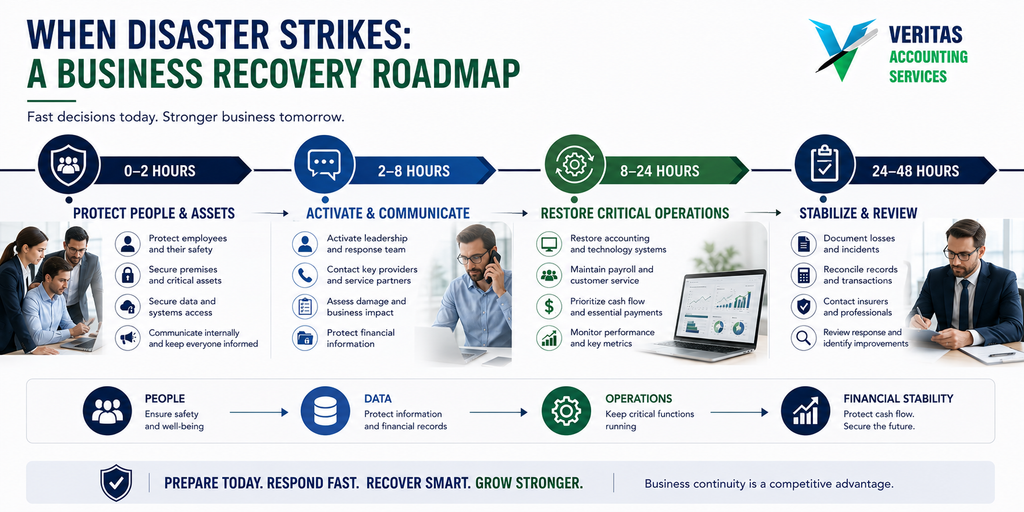
Business leaders can use the following checklist as a starting point:

Before a Disaster

  • Identify critical business processes
  • Assess major risks
  • Back up important records
  • Protect financial and tax documents
  • Document key contacts
  • Establish communication procedures
  • Review insurance coverage
  • Define emergency spending authority
  • Identify alternative suppliers
  • Test recovery procedures

During a Disaster

  • Protect employees first
  • Activate the recovery team
  • Establish reliable communication
  • Protect financial information
  • Prioritize critical operations
  • Contact key vendors and service providers
  • Monitor cash flow
  • Document losses and expenses

After a Disaster

  • Restore critical systems
  • Reconcile financial records
  • Reconstruct missing documents
  • Document business losses
  • Communicate with customers
  • Review insurance and assistance options
  • Identify weaknesses in the recovery process
  • Update the plan based on lessons learned

FAQ

What is the purpose of a disaster recovery plan?

The purpose is to help a business respond to a disruption, protect critical information, restore important operations, and reduce the financial and operational impact of an unexpected event.

How often should a disaster recovery plan be updated?

Businesses should review it regularly and whenever there are significant changes to employees, technology, locations, vendors, systems, or business operations. The IRS specifically recommends reviewing emergency plans annually.

Should financial records be included?

Absolutely. Accounting, payroll, tax, banking, customer, vendor, and financial reporting information can be critical to continuing operations and documenting losses.

Can an outsourced accounting firm help with recovery?

Yes. An experienced accounting team can help maintain organized financial records, reporting processes, reconciliations, and access to important financial information, making the recovery process more manageable.

Is a disaster recovery plan only for large businesses?

No. Smaller businesses may be particularly vulnerable because they often depend on a small number of employees, systems, suppliers, and customers. A practical plan can be scaled according to the size and complexity of the business.

Conclusion

Unexpected events are part of doing business. The difference between a temporary disruption and a prolonged crisis often depends on how prepared the organization was before the event occurred.

A disaster recovery plan does not need to be complicated. It needs to be realistic, accessible, tested, and connected to the way the business actually operates.

Business leaders should think beyond physical emergencies. Cybersecurity incidents, technology failures, employee loss, supplier disruptions, and financial-system interruptions can all affect business continuity.

Financial information deserves particular attention. If management cannot access accounting records, banking information, payroll data, invoices, tax documents, or financial reports, recovering operations can become considerably more difficult.

The IRS recommends safeguarding financial and tax records, maintaining backups, and planning for continuity of operations.

A strong disaster recovery plan gives management something valuable during an uncertain situation: clarity.

Know what matters. Protect it. Assign responsibility. Test the process. Review it regularly.

And do not wait for a disaster to discover that an important process depended on one person, one computer, one supplier, or one undocumented procedure.

At Veritas Accounting Services, we help businesses maintain organized bookkeeping, accounting, tax support, financial reporting, and CFO-related processes so that financial information remains structured and accessible when management needs it most.

Business continuity is not simply about recovering technology.

It is about recovering the business.

GET IN TOUCH

Schedule a FREE Call

What to Do When You Pay for Business Expenses Personally

A practical guide to documenting business purchases you paid for personally, matching any repayment…

When the Bank Balance and Your Books Disagree

A practical month-end walkthrough for comparing your bank statement and books, with a worked example…

Vendor Bills and a Simple Routine for Better Cash Planning

A practical weekly routine for checking supplier bills, planning the payment batch and matching what…

Tax Bracket Mistakes: A Simple Guide to Better Planning

The November 5 IRS inflation update is a prompt to review your planning assumptions. Learn how…

Your Simple Guide to PTIN Renewal Mistakes and Better Records

The November 4 IRS reminder is a timely prompt to check 2027 preparer renewals, separate enrolled…

Inventory Tax Mistakes: A Simple Guide to Better Records

Stock purchases do not automatically equal a tax deduction. Review the inventory method, quantities…

Payroll Deposit Mistakes: A Simple Guide to Better Records

A quarterly payroll return does not set every tax deposit deadline. Check the schedule, actual pay…

Your Simple Guide to Home Office Mistakes and Better Records

Working from home does not automatically create a deduction. Check eligibility, space, dates…

Your Simple Guide to Unpaid Invoice Mistakes and Better Records

An unpaid customer invoice is not automatically a tax deduction. Review the tax accounting method…

Connect on our Socials!

business outsourcing strategy for growing businesses

Build In-House or Outsource? How to Choose the Right Business Model

As a business grows, management eventually faces an important question: should a particular function be handled by an internal employee or entrusted to an experienced external team?

The answer is rarely as simple as comparing an employee’s salary with an outsourcing fee.

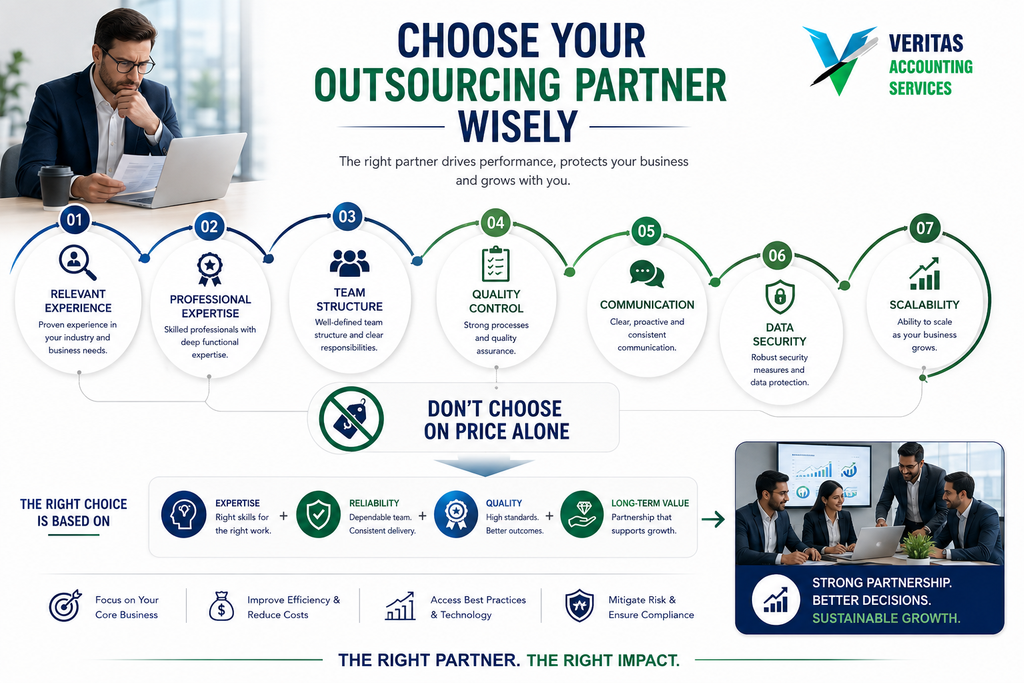
A better decision considers expertise, total cost, flexibility, quality, management time, scalability, risk, and the strategic importance of the function.

This is why business outsourcing has become an important consideration for growing companies. Businesses can access experienced professionals without necessarily building a complete department internally.

But outsourcing everything is not the answer either.

The real question is:

What should remain in-house, what should be outsourced, and which responsibilities require professional expertise?

For accounting, bookkeeping, tax, financial reporting, and CFO support, working with an experienced professional team can allow business owners to maintain better financial control while focusing their time on customers, operations, and growth.

Table of Contents

  1. In-House vs. Outsourcing: What Is the Difference?
  2. Pros and Cons of Hiring In-House
  3. Pros and Cons of Outsourcing
  4. When Should a Business Consider Outsourcing?
  5. Why Accounting and Bookkeeping Are Strong Candidates
  6. Why Tax Services Require Professional Expertise
  7. Other Functions Businesses Can Outsource
  8. How Outsourcing Can Improve Productivity
  9. The Importance of Choosing the Right Partner
  10. The Hybrid Model
  11. A Practical Decision Framework
  12. FAQ
  13. Conclusion

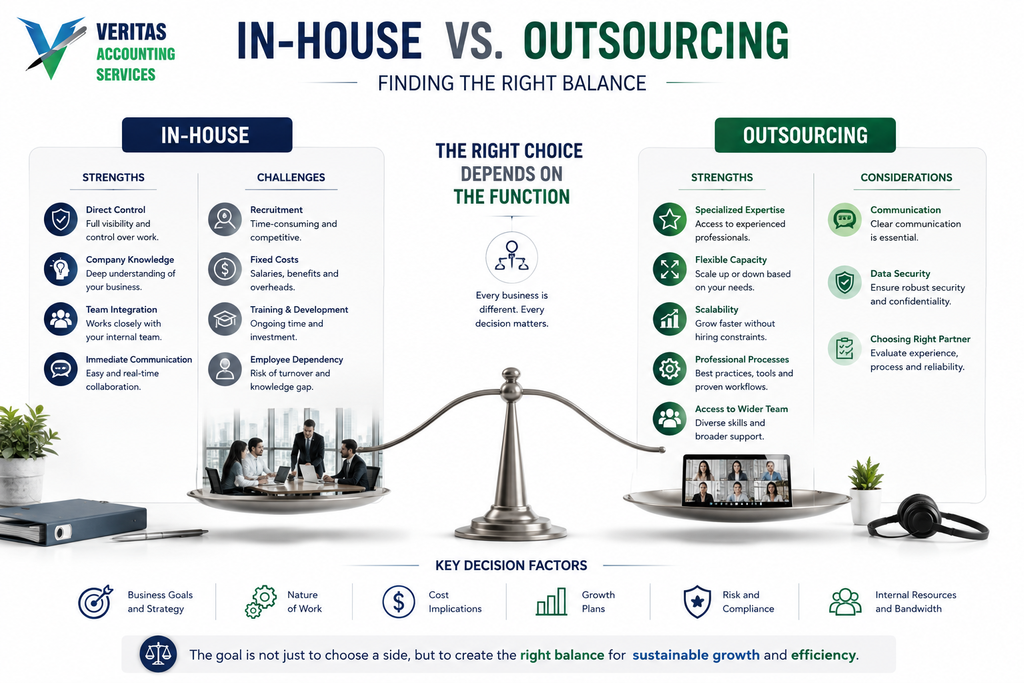
In-House vs. Outsourcing: What Is the Difference?

Hiring in-house means the company employs and manages its own people to perform a function.

Business outsourcing means engaging an external professional or organization to perform defined responsibilities on behalf of the company.

Both models have legitimate advantages.

An internal employee may have deeper day-to-day knowledge of the company, while an external team may provide broader technical expertise and access to multiple professionals.

The right model depends on the nature of the work.

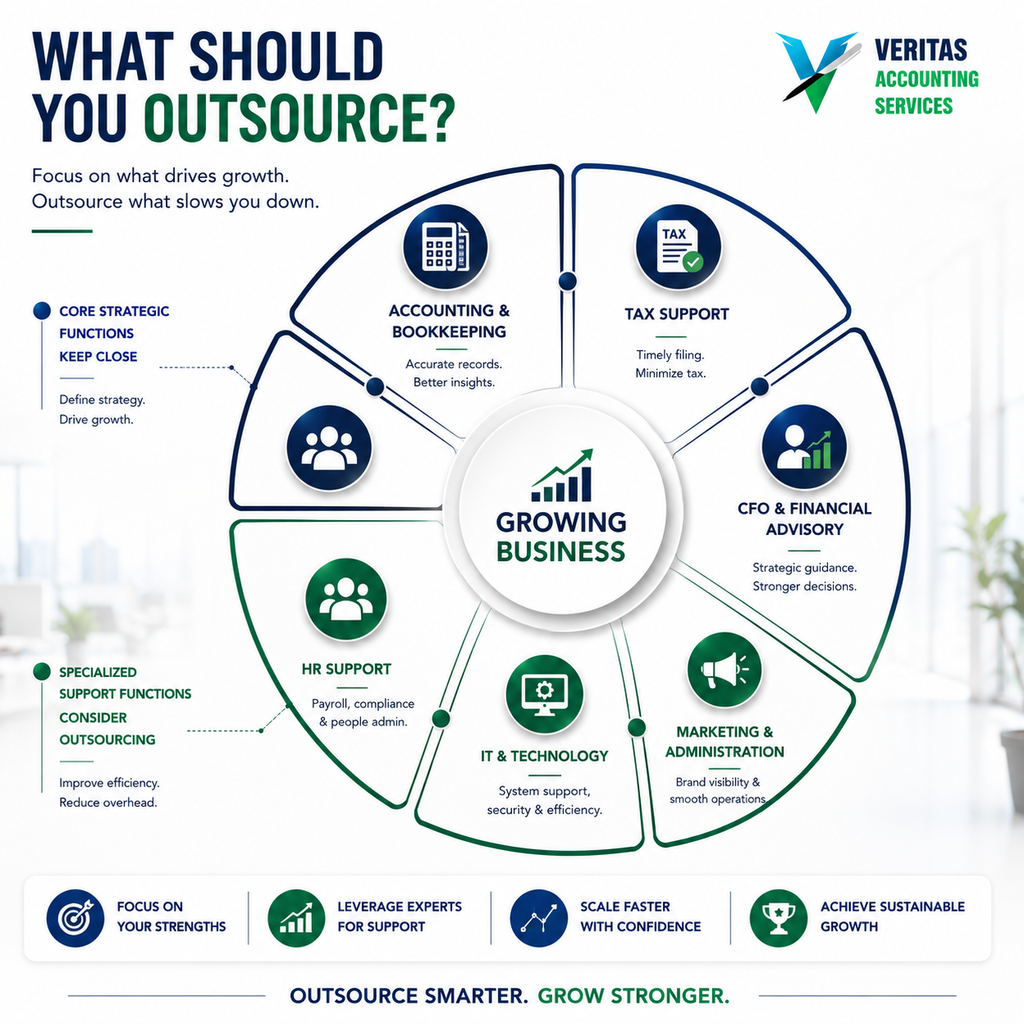
For example, a business may want its sales leadership and customer relationships managed internally while using business outsourcing for bookkeeping, tax preparation support, payroll administration, or financial reporting.

The decision should therefore be made function by function, not as an all-or-nothing strategy.

business outsourcing

Pros and Cons of Hiring In-House

Advantages of an In-House Team

An internal team can provide:

  • Direct supervision
  • Immediate communication
  • Strong company-specific knowledge
  • Greater control over daily activities
  • Closer integration with other departments
  • Stronger understanding of internal culture
  • Dedicated attention to the company’s priorities

For highly strategic functions that require constant collaboration, an internal employee may be the right choice.

For example, a company developing proprietary technology may prefer to keep its core development team in-house.

Disadvantages of Hiring In-House

However, hiring internally also creates responsibilities for the business.

Management needs to consider:

  • Recruitment costs
  • Salaries and benefits
  • Training
  • Software and technology
  • Employee turnover
  • Leave and backup coverage
  • Performance management
  • Office infrastructure
  • Professional development
  • Management time

There is also a specialization problem.

A small business may need the expertise of a senior accountant, tax professional, financial analyst, and CFO—but may not have enough workload to justify hiring four separate specialists.

That is one situation where business outsourcing can provide an alternative.

Pros and Cons of Outsourcing

Advantages of Outsourcing

A well-managed outsourcing arrangement can provide:

  • Access to specialized professionals
  • Flexible capacity
  • Lower fixed staffing requirements
  • Established processes
  • Multiple levels of review
  • Faster access to expertise
  • Reduced recruitment burden
  • Better scalability
  • Access to technology and accounting systems
  • More time for management to focus on strategic work

One major advantage is that the business may gain access to a team rather than one employee.

For example, an outsourced accounting arrangement could include a bookkeeper, accountant, senior reviewer, and manager.

This structure can provide continuity if one team member is unavailable.

Disadvantages of Outsourcing

Outsourcing is not automatically successful.

Potential challenges include:

  • Communication gaps
  • Poor-quality providers
  • Lack of business understanding
  • Data-security concerns
  • Inconsistent service
  • Unclear responsibilities
  • Overdependence on an external provider
  • Transition difficulties

Therefore, the quality of the outsourcing partner matters enormously.

A low-cost provider that creates errors and requires constant supervision may ultimately cost more than a competent professional team.

When Should a Business Consider Outsourcing?

Business outsourcing becomes particularly attractive when a company faces one or more of the following situations.

The Owner Is Doing Too Much Routine Work

If the owner spends several hours every week reviewing transactions, chasing documents, preparing reports, or solving recurring administrative problems, there is an opportunity cost.

That time could instead be spent on customers, strategy, pricing, partnerships, and growth.

Specialized Expertise Is Difficult to Hire

Some businesses need specialist knowledge without needing a full-time specialist.

A growing company may need financial forecasting every month but may not need a full-time CFO.

It may need experienced tax support during filing periods without needing a permanent tax department.

Business outsourcing can provide access to this expertise when it is required.

Workload Changes Throughout the Year

Tax, accounting, payroll, financial reporting, and compliance workloads can fluctuate.

Maintaining a large permanent team during low-volume periods may not be efficient.

External professionals can provide additional capacity when the workload increases.

The Business Is Growing Faster Than Its Internal Team

Hiring takes time.

Recruiting, interviewing, onboarding, training, and developing employees can delay the expansion of a department.

A qualified external team can sometimes provide additional capacity much faster.

Why Accounting and Bookkeeping Are Strong Candidates

Accounting and bookkeeping are often excellent areas for business outsourcing because they require technical knowledge, consistent processes, attention to detail, and regular execution.

These functions are essential to the business, but that does not necessarily mean every task needs to be performed internally.

A professional accounting team can support:

  • Daily bookkeeping
  • Bank reconciliation
  • Credit-card reconciliation
  • Accounts payable
  • Accounts receivable
  • Transaction classification
  • Month-end closing
  • Financial statement preparation
  • Management reports
  • Bookkeeping cleanup
  • Financial analysis
  • Cash-flow reporting

The biggest advantage is not simply saving the cost of an employee.

It is gaining access to a structured process and professional review.

Consider a company with one internal bookkeeper.

If that person leaves, the business may suddenly face delays in reconciliations, reporting, and month-end closing.

A properly structured external team can provide greater continuity because responsibilities can be distributed among multiple professionals.

For international businesses, business outsourcing can also provide access to professionals experienced with different accounting platforms, reporting requirements, currencies, and business models.

Why Tax Services Require Professional Expertise

Tax is another area where businesses should be careful about choosing between internal hiring and business outsourcing.

Tax rules can be complex, and requirements can vary based on business structure, location, transactions, employees, and jurisdictions.

The objective should not simply be to find the lowest-cost tax preparer.

A professional tax team should understand the client’s financial information, identify relevant compliance requirements, maintain appropriate documentation, and communicate issues clearly.

Tax-related outsourcing may include:

  • Tax return preparation support
  • Tax document organization
  • Tax compliance coordination
  • Sales tax support
  • Payroll tax support
  • Tax notice assistance
  • Tax planning support, where appropriately qualified

Businesses operating in multiple jurisdictions may have an even stronger need for professional assistance.

The important point is to clearly define who is responsible for preparation, review, filing, communication, and final approval.

Other Functions Businesses Can Outsource

Accounting and tax are not the only areas where external expertise can help.

CFO and Financial Advisory

A growing company may require:

  • Budgeting
  • Financial projections
  • Cash-flow forecasting
  • KPI dashboards
  • Profitability analysis
  • Scenario planning
  • Management reporting

An outsourced CFO can provide senior financial guidance without the cost of employing a full-time executive.

Human Resources

Recruitment coordination, payroll administration, employee documentation, and selected HR functions can often be handled externally.

Information Technology

Businesses may outsource IT support, cybersecurity, software administration, infrastructure, and technical assistance.

Digital Marketing

SEO, advertising, social media management, content development, and analytics are specialist areas that may be more efficient when managed by experienced external professionals.

Administrative Functions

Data entry, document management, scheduling, research, and other repetitive tasks can also be outsourced.

The principle is simple:

Keep strategic ownership where it matters and use specialists where they can deliver better value.

How Outsourcing Can Improve Productivity

The value of business outsourcing should not be measured only by the monthly invoice.

Consider a business owner who spends eight hours every week managing routine accounting issues.

That represents more than 400 hours a year.

What could the owner accomplish with those hours?

Perhaps:

  • Develop new customers
  • Improve pricing
  • Review profitability
  • Build strategic partnerships
  • Improve operations
  • Develop employees
  • Plan expansion
  • Strengthen customer relationships

This is where business outsourcing can become a productivity strategy.

The business is not simply purchasing labor.

It is gaining capacity, expertise, processes, and management time.

However, productivity improvements only happen when the outsourced team is capable of performing the work with limited supervision.

A poor provider can create additional work.

An experienced team should reduce the owner’s workload rather than transfer the workload into another form.

The Importance of Choosing the Right Outsourcing Partner

Choosing the right provider is one of the most important decisions in business outsourcing.

Price should be considered, but it should never be the only criterion.

1. Relevant Experience

Does the team understand your industry, accounting software, business model, and geographic requirements?

2. Professional Expertise

Who performs the work?

Who reviews it?

What qualifications and experience do they have?

3. Team Structure

Does the relationship depend entirely on one individual?

A structured team with backup and review procedures can provide greater continuity.

4. Quality Control

Ask how the provider reviews work before delivering it.

For accounting and tax-related services, review procedures are particularly important.

5. Communication

Agree on:

  • Response times
  • Reporting deadlines
  • Meeting frequency
  • Escalation procedures
  • Primary contacts

6. Data Security

Financial and tax information is highly sensitive.

Understand how documents are transferred, stored, accessed, and protected.

7. Scalability

Ask whether the provider can support additional transactions, entities, employees, or reporting requirements as the company grows.

8. Transparent Scope

A professional provider should clearly define:

  • Deliverables
  • Fees
  • Responsibilities
  • Turnaround times
  • Review procedures
  • Exclusions

Choosing the right partner makes business outsourcing significantly more effective.

The Hybrid Model: Often the Best of Both Worlds

Companies do not have to choose between completely internal and completely external operations.

A hybrid structure can often provide the best balance.

For example, a business might have an internal Finance Manager who maintains management control while outsourcing:

  • Bookkeeping
  • Reconciliations
  • Accounts payable
  • Accounts receivable
  • Month-end preparation
  • Tax support
  • Financial reporting

The internal manager maintains oversight while the external team handles recurring execution.

This creates a combination of control, flexibility, expertise, and scalability.

For many growing companies, this can be more practical than building a large finance department immediately.

A Practical Decision Framework

Before deciding whether to hire internally or outsource a function, ask these questions:

Is It Core to Our Competitive Advantage?

If the function directly creates competitive differentiation, keeping ownership internally may make sense.

Do We Need Specialized Expertise?

If expertise is expensive or difficult to recruit, an external professional team may be more practical.

Is the Workload Consistent?

If demand changes significantly throughout the year, flexible external capacity can be valuable.

Does the Function Require Daily Internal Collaboration?

If constant interaction is essential, an internal role may be preferable.

What Is the Total Cost?

Do not compare only salary against an outsourcing fee.

Include:

  • Recruitment
  • Benefits
  • Training
  • Software
  • Management time
  • Infrastructure
  • Employee turnover
  • Professional development
  • Opportunity cost

Then compare the total cost with the external solution.

This creates a more realistic decision.

FAQ

Is business outsourcing always cheaper than hiring in-house?

No. The objective should not simply be to find the cheapest option. Businesses should compare total cost, expertise, flexibility, quality, management time, and expected outcomes.

Should accounting and bookkeeping be outsourced?

For many growing companies, outsourcing accounting and bookkeeping can provide access to experienced professionals and structured processes without building a complete internal accounting department.

Can tax services be outsourced?

Yes. Many tax-related functions can be handled by appropriately qualified professionals. Businesses should verify experience, qualifications, responsibilities, review procedures, and compliance scope.

How do I choose the right outsourcing company?

Evaluate experience, qualifications, team structure, quality control, communication, technology, data security, scalability, transparency, and references or relevant track record.

Can outsourcing work together with an internal finance team?

Absolutely. A hybrid model can combine internal management oversight with external execution, particularly for bookkeeping, accounting operations, tax support, and financial reporting.

Is outsourced CFO support suitable for small businesses?

It can be. A growing business may need forecasting, budgeting, cash-flow planning, profitability analysis, and strategic financial advice without requiring a full-time CFO.

Conclusion

The decision to outsource or hire in-house should not be based solely on cost.

The better question is:

Which structure gives your business the right combination of expertise, control, flexibility, quality, and productivity?

Some functions are better kept internally. Others can be handled more efficiently by experienced specialists.

Accounting, bookkeeping, tax support, financial reporting, and selected CFO functions are often strong candidates for business outsourcing because they require technical expertise, consistent processes, and reliable execution.

But outsourcing successfully depends on choosing the right partner.

The right provider should not simply complete assigned tasks. It should understand your business, communicate clearly, maintain quality controls, protect confidential information, and scale with you.

At Veritas Accounting Services, we support businesses and professional firms with outsourced bookkeeping, accounting, tax support, financial reporting, financial projections, and CFO-related services. Our objective is to work as an extension of your team while allowing business leaders to focus on customers, strategy, and growth.

The goal is not to outsource everything.

The goal is to build the right team around your business.

Keep strategic responsibilities where they belong. Delegate specialized work to experienced professionals. And choose outsourcing partners based on expertise, reliability, processes, security, and long-term value—not simply price.

When approached strategically, business outsourcing is not merely a staffing decision.

It can become a competitive advantage.

GET IN TOUCH

Schedule a FREE Call

What to Do When You Pay for Business Expenses Personally

A practical guide to documenting business purchases you paid for personally, matching any repayment…

When the Bank Balance and Your Books Disagree

A practical month-end walkthrough for comparing your bank statement and books, with a worked example…

Vendor Bills and a Simple Routine for Better Cash Planning

A practical weekly routine for checking supplier bills, planning the payment batch and matching what…

Tax Bracket Mistakes: A Simple Guide to Better Planning

The November 5 IRS inflation update is a prompt to review your planning assumptions. Learn how…

Your Simple Guide to PTIN Renewal Mistakes and Better Records

The November 4 IRS reminder is a timely prompt to check 2027 preparer renewals, separate enrolled…

Inventory Tax Mistakes: A Simple Guide to Better Records

Stock purchases do not automatically equal a tax deduction. Review the inventory method, quantities…

Payroll Deposit Mistakes: A Simple Guide to Better Records

A quarterly payroll return does not set every tax deposit deadline. Check the schedule, actual pay…

Your Simple Guide to Home Office Mistakes and Better Records

Working from home does not automatically create a deduction. Check eligibility, space, dates…

Your Simple Guide to Unpaid Invoice Mistakes and Better Records

An unpaid customer invoice is not automatically a tax deduction. Review the tax accounting method…

Connect on our Socials!

business productivity

The Difference Between Being Busy and Being Productive: What Business Leaders Need to Know

Running a business can create a dangerous illusion: a full calendar looks like progress. Business productivity starts with asking what the activity achieves. Meetings are attended, emails answered, invoices chased, and problems solved. Yet the week ends with one question: what actually moved the business forward?

That is the difference between activity and business productivity. Understanding business productivity is essential when leadership wants growth without adding unnecessary complexity.

Business productivity is not about making people work longer hours. It is about directing time, money, people, and technology toward outcomes that improve revenue, profitability, cash flow, customer experience, and long-term value.

For business leaders, this distinction becomes more important as the company grows. A founder can personally solve problems in a small business. At scale, the same approach creates bottlenecks, delays decisions, and keeps senior management trapped in routine work.

Table of Contents

  1. What Does It Mean to Be Busy?
  2. What Does It Mean to Be Productive?
  3. Busy vs. Productive: The Key Difference
  4. Why Business Leaders Fall Into the Busy Trap
  5. How Financial Information Supports Business Productivity
  6. 7 Ways to Move From Busy to Productive
  7. How a CA or CFO Can Improve Business Productivity
  8. Questions Business Leaders Should Ask
  9. FAQ
  10. Conclusion

What Does It Mean to Be Busy?

Being busy usually means responding to whatever demands attention. A business owner may spend a day answering emails, approving expenses, checking bank balances, attending meetings, following up with customers, reviewing spreadsheets, and solving employee questions.

Those activities may be necessary. The problem is that necessity does not create value.

A business can have employees working hard while receivables remain overdue, monthly accounts stay late, or margins fall. Effort is not the issue.

What Does It Mean to Be Productive?

Productive work creates a measurable outcome. A productive finance team does not simply enter transactions; it closes the books accurately and on time. A productive sales team does not simply make calls; it generates qualified opportunities and revenue. A productive management meeting does not simply consume an hour; it produces decisions, owners, and deadlines.

This is the foundation of business productivity: connect activity to outcomes. Strong business productivity comes from choosing work that produces a measurable result.

For example, instead of asking an employee to “work on receivables,” management can define the outcome as reducing overdue invoices. For accounting, the objective can be accurate month-end financials by an agreed date.

Busy vs. Productive: The Key Difference

The difference becomes clearer when management looks at results rather than hours.

Busy businesses often:

  • React to every request immediately
  • Keep the owner involved in routine decisions
  • Measure effort rather than outcomes
  • Rely heavily on spreadsheets and manual processes
  • Discover financial problems after they become urgent
  • Hold meetings without clear decisions
  • Repeatedly solve the same operational problems

Productive businesses tend to:

  • Prioritize high-value work
  • Delegate responsibility with accountability
  • Use measurable KPIs
  • Standardize recurring processes
  • Review financial information regularly
  • Automate repetitive tasks
  • Focus leadership attention on decisions that require judgment

A strong business does not eliminate activity. It makes activity purposeful. That is what sustainable business productivity looks like in practice.

Why Business Leaders Fall Into the Busy Trap

Owner Dependency

Many growing businesses depend heavily on the founder. The owner approves payments, answers customer questions, reviews every expense, resolves staff issues, and makes operational decisions.

This may work initially, but it becomes a constraint as the company grows.

If every decision has to reach the owner, employees wait, customers wait, and strategic work gets postponed. Improving business productivity often begins with identifying decisions that can be delegated. That creates room for leadership to focus on strategy.

Manual Processes

Manual work is another major source of wasted capacity.

Consider a business where employees download bank statements, enter transactions into spreadsheets, match payments manually, collect receipts by email, and prepare management reports from multiple files.

Each individual task may appear small. Together, they can consume hundreds of hours every year.

The solution is not always more employees. Better workflow design, accounting software, automation, and clear responsibilities can remove unnecessary work.

For businesses that are spending too much management time on routine bookkeeping, outsourcing can be an effective option. Veritas provides virtual bookkeeping services designed to help businesses maintain organized and accurate financial records while allowing management to focus on higher-value activities.

Delayed Financial Information

A business leader cannot make productive decisions without reliable financial information.

If management receives financial statements months after the period ends, the information has limited value for immediate decision-making. Timely bookkeeping and month-end reporting can reveal changes in revenue, gross margin, expenses, receivables, payables, and cash flow while there is still time to respond.

How Financial Information Supports Business Productivity

Financial reporting is not simply a compliance exercise. It is a management system.

The U.S. Small Business Administration notes that accounting for revenue and expenses can help a business operate smoothly, while a balance sheet provides a snapshot of financial position and supports financial management. Business owners can also refer to the SBA financial management guidance for additional information.

The IRS likewise explains that good business records help owners monitor progress, prepare financial statements, identify income sources, track expenses, and prepare tax returns. The IRS recordkeeping guidance provides additional detail.

This matters because leaders need more than a bank balance. They need to understand what the numbers are saying.

Useful measures may include:

  • Revenue growth
  • Gross profit margin
  • Operating expense ratio
  • Accounts receivable days
  • Cash conversion cycle
  • Revenue per employee
  • Customer or product profitability
  • Actual results versus budget
  • Forecast versus actual cash flow

For example, revenue may increase while receivables rise sharply and gross margin declines. The company may be growing without improving its financial position.

Better business productivity comes from understanding these relationships. Financial visibility helps leaders measure whether effort is creating value.

7 Ways to Move From Busy to Productive

1. Define Outcomes Before Activities

Before adding a task to the calendar, ask what outcome it is expected to create.

Instead of “review expenses,” the goal might be “identify and remove recurring costs that do not support business priorities.”

Instead of “check cash,” the goal might be “maintain sufficient liquidity for the next 90 days.”

The question should always be:

What business result will this activity create?

2. Delegate Ownership, Not Just Tasks

Effective delegation means transferring responsibility for a result.

For example, an accounts receivable manager should not merely send reminder emails. The person should own the process of monitoring aging, following up with customers, identifying disputes, and escalating collection risks.

Clear ownership improves accountability and supports business productivity. It also reduces the number of routine decisions that return to the owner.

3. Create Repeatable Processes

If the same issue appears every month, do not rely on another reminder.

Build a process.

Document who performs the task, what information is needed, when it must be completed, what review is required, and what happens when something goes wrong.

Standard operating procedures reduce dependence on memory and make it easier to train new employees.

4. Close the Books on a Regular Schedule

A disciplined month-end close gives management a reliable view of performance.

A useful monthly close can include:

  • Bank and credit-card reconciliations
  • Accounts receivable review
  • Accounts payable review
  • Accruals and prepaid expenses
  • Payroll review
  • Fixed-asset updates
  • Revenue reconciliation
  • Management reporting

Accurate books make business productivity measurable because management can compare actual performance with targets. This makes financial reviews more useful.

5. Automate Repetitive Work

Technology should remove repetitive administration where practical.

Businesses can often automate or streamline:

  • Bank feeds
  • Invoice creation
  • Payment reminders
  • Receipt collection
  • Recurring transactions
  • Payroll workflows
  • Management reports
  • Data synchronization between platforms

Automation should not replace professional judgment. It should create more time for analysis and decision-making.

6. Use a Management Dashboard

A dashboard should answer the questions leadership actually cares about.

Depending on the business, it might include:

  • How much did we sell?
  • How profitable were those sales?
  • How much cash do we have?
  • What customers owe us?
  • What bills are due?
  • Which costs increased?
  • Are we on budget?
  • What is expected over the next three to six months?

A focused dashboard can improve business productivity by reducing the time required to locate and interpret information.

7. Review Performance and Take Action

Reporting has little value if no one acts on it.

A monthly management review should answer four questions:

What happened?

Why?

What happens next?

What action should we take?

This turns accounting information into action.

How a CA or CFO Can Improve Business Productivity

Business leaders do not need to perform every financial task themselves.

An experienced CA, accountant, controller, or outsourced CFO can build the financial infrastructure that supports better decisions.

A professional accounting partner can help with:

  • Bookkeeping and transaction classification
  • Bank and credit-card reconciliation
  • Accounts payable and receivable
  • Month-end closing
  • Financial statement preparation
  • Budgeting and forecasting
  • Cash-flow planning
  • KPI and ratio analysis
  • Profitability analysis
  • Tax compliance coordination
  • Management reporting
  • Financial projections

The value is not completing tasks. The goal is to create business productivity through reliable financial information.

The professional should help management understand what the numbers mean and what action is appropriate.

For example, if operating expenses increase, the right question is not simply, “Which expense increased?”

Management should also ask:

  • Why did it increase?
  • Is the increase temporary or recurring?
  • Did it generate additional revenue?
  • Is the return sufficient?
  • Can the process be redesigned?
  • Does the business need to change its budget or forecast?

That is where accounting becomes advisory rather than purely administrative.

For businesses working across borders, outsourced accounting can also create consistency across entities, currencies, accounting systems, and reporting requirements. A centralized finance process gives leadership a clearer view without requiring the owner to coordinate every transaction.

Businesses that need flexible financial support can also consider remote bookkeeping services as part of a broader outsourced accounting structure.

Questions Business Leaders Should Ask

To assess your current level of business productivity, ask:

  • How much of my week is routine operational work?
  • Which decisions still require my approval?
  • Are our books closed on time?
  • Can I see profitability by customer or service?
  • Do I have a current cash-flow forecast?
  • How quickly can I identify unusual expenses?
  • Which processes still depend on spreadsheets?
  • What recurring problems keep returning?
  • Are employees measured by activity or outcomes?
  • If revenue doubled, would our systems handle it?

If several answers concern you, the issue may not be a lack of effort. It may be a lack of systems. Improving business productivity often requires redesigning how information and decisions move through the company.

FAQ

What is the difference between being busy and being productive?

Being busy means completing many activities, while being productive means directing time and resources toward measurable outcomes that support business goals.

How does accounting support business productivity?

Accurate accounting provides timely information about revenue, expenses, margins, receivables, payables, cash flow, and profitability. This helps management make informed decisions.

Can an outsourced accountant improve business productivity?

Yes. An outsourced accountant can take responsibility for recurring financial processes, allowing business owners and internal teams to focus on customers, operations, strategy, and growth.

What financial metrics should business leaders monitor?

Common measures include revenue growth, gross margin, operating expenses, receivable days, cash flow, revenue per employee, customer profitability, and budget-to-actual performance.

When should a company consider CFO advisory services?

CFO advisory support can be useful when a company needs stronger forecasting, cash-flow planning, profitability analysis, budgeting, financial strategy, or management reporting without hiring a full-time CFO.

Conclusion

Being busy can feel productive because activity is visible. Business performance, however, is determined by outcomes.

A productive business creates systems, financial visibility, and accountability so work contributes to objectives.

For leaders, the first step is often financial clarity. When you understand where revenue comes from, where cash is going, which activities create value, and where inefficiencies exist, you can make better decisions.

This is where professional accounting and CFO support can make a meaningful difference.

Veritas Accounting Services helps business owners, CPA firms, and tax professionals with outsourced bookkeeping, accounting, financial reporting, CFO support, cash-flow management, financial projections, and related finance functions. Our goal is to help clients spend less time managing routine financial work and more time managing the business.

If your company is constantly busy but still struggling to achieve the results you expect, it may be time to examine the systems behind the work.

Build better processes. Measure meaningful outcomes. Protect business productivity by reviewing what actually creates value. Use your financial data. And make productivity a business strategy, not simply a personal goal.

GET IN TOUCH

Schedule a FREE Call

What to Do When You Pay for Business Expenses Personally

A practical guide to documenting business purchases you paid for personally, matching any repayment…

When the Bank Balance and Your Books Disagree

A practical month-end walkthrough for comparing your bank statement and books, with a worked example…

Vendor Bills and a Simple Routine for Better Cash Planning

A practical weekly routine for checking supplier bills, planning the payment batch and matching what…

Tax Bracket Mistakes: A Simple Guide to Better Planning

The November 5 IRS inflation update is a prompt to review your planning assumptions. Learn how…

Your Simple Guide to PTIN Renewal Mistakes and Better Records

The November 4 IRS reminder is a timely prompt to check 2027 preparer renewals, separate enrolled…

Inventory Tax Mistakes: A Simple Guide to Better Records

Stock purchases do not automatically equal a tax deduction. Review the inventory method, quantities…

Payroll Deposit Mistakes: A Simple Guide to Better Records

A quarterly payroll return does not set every tax deposit deadline. Check the schedule, actual pay…

Your Simple Guide to Home Office Mistakes and Better Records

Working from home does not automatically create a deduction. Check eligibility, space, dates…

Your Simple Guide to Unpaid Invoice Mistakes and Better Records

An unpaid customer invoice is not automatically a tax deduction. Review the tax accounting method…

Connect on our Socials!

legal documents

Why Legal Documents Matter for Small Businesses

Running a small business is about more than generating revenue. Owners also need to protect the company, define relationships, manage financial obligations, and prepare for unexpected situations.

One of the most practical ways to create that foundation is by using appropriate legal documents.

Many businesses begin with informal arrangements. A customer agrees to work through email, business partners rely on verbal conversations, or an owner downloads a generic agreement from the internet. These approaches may work temporarily, but they can create uncertainty as the business grows.

Well-prepared legal documents establish clear expectations around ownership, responsibilities, payments, confidentiality, services, and other important business relationships.

They also help attorneys, CAs, accountants, advisors, and management work from the same information.


What Are Legal Documents?

Legal documents are formal records and agreements that establish or support important aspects of a company’s legal and business relationships.

Depending on the company, these may include:

  • Business formation records
  • Operating agreements
  • Partnership agreements
  • Customer contracts
  • Vendor agreements
  • Employment agreements
  • Contractor agreements
  • Non-disclosure agreements
  • Lease agreements
  • Privacy policies
  • Terms and conditions
  • Intellectual property agreements
  • Insurance records
  • Tax and financial documentation

Not every business requires the same documents.

The appropriate documentation depends on the business structure, industry, location, employees, customers, assets, and activities of the company.

Legal Documents Every Small Business Should Consider

Why Legal Documents Matter for Small Businesses

The purpose of legal documents goes beyond protecting a business during a dispute.

They can improve clarity, establish accountability, reduce misunderstandings, and support better financial and operational management.

1. They Clarify Ownership

Businesses with multiple owners should clearly document their ownership arrangements.

Important areas may include:

  • Ownership percentages
  • Capital contributions
  • Profit distributions
  • Voting rights
  • Management responsibilities
  • Owner compensation
  • Transfer of ownership
  • Withdrawal of an owner
  • Business dissolution

Without written documentation, different owners may have completely different expectations.

An operating or partnership agreement can provide a common reference point.


2. They Define Responsibilities

Every business relationship has expectations.

A customer needs to know what will be delivered.

A vendor needs to understand its obligations.

An employee needs to understand their role.

A business partner needs to understand their responsibilities.

Written legal documents can establish these expectations before work begins.

This reduces the risk of disagreements based on different interpretations of verbal conversations.


3. They Reduce Business Disputes

A significant number of business disagreements arise from unclear expectations.

For example, a customer may believe additional work is included in a fixed fee. A supplier may expect payment earlier than anticipated. A partner may believe they have authority to make a decision that another owner believes requires approval.

Clear legal documents can provide evidence of what the parties agreed to.

They cannot prevent every disagreement, but they can create greater clarity when questions arise.


Important Legal Documents Every Small Business Should Consider

The documents a company needs will vary, but several categories are commonly important.

1. Business Formation Documents

When a company is established as an LLC, corporation, partnership, or another structure, formation records establish important information about the business.

Depending on the structure, these may include:

  • Articles of incorporation
  • Articles of organization
  • Partnership agreements
  • Operating agreements
  • Ownership records

A CA can help explain accounting and tax considerations associated with a structure, while an attorney can advise on legal requirements.


2. Operating and Partnership Agreements

Multiple-owner businesses should carefully document how the company will operate.

These legal documents may address:

  • Ownership percentages
  • Capital contributions
  • Profit and loss allocation
  • Voting rights
  • Management responsibilities
  • Owner compensation
  • Transfer restrictions
  • Withdrawal procedures
  • Dispute resolution
  • Dissolution

Putting these matters in writing can prevent serious confusion later.


3. Customer Contracts

Customer contracts are particularly important for service businesses.

A customer agreement may define:

  • Scope of work
  • Services provided
  • Pricing
  • Payment terms
  • Deadlines
  • Deliverables
  • Customer responsibilities
  • Cancellation conditions
  • Confidentiality
  • Other applicable terms

A written agreement allows both parties to understand what they are accepting before work begins.


4. Vendor and Supplier Agreements

Businesses should also document important relationships with suppliers and service providers.

Vendor legal documents may establish:

  • Pricing
  • Payment schedules
  • Delivery requirements
  • Quality expectations
  • Responsibilities
  • Confidentiality
  • Termination provisions

These arrangements can directly affect operating costs and cash flow.

A CA or financial professional can help evaluate the financial impact of these commitments.


5. Employment and Contractor Agreements

Employees and independent contractors may require different documentation.

Depending on the relationship, agreements can address:

  • Compensation
  • Responsibilities
  • Working arrangements
  • Confidentiality
  • Intellectual property
  • Benefits
  • Termination
  • Company policies

Employment classification and related requirements can be complex, so businesses should seek appropriate professional advice.


6. Non-Disclosure Agreements

Companies frequently share confidential information with employees, contractors, vendors, partners, and potential investors.

This information could include:

  • Customer information
  • Pricing
  • Financial information
  • Business plans
  • Product designs
  • Marketing strategies
  • Proprietary processes

A non-disclosure agreement, commonly called an NDA, can establish expectations regarding confidential information.


7. Terms and Conditions

Businesses operating websites, ecommerce stores, or digital services may need appropriate terms and conditions.

These may cover:

  • Payments
  • Returns
  • Cancellations
  • Customer responsibilities
  • Service limitations
  • Website usage
  • Dispute procedures

The appropriate terms depend on the company’s activities and applicable laws.


8. Privacy and Data Protection Documents

Modern businesses often collect customer information through websites, ecommerce platforms, applications, and other systems.

Appropriate privacy documentation can explain how information is:

  • Collected
  • Used
  • Stored
  • Shared
  • Protected

Privacy requirements vary by location and industry, so professional legal advice may be appropriate.


9. Intellectual Property Documents

Businesses can own valuable intellectual property such as:

  • Trademarks
  • Copyrights
  • Designs
  • Software
  • Written content
  • Branding
  • Proprietary processes

Documentation can establish ownership and licensing arrangements.

This becomes especially important when contractors or outside agencies create designs, software, marketing materials, or other assets for the company.

Legal Documents Every Small Business Should Consider

How a CA Can Help With Legal Documents

A CA or accounting professional does not replace an attorney.

However, a CA can provide valuable financial and tax support when legal documents have accounting or financial consequences.

Understanding Financial Impact

Agreements can affect:

  • Revenue
  • Expenses
  • Cash flow
  • Liabilities
  • Profitability
  • Tax considerations

A CA can help business owners understand these consequences before entering into important arrangements.

For example, a long-term supplier agreement may appear commercially attractive but create significant recurring financial commitments.


Evaluating Business Structure

Business structure can have accounting and tax consequences.

A CA can help owners evaluate:

  • Tax treatment
  • Owner compensation
  • Profit distributions
  • Capital contributions
  • Financial reporting
  • Payroll implications

The legal aspects of establishing a structure should be addressed by an appropriate attorney.


Reviewing Financial Terms

Many important business agreements contain financial provisions that deserve careful attention.

A financial professional can help evaluate:

  • Payment schedules
  • Deposits
  • Retainers
  • Pricing
  • Revenue-sharing arrangements
  • Refund obligations
  • Late-payment terms
  • Financial commitments

The CA’s role is to assess financial and accounting implications rather than provide legal interpretation.


Maintaining Supporting Records

A signed agreement is only part of good business documentation.

Companies should also maintain:

  • Invoices
  • Receipts
  • Payment records
  • Bank records
  • Tax documents
  • Amendments
  • Financial schedules
  • Supporting correspondence

Accountants can help maintain organized financial records that support these relationships.


How Other Professionals Can Help

Small businesses often benefit from having several professionals contribute to different areas.

Attorney

An attorney can provide legal advice, prepare or review agreements, interpret legal obligations, and assist with disputes.

CA or Accountant

A CA can evaluate accounting, tax, financial, and recordkeeping implications.

CFO or Business Advisor

A CFO or advisor can evaluate financial commitments, risks, profitability, and strategic consequences.

HR Professional

An HR professional can support employment-related processes and documentation.

Insurance Professional

An insurance professional can help assess appropriate business coverage and risk-management requirements.

Each specialist provides a different layer of protection.


Legal Documents and Financial Management Work Together

Legal and financial matters are closely connected.

Consider a simple customer agreement:

Service → Price → Payment Terms → Delivery → Refund Conditions

These terms can eventually affect:

  • Revenue
  • Accounts receivable
  • Cash flow
  • Financial reporting
  • Tax calculations
  • Profitability

A vendor agreement can similarly influence expenses, working capital, and budgeting.

This is why financial professionals should understand the financial implications of important agreements.


Common Mistakes Small Businesses Make

Relying on Verbal Agreements

Important business arrangements should not depend entirely on conversations.

Using Generic Templates

An online template may not reflect the company’s specific circumstances or jurisdiction.

Ignoring Financial Terms

Owners may focus on legal wording while overlooking payment obligations and financial commitments.

Failing to Update Agreements

A document created several years ago may no longer reflect the current business.

Poor Document Organization

Important records should be stored securely and remain accessible to authorized people.

Waiting Until a Dispute Occurs

It is better to establish clear documentation before a problem develops.


Create a Business Document Management System

Small businesses do not need a complicated system.

A practical digital structure can organize records into categories such as:

Corporate Records

Formation records, ownership information, and company agreements.

Customer Records

Contracts, proposals, service agreements, and amendments.

Vendor Records

Supplier contracts and service agreements.

Employee Records

Employment agreements, policies, and relevant documentation.

Financial Records

Tax documents, invoices, financial statements, and supporting records.

Insurance Records

Policies, certificates, and claims information.

A secure document management system makes it easier to locate important information when management, accountants, auditors, or attorneys need it.

Legal Documents Every Small Business Should Consider

When Should Businesses Review Legal Documents?

Companies should review important legal documents periodically and whenever major changes occur.

Examples include:

  • A new owner joins
  • An owner leaves
  • Ownership percentages change
  • The company enters a new market
  • New employees are hired
  • New services are introduced
  • Major contracts are signed
  • The company expands geographically
  • Significant assets are acquired
  • Regulations change

Regular reviews help identify outdated, incomplete, or missing documentation.


Legal Protection Is Part of Business Planning

Business owners naturally focus on revenue, customers, marketing, and profitability.

However, protecting the business is equally important.

Effective legal documents can establish:

Clear ownership

Clear responsibilities

Clear payment expectations

Clear business relationships

Clear financial obligations

Clear processes

This creates a stronger foundation for sustainable growth.


Building the Right Professional Team

A business owner should not expect one professional to handle every aspect of the company.

Instead, different specialists can work together.

The attorney focuses on legal matters.

The CA focuses on accounting and taxation.

The financial advisor focuses on financial planning.

The HR professional focuses on employment processes.

The business advisor focuses on strategy and risk.

When these professionals collaborate, business owners can make better-informed decisions.


The Bottom Line

Legal documents are not simply paperwork stored in a folder.

They help define relationships, clarify responsibilities, establish financial expectations, protect business interests, and reduce uncertainty.

Every small business should identify the documentation appropriate for its structure, industry, location, and operations.

A CA can provide valuable support by explaining accounting and tax implications, reviewing financial terms, organizing supporting records, and identifying situations where additional professional guidance may be appropriate.

Legal advice and legal drafting, however, should be handled by a qualified attorney.

The strongest approach is collaboration.

Legal professionals protect the legal side. Financial professionals protect the financial side. Business leaders bring the information together to make better decisions.

A strong documentation foundation can help a small business operate with greater clarity, confidence, and resilience.


Frequently Asked Questions

Why are legal documents important for a small business?

They help establish ownership, responsibilities, payment terms, business relationships, confidentiality, and other important obligations.

What legal documents should a small business consider?

Depending on the company, these may include formation records, operating agreements, customer contracts, vendor agreements, employment agreements, NDAs, privacy documents, and intellectual property agreements.

Can a CA prepare legal documents?

A CA can provide accounting, tax, and financial guidance, but legal drafting and legal advice should generally be handled by a qualified attorney.

How can a CA help with business agreements?

A CA can review financial provisions and explain their potential accounting, tax, cash-flow, and profitability implications.

How often should business documentation be reviewed?

It should be reviewed periodically and whenever there are significant changes in ownership, operations, contracts, employees, markets, or applicable requirements.

Are online templates enough?

Templates can provide a starting point, but important agreements should be reviewed by an appropriate professional to ensure they fit the company’s circumstances.

GET IN TOUCH

Schedule a FREE Call

What to Do When You Pay for Business Expenses Personally

A practical guide to documenting business purchases you paid for personally, matching any repayment…

When the Bank Balance and Your Books Disagree

A practical month-end walkthrough for comparing your bank statement and books, with a worked example…

Vendor Bills and a Simple Routine for Better Cash Planning

A practical weekly routine for checking supplier bills, planning the payment batch and matching what…

Tax Bracket Mistakes: A Simple Guide to Better Planning

The November 5 IRS inflation update is a prompt to review your planning assumptions. Learn how…

Your Simple Guide to PTIN Renewal Mistakes and Better Records

The November 4 IRS reminder is a timely prompt to check 2027 preparer renewals, separate enrolled…

Inventory Tax Mistakes: A Simple Guide to Better Records

Stock purchases do not automatically equal a tax deduction. Review the inventory method, quantities…

Payroll Deposit Mistakes: A Simple Guide to Better Records

A quarterly payroll return does not set every tax deposit deadline. Check the schedule, actual pay…

Your Simple Guide to Home Office Mistakes and Better Records

Working from home does not automatically create a deduction. Check eligibility, space, dates…

Your Simple Guide to Unpaid Invoice Mistakes and Better Records

An unpaid customer invoice is not automatically a tax deduction. Review the tax accounting method…

Connect on our Socials!

AI in ecommerce

How AI Is Reshaping Ecommerce—and Why Professionals Matter

Artificial intelligence is changing how people discover products, compare options, make purchases, and interact with online businesses. From personalized recommendations to automated customer support, technology is becoming an important part of modern ecommerce.

The growth of AI in ecommerce is not simply about adding new technology to an online store. The bigger opportunity is using technology to improve profitability, customer experience, operational efficiency, financial planning, and long-term business growth.

Understanding AI in ecommerce therefore requires more than understanding what AI can do. Businesses also need professionals who can determine where technology creates value, where it creates risk, and how it should be integrated into the broader business strategy.

How AI in Ecommerce Is Changing Online Shopping

Traditional online shopping required customers to search through categories, compare products, read descriptions, and make purchasing decisions largely on their own.

AI in ecommerce is changing this experience.

AI-powered platforms can analyze customer behavior and provide personalized product recommendations, smarter search results, automated assistance, and more relevant shopping experiences.

For example, a customer who frequently purchases office supplies may receive recommendations based on previous purchases, browsing behavior, and related products.

This can make shopping faster and more convenient.

However, businesses should not measure success simply by asking whether AI increased the number of recommendations.

They should ask whether AI in ecommerce is improving conversion rates, average order value, customer satisfaction, retention, and profitable revenue.

That is where professional analysis becomes valuable.

Personalization Can Increase Customer Value

One of the biggest opportunities created by AI in ecommerce is personalization.

Businesses can analyze information such as:

  • Previous purchases
  • Browsing behavior
  • Product preferences
  • Search activity
  • Customer interactions
  • Purchase frequency
  • Shopping patterns

This information can help businesses present products that are more relevant to individual customers.

For example, an ecommerce store selling electronics may recognize that a customer who purchased a laptop could also need a laptop bag, docking station, or accessories.

The opportunity is not simply to sell more.

It is to understand customer needs and provide a more useful shopping experience.

Professionals can help businesses determine whether personalization is actually increasing customer value or simply increasing marketing and technology costs.

AI Can Support Better Pricing Decisions

Pricing is another area where AI in ecommerce can influence business decisions.

Businesses can analyze demand, historical sales, competitor activity, customer behavior, and product performance to identify potential pricing opportunities.

However, businesses should be careful about changing prices simply because an algorithm recommends doing so.

A higher price may increase revenue per transaction but reduce sales volume.

A discount may increase order volume but reduce profit margins.

A financial professional can help management evaluate the complete impact.

The important question is not:

“Will this increase sales?”

The better question is:

“Will this improve profitable growth?”

This distinction becomes particularly important when businesses use AI in ecommerce for pricing and promotional decisions.

Better Demand Forecasting and Inventory Management

Inventory is one of the biggest challenges for ecommerce businesses.

Too much inventory can tie up working capital.

Too little inventory can create stockouts, missed sales, and disappointed customers.

AI in ecommerce can help analyze historical sales, seasonal trends, customer behavior, and other available information to improve demand forecasting.

But forecasting is not only an operational issue.

It is also a financial issue.

Finance professionals can help businesses understand how inventory decisions affect:

  • Cash flow
  • Working capital
  • Profit margins
  • Storage costs
  • Purchasing requirements
  • Financing needs

For example, a product may generate strong sales but require substantial working capital.

Another product may have lower sales but significantly higher margins.

AI can identify patterns, while professionals can help management understand what those patterns mean financially.

AI Can Improve Customer Service

Customer service is another area where AI in ecommerce can provide practical benefits.

AI-powered chatbots and virtual assistants can handle many routine customer questions.

They can assist with:

  • Product information
  • Order status
  • Shipping questions
  • Returns
  • Frequently asked questions
  • Basic troubleshooting

This can reduce repetitive work for customer service teams and provide faster responses to customers.

However, businesses should evaluate more than the number of inquiries handled by AI.

They should also measure:

  • Customer satisfaction
  • Resolution rates
  • Employee productivity
  • Cost savings
  • Customer retention
  • Revenue impact

Professionals can help determine whether AI in ecommerce is actually creating measurable business value.

Understanding Customer Behavior Through Data

Modern ecommerce businesses generate enormous amounts of data.

Information can come from:

  • Ecommerce platforms
  • Payment processors
  • Advertising platforms
  • Customer relationship systems
  • Websites
  • Email campaigns
  • Social media

AI in ecommerce can help identify patterns within this information.

For example, businesses may discover:

  • Which products perform best
  • Which customers purchase repeatedly
  • Which campaigns generate profitable sales
  • Which products are losing demand
  • Which customers may stop purchasing
  • Which channels produce better returns

But data alone does not create good decisions.

Professionals need to interpret the information and connect it with financial and strategic objectives.

How Professionals Contribute to AI-Driven Ecommerce Growth

Technology can process information quickly, but professionals bring context, experience, judgment, and accountability.

This combination is where AI in ecommerce becomes much more powerful.

Accountants Help Measure Profitability

An ecommerce business can generate impressive sales and still struggle to produce healthy profits.

Accountants help businesses understand:

  • Revenue
  • Cost of goods sold
  • Gross profit
  • Operating expenses
  • Marketplace fees
  • Advertising costs
  • Shipping expenses
  • Refunds
  • Returns
  • Cash flow

This becomes especially important when businesses invest in AI tools.

AI software may reduce labor costs, improve conversion rates, or increase sales, but the business still needs to know whether the overall financial result justifies the investment.

Accounting provides that visibility.

Financial Professionals Help Evaluate AI Investments

The implementation of AI in ecommerce may require investments in software, integration, employee training, consulting, and ongoing subscriptions.

A financial professional can help management evaluate:

  • Initial investment
  • Expected revenue improvement
  • Cost savings
  • Payback period
  • Return on investment
  • Cash flow requirements
  • Potential risks

For example, an AI solution might increase sales by 10%, but if implementation costs and operating expenses increase significantly, the actual financial benefit may be much smaller.

Professional financial analysis helps management look beyond headline revenue numbers.

Ecommerce Professionals Improve Commercial Performance

Ecommerce specialists understand the customer journey and commercial performance of an online store.

They can analyze:

  • Conversion rates
  • Average order value
  • Customer acquisition cost
  • Repeat purchases
  • Customer lifetime value
  • Cart abandonment
  • Product performance

AI in ecommerce can provide additional insights, but ecommerce professionals help determine which insights should influence the customer experience.

Their role is to connect technology with actual commercial objectives.

Marketing Professionals Turn AI Data Into Action

AI can analyze large amounts of marketing data quickly.

Marketing professionals can use these insights to improve:

  • Audience segmentation
  • Advertising campaigns
  • Email marketing
  • Content strategy
  • Product positioning
  • Promotions
  • Customer engagement

For businesses using AI in ecommerce, the professional’s role is to combine technological capabilities with market knowledge and brand strategy.

AI may identify that a particular customer segment responds strongly to a product.

A marketing professional can then determine how to communicate with that audience while protecting the company’s brand and profitability.

Operations Professionals Make AI Practical

AI implementation can fail when businesses focus on technology without redesigning their processes.

Operations professionals can help determine:

  • Which tasks should be automated
  • Which processes need human review
  • Where employees should use AI
  • How workflows should change
  • How quality should be monitored
  • How different systems should connect

The goal should not be to automate everything.

The goal should be to remove unnecessary manual work while maintaining quality and control.

This makes professional oversight an important part of successful AI in ecommerce implementation.

AI Should Support Judgment, Not Replace It

One of the biggest risks businesses face is assuming that an AI-generated recommendation must be correct.

AI depends heavily on the quality of the data and assumptions behind the analysis.

Poor data can produce poor recommendations.

Incomplete information can create misleading conclusions.

Professionals can challenge AI-generated results by asking:

  • Is the data reliable?
  • Are the assumptions reasonable?
  • What information is missing?
  • What risks have been overlooked?
  • What happens under a different scenario?
  • Does the recommendation make financial sense?

This human review remains important even as AI in ecommerce becomes more capable.

The Financial Side of AI Adoption

Before implementing AI in ecommerce, businesses should evaluate the complete financial picture.

Initial Costs

Consider software, implementation, integration, consulting, and employee training.

Ongoing Costs

Include subscriptions, maintenance, support, data storage, and system upgrades.

Productivity Gains

Measure how much employee time can actually be saved.

Revenue Opportunities

Evaluate potential improvements in conversion, average order value, repeat purchases, and customer retention.

Cost Reduction

Identify whether AI can reduce repetitive work, errors, or operating expenses.

Risk Reduction

Consider whether better forecasting, controls, and data analysis can reduce financial and operational risk.

A professional can help bring these factors together and determine whether the investment is justified.

AI in Ecommerce and Better Decision-Making

The strongest opportunity is not choosing between AI and professionals.

It is combining both.

Think of the relationship this way:

AI → Processes information

Professionals → Interpret information

Management → Makes decisions

Business → Takes action

AI can make analysis faster and more scalable.

Professionals can make that analysis more meaningful.

Management can then use the combined information to decide where to invest, what to change, and how to grow.

This is the real business opportunity behind AI in ecommerce.

Start With Business Problems, Not Technology

Businesses do not need to implement every AI solution available.

Instead, begin with specific business problems.

Ask:

  1. Where are we losing time?
  2. Where are customers experiencing friction?
  3. Which processes are repetitive?
  4. Where do we lack useful information?
  5. Which products generate the strongest margins?
  6. Where could better forecasting help?
  7. Which decisions require better financial analysis?

Then determine whether AI in ecommerce can provide a practical solution.

This prevents technology from becoming the objective.

The objective should always be better business performance.

The Future of Ecommerce Will Be More Intelligent

Online shopping will continue to become more personalized, automated, and data-driven.

Customers will expect:

  • Faster answers
  • Better recommendations
  • Easier purchasing
  • More personalized experiences
  • Faster service

Businesses will therefore need to adapt.

But successful adaptation does not mean adopting every new technology.

Companies need to understand profitability, processes, controls, customer behavior, and strategy before making major investments in AI in ecommerce.

That is why professional expertise continues to matter.

The Competitive Advantage of Combining AI and Expertise

AI can provide speed and scale.

Professionals provide experience and judgment.

Together, they can help ecommerce businesses:

  • Improve profitability
  • Understand customer value
  • Reduce unnecessary costs
  • Forecast demand
  • Improve cash flow
  • Make better pricing decisions
  • Strengthen operations
  • Evaluate investments
  • Identify new growth opportunities

When AI in ecommerce is combined with the right professional expertise, technology becomes more than an automation tool.

It becomes a business decision-support system.

Final Thoughts

AI is reshaping ecommerce, but technology alone does not create sustainable growth.

The real advantage comes from combining AI capabilities with professional expertise.

Accountants can measure profitability.

Financial professionals can evaluate investments and cash flow.

Ecommerce professionals can improve customer value and commercial performance.

Marketing professionals can turn data into stronger campaigns.

Operations professionals can create more efficient workflows.

Business advisors can connect these areas to strategic decisions.

AI in ecommerce can provide speed, scale, and information.

Professionals provide context, judgment, and accountability.

Together, they can help ecommerce businesses move from simply adopting AI to using it intelligently for profitable growth.

The future of ecommerce is not AI versus professionals.

It is AI working with professionals to make better business decisions.

Frequently Asked Questions

How is AI in ecommerce changing online shopping?

AI in ecommerce is changing product recommendations, search, customer service, pricing analysis, demand forecasting, and personalization.

Can AI in ecommerce improve profitability?

Yes. AI can help identify opportunities involving pricing, inventory, marketing, customer value, and operational efficiency. Professionals should evaluate whether those improvements actually increase profitability.

Why do ecommerce businesses need accountants?

Accountants help businesses understand revenue, costs, margins, marketplace fees, cash flow, and overall financial performance. This information is essential when evaluating AI investments.

Should every ecommerce business invest heavily in AI?

No. Businesses should first identify specific problems and determine whether an AI solution can provide enough value to justify its cost and complexity.

How can professionals work with AI?

Professionals can use AI to analyze information faster while applying human judgment to evaluate results, identify risks, and make practical business recommendations.

GET IN TOUCH

Schedule a FREE Call

What to Do When You Pay for Business Expenses Personally

A practical guide to documenting business purchases you paid for personally, matching any repayment…

When the Bank Balance and Your Books Disagree

A practical month-end walkthrough for comparing your bank statement and books, with a worked example…

Vendor Bills and a Simple Routine for Better Cash Planning

A practical weekly routine for checking supplier bills, planning the payment batch and matching what…

Tax Bracket Mistakes: A Simple Guide to Better Planning

The November 5 IRS inflation update is a prompt to review your planning assumptions. Learn how…

Your Simple Guide to PTIN Renewal Mistakes and Better Records

The November 4 IRS reminder is a timely prompt to check 2027 preparer renewals, separate enrolled…

Inventory Tax Mistakes: A Simple Guide to Better Records

Stock purchases do not automatically equal a tax deduction. Review the inventory method, quantities…

Payroll Deposit Mistakes: A Simple Guide to Better Records

A quarterly payroll return does not set every tax deposit deadline. Check the schedule, actual pay…

Your Simple Guide to Home Office Mistakes and Better Records

Working from home does not automatically create a deduction. Check eligibility, space, dates…

Your Simple Guide to Unpaid Invoice Mistakes and Better Records

An unpaid customer invoice is not automatically a tax deduction. Review the tax accounting method…

Connect on our Socials!

Accounting

The 4 Essential Pillars Behind Strong Financial Management

Accounting, bookkeeping, finance, and audit form the core of a financially well-managed business. When these four functions work together, they provide accurate information, better control, compliance, and a stronger foundation for sustainable growth.

These functions are related, but they are not the same. Each has a specific purpose, and understanding how they work together can help business owners, CFOs, and finance leaders make better decisions.

When one area is neglected, businesses can face inaccurate reporting, cash flow problems, compliance risks, and costly financial surprises.

Pillar 1: Bookkeeping — Building the Financial Foundation

Bookkeeping is the starting point of the financial process. It focuses on systematically recording the company’s day-to-day financial transactions.

This includes:

  • Sales and revenue
  • Vendor payments
  • Payroll expenses
  • Bank reconciliations
  • Accounts receivable
  • Accounts payable
  • Credit card transactions

If the underlying records are inaccurate, every report built from those records can become unreliable.

Why Bookkeeping Matters

Good bookkeeping provides:

  • Better visibility into cash flow
  • Accurate bank and credit card reconciliations
  • Proper expense classification
  • Reliable financial information
  • Better preparation for tax and financial reporting

Poor bookkeeping can result in incorrect financial statements, missed deductions, cash flow uncertainty, and compliance problems.

For a growing business, organized bookkeeping also creates a financial structure that can scale with the company.

Bookkeeping is not primarily about strategy. It creates the reliable financial foundation that allows strategy to work.


Pillar 2: Accounting — Turning Transactions Into Understanding

Bookkeeping records financial activity. Accounting takes that information and turns it into meaningful financial information.

Accounting may involve:

  • Preparing financial statements
  • Recording accrual adjustments
  • Revenue recognition
  • Expense matching
  • Asset depreciation
  • Financial analysis
  • Tax and reporting alignment

A simple way to understand the difference is:

Bookkeeping records what happened.

Accounting helps explain what it means.

Why Accounting Matters

Strong accounting helps businesses maintain:

  • Accurate profit and loss statements
  • Reliable balance sheets
  • Consistent financial reporting
  • Better tax positioning
  • More informed business decisions

Depending on the business and reporting requirements, accounting may also involve applying appropriate accounting standards and reporting frameworks.

Without proper accounting oversight, businesses can make decisions based on misleading financial information.

Accounting therefore acts as a bridge between daily business activity and management decision-making.


Pillar 3: Finance — Turning Information Into Action

Finance looks beyond historical transactions.

While bookkeeping and accounting primarily help explain what has already happened, finance focuses heavily on planning for what comes next.

Core finance activities can include:

  • Budgeting
  • Financial forecasting
  • Cash flow planning
  • Capital allocation
  • Debt management
  • Risk assessment
  • Scenario analysis
  • Investment decisions

Finance helps answer important questions such as:

  • Can the business afford to expand?
  • How much working capital is required?
  • Should profits be reinvested?
  • Should debt be reduced?
  • What happens if revenue declines?
  • What level of sales is required to reach break-even?

Why Financial Planning Matters

A business can show a profit and still experience serious cash flow problems.

For example, a company may have strong sales but have too much money tied up in receivables or inventory.

Financial planning helps management understand these situations before they become critical.

Good finance management helps businesses allocate resources wisely, prepare for uncertainty, and make more informed growth decisions.


Pillar 4: Audit — Strengthening Trust and Control

Audit provides an additional layer of review and assurance.

Depending on the type of engagement, auditing can examine areas such as:

  • Financial statement reliability
  • Internal controls
  • Fraud risk
  • Regulatory compliance
  • Operational processes
  • Financial accuracy

Audits may be performed internally or by independent external professionals, depending on the organization’s requirements and objectives.

Why Audit Matters

A strong audit or review process can help:

  • Identify errors
  • Highlight control weaknesses
  • Reduce fraud exposure
  • Improve financial reporting
  • Strengthen stakeholder confidence

Investors, lenders, regulators, and business partners may rely on credible financial information when making decisions.

Even businesses that are not legally required to undergo an audit can benefit from periodic internal reviews.

Audit is not simply about finding mistakes.

It is about creating discipline, accountability, and confidence in the financial information used by the business.


How the Four Pillars Work Together

These four functions are most effective when they operate as one connected financial system.

Bookkeeping → Accurate financial records

Accounting → Reliable financial reporting

Finance → Planning and strategic decisions

Audit → Review, control, and confidence

Consider what happens when one area is weak.

Poor bookkeeping can lead to inaccurate accounting.

Inaccurate accounting can produce unreliable financial reports.

Unreliable reports can lead to poor financial decisions.

Weak controls can increase the risk of errors or fraud.

The four pillars therefore support one another.

Financial strength is not created by one department or one professional. It comes from the quality of the entire financial system.


Common Misunderstandings About Financial Functions

1. Bookkeeping and Accounting Are the Same

They are connected, but they serve different purposes.

Bookkeeping focuses on recording transactions, while accounting focuses on organizing, interpreting, and reporting financial information.

2. Finance Is Only Important for Large Companies

Every business makes financial decisions.

Even a small business needs to think about cash flow, budgets, pricing, expenses, investments, and future growth.

3. Audit Is Only Necessary When Required

Mandatory audits are only one reason businesses use audit procedures.

Internal reviews can also help identify weaknesses, improve controls, and reduce financial risk.

4. Profit Automatically Means Financial Success

Profit is important, but it is only one part of financial health.

Cash flow, debt, working capital, compliance, controls, and financial planning also matter.


What Happens When a Pillar Is Neglected?

Each financial function protects the business from different risks.

Weak Bookkeeping Can Lead To:

  • Incorrect financial records
  • Missed transactions
  • Poor reconciliations
  • Tax reporting problems
  • Limited cash flow visibility

Weak Accounting Can Lead To:

  • Misleading financial statements
  • Incorrect financial analysis
  • Reporting problems
  • Poor management decisions

Weak Finance Can Lead To:

  • Cash shortages
  • Poor capital allocation
  • Excessive borrowing
  • Expansion mistakes
  • Weak financial forecasting

Weak Audit and Controls Can Lead To:

  • Undetected errors
  • Fraud exposure
  • Control weaknesses
  • Compliance concerns
  • Reduced stakeholder confidence

A business does not necessarily experience all these problems at once. But weaknesses in one area can eventually affect the others.


The Advantage of Connecting All Four

Modern businesses can bring these functions together using technology and structured processes.

Examples include:

  • Cloud accounting platforms
  • Automated bank reconciliation
  • Financial dashboards
  • Budgeting systems
  • Internal control procedures
  • Regular management reporting
  • Periodic financial reviews

Technology can make financial processes faster, but technology alone does not guarantee accurate information.

Professional expertise remains important.

Bookkeeping creates organized records.

Accounting creates reliable financial information.

Finance uses that information to plan ahead.

Audit provides an additional layer of review and control.

Together, they create a stronger financial management framework.


When Should a Business Strengthen Its Financial Structure?

Businesses should reassess their financial systems when significant changes occur.

For example:

  • Revenue is growing rapidly
  • The company is hiring more employees
  • New investors become involved
  • The business enters new markets
  • International operations begin
  • Cash flow becomes unpredictable
  • Debt increases
  • Regulatory requirements become more complex

Growth without adequate financial infrastructure can create unnecessary risk.

Building stronger systems before problems appear is often easier than trying to repair them after the business has become more complex.


The Leadership Perspective

For founders, CEOs, and business owners, accounting, bookkeeping, finance, and audit should not be viewed only as administrative functions.

They can become strategic assets.

A strong financial structure can help a business:

  • Understand its true profitability
  • Improve cash flow management
  • Make better investment decisions
  • Prepare for expansion
  • Improve financial transparency
  • Reduce unnecessary risk
  • Strengthen investor and lender confidence
  • Build scalable processes

The numbers become much more useful when leadership understands what they are saying and knows how to act on them.


Financial Success Requires More Than Profit

Generating revenue is only one part of building a financially successful business.

A stronger business understands:

Where money comes from.

Where money goes.

What is actually profitable.

How much cash is available.

What risks exist.

What needs to change.

Where the business should invest next.

That requires more than transaction recording.

It requires reliable bookkeeping, meaningful accounting, forward-looking finance, and appropriate review and controls.


The Bottom Line

Accounting, bookkeeping, finance, and audit each serve a different purpose, but together they create a stronger financial foundation.

Bookkeeping provides accurate records.

Accounting creates financial clarity.

Finance supports planning and growth.

Audit strengthens control and confidence.

Businesses that invest in these four areas are better positioned to understand their financial position, manage risk, and make informed decisions.

Financial success is not simply about making money.

It is about understanding, managing, protecting, and strategically using that money.

And that starts with building the right financial foundation.


Frequently Asked Questions

What is the difference between bookkeeping and accounting?

Bookkeeping focuses primarily on recording financial transactions, while accounting organizes, analyzes, interprets, and reports that financial information.

Why is finance important for a small business?

Finance helps businesses plan cash flow, manage resources, evaluate investments, prepare budgets, and make decisions about future growth.

Does every business need an audit?

Not every business is legally required to undergo an audit. However, internal reviews and appropriate control procedures can still provide valuable benefits.

Can a business be profitable but have cash flow problems?

Yes. Profit and cash flow are different measures. A profitable business can experience cash shortages because of receivables, inventory, debt payments, or other cash requirements.

Why should these four functions work together?

Bookkeeping provides the underlying records, accounting turns them into useful financial information, finance uses that information for planning, and audit or review processes help verify accuracy and strengthen controls.

GET IN TOUCH

Schedule a FREE Call

What to Do When You Pay for Business Expenses Personally

A practical guide to documenting business purchases you paid for personally, matching any repayment…

When the Bank Balance and Your Books Disagree

A practical month-end walkthrough for comparing your bank statement and books, with a worked example…

Vendor Bills and a Simple Routine for Better Cash Planning

A practical weekly routine for checking supplier bills, planning the payment batch and matching what…

Tax Bracket Mistakes: A Simple Guide to Better Planning

The November 5 IRS inflation update is a prompt to review your planning assumptions. Learn how…

Your Simple Guide to PTIN Renewal Mistakes and Better Records

The November 4 IRS reminder is a timely prompt to check 2027 preparer renewals, separate enrolled…

Inventory Tax Mistakes: A Simple Guide to Better Records

Stock purchases do not automatically equal a tax deduction. Review the inventory method, quantities…

Payroll Deposit Mistakes: A Simple Guide to Better Records

A quarterly payroll return does not set every tax deposit deadline. Check the schedule, actual pay…

Your Simple Guide to Home Office Mistakes and Better Records

Working from home does not automatically create a deduction. Check eligibility, space, dates…

Your Simple Guide to Unpaid Invoice Mistakes and Better Records

An unpaid customer invoice is not automatically a tax deduction. Review the tax accounting method…

Connect on our Socials!

existing customers

Stop Chasing New Customers: Grow Revenue From the Ones You Have

Getting new customers is important, but it is not the only way to grow a business.

Many companies spend heavily on advertising, lead generation, sales campaigns, and promotions while overlooking an opportunity that is already in front of them: their existing customers.

These customers already know your business. They have experienced your product or service and have already made the decision to trust you.

That makes existing customers one of the most practical opportunities for increasing revenue without constantly increasing acquisition spending.

The goal is not to sell something to every customer at every opportunity. Instead, understand what customers actually need and find additional ways to help them.

When businesses approach their customer relationships this way, revenue growth can become more sustainable.

Why Existing Customers Matter

A new customer requires marketing, sales conversations, follow-ups, and often a significant acquisition cost.

Existing customers are different.

They already have a relationship with your business and understand at least some of the value you provide.

They may already know:

  • Your products
  • Your service quality
  • Your pricing
  • Your communication style
  • Your expertise
  • Your customer support

This creates opportunities for repeat purchases, upgrades, complementary services, renewals, and referrals.

For many businesses, existing customers can become an important part of a sustainable revenue strategy.


Stop Thinking About One Customer as One Sale

One of the biggest mistakes businesses make is treating a customer relationship as a single transaction.

A customer may purchase one product today but have several other needs tomorrow.

For example:

A bookkeeping client may later need payroll.

A website client may need maintenance.

A software customer may need additional users.

A business using tax preparation services may later need financial planning.

The important question is not:

“What else can I sell?”

Instead, ask:

“What other problems can I solve for this customer?”

That small change in thinking can completely change your approach to growth.

Your existing customers should be viewed as ongoing relationships rather than completed transactions.


Understand What Your Customers Need

Before offering additional products or services, understand your customers better.

Review:

  • What they currently purchase
  • What problems they originally wanted to solve
  • What questions they regularly ask
  • What challenges they are currently facing
  • What services they purchase elsewhere
  • What they may need as their business grows

Your customer conversations can be particularly valuable.

A customer may mention a problem casually during a meeting that reveals an opportunity for your business to help.

Listen carefully.

Sometimes the best opportunities with existing customers are hidden inside ordinary conversations.


Use Cross-Selling

Cross-selling means offering something that naturally complements what the customer already purchased.

For example:

A customer purchasing accounting software may need bookkeeping support.

A customer buying equipment may need maintenance.

A website customer may need hosting or ongoing support.

A bookkeeping client may need payroll services.

The key is relevance.

A cross-sell should make the customer’s life easier or solve another genuine problem.

If the additional product has no connection to the customer’s needs, it will feel like an unnecessary sales pitch.

The strongest cross-selling opportunities come from understanding what existing customers are already trying to accomplish.


Use Upselling Carefully

Upselling means offering a higher-value version of an existing product or service.

Examples include:

  • Basic package → Premium package
  • Standard support → Priority support
  • Monthly service → Full-service package
  • Basic product → Advanced product

Upselling works best when the customer receives a clear benefit from upgrading.

Don’t simply encourage customers to spend more.

Explain what additional value they receive and why the upgrade may be useful for their situation.

When handled properly, upselling can increase the value of existing customers while improving the service they receive.


Create Recurring Revenue

Another way to increase revenue is to identify services customers genuinely need on an ongoing basis.

Depending on the business, this could include:

  • Monthly subscriptions
  • Maintenance plans
  • Support packages
  • Retainers
  • Memberships
  • Annual contracts
  • Regular consulting
  • Monitoring services

For example, a business that provides a one-time accounting cleanup could offer ongoing bookkeeping afterward.

A website developer could offer monthly maintenance.

A consultant could provide an ongoing advisory package.

The objective is not to force customers into recurring contracts.

It is to identify genuine recurring needs and create a convenient solution.

Recurring services can also make revenue more predictable while increasing the long-term value of existing customers.


Build Better Packages

Customers don’t always know which individual services they need.

Packages can make the buying decision easier.

For example:

Basic

Core service for customers with simple requirements.

Growth

Core service plus additional support.

Premium

Core service plus strategic advice and priority support.

Packages can help customers understand the difference between service levels while giving the business more opportunities to serve different needs.

They can also make it easier for existing customers to move into a broader relationship with your business.


Look at Customer Data

Your customer data can reveal opportunities you may not notice during daily operations.

Review:

  • Purchase history
  • Invoice history
  • Service usage
  • Renewal dates
  • Support requests
  • Customer feedback
  • Previous conversations

Look for patterns.

Suppose customers who purchase one service frequently purchase another six months later.

That could become a natural cross-selling opportunity.

If customers regularly ask for a service you don’t currently provide, that could also reveal a potential new offering.

Your customer data can tell you where opportunities already exist.

For existing customers, purchase history can be especially useful because it shows what they have already trusted your business to provide.


Timing Matters

Even a useful offer can fail if it reaches the customer at the wrong time.

Think about when customers naturally need additional support.

For example:

  • Annual renewals
  • Business expansion
  • Seasonal demand
  • Equipment maintenance
  • Tax deadlines
  • Contract renewals
  • Product upgrades

Create a simple customer calendar around these events.

Instead of sending random promotional messages, contact customers when the offer is actually relevant.

This makes the conversation more useful and less sales-focused.

Timing is particularly important when communicating with existing customers because you already have information about their previous purchases and interactions.


Ask Better Questions

Good questions can uncover opportunities without making the conversation feel like a sales call.

Instead of asking:

“Would you like to buy another service?”

ask:

  • What is currently taking the most time?
  • What is your biggest business challenge right now?
  • What are you planning to improve this year?
  • Is there anything you are still handling manually?
  • Are you using another provider for related services?
  • What would make our service more useful?

The answers can reveal problems your business is capable of solving.

Listening is often more effective than immediately presenting another offer.

This approach also helps existing customers feel that your business is interested in their success rather than simply trying to increase their spending.


Build a Customer Review Process

Don’t wait for customers to ask for additional services.

Create a regular review process.

For example, every quarter, review:

  1. Current services
  2. Customer satisfaction
  3. Recent concerns
  4. Upcoming needs
  5. Possible upgrades
  6. Related services
  7. Renewal opportunities

This turns customer growth into a process rather than something that happens by chance.

It can also help identify unhappy customers before they decide to leave.

A regular review gives you a structured opportunity to understand existing customers and identify where additional value can be created.


Retention Comes First

Increasing revenue from existing customers is difficult if those customers don’t stay.

Retention should therefore be part of the strategy.

Focus on:

  • Consistent service
  • Clear communication
  • Fast problem-solving
  • Realistic expectations
  • Regular feedback
  • Customer appreciation

A customer who stays for five years has far more potential value than one who leaves after the first purchase.

Retention protects the revenue you’ve already worked to generate.

It also gives your business more time to identify additional ways to serve existing customers.


Turn Happy Customers Into Referrals

Your existing customers can also help you find new business.

When a customer has had a positive experience, ask whether they know someone who could benefit from your service.

A simple referral process can generate new opportunities without relying entirely on paid advertising.

The most important part is timing.

Ask after delivering meaningful value rather than immediately after a transaction.

A satisfied customer is more likely to recommend a business they genuinely trust.

Referrals can therefore create a valuable cycle:

Good service → Happy customer → Referral → New customer


Personalize Your Offers

Not every customer needs the same thing.

Avoid sending the same promotion to everyone.

Instead, group customers based on:

  • Industry
  • Purchase history
  • Company size
  • Service usage
  • Customer age
  • Business stage
  • Previous interactions

For example, a new customer may need onboarding support, while a long-term customer may benefit from an upgrade or additional service.

Personalization makes offers more relevant.

It also shows customers that your business understands their situation.

The more you understand your existing customers, the easier it becomes to present relevant solutions rather than generic promotions.


Don’t Turn Every Interaction Into a Sales Pitch

There is an important difference between expanding a relationship and constantly trying to sell.

If every email, meeting, and phone call contains another offer, customers may begin to feel that the relationship is purely transactional.

Sometimes the best thing you can say is:

“You don’t need this right now.”

That honesty can strengthen trust.

When customers believe your recommendations are based on their needs, they are more likely to listen when you make a genuine suggestion.

Trust is especially valuable with existing customers because long-term relationships can produce more value than individual transactions.


Track More Than Customer Count

A growing customer count does not automatically mean a growing business.

Track metrics such as:

  • Average revenue per customer
  • Repeat purchase rate
  • Customer lifetime value
  • Retention rate
  • Renewal rate
  • Upsell revenue
  • Cross-sell revenue
  • Referral revenue

These numbers show whether your customer relationships are becoming more valuable over time.

A business with fewer customers but strong retention and high customer value can sometimes be healthier than a business constantly chasing new leads.

When reviewing performance, separate revenue from new customers from revenue generated by existing customers.

That gives management a clearer picture of where growth is actually coming from.


A Simple Growth Framework

You don’t need dozens of new products to increase customer value.

Start with a simple process.

Step 1: Understand

Identify what customers currently purchase.

Step 2: Listen

Find out what additional problems they are experiencing.

Step 3: Identify

Look for related products or services that can solve those problems.

Step 4: Create

Develop simple packages, upgrades, subscriptions, or complementary services.

Step 5: Offer

Present the right solution at the right time.

Step 6: Measure

Track additional revenue, retention, satisfaction, and repeat purchases.

Step 7: Improve

Use customer feedback to refine the offering.

This creates a repeatable system for increasing the value of existing customers.


What Businesses Should Avoid

Trying to increase revenue from customers can backfire if done poorly.

Avoid:

Selling Irrelevant Products

An offer should solve a genuine customer problem.

Overcomplicating Pricing

Customers should quickly understand what they’re buying.

Ignoring Service Quality

Additional sales cannot compensate for poor customer experience.

Sending Too Many Promotions

Constant selling can reduce trust.

Assuming Everyone Wants More

Some customers only need your existing service. Respect that.

Measuring Sales Alone

A short-term revenue increase isn’t worthwhile if customer satisfaction and retention decline.


The Goal Is More Customer Value

The strongest businesses don’t simply ask how much they can sell.

They ask how much value they can create.

If a customer has another problem you can solve, there is an opportunity.

If the customer is growing and needs additional support, there is an opportunity.

If the customer is spending too much time on something your business can handle more efficiently, there is an opportunity.

Revenue should be the result of solving those problems.

That approach creates healthier relationships and more sustainable growth.

For existing customers, the best additional sale is often the one that makes their business easier, faster, safer, or more profitable.


Final Thoughts

New customers will always matter.

But businesses don’t need to depend entirely on finding someone new every time they want to increase revenue.

Their existing customer base may already contain significant opportunities.

Understand customer needs. Listen to their challenges. Offer relevant complementary services. Create useful upgrades. Build recurring services where there is a genuine need. Improve retention and encourage referrals.

Most importantly, stop thinking about customers as completed transactions.

Think of them as ongoing relationships.

The next stage of growth may not require hundreds of new customers.

It may simply require creating more value for the customers you already have.

When businesses consistently serve existing customers better, revenue growth can become a natural result of stronger relationships rather than a constant race to find the next buyer.


Frequently Asked Questions

How can businesses increase revenue from existing customers?

Businesses can offer relevant complementary services, upgrades, recurring solutions, renewals, and products that solve additional customer problems.

What is cross-selling?

Cross-selling means offering a related product or service that complements something the customer has already purchased.

What is upselling?

Upselling means offering a higher-value version of an existing product or service when the additional features provide meaningful benefits.

Why is customer retention important?

Customers who stay longer have more opportunities to make repeat purchases, purchase additional services, and refer other customers.

How can customer data identify new opportunities?

Purchase history, service usage, renewal dates, support requests, and feedback can reveal patterns that indicate what customers may need next.

Schedule a FREE Call
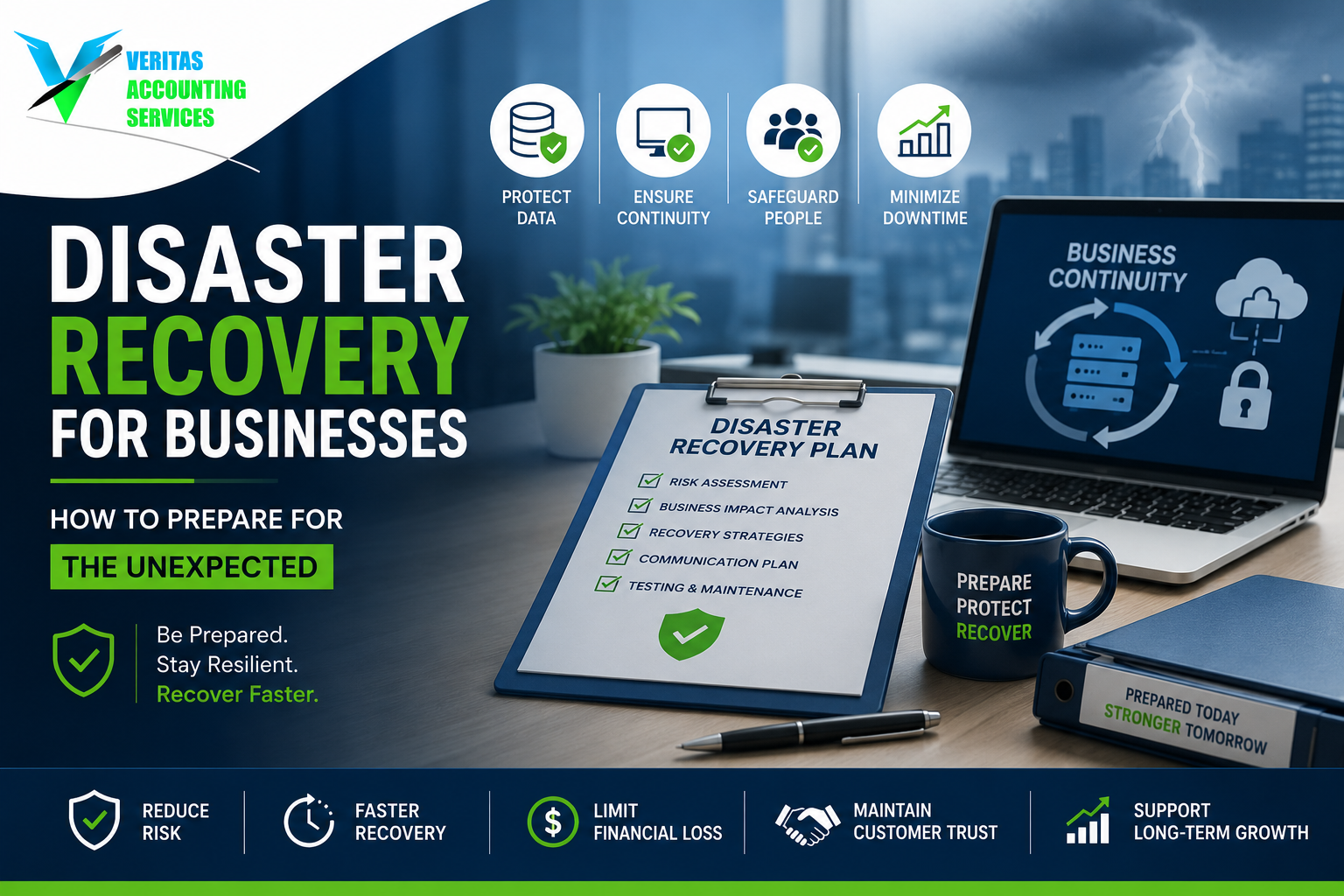

GET IN TOUCH

What to Do When You Pay for Business Expenses Personally

A practical guide to documenting business purchases you paid for personally, matching any repayment…

When the Bank Balance and Your Books Disagree

A practical month-end walkthrough for comparing your bank statement and books, with a worked example…

Vendor Bills and a Simple Routine for Better Cash Planning

A practical weekly routine for checking supplier bills, planning the payment batch and matching what…

Tax Bracket Mistakes: A Simple Guide to Better Planning

The November 5 IRS inflation update is a prompt to review your planning assumptions. Learn how…

Your Simple Guide to PTIN Renewal Mistakes and Better Records

The November 4 IRS reminder is a timely prompt to check 2027 preparer renewals, separate enrolled…

Inventory Tax Mistakes: A Simple Guide to Better Records

Stock purchases do not automatically equal a tax deduction. Review the inventory method, quantities…

Payroll Deposit Mistakes: A Simple Guide to Better Records
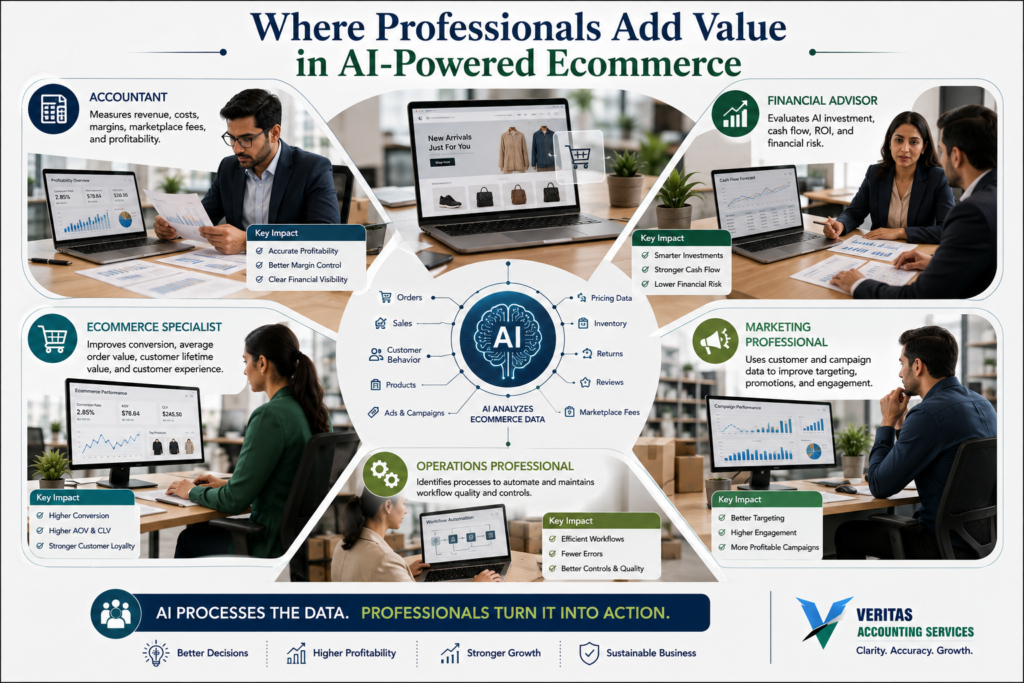
A quarterly payroll return does not set every tax deposit deadline. Check the schedule, actual pay…

Your Simple Guide to Home Office Mistakes and Better Records

Working from home does not automatically create a deduction. Check eligibility, space, dates…

Your Simple Guide to Unpaid Invoice Mistakes and Better Records

An unpaid customer invoice is not automatically a tax deduction. Review the tax accounting method…