📩 Get A Quote : hello@veritasaccountingservices.com
growth-focused accounting

Why Your Accountant Isn’t Helping You Grow: 7 Signs You Need More Than Compliance

Compliance Keeps You Safe—It Doesn’t Help You Grow

Imagine two businesses operating in the same industry.

Both have similar annual revenue.

Both submit their tax returns on time.

Both maintain accurate bookkeeping.

Five years later, one company has doubled in size while the other continues to struggle with profitability and cash flow.

What changed?

Surprisingly, it often isn’t the product, the market, or even the owner.

It’s the quality of financial guidance behind the business.

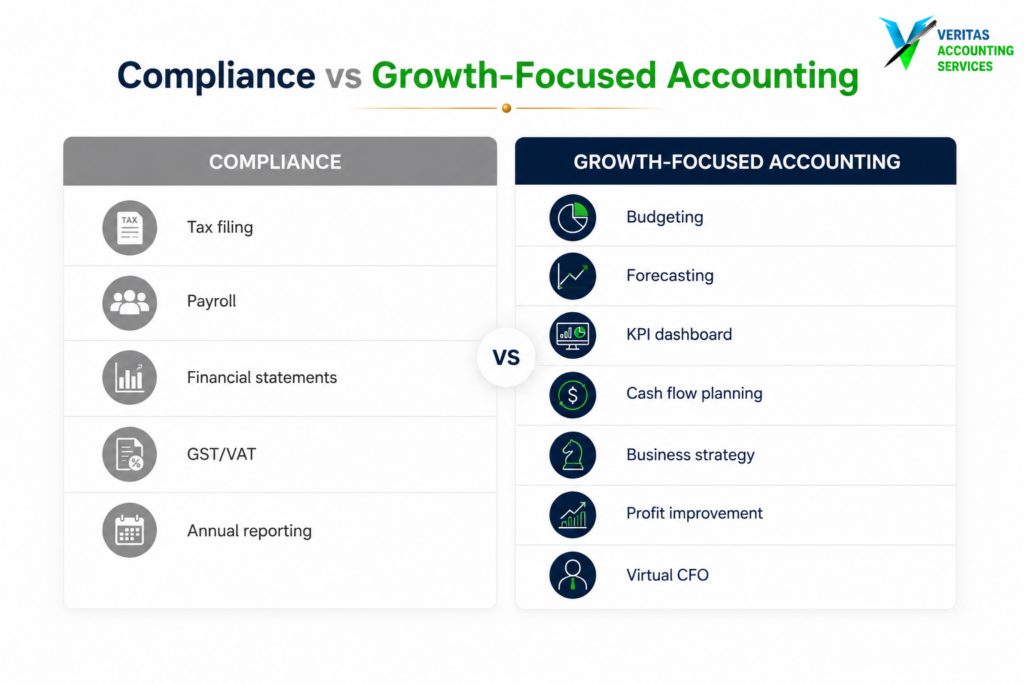
Many accountants provide excellent compliance services. They prepare financial statements, file tax returns, manage payroll, and ensure regulatory requirements are met. Those responsibilities are essential, and every business depends on them.

However, compliance alone rarely drives business growth.

Today’s business environment demands something more. Owners need timely financial insights, practical advice, and strategic planning that support better decisions throughout the year. This is where growth-focused accounting creates real value.

Rather than simply reporting what happened last year, it helps businesses understand what should happen next.


The Difference Between Recording History and Shaping the Future

Traditional accounting focuses on recording financial transactions accurately.

Growth-focused accounting goes a step further.

Instead of asking only whether the accounts balance, it asks questions such as:

  • Which products generate the strongest margins?
  • Why is cash flow tightening despite higher sales?
  • Are operating costs increasing faster than revenue?
  • Can the business afford to expand this year?
  • Which customers create the highest long-term value?

These conversations transform accounting from an administrative function into a strategic business tool.

Business owners don’t simply need reports.

They need clarity.

When financial information explains why performance is changing—and what actions should be taken next—it becomes one of the most valuable resources in the business.

Financial Reports Should Answer Questions, Not Just Meet Requirements

Most businesses receive a Profit and Loss Statement and Balance Sheet every year.

Many owners glance at the figures, file the reports away, and move on.

Unfortunately, this means valuable opportunities are often missed.

Financial reports should answer practical business questions such as:

  • Why did profitability decline this quarter?
  • Which expenses increased unexpectedly?
  • Are we collecting customer payments quickly enough?
  • Which services generate the highest returns?
  • Do we have enough cash to support expansion?

When reports become decision-making tools rather than compliance documents, management gains a much clearer understanding of business performance.

This is one of the biggest advantages of growth-focused accounting.

Instead of looking at numbers in isolation, business owners begin to see the story behind those numbers.


If You Only Speak to Your Accountant During Tax Season, You’re Missing Opportunities

Many business owners communicate with their accountant only once or twice a year.

Usually, the conversation begins with:

“Please send us your financial records.”

A few weeks later, tax returns are completed, financial statements are finalised, and the next discussion takes place months later.

While this process satisfies compliance requirements, it does little to improve the business.

Growing companies benefit from regular financial conversations.

Monthly or quarterly reviews often focus on:

  • Cash flow performance
  • Profitability trends
  • Budget comparisons
  • Investment opportunities
  • Business risks
  • Operational improvements

These discussions allow management to solve problems while there is still time to act.

Waiting until year-end often means the opportunity has already passed.


Revenue Doesn’t Guarantee Growth

One of the most common misconceptions among business owners is that higher sales automatically lead to a stronger business.

In reality, many companies experience record revenue while struggling to pay suppliers, invest in new opportunities, or maintain healthy cash flow.

Revenue measures activity.

Cash flow measures sustainability.

A business may generate impressive sales while simultaneously experiencing:

  • Slow customer collections
  • Rising operating costs
  • Increasing inventory
  • Lower profit margins
  • Higher borrowing requirements

Without regular financial analysis, these warning signs often remain unnoticed until they become serious problems.

Growth-focused accounting helps business owners understand how revenue, profitability, and cash flow work together rather than viewing them as separate financial measures.
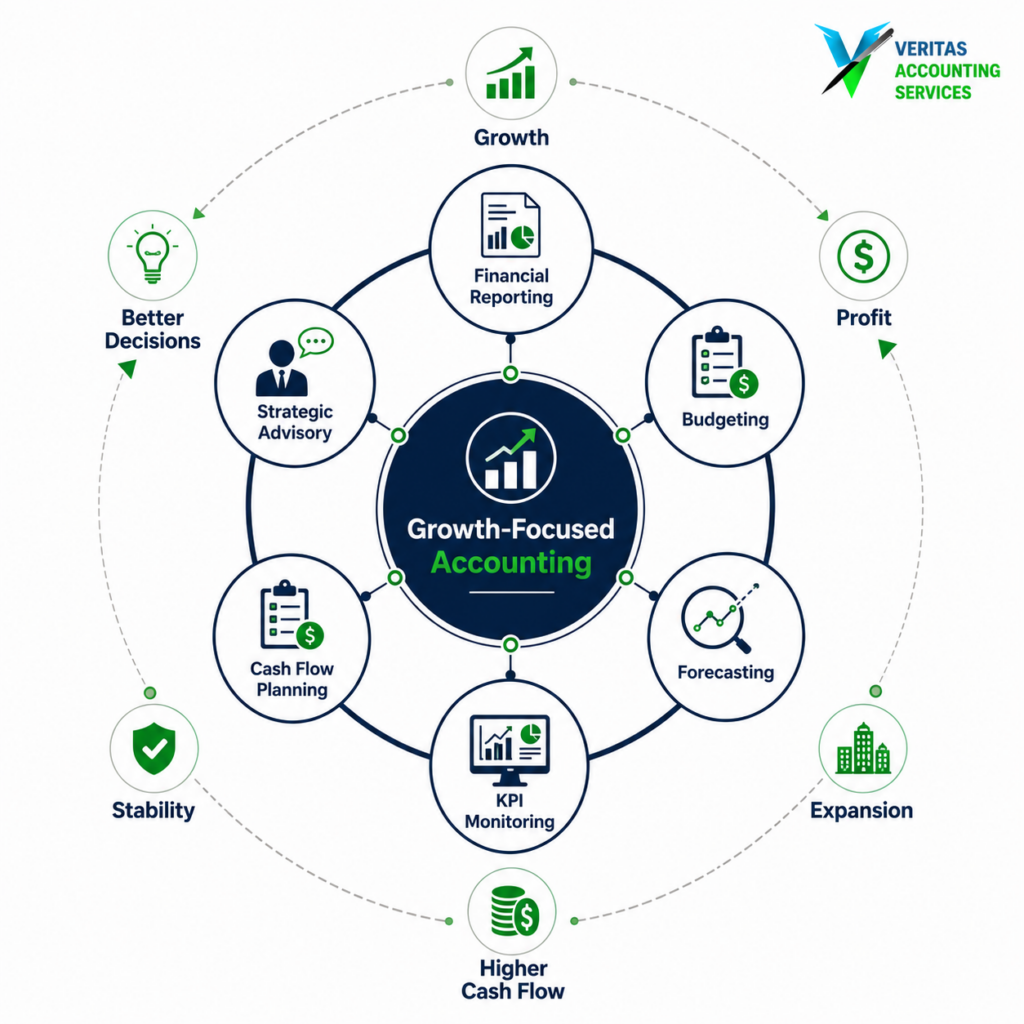
growth-focused accounting roadmap

Better Decisions Begin With Better Questions

Successful businesses rarely grow because they receive better financial statements.

They grow because someone helps them ask better financial questions.

Questions like:

  • Which service should we stop offering?
  • Where are we losing profit?
  • Should we recruit another employee now or six months from now?
  • Is expansion financially sustainable?
  • What happens if revenue slows by 15% next quarter?

These are strategic business questions.

Answering them requires more than historical bookkeeping.

It requires financial interpretation, forecasting, and ongoing business advice.

That is where growth-focused accounting becomes a competitive advantage rather than simply a compliance function.

Budgeting and Forecasting Turn Ambition into Action

Every business owner has goals.

Expand into a new market.

Hire more employees.

Launch a new product.

Open another location.

The challenge isn’t having ambitious plans—it’s knowing whether the business can afford them.

Many growing businesses make major decisions based on optimism rather than financial planning. While confidence is important, sustainable growth depends on understanding the financial impact before committing resources.

This is where growth-focused accounting provides real value.

Instead of simply reporting last month’s performance, it helps answer questions such as:

  • How much cash will expansion require?
  • Can the business support another employee?
  • What happens if sales increase more slowly than expected?
  • How will higher operating costs affect profitability?

Forecasting doesn’t predict the future with certainty, but it allows business owners to prepare for different scenarios. That preparation reduces financial surprises and supports more confident decision-making.

Businesses that budget and forecast regularly tend to grow more steadily because their decisions are based on financial evidence rather than assumptions.


The Right Numbers Should Drive Every Important Decision

Every successful business tracks performance.

The difference is that high-performing companies monitor the numbers that actually influence future growth.

Revenue is only one measure of success.

Equally important are indicators such as:

  • Gross Profit Margin
  • Operating Profit
  • Cash Flow
  • Customer Collection Period
  • Inventory Turnover
  • Working Capital
  • Customer Retention

These metrics provide early warning signs that traditional financial statements may not immediately reveal.

For example, a business may celebrate record sales while gross margins continue to decline. Without reviewing key performance indicators, management may not recognise the issue until profitability has already been affected.

Growth-focused accounting transforms financial information into meaningful business intelligence.

Instead of asking, “How much did we sell?”, business owners begin asking, “Why are profits changing?” and “What should we do next?”

Those questions lead to better decisions.


Financial Advice Should Be Ongoing—Not Annual

One of the biggest misconceptions about accounting is that advice is only needed at year-end.

In reality, the most valuable financial conversations happen throughout the year.

Regular meetings create opportunities to discuss:

  • Cash flow challenges
  • Pricing strategies
  • Rising operating costs
  • Investment opportunities
  • Business expansion
  • Financing requirements
  • Tax planning before deadlines

These discussions help businesses respond quickly to changing market conditions instead of reacting after opportunities have passed.

Growth-focused accounting is built on continuous communication rather than occasional compliance meetings.

The result is greater confidence and better financial control.


As Your Business Grows, Your Financial Needs Change

The accounting support required by a start-up is very different from the support needed by a growing business.

In the early stages, bookkeeping, payroll, and tax compliance may be enough.

As revenue increases, financial decisions become more complex.

Business owners begin asking questions such as:

  • Should we recruit another manager?
  • Is this expansion financially sustainable?
  • Which products generate the highest margins?
  • Can we improve cash flow without borrowing?
  • Are we pricing our services correctly?

Answering these questions requires more than accurate bookkeeping.

It requires financial analysis, forecasting, strategic planning, and ongoing advisory support.

This is why many growing businesses choose to work with a Virtual CFO or an outsourced finance partner alongside their compliance accountant.
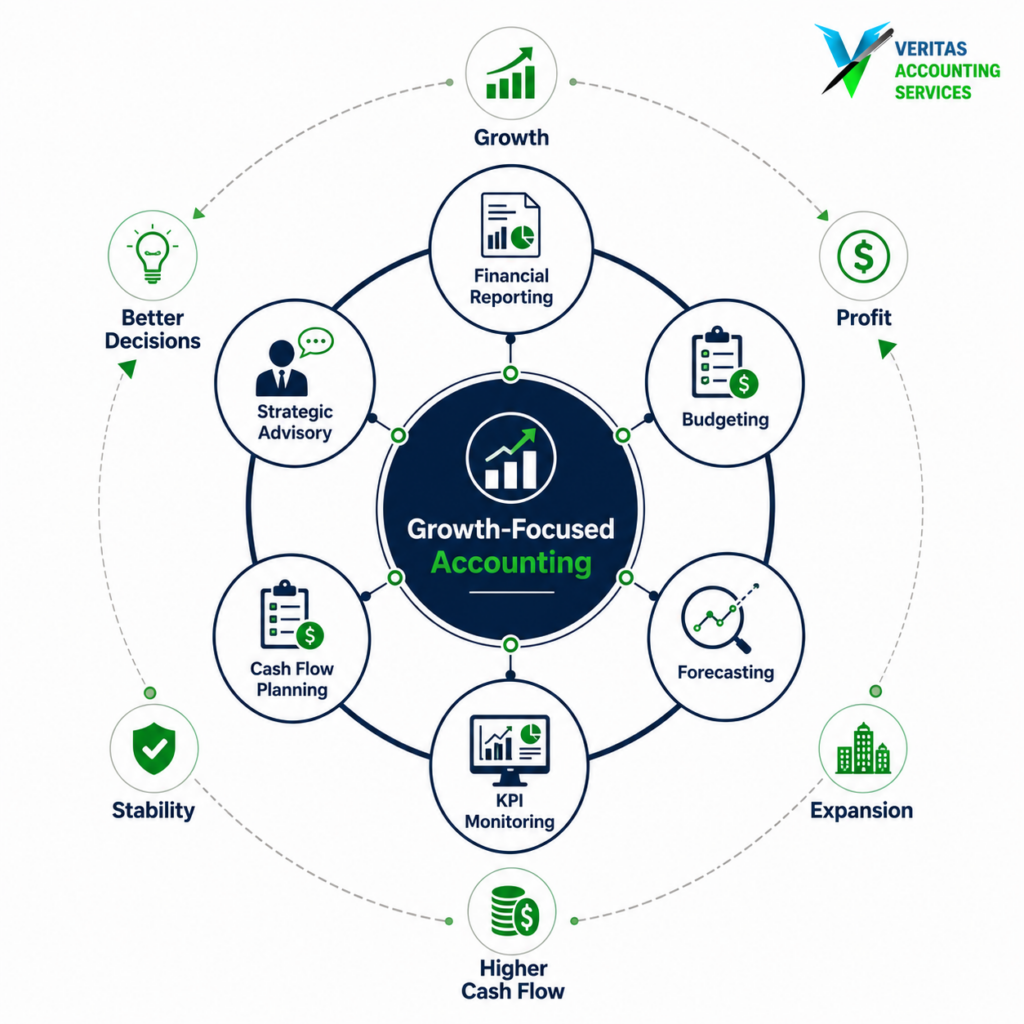
growth-focused accounting roadmap

The Best Accountants Help You Build the Future

The purpose of accounting has evolved.

Today’s business owners expect more than financial statements and tax returns.

They want insights.

They want practical recommendations.

They want someone who understands both the numbers and the business behind those numbers.

Growth-focused accounting bridges that gap.

It combines reliable bookkeeping, accurate reporting, budgeting, forecasting, KPI monitoring, and strategic advice into one continuous financial process.

Rather than simply recording history, it helps shape the future.

That difference often determines whether a business merely survives—or continues to grow year after year.


Frequently Asked Questions

What is growth-focused accounting?

Growth-focused accounting combines traditional accounting services with financial planning, management reporting, budgeting, forecasting, KPI monitoring, and strategic business advice to support long-term growth.


How is growth-focused accounting different from traditional accounting?

Traditional accounting focuses primarily on compliance, tax filings, and historical reporting. Growth-focused accounting uses financial information to improve decision-making, profitability, cash flow, and business performance throughout the year.


Does every business need growth-focused accounting?

Not every business requires advanced financial advisory services immediately with Growth-focused accounting. However, businesses planning to expand, improve profitability, or make significant financial decisions often benefit from additional strategic support.


What are the benefits of working with a Virtual CFO?

A Virtual CFO provides financial expertise without the cost of employing a full-time Chief Financial Officer. Services typically include budgeting, forecasting, cash flow management, KPI reporting, financial analysis, and strategic planning and Growth-focused accounting


How often should business owners review financial performance?

Monthly reviews are generally recommended. Regular reporting helps identify trends early, improve decision-making, Growth-focused accountingand address financial issues before they become significant.


Conclusion

Tax compliance will always remain an essential part of running a successful business.

But compliance alone does not create growth, it requires Growth-focused accounting

The businesses that consistently outperform their competitors are those that use financial information as a strategic decision-making tool rather than simply a reporting requirement.

They review performance regularly.

They monitor cash flow.

They measure key performance indicators.

They prepare budgets.

They forecast future results.

Most importantly, they work with finance professionals who help them understand what the numbers mean—not just what the numbers are.

If your accountant only helps you meet deadlines, your business may be missing opportunities to improve profitability, strengthen cash flow, and plan for sustainable growth.

The right financial partner doesn’t simply keep your business compliant.

They help move your business forward.


Call to Action

At Veritas Accounting Services, we believe accounting should do more than keep your business compliant.

Our team provides bookkeeping, management reporting, budgeting, forecasting, KPI reporting, cash flow planning, and Virtual CFO services designed to help business owners make informed decisions with confidence.

If you’re looking for financial support that goes beyond year-end reporting, we’re here to help you build a stronger and more profitable business.


GET IN TOUCH

Schedule a FREE Call

What to Do When You Pay for Business Expenses Personally

A practical guide to documenting business purchases you paid for personally, matching any repayment…

When the Bank Balance and Your Books Disagree

A practical month-end walkthrough for comparing your bank statement and books, with a worked example…

Vendor Bills and a Simple Routine for Better Cash Planning

A practical weekly routine for checking supplier bills, planning the payment batch and matching what…

Tax Bracket Mistakes: A Simple Guide to Better Planning

The November 5 IRS inflation update is a prompt to review your planning assumptions. Learn how…

Your Simple Guide to PTIN Renewal Mistakes and Better Records

The November 4 IRS reminder is a timely prompt to check 2027 preparer renewals, separate enrolled…

Inventory Tax Mistakes: A Simple Guide to Better Records

Stock purchases do not automatically equal a tax deduction. Review the inventory method, quantities…

Payroll Deposit Mistakes: A Simple Guide to Better Records

A quarterly payroll return does not set every tax deposit deadline. Check the schedule, actual pay…

Your Simple Guide to Home Office Mistakes and Better Records

Working from home does not automatically create a deduction. Check eligibility, space, dates…

Your Simple Guide to Unpaid Invoice Mistakes and Better Records

An unpaid customer invoice is not automatically a tax deduction. Review the tax accounting method…

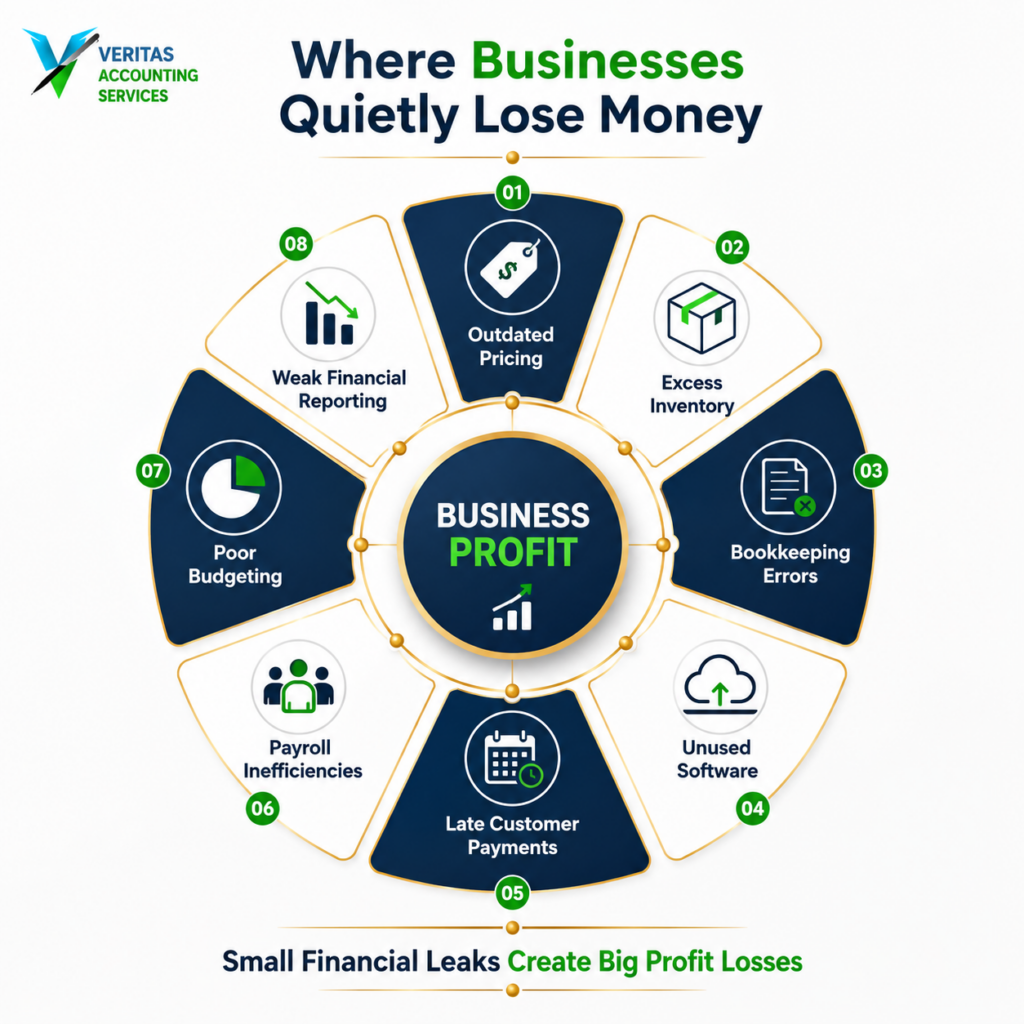
Hidden Financial Leaks

The Silent Profit Killers: Hidden Financial Leaks in Every Business

Every Business Has Hidden Financial Leaks

Most business owners believe profits disappear because sales are too low.

In reality, many profitable businesses quietly lose thousands of dollars every year through small financial inefficiencies that often go unnoticed.

These hidden financial leaks rarely appear as one large expense. Instead, they develop gradually through inefficient processes, outdated pricing, poor financial controls, and missed opportunities to improve operational efficiency.

The challenge is that these leaks become part of everyday business operations.

Over time, they reduce profitability, create unnecessary cash flow pressure, and limit the company’s ability to invest in future growth.

The good news is that most of these issues can be identified and corrected with regular financial reviews and accurate reporting.

Let’s look at some of the most common areas where businesses unknowingly lose money.


Pricing That No Longer Reflects Rising Costs

One of the largest hidden financial leaks occurs when businesses continue charging the same prices while operating costs continue to increase.

Many companies hesitate to review pricing because they worry about losing customers.

However, supplier prices, employee salaries, freight costs, software subscriptions, insurance premiums, and utilities rarely remain constant.

If selling prices remain unchanged while costs increase, profit margins gradually shrink.

This often happens so slowly that management doesn’t notice the impact until profitability begins to decline.

Successful businesses review pricing regularly by considering:

  • Changes in supplier costs
  • Inflation
  • Labour expenses
  • Competitor pricing
  • Customer value
  • Market demand

Pricing should be reviewed as part of an ongoing financial strategy rather than only during periods of financial pressure.

Regular pricing analysis helps eliminate one of the most common hidden financial leaks affecting growing businesses.

hidden financial leaks - business profit

Poor Cash Flow Management

Revenue and cash are not the same.

A business can generate record sales while still struggling to pay suppliers or employees.

This usually happens because customer payments arrive much later than operating expenses.

Examples include:

  • Slow customer collections
  • Excessive credit terms
  • Large inventory purchases
  • Unexpected tax payments
  • Loan repayments
  • Seasonal fluctuations

Without proper monitoring, cash shortages often force businesses to rely on overdrafts or short-term borrowing.

The interest costs associated with emergency financing become another hidden financial leak that gradually reduces profitability.

Businesses that prepare monthly cash flow forecasts are better positioned to anticipate shortfalls before they become serious financial problems.


Software and Subscription Expenses

Modern businesses rely on dozens of software applications.

Accounting software.

CRM systems.

Project management platforms.

Marketing tools.

Payroll software.

Cloud storage.

Communication platforms.

Over time, many businesses continue paying for software that employees no longer use.

It is common to find:

  • Duplicate software
  • Multiple users with inactive accounts
  • Free alternatives that meet business needs
  • Premium features that remain unused

Although each subscription may appear relatively small, together they can represent thousands of dollars in unnecessary annual expenses.

Reviewing subscriptions every six months helps identify another category of hidden financial leaks that are surprisingly easy to eliminate.


Weak Inventory Management

Inventory should generate revenue—not quietly consume cash.

Unfortunately, many businesses purchase more inventory than they actually need.

This creates several financial challenges:

  • Cash tied up in slow-moving stock
  • Additional warehouse costs
  • Higher insurance expenses
  • Product obsolescence
  • Damage and shrinkage

Poor inventory management also increases financing costs because money invested in unsold products cannot be used elsewhere in the business.

Successful companies regularly review inventory reports to identify:

  • Slow-moving products
  • Excess stock
  • Seasonal demand changes
  • Purchasing trends

Improving inventory turnover strengthens both profitability and cash flow while reducing hidden financial leaks.

hidden financial leaks

Financial Leaks Often Start Small

One important lesson shared by successful businesses is that financial problems rarely begin with one major mistake.

Instead, they develop through dozens of small inefficiencies that appear insignificant on their own.

An unnecessary subscription.

A pricing decision that was never reviewed.

Inventory sitting in storage for too long.

Customers paying invoices weeks after they become due.

Individually, these issues may seem minor.

Together, they quietly reduce profitability every month.

Businesses that identify these warning signs early place themselves in a much stronger financial position than those waiting until profits begin to decline.

Payroll and Productivity Costs

Payroll is one of the largest investments for most businesses.

However, higher payroll costs do not always translate into higher productivity.

Over time, businesses may experience:

  • Unnecessary overtime
  • Duplicate responsibilities
  • Inefficient scheduling
  • Low employee utilisation
  • Manual administrative work that could be automated

These issues quietly increase operating expenses without improving business performance.

Regularly reviewing workforce productivity helps ensure payroll expenses support business growth rather than becoming one of the hidden financial leaks affecting profitability.

This does not necessarily mean reducing staff. Often, improving processes, providing better training, or introducing automation can significantly increase productivity without increasing payroll costs.


Bookkeeping Errors That Reduce Profit

Accurate bookkeeping is far more than a compliance requirement.

It provides the financial information business owners rely on when making important decisions.

When bookkeeping is neglected, businesses may experience:

  • Duplicate expense entries
  • Missing supplier invoices
  • Unreconciled bank accounts
  • Incorrect expense classifications
  • Unrecorded customer payments

Although each error may appear small, together they distort financial reports and make it difficult to understand the true profitability of the business.

Reliable bookkeeping allows management to identify hidden financial leaks before they become costly problems.

It also improves budgeting, forecasting, tax planning, and financial reporting.


Lack of Budgeting Leads to Uncontrolled Spending

Businesses rarely overspend intentionally.

More often, spending gradually increases because there is no clear financial plan.

Without an annual budget, it becomes difficult to answer questions such as:

  • Can we afford another employee?
  • Is this software investment necessary?
  • Should we expand into a new market?
  • Are marketing costs delivering acceptable returns?

Budgets provide financial discipline.

They help management compare planned spending with actual results and investigate significant differences.

Companies that regularly monitor budgets often identify hidden financial leaks much earlier than businesses operating without financial targets.

hidden financial leaks

Regular Financial Reviews Prevent Hidden Financial Leaks

One of the simplest ways to improve profitability is to review financial performance every month.

Successful businesses do not wait until year-end to understand how they are performing.

Instead, they review:

  • Profit and Loss Statement
  • Balance Sheet
  • Cash Flow Statement
  • Budget comparisons
  • Key performance indicators
  • Outstanding receivables
  • Inventory reports

Monthly reviews help management identify unusual trends before they affect business performance.

For example:

  • A gradual increase in software expenses.
  • Declining gross profit margins.
  • Slow customer collections.
  • Rising inventory levels.
  • Increasing payroll costs.

By identifying these issues early, businesses can take corrective action before they significantly reduce profitability.

Regular financial reviews are one of the most effective ways to eliminate hidden financial leaks.


Building a Business That Keeps More of What It Earns

Growing revenue is important.

Keeping more of that revenue is equally important.

Many businesses focus heavily on generating new customers while overlooking opportunities to improve profitability through better financial management.

Small improvements made consistently often produce significant long-term results.

Examples include:

  • Reviewing pricing annually.
  • Monitoring cash flow monthly.
  • Reconciling bank accounts regularly.
  • Removing unnecessary subscriptions.
  • Improving inventory turnover.
  • Following up on overdue invoices.
  • Comparing actual results with budgets.

These improvements may appear modest individually, but together they strengthen financial performance and support sustainable growth.


Frequently Asked Questions

What are hidden financial leaks?

Hidden financial leaks are unnecessary expenses, inefficient processes, or weak financial controls that gradually reduce business profitability without being immediately obvious.


Why do businesses fail to identify hidden financial leaks?

Many financial leaks develop slowly over time.

Without regular financial reporting, budgeting, and performance reviews, they often become part of normal business operations.


Can better bookkeeping reduce hidden financial leaks?

Yes.

Accurate bookkeeping provides reliable financial information that helps businesses identify duplicate expenses, cash flow issues, pricing problems, and operational inefficiencies.


How often should businesses review their finances?

Monthly financial reviews are generally recommended.

Regular monitoring allows businesses to identify trends early and make informed decisions before small issues become major financial problems.


What is the easiest financial leak to fix?

Unused software subscriptions, duplicate services, and delayed customer collections are often among the quickest and easiest opportunities to improve profitability.


Conclusion

Every business has opportunities to improve profitability.

The challenge is that many of those opportunities remain hidden beneath everyday operations.

Pricing that has not been reviewed.

Inventory sitting in storage.

Unused software subscriptions.

Delayed customer payments.

Bookkeeping inaccuracies.

Uncontrolled spending.

Individually, these issues may seem insignificant.

Collectively, they become hidden financial leaks that quietly reduce profits and limit business growth.

The most successful businesses do not simply focus on increasing sales.

They regularly review their finances, strengthen internal controls, monitor performance, and continuously improve their financial systems.

By identifying and eliminating hidden financial leaks, businesses can improve profitability without necessarily increasing revenue.


Call to Action

At Veritas Accounting Services, we help businesses identify financial inefficiencies through professional bookkeeping, financial reporting, budgeting, cash flow management, and Virtual CFO services.

If you’re looking to improve profitability, strengthen financial controls, and build a healthier business, our team is ready to help.

Contact us today to discover where your business may be losing money—and how to stop it.


GET IN TOUCH

Schedule a FREE Call

What to Do When You Pay for Business Expenses Personally

A practical guide to documenting business purchases you paid for personally, matching any repayment…

When the Bank Balance and Your Books Disagree

A practical month-end walkthrough for comparing your bank statement and books, with a worked example…

Vendor Bills and a Simple Routine for Better Cash Planning

A practical weekly routine for checking supplier bills, planning the payment batch and matching what…

Tax Bracket Mistakes: A Simple Guide to Better Planning

The November 5 IRS inflation update is a prompt to review your planning assumptions. Learn how…

Your Simple Guide to PTIN Renewal Mistakes and Better Records

The November 4 IRS reminder is a timely prompt to check 2027 preparer renewals, separate enrolled…

Inventory Tax Mistakes: A Simple Guide to Better Records

Stock purchases do not automatically equal a tax deduction. Review the inventory method, quantities…

Payroll Deposit Mistakes: A Simple Guide to Better Records

A quarterly payroll return does not set every tax deposit deadline. Check the schedule, actual pay…

Your Simple Guide to Home Office Mistakes and Better Records

Working from home does not automatically create a deduction. Check eligibility, space, dates…

Your Simple Guide to Unpaid Invoice Mistakes and Better Records

An unpaid customer invoice is not automatically a tax deduction. Review the tax accounting method…
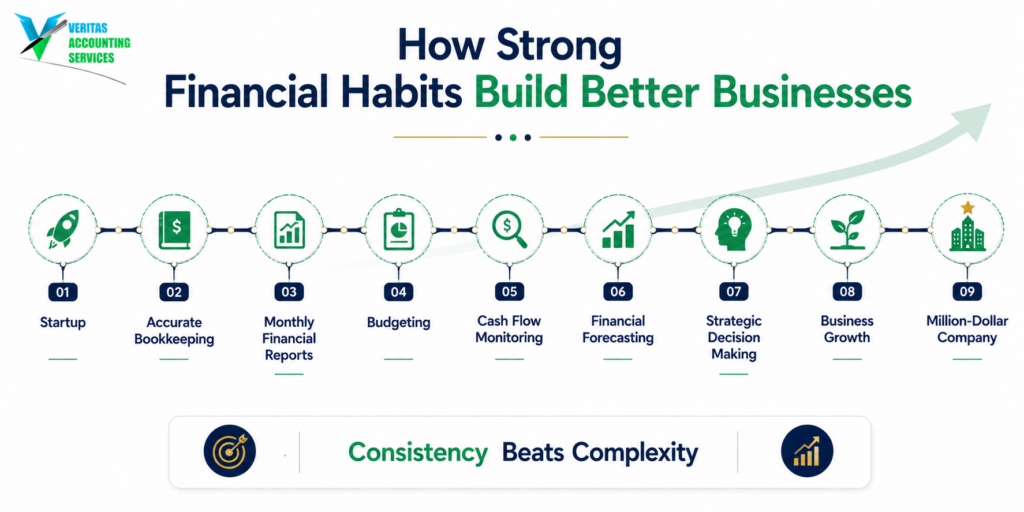
Financial Habits

What Million-Dollar Companies Do Differently with Their Finances

Success Starts with Strong Financial Habits

Many business owners believe that reaching seven figures is simply a matter of increasing sales. While revenue growth is important, it is only one part of building a successful business.

Many companies generate impressive sales but continue to struggle with profitability, cash flow, and long-term sustainability. Others achieve steady, profitable growth because they have developed disciplined financial habits that support every business decision.

These habits are rarely complicated. Instead, they are consistent, practical, and supported by accurate financial information.

Whether you’re running a startup, an e-commerce business, a consulting firm, or a growing SME, adopting better financial habits can improve decision-making, strengthen profitability, and reduce unnecessary financial risk.

Rather than reacting to financial challenges, million-dollar companies build systems that help prevent those challenges from occurring in the first place.


They Treat Financial Reports as Decision-Making Tools

Many businesses prepare financial statements only because they are required for tax filings or year-end compliance.

Successful companies take a different approach.

They review financial reports every month because those reports provide valuable insights into business performance.

The three reports they rely on most are:

  • Profit and Loss Statement
  • Balance Sheet
  • Cash Flow Statement

Instead of asking,

“How much revenue did we generate?”

they ask questions such as:

  • Are profit margins improving?
  • Which expenses are increasing?
  • Are customers paying on time?
  • Can we afford another employee?
  • Is cash flow supporting our growth plans?

Financial reports help management identify opportunities and potential risks before they become serious problems.

Using financial information to guide business decisions is one of the most valuable financial habits successful companies develop.


They Focus on Cash Flow, Not Just Sales

Revenue attracts attention.

Cash keeps the business operating.

Million-dollar companies understand the difference.

A business may generate record sales while still experiencing financial pressure because customer payments are delayed or operating costs increase faster than collections.

For this reason, successful businesses monitor:

  • Customer collections
  • Supplier payments
  • Payroll obligations
  • Tax liabilities
  • Loan repayments
  • Working capital

They know that profitable businesses can still run into cash shortages if money is not flowing through the business efficiently.

Strong cash flow management is one of the financial habits that allows growing businesses to continue expanding without unnecessary financial stress.

Financial Habits

They Build Budgets Before Spending

Successful businesses rarely make major financial decisions without first preparing a budget.

Budgets provide a roadmap for growth.

Instead of restricting spending, they help management invest in areas that generate the greatest long-term value.

A practical budget helps answer questions such as:

  • Can we hire additional staff?
  • Is now the right time to purchase new equipment?
  • How much should we invest in marketing?
  • Do we have sufficient working capital?
  • What happens if revenue slows for several months?

Budgets also create accountability by allowing management to compare actual results with planned performance.

Companies that consistently follow budgeting processes generally make better financial decisions than those relying solely on intuition.


They Invest in Accurate Bookkeeping

Every financial decision depends on reliable information.

Without accurate bookkeeping, management cannot fully understand business performance.

Million-dollar companies treat bookkeeping as an investment rather than an administrative task.

Reliable bookkeeping ensures:

  • Transactions are recorded accurately.
  • Bank accounts are reconciled regularly.
  • Financial reports remain reliable.
  • Tax records stay organised.
  • Management receives timely information.

Accurate records also improve forecasting, budgeting, profitability analysis, and strategic planning.

Among all financial habits, maintaining clean bookkeeping is one of the most important because every business decision depends on the quality of financial information.


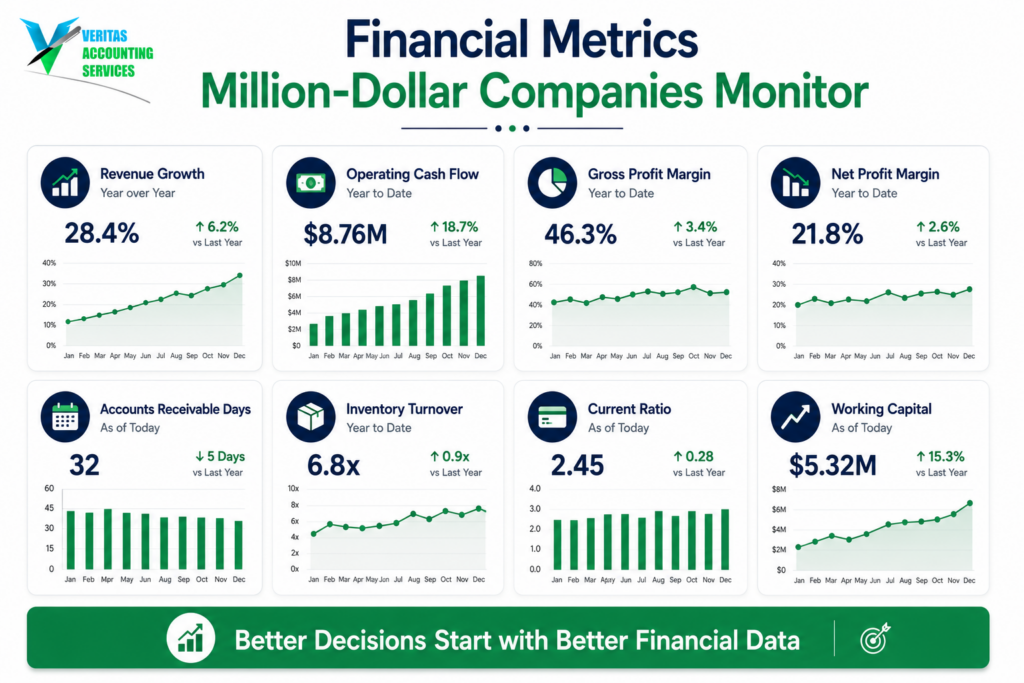
They Measure What Really Matters

Financial Habits & metrics

Revenue is only one indicator of business success.

Million-dollar companies monitor a broader range of financial metrics that provide a complete picture of business performance.

Common indicators include:

  • Gross Profit Margin
  • Net Profit Margin
  • Accounts Receivable Days
  • Inventory Turnover
  • Operating Cash Flow
  • Current Ratio
  • Working Capital

Reviewing these indicators regularly helps management identify trends early and take corrective action before problems become significant.

Instead of waiting until year-end, successful businesses continuously evaluate performance and adjust their strategies.

Consistently monitoring business performance is another example of the financial habits that support sustainable growth.

They Forecast Before Making Major Decisions

Successful businesses do not rely solely on historical financial reports. They also look ahead.

Before expanding into a new market, hiring additional employees, purchasing equipment, or launching a new product, they prepare financial forecasts to understand how these decisions may affect future performance.

A forecast helps answer questions such as:

  • Will the business generate enough cash to support expansion?
  • How will additional expenses affect profitability?
  • What happens if sales are lower than expected?
  • How much funding will be required over the next six to twelve months?

Forecasting allows management to evaluate different scenarios before committing resources. It reduces uncertainty and helps businesses make informed decisions based on financial data rather than assumptions.

This forward-looking approach is one of the financial habits that allows million-dollar companies to grow with greater confidence.


They Plan Taxes Throughout the Year

Many businesses think about taxes only when filing deadlines approach.

Successful companies take a different approach.

They review their tax position throughout the year so there are fewer surprises when returns are due.

Proactive tax planning helps businesses:

  • Estimate future tax liabilities.
  • Improve cash flow planning.
  • Maximise available deductions.
  • Maintain organised financial records.
  • Reduce the risk of penalties caused by missed deadlines or inaccurate reporting.

Tax planning is not about avoiding taxes. It is about understanding obligations in advance and making informed business decisions.

Businesses that treat tax planning as an ongoing process are generally better prepared for growth and changing regulations.


They Use Technology to Improve Efficiency

Technology has transformed modern finance functions.

Cloud accounting software, automation tools, and artificial intelligence have significantly reduced the time required to complete routine accounting tasks.

Successful businesses use technology to automate repetitive activities such as:

  • Invoice processing
  • Expense tracking
  • Receipt capture
  • Bank feeds
  • Payment reminders
  • Routine reporting

Automation improves speed and reduces manual errors.

However, technology is only part of the solution.

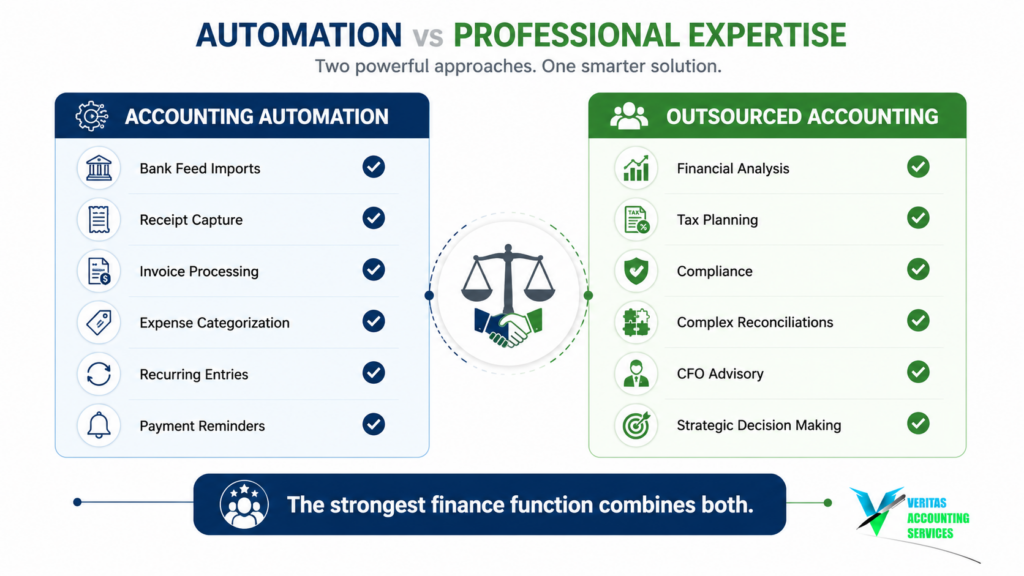
Financial information still requires professional review, interpretation, and strategic analysis.

Million-dollar companies use technology to improve efficiency while relying on experienced finance professionals to support decision-making.

This balanced approach allows them to gain the benefits of innovation without sacrificing financial accuracy.


They Seek Professional Financial Advice

Growing businesses eventually reach a stage where owners cannot manage every financial decision alone.

Successful companies recognise the value of experienced advisors.

Professional accountants and Virtual CFOs contribute far more than bookkeeping and tax compliance.

They help businesses:

  • Interpret financial reports.
  • Improve cash flow.
  • Build realistic budgets.
  • Prepare financial forecasts.
  • Evaluate investments.
  • Monitor business performance.
  • Support strategic planning.

Having access to reliable financial advice often enables business owners to identify opportunities and risks that may not be obvious from day-to-day operations.

This willingness to seek expert guidance is one of the financial habits that consistently supports sustainable business growth.


Building Better Financial Habits Starts with Small Changes

Many business owners believe they need to transform their entire finance function overnight.

In reality, long-term success usually comes from making consistent improvements over time.

Simple actions such as reviewing monthly financial reports, preparing budgets, monitoring cash flow, and maintaining accurate bookkeeping can significantly strengthen financial performance.

As these processes become part of everyday operations, better decision-making becomes a natural outcome.

Million-dollar companies are rarely built through one major financial decision.

They are built through disciplined financial habits practiced consistently over many years.


Frequently Asked Questions

Why are financial habits important for business growth?

Strong financial habits help businesses make informed decisions, manage cash flow effectively, control costs, and identify opportunities for sustainable growth.


How often should financial reports be reviewed?

Most businesses should review their Profit and Loss Statement, Balance Sheet, and Cash Flow Statement every month. Regular reviews help identify trends and address issues before they become significant.


Is bookkeeping really that important?

Yes.

Accurate bookkeeping provides reliable financial information, supports tax compliance, improves reporting, and enables better business decisions.


What financial reports should every business monitor?

At a minimum, businesses should regularly review:

  • Profit and Loss Statement
  • Balance Sheet
  • Cash Flow Statement

Depending on the business, management reports and KPI dashboards may also be valuable.


When should a business consider Virtual CFO services?

Businesses often benefit from Virtual CFO services when they require financial forecasting, budgeting, strategic reporting, performance analysis, or guidance during periods of growth.


Conclusion

The difference between an average business and a million-dollar company is not always the product, the industry, or even the number of customers.

More often, it is the quality of financial decision-making.

Successful businesses understand that growth requires more than increasing sales.

They invest in reliable bookkeeping, monitor financial performance regularly, manage cash flow carefully, prepare realistic budgets, forecast future results, and seek professional advice when needed.

These financial habits create stronger businesses because decisions are based on accurate information rather than assumptions.

Regardless of the size of your business today, adopting these habits can help you build a stronger financial foundation and support sustainable growth for years to come.


Call to Action

At Veritas Accounting Services, we help businesses build the financial systems needed for long-term success.

From bookkeeping and financial reporting to budgeting, forecasting, tax planning, and Virtual CFO services, our team provides practical financial support that helps business owners make informed decisions with confidence.

If you’re ready to strengthen your financial foundation, contact us today to learn how we can support your business growth.


GET IN TOUCH

Schedule a FREE Call

What to Do When You Pay for Business Expenses Personally

A practical guide to documenting business purchases you paid for personally, matching any repayment…

When the Bank Balance and Your Books Disagree

A practical month-end walkthrough for comparing your bank statement and books, with a worked example…

Vendor Bills and a Simple Routine for Better Cash Planning

A practical weekly routine for checking supplier bills, planning the payment batch and matching what…

Tax Bracket Mistakes: A Simple Guide to Better Planning

The November 5 IRS inflation update is a prompt to review your planning assumptions. Learn how…

Your Simple Guide to PTIN Renewal Mistakes and Better Records

The November 4 IRS reminder is a timely prompt to check 2027 preparer renewals, separate enrolled…

Inventory Tax Mistakes: A Simple Guide to Better Records

Stock purchases do not automatically equal a tax deduction. Review the inventory method, quantities…

Payroll Deposit Mistakes: A Simple Guide to Better Records

A quarterly payroll return does not set every tax deposit deadline. Check the schedule, actual pay…

Your Simple Guide to Home Office Mistakes and Better Records

Working from home does not automatically create a deduction. Check eligibility, space, dates…

Your Simple Guide to Unpaid Invoice Mistakes and Better Records

An unpaid customer invoice is not automatically a tax deduction. Review the tax accounting method…
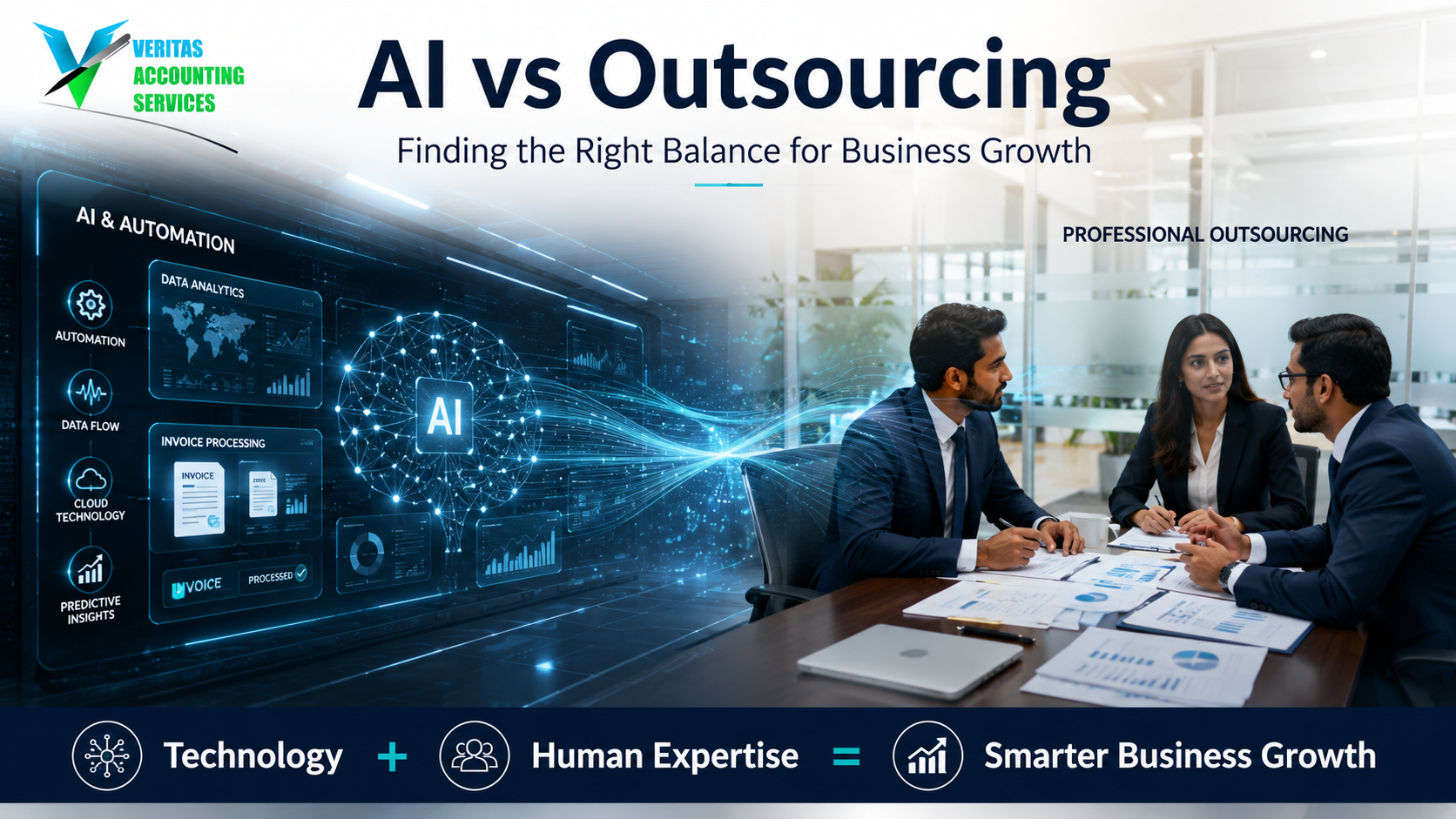
AI vs Outsourcing

AI vs Outsourcing: Finding the Right Balance for Business Growth

Why Businesses Are Comparing AI vs Outsourcing

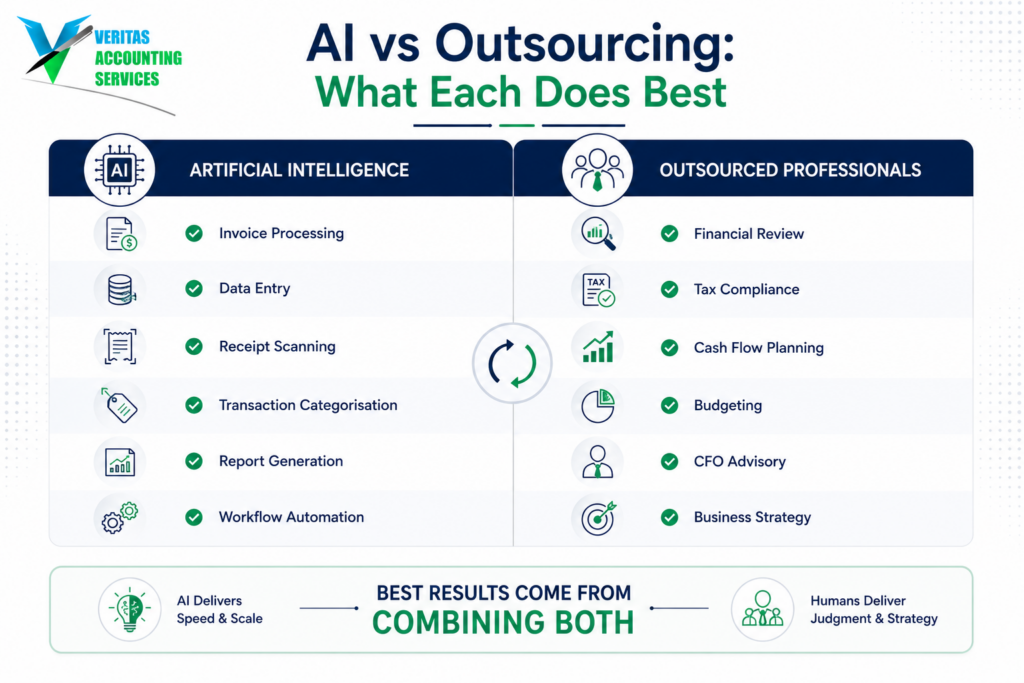
Artificial intelligence is transforming the way businesses operate. From drafting emails and analysing data to automating bookkeeping tasks and generating reports, AI has become an essential tool for improving efficiency.

At the same time, outsourcing continues to grow as businesses look for experienced professionals who can manage specialised functions without the cost of building large in-house teams.

This has created an important question for business owners:

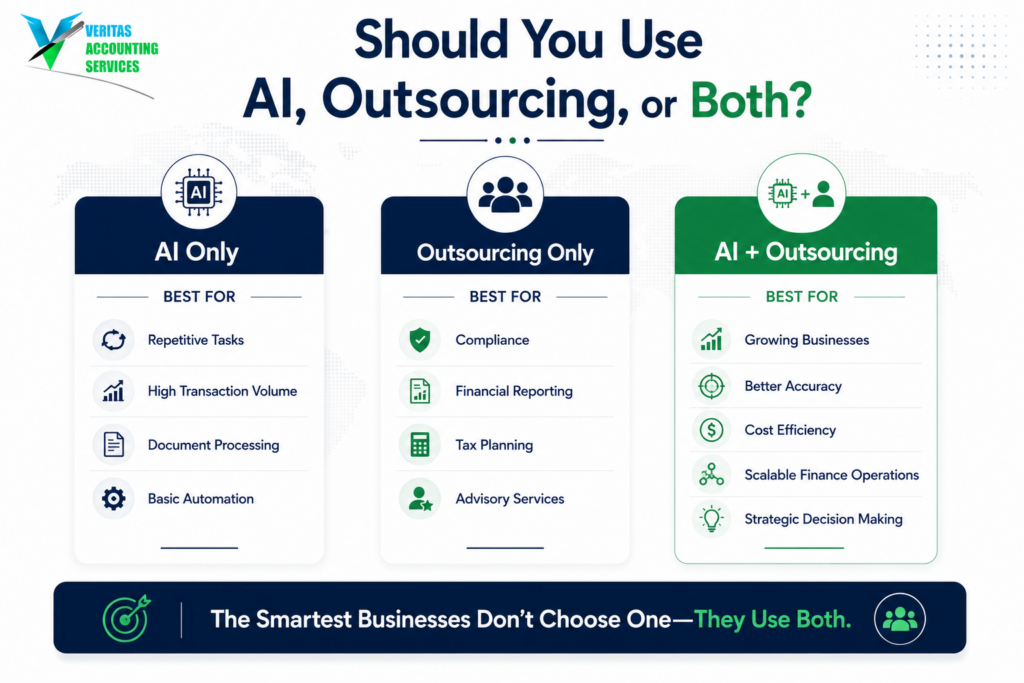
Should you invest in AI, outsource key business functions, or combine both?

The discussion around AI vs outsourcing is no longer about choosing one over the other. Instead, it is about understanding how each approach contributes to productivity, profitability, and long-term business growth.

Businesses that make informed decisions are not simply looking for the cheapest option. They are looking for solutions that improve quality, reduce risk, and create capacity for growth.

AI vs outsourcing

What AI Does Best

Artificial intelligence excels at handling repetitive and data-driven tasks.

Rather than replacing people, AI helps businesses complete routine activities faster and with greater consistency.

Today, AI can assist with:

  • Data entry
  • Invoice processing
  • Receipt extraction
  • Document summarisation
  • Email drafting
  • Meeting notes
  • Basic financial reporting
  • Expense categorisation
  • Workflow automation

For example, accounting software now uses AI to read invoices, suggest transaction categories, detect duplicate entries, and identify unusual spending patterns.

These capabilities reduce manual effort and allow finance teams to focus on higher-value work.

For growing businesses, AI also improves scalability. As transaction volumes increase, automation can process significantly more information without requiring additional administrative staff.

This is one of the biggest advantages highlighted in the AI vs outsourcing discussion.


Where AI Still Has Limitations

Although AI is becoming increasingly capable, it cannot replace professional judgment.

Business decisions often involve context, experience, regulations, and commercial understanding that software alone cannot fully evaluate.

Consider the following situations:

  • Determining the correct accounting treatment for a complex transaction.
  • Advising on international tax compliance.
  • Preparing for an external audit.
  • Managing a cash flow crisis.
  • Interpreting financial statements for strategic decisions.
  • Identifying risks hidden within business operations.

These activities require professional expertise rather than automation.

AI can generate recommendations based on available information, but it cannot accept responsibility for regulatory compliance or provide professional assurance.

This is particularly important in accounting and finance, where accuracy and compliance have legal and financial consequences.

For this reason, the AI vs outsourcing debate should focus on capability rather than replacement.

Technology performs repetitive work exceptionally well.

Professionals apply experience, judgment, and accountability.


What Outsourcing Offers Beyond Cost Savings

Many business owners associate outsourcing with lower operating costs.

While cost reduction is certainly an advantage, it is only one part of the value outsourcing provides.

Professional outsourcing firms contribute:

Industry Expertise

Experienced accountants, bookkeepers, payroll specialists, and finance professionals understand industry regulations and best practices.

They recognise issues that automated systems may overlook.


Scalability

Businesses can expand services without recruiting, training, or managing additional employees.

As workloads increase, outsourced teams can often scale more efficiently than internal departments.


Compliance Support

Accounting regulations, payroll requirements, tax laws, and financial reporting standards continue to evolve.

Professional outsourcing providers monitor these changes and help businesses remain compliant.


Independent Review

Experienced professionals question unusual transactions, investigate discrepancies, and identify opportunities for process improvement.

This independent perspective often improves financial accuracy and internal controls.


Advisory Services

Unlike software, outsourcing providers can explain financial reports, recommend improvements, assist with budgeting, support cash flow planning, and contribute to strategic business decisions.

This advisory role is one of the biggest reasons many growing businesses continue investing in outsourcing despite advances in artificial intelligence.

The goal is no longer choosing between AI vs outsourcing.

It is determining how each can create greater value when used together.
How AI and Outsourcing Work Better Together

The discussion should not be AI or outsourcing.

Instead, businesses should ask:

“Which tasks should AI handle, and where do experienced professionals add the greatest value?”

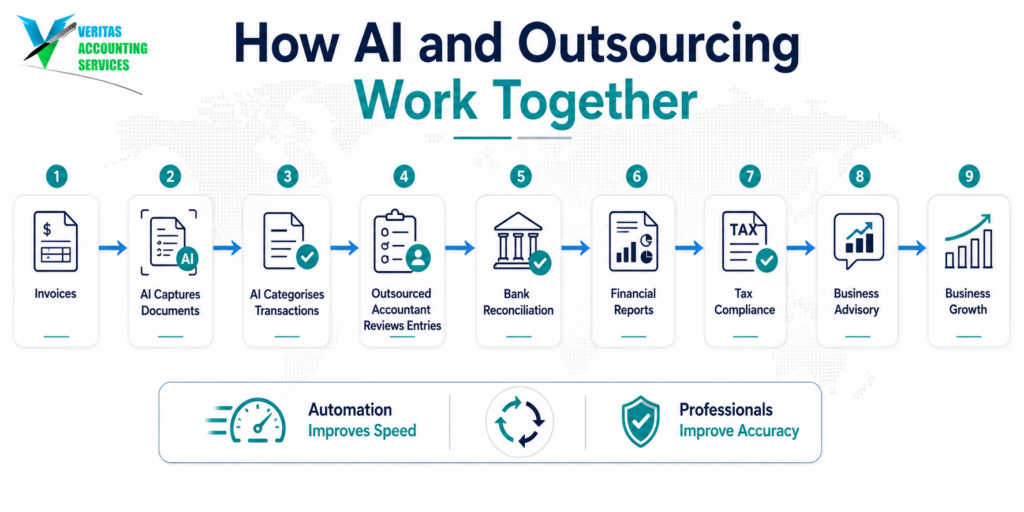
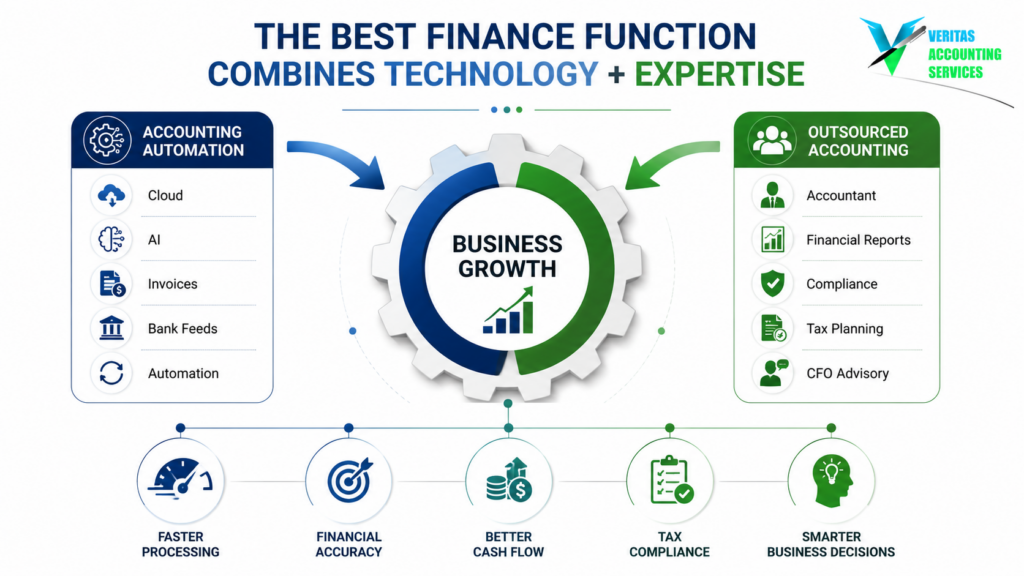
The most successful businesses combine both approaches.

For example:

AI can:

  • Capture invoices automatically.
  • Categorize routine transactions.
  • Process receipts.
  • Generate draft reports.
  • Flag unusual spending patterns.

An outsourced finance team can:

  • Review financial accuracy.
  • Perform reconciliations.
  • Prepare management reports.
  • Ensure tax compliance.
  • Advise on business performance.
  • Support budgeting and forecasting.
  • Help management make informed decisions.

In this model, AI improves efficiency while outsourcing provides expertise, oversight, and accountability.

This balanced approach allows businesses to benefit from technology without compromising financial accuracy.


Which Businesses Benefit the Most?

Every business is different, but some organisations gain particular advantages from combining AI with outsourced expertise.

Startups

Startups often have limited budgets but ambitious growth plans.

Using AI for routine administration while outsourcing bookkeeping and financial reporting provides access to experienced professionals without hiring a full finance department.


Small and Medium-Sized Businesses

SMEs usually require:

  • Accurate bookkeeping
  • Payroll support
  • Tax compliance
  • Financial reporting

AI improves efficiency, while outsourced specialists ensure the information remains reliable.


E-Commerce Businesses

Online sellers process thousands of transactions across platforms such as Shopify, Amazon, Stripe, and PayPal.

AI helps automate data collection, but experienced accountants are still needed to:

  • Reconcile marketplace payouts.
  • Record inventory correctly.
  • Calculate taxes.
  • Prepare financial statements.

CPA Firms

Many CPA firms now combine AI-powered tools with outsourced bookkeeping teams.

This allows internal staff to focus on advisory services while repetitive accounting tasks are completed efficiently.


Growing Businesses

As companies expand, financial complexity increases.

Business owners require more than transaction processing.

They need:

  • Budgeting
  • Forecasting
  • Cash flow analysis
  • KPI reporting
  • Strategic financial advice

These services continue to rely on professional expertise.


Common Misconceptions About AI vs Outsourcing

Several myths influence the AI vs outsourcing conversation.

AI Will Replace Accountants

AI is transforming accounting, but it is not replacing experienced professionals.

Instead, it is changing how accountants work by automating repetitive tasks and allowing them to focus on analysis and advisory services.


Outsourcing Means Losing Control

Modern outsourcing provides transparency through cloud accounting software, shared dashboards, and regular reporting.

Business owners maintain visibility while reducing operational workload.


AI Never Makes Mistakes

AI depends on the quality of the information it receives.

Incorrect data, poorly configured systems, or unusual transactions can still produce inaccurate results.

Professional review remains essential.


Outsourcing Is Only for Large Businesses

Many startups and SMEs successfully outsource finance functions because it provides access to experienced professionals without the expense of hiring full-time staff.


Finding the Right Balance

AI vs outsourcing work together

The answer to AI vs outsourcing is rarely one or the other.

Businesses should evaluate each activity individually.

Tasks that are repetitive, rule-based, and time-consuming are often suitable for AI.

Tasks requiring expertise, interpretation, compliance, or business judgment are better handled by experienced professionals.

Combining both creates a finance function that is:

  • Efficient
  • Accurate
  • Scalable
  • Cost-effective
  • Future-ready

Rather than replacing people, AI enables professionals to deliver higher-value services that directly support business growth.


Frequently Asked Questions

Can AI completely replace outsourced accounting?

No.

AI can automate routine bookkeeping tasks, but professional accountants are still needed for reconciliations, compliance, financial reporting, tax planning, and business advice.


Is AI cheaper than outsourcing?

Not always.

Businesses should consider implementation costs, software subscriptions, integration, training, monitoring, and ongoing maintenance—not just licensing fees.


Can AI and outsourcing work together?

Yes.

Many businesses use AI to automate repetitive work while relying on outsourced professionals for review, reporting, compliance, and strategic support.


Which businesses benefit most from combining AI and outsourcing?

Startups, SMEs, e-commerce businesses, CPA firms, and rapidly growing companies often achieve the best results by combining both approaches.


What should businesses automate first?

Routine administrative activities such as invoice processing, receipt capture, expense categorisation, and document management are good starting points.


Conclusion

Artificial intelligence is changing the way businesses operate, but it is not replacing professional expertise.

AI excels at improving efficiency, reducing manual effort, and automating repetitive tasks.

Outsourcing provides something technology cannot—experience, professional judgment, compliance, and strategic guidance.

The businesses achieving the greatest success are not choosing between AI and outsourcing.

They are integrating both into a smarter operating model.

By allowing technology to handle routine processes while experienced professionals manage financial oversight and decision-making, businesses can reduce costs, improve accuracy, and build a stronger foundation for long-term growth.

The future is not AI instead of people.

The future is AI working alongside people.


Call to Action

At Veritas Accounting Services, we combine modern AI-powered accounting tools with experienced finance professionals to deliver accurate bookkeeping, financial reporting, tax compliance, and Virtual CFO support.

Whether you’re a startup, an e-commerce business, or a growing company, we can help you build a finance function that balances technology with professional expertise.

Contact us today to discover how the right combination of AI and outsourcing can support your business growth.


GET IN TOUCH

Schedule a FREE Call

What to Do When You Pay for Business Expenses Personally

A practical guide to documenting business purchases you paid for personally, matching any repayment…

When the Bank Balance and Your Books Disagree

A practical month-end walkthrough for comparing your bank statement and books, with a worked example…

Vendor Bills and a Simple Routine for Better Cash Planning

A practical weekly routine for checking supplier bills, planning the payment batch and matching what…

Tax Bracket Mistakes: A Simple Guide to Better Planning

The November 5 IRS inflation update is a prompt to review your planning assumptions. Learn how…

Your Simple Guide to PTIN Renewal Mistakes and Better Records

The November 4 IRS reminder is a timely prompt to check 2027 preparer renewals, separate enrolled…

Inventory Tax Mistakes: A Simple Guide to Better Records

Stock purchases do not automatically equal a tax deduction. Review the inventory method, quantities…

Payroll Deposit Mistakes: A Simple Guide to Better Records

A quarterly payroll return does not set every tax deposit deadline. Check the schedule, actual pay…

Your Simple Guide to Home Office Mistakes and Better Records

Working from home does not automatically create a deduction. Check eligibility, space, dates…

Your Simple Guide to Unpaid Invoice Mistakes and Better Records

An unpaid customer invoice is not automatically a tax deduction. Review the tax accounting method…

Business Registration

Where Should You Register Your Business? A Practical Comparison of US, UK, UAE & India

Why Business Registration Is More Than Just Paperwork

Choosing where to register your business is one of the first major decisions an entrepreneur makes. Yet many founders focus only on the ease of incorporation or the headline tax rate.

In reality, business registration influences far more than the initial setup process.

It affects:

  • Your ongoing compliance responsibilities
  • Tax reporting requirements
  • Banking options
  • Investor confidence
  • Access to customers
  • Business credibility
  • Expansion opportunities
  • Accounting and bookkeeping obligations

The jurisdiction that works well for one business may be completely unsuitable for another.

For example:

  • A SaaS startup seeking venture capital may benefit from a different structure than a freelance consultant.
  • An Amazon seller shipping products globally may have different priorities than a manufacturer serving the local market.
  • A digital agency working with international clients may value banking flexibility more than a retail business operating in one country.

Rather than asking, “Which country is the best?”, a better question is:

“Which country best supports my business goals (business registration)?”


What Should You Compare Before Choosing a Country?

Before deciding on business registration, every entrepreneur should evaluate several key factors.

Business Objectives

Start by understanding your long-term plans.

Ask yourself:

  • Will you operate locally or internationally?
  • Are you planning to raise investment?
  • Will you hire employees?
  • Do you expect rapid growth?
  • Will you sell digital services or physical products?

Your answers often determine which jurisdiction is most appropriate.


Tax Considerations

Tax should always be considered—but never in isolation.

Important questions include:

  • How is business income taxed?
  • Will profits be taxed personally?
  • Are dividends taxed?
  • Are there tax treaty benefits?
  • What indirect taxes may apply?

Choosing a country solely because of a lower tax rate can create unexpected compliance or residency issues later.


Compliance Requirements

Every country has ongoing obligations after incorporation.(for business registration)

These may include:

  • Annual returns
  • Financial statements
  • Tax filings
  • Payroll reporting
  • Accounting records
  • Regulatory filings
    (business registration)

Some jurisdictions have relatively simple compliance requirements, while others involve more extensive reporting.


Registering a Business in the United States

The United States remains one of the world’s most popular destinations for entrepreneurs, particularly technology startups, consultants, agencies, and e-commerce businesses.(business registration)

The most common legal structures include:

  • Limited Liability Company (LLC)
  • C Corporation
  • S Corporation (available only to eligible US owners)

For many international founders, the LLC is often the starting point because it offers operational flexibility and relatively straightforward formation.

Advantages

A US business can offer several benefits.

Strong Business Reputation

A US business entity often increases credibility when working with American customers, suppliers, and investors.

Many global clients are already familiar with US business structures. business registration


Flexible Ownership

Depending on the structure chosen, ownership arrangements can be relatively flexible, making it easier to accommodate future business growth.


Access to the US Market

Businesses targeting US customers often find that a US entity simplifies contracts, payment processing, and customer relationships.


Modern Financial Ecosystem

Businesses generally have access to:

  • Cloud accounting platforms
  • Digital payment providers
  • Merchant processing
  • Financial technology solutions

This ecosystem makes managing operations considerably easier.


Practical Considerations

A US business still carries important responsibilities.

These may include:

  • Federal tax filings
  • State-level compliance
  • Annual reports (depending on the state)
  • Registered agent requirements
  • Bookkeeping and accounting
  • Beneficial ownership reporting where applicable

Many entrepreneurs underestimate these ongoing obligations when focusing only on incorporation.


Who Is It Best Suited For?

A US business structure is often considered by:

  • SaaS companies
  • Software developers
  • Digital agencies
  • Consultants
  • Amazon FBA sellers
  • Shopify businesses targeting US customers
  • Businesses planning to attract US investors

However, whether it is the right choice depends on the owner’s tax residency, business activities, and long-term expansion plans.


Registering a Business in the United Kingdom

The UK continues to be a popular jurisdiction for entrepreneurs because of its established legal system, transparent regulatory framework, and international reputation.

The most common structure is the Private Limited Company (Ltd).

A Limited Company is a separate legal entity from its owners, offering limited liability protection while providing a recognised corporate structure.

Advantages

International Credibility

UK companies enjoy strong recognition worldwide.

Many international businesses and financial institutions are familiar with the UK corporate framework. (business registration)


Straightforward Incorporation

The incorporation process is generally efficient, making it attractive for startups and small businesses.


Well-Developed Financial Infrastructure

Businesses benefit from:

  • Established banking institutions
  • Modern accounting software
  • Professional advisory services
  • Access to international markets

Suitable for Growing Businesses

A UK Limited Company often suits businesses intending to:

  • Build a long-term brand
  • Employ staff
  • Expand internationally
  • Establish a physical presence in the UK

Practical Considerations

Running a UK company involves ongoing responsibilities such as:

  • Annual accounts
  • Confirmation statements
  • Corporation tax compliance
  • Accounting records
  • Payroll obligations where employees exist

Strong bookkeeping systems help businesses meet these requirements efficiently.


Who Is It Best Suited For?

A UK Limited Company is often considered by:

  • Consulting firms
  • Marketing agencies
  • Professional service providers
  • Technology startups
  • International trading businesses
  • Companies serving UK and European customers

As with any jurisdiction, the best choice depends on your wider business strategy rather than incorporation costs alone.

Registering a Business in the UAE

Over the last decade, the UAE has become one of the world’s most attractive business destinations for entrepreneurs, consultants, trading businesses, and international service providers.

Businesses can generally choose between:

  • Mainland companies
  • Free Zone companies

The right option depends on where the business intends to operate, its ownership structure, licensing requirements, and long-term objectives.

Advantages

Business-Friendly Environment

The UAE has developed a modern commercial ecosystem with world-class infrastructure, making it attractive for international businesses.


Strategic Global Location

Located between Europe, Asia, and Africa, the UAE serves as an international business hub, particularly for businesses involved in trading, logistics, consulting, and professional services.


Modern Banking & International Trade

Many businesses choose the UAE because of:

  • International banking options
  • Multi-currency transactions
  • Access to global markets
  • Strong logistics infrastructure

Attractive for International Entrepreneurs

The UAE is often considered by founders looking to establish an international presence while serving clients across multiple countries.


Practical Considerations

Although company formation can be straightforward, businesses should also evaluate:

  • Corporate tax obligations where applicable
  • Economic substance requirements
  • VAT registration requirements
  • Accounting and bookkeeping
  • Annual compliance obligations
  • Banking documentation

Many entrepreneurs assume the UAE has “no compliance.” In reality, businesses still have accounting and regulatory responsibilities that should not be overlooked.


Who Is It Best Suited For?

A UAE company is commonly considered by:

  • International consultants
  • Trading businesses
  • Digital agencies
  • Professional service firms
  • Import-export businesses
  • Companies serving clients across multiple countries

Registering a Business in India

India remains one of the fastest-growing business markets globally and offers significant opportunities for companies serving domestic customers.

Among various business structures, the Private Limited Company is widely used by startups and growing businesses because it provides limited liability and a recognised corporate framework. (business registration)

Advantages

Strong Domestic Market

India offers access to one of the world’s largest consumer markets, making it an attractive destination for businesses targeting local customers.


Startup Ecosystem

India has a rapidly growing startup environment supported by:

  • Technology hubs
  • Skilled professionals
  • Venture capital
  • Government initiatives

Credibility with Investors

Many investors prefer investing through a Private Limited Company because of its structured governance and ownership framework. (business registration)


Suitable for Long-Term Growth

Businesses planning to:

  • Hire employees
  • Raise funding
  • Expand nationally
  • Build manufacturing operations

often choose a Private Limited Company.


Practical Considerations

Compared to some jurisdictions, India generally involves higher ongoing compliance requirements.

These may include:

  • Annual financial statements
  • Income tax filings
  • GST compliance (where applicable)
  • TDS compliance
  • Payroll reporting
  • ROC filings
  • Statutory audits where required

Maintaining proper bookkeeping from the beginning significantly reduces compliance challenges.


Who Is It Best Suited For?

business registration

Indian Private Limited Companies are commonly chosen by:

  • Technology startups
  • Manufacturing businesses
  • Service providers
  • Retail businesses
  • Domestic consulting firms
  • Companies planning long-term operations in India

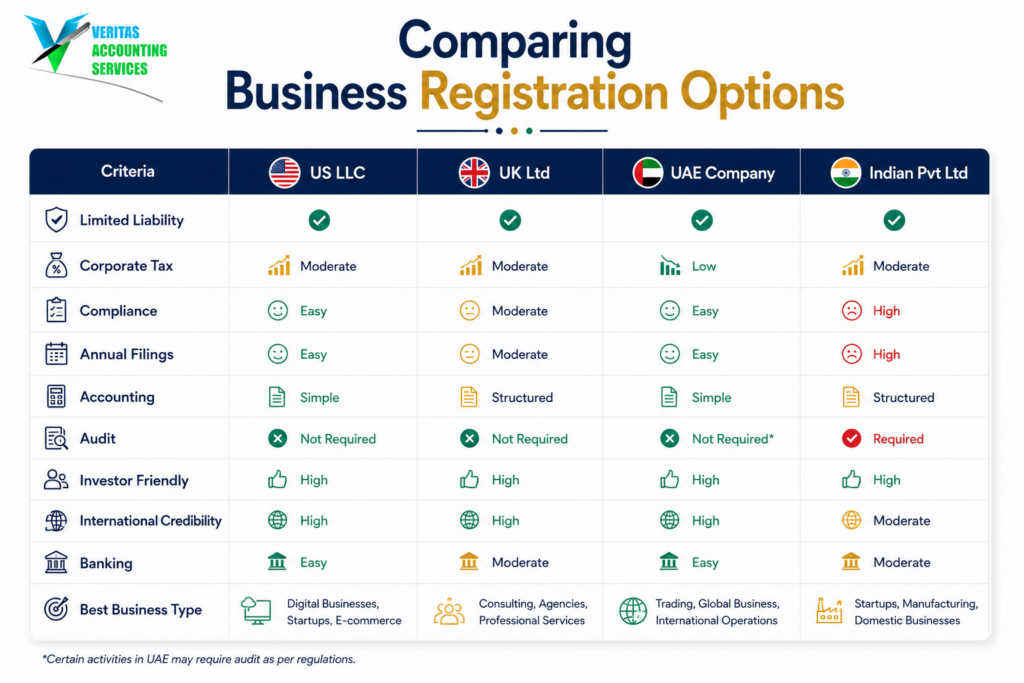
Comparing the Four Jurisdictions

FeatureUS LLCUK LtdUAE CompanyIndian Pvt Ltd
Limited Liability✔✔✔✔
Separate Legal EntityDepends on structure✔✔✔
International ReputationExcellentExcellentExcellentStrong
Suitable for Foreign Owners✔✔✔✔
Banking AvailabilityExcellentExcellentGoodGood
Investor FriendlyVery HighHighModerateHigh
Compliance LevelModerateModerateModerateHigher
Bookkeeping Required✔✔✔✔
Tax Filings✔✔✔✔
Best ForGlobal business, SaaS, e-commerceService businesses, startupsInternational consulting & tradingIndian operations & startups

Note: Compliance and tax obligations vary based on the company’s activities, ownership, and applicable local laws. Professional advice should be obtained before making incorporation decisions.


Which Country Fits Your Business?

There is no universal answer.

Instead, consider your business model.

SaaS Startup

Often considers:

  • US LLC or Corporation
  • UK Ltd

especially when targeting international customers or future investment. (business registration)


E-Commerce Business

Businesses selling through Shopify, Amazon, or other marketplaces frequently evaluate:

  • US LLC
  • UK Ltd
  • UAE Company

depending on customer locations, logistics, and tax considerations.


Consultant or Freelancer

Consultants serving international clients may find:

  • UK Ltd
  • UAE Company

more aligned with their operational requirements.


Agency Business

Marketing agencies, accounting firms, and IT service providers often choose jurisdictions that provide international credibility and efficient banking. (business registration)


Manufacturing Business

Businesses producing goods locally generally benefit from establishing operations in the country where manufacturing takes place.


Export Businesses

Exporters should evaluate:

  • Banking
  • Trade regulations
  • Tax treaties
  • Customs procedures
  • International logistics

before choosing a jurisdiction.(for business registration)


Conclusion

Choosing where to register your business is not simply about incorporating a company.

It is about building the right foundation for long-term success.

A US LLC, UK Limited Company, UAE Company, and Indian Private Limited Company each offer unique advantages.

The right choice depends on your customers, business model, growth strategy, tax residency, compliance obligations, and future plans.

Taking time to evaluate these factors before incorporation can save significant time, money, and restructuring costs later.

Rather than asking which country is “best,” ask which jurisdiction best supports the future you want to build.(business registration)


Call to Action

Planning to register a business in the US, UK, UAE, or India? (for business registration)

At Veritas Accounting Services, we help entrepreneurs evaluate business structures, understand compliance requirements, establish accounting systems, and stay tax compliant across multiple jurisdictions.

Contact our team today to discuss the most suitable structure for your (business registration).

GET IN TOUCH

Schedule a FREE Call

What to Do When You Pay for Business Expenses Personally

A practical guide to documenting business purchases you paid for personally, matching any repayment…

When the Bank Balance and Your Books Disagree

A practical month-end walkthrough for comparing your bank statement and books, with a worked example…

Vendor Bills and a Simple Routine for Better Cash Planning

A practical weekly routine for checking supplier bills, planning the payment batch and matching what…

Tax Bracket Mistakes: A Simple Guide to Better Planning

The November 5 IRS inflation update is a prompt to review your planning assumptions. Learn how…

Your Simple Guide to PTIN Renewal Mistakes and Better Records

The November 4 IRS reminder is a timely prompt to check 2027 preparer renewals, separate enrolled…

Inventory Tax Mistakes: A Simple Guide to Better Records

Stock purchases do not automatically equal a tax deduction. Review the inventory method, quantities…

Payroll Deposit Mistakes: A Simple Guide to Better Records

A quarterly payroll return does not set every tax deposit deadline. Check the schedule, actual pay…

Your Simple Guide to Home Office Mistakes and Better Records

Working from home does not automatically create a deduction. Check eligibility, space, dates…

Your Simple Guide to Unpaid Invoice Mistakes and Better Records

An unpaid customer invoice is not automatically a tax deduction. Review the tax accounting method…

Cashflow Problems

Growing Fast but Running Out of Cash? Here’s Why

Business owners often assume that increasing sales automatically lead to more cash in the bank.

Unfortunately, that isn’t always true.

Many successful businesses experience serious cash flow problems during periods of rapid growth. Sales increase, customers keep placing orders, profits look healthy, yet payroll becomes stressful, suppliers demand payment, and the bank balance continues shrinking.

At first glance, this seems impossible.

How can a growing business struggle with cash?

The answer lies in understanding the difference between revenue, profit, and cash flow.

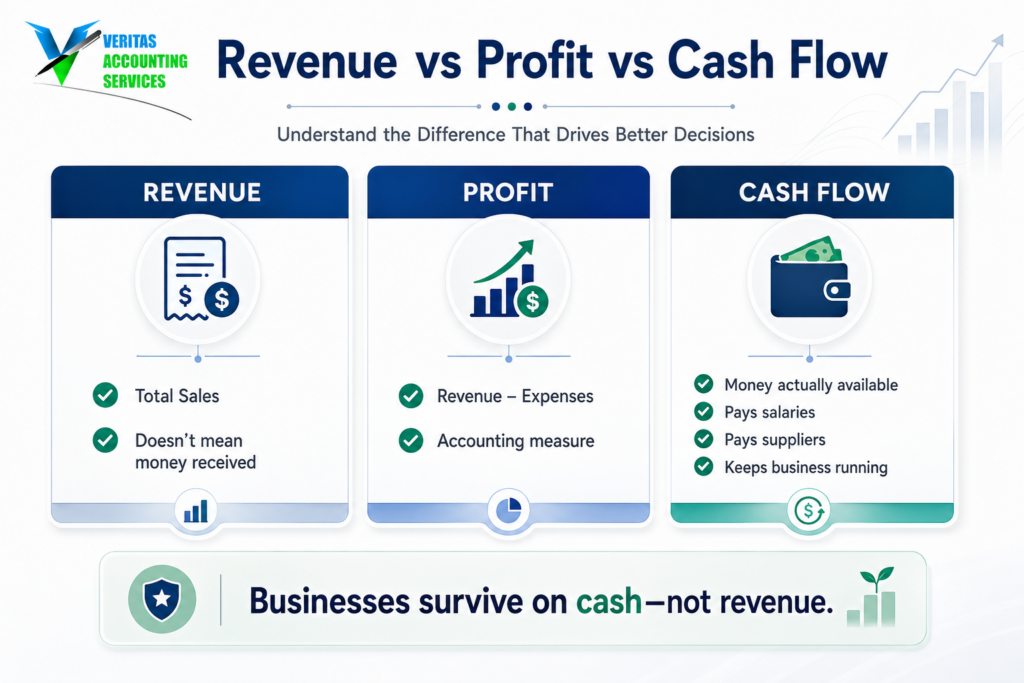
Revenue shows how much you’ve sold.

Profit measures what remains after expenses.

Cash represents the money actually available to operate the business.

A company can report record-breaking sales while still facing significant cash flow problems if cash isn’t arriving at the right time or is being consumed faster than it comes in.

Understanding why this happens is the first step toward building a financially stronger business.


Why Revenue Doesn’t Equal Cash

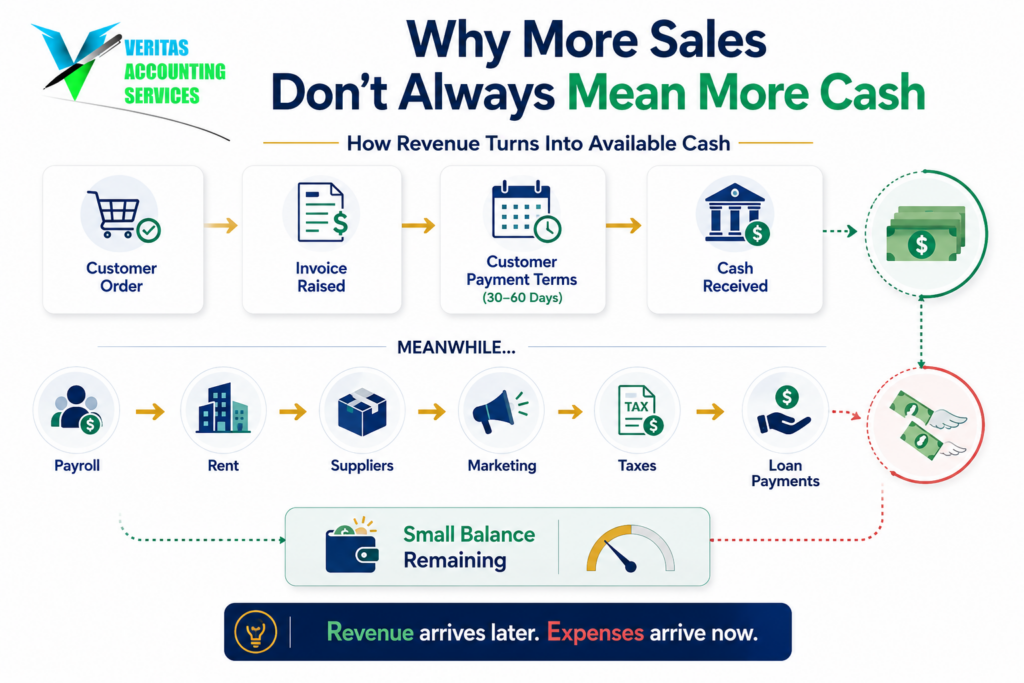
cash flow problems

One of the biggest misconceptions among entrepreneurs is believing that revenue automatically becomes available cash.

Imagine a business that invoices customers for $500,000 during the month.

The sales look impressive.

However, if those customers have 60-day payment terms, very little of that money may actually be sitting in the company’s bank account today.

Meanwhile, the business must continue paying:

  • Employee salaries
  • Rent
  • Marketing costs
  • Software subscriptions
  • Loan repayments
  • Inventory purchases
  • Taxes

This timing gap is one of the most common causes of cash flow problems.

Financial statements may show healthy growth, but the business still lacks enough cash to fund daily operations.

This is why experienced finance professionals focus just as much on cash flow as they do on revenue.


Customers Pay Later, Bills Come First

Most businesses don’t receive payment immediately after making a sale.

Instead, they offer payment terms such as:

  • 15 days
  • 30 days
  • 45 days
  • 60 days

Some industries wait even longer.

While businesses wait for customers to pay, their own expenses continue without delay.

Suppliers expect payment.

Employees expect salaries.

Governments expect taxes.

Landlords expect rent.

The result is a growing gap between money leaving the business and money coming in.

As sales increase, this gap often becomes larger rather than smaller.

Ironically, growth itself can increase cash flow problems if receivables are not managed carefully.

Businesses that monitor outstanding invoices, follow up on overdue accounts, and shorten collection periods generally maintain healthier cash positions.


Inventory Can Quietly Drain Cash

Inventory is another major reason growing businesses suddenly experience financial pressure.

Consider an e-commerce business preparing for higher demand.

To avoid stock shortages, management purchases additional inventory months before it is sold.

Although this decision supports future sales, it immediately reduces available cash.

The inventory may remain in a warehouse for weeks or even months before generating revenue.

During that time, the business has already paid suppliers, freight companies, customs duties, storage costs, and insurance expenses.

The cash has left the business, but sales haven’t yet generated replacement cash.

Many retail, manufacturing, and e-commerce businesses underestimate how much working capital becomes tied up in inventory.

Effective inventory management is therefore one of the most important tools for reducing cash flow problems.


Rapid Growth Increases Operating Costs

Growth creates opportunities, but it also creates expenses.

As businesses expand, they often invest in:

  • New employees
  • Additional office space
  • Larger warehouses
  • Better technology
  • Increased advertising
  • New equipment
  • Professional services

Most of these costs must be paid before they generate additional revenue.

For example, hiring five new employees increases payroll immediately.

However, the additional sales those employees generate may not appear for several months.

This timing difference places pressure on available cash.

Without careful planning, businesses may experience cash flow problems despite reporting excellent sales growth.

Successful companies understand that growth requires funding.

The faster a business grows, the greater its working capital requirements become.


Borrowing Can Create Hidden Cash Pressure

Business loans often help finance expansion.

However, loan repayments affect cash differently than they affect profit.

When a company repays the principal portion of a loan:

  • Cash decreases.
  • Profit does not.

Many business owners overlook this difference.

Financial statements may still show healthy profits while loan repayments steadily reduce available cash each month.

The same applies to equipment financing, vehicle loans, and other debt obligations.

Borrowing can support growth, but repayment schedules should always be considered when evaluating future cash needs.

Ignoring debt obligations during planning frequently contributes to unexpected cash flow problems.
Why Cash Flow Forecasting Matters More Than Ever

One of the biggest differences between businesses that survive rapid growth and those that struggle is financial visibility.

Many companies only review historical financial statements. While these reports explain what happened last month, they do not show what is likely to happen next month.

This is where cash flow forecasting becomes invaluable.

A well-prepared cash flow forecast estimates:

  • Expected customer receipts
  • Supplier payments
  • Payroll obligations
  • Tax payments
  • Loan repayments
  • Capital expenditures
  • Planned investments

By forecasting cash movements in advance, business owners can identify potential shortfalls before they become emergencies.

Instead of reacting to cash flow problems, they can take proactive steps to improve liquidity.

Growing businesses should review cash flow forecasts regularly rather than waiting until year-end.


Practical Ways to I


Key Financial Indicators Every Business Should Monitor

Growing companies should not rely solely on revenue when evaluating performance.

Several financial indicators provide early warning signs of potential cash flow problems.

These include:

Operating Cash Flow

Measures whether day-to-day operations are generating sufficient cash and observe whether there is any cash flow problems.


Accounts Receivable Days

Shows how long customers take to pay.

Long collection periods often create liquidity challenges.


Inventory Turnover

Indicates how efficiently inventory converts into sales.

Low turnover may suggest excessive capital tied up in stock.


Current Ratio

Measures the business’s ability to meet short-term obligations.


Working Capital

Represents the funds available to operate the business on a daily basis.

Monitoring these indicators regularly helps identify cash flow problems and other problems before they affect operations.


Why a Virtual CFO Can Make a Difference

Many small and medium-sized businesses have excellent accountants but lack strategic financial guidance.

A Virtual CFO provides more than bookkeeping or tax compliance.

They help businesses:

  • Prepare cash flow forecasts
  • Monitor key performance indicators
  • Improve budgeting
  • Evaluate financing options
  • Strengthen working capital
  • Support expansion decisions
  • Build long-term financial strategies

Rather than reacting to financial challenges, a Virtual CFO helps business owners anticipate them and cash flow problems.

For companies experiencing rapid growth, this strategic support often becomes one of the most valuable investments they make.


Frequently Asked Questions

Why do profitable businesses experience cash shortages?

Profit is calculated using accounting principles, while cash flow measures the actual movement of money.

A profitable business can still experience cash flow problems if customer payments are delayed, inventory levels increase, or operating costs grow faster than cash collections.


What is the difference between revenue and cash flow?

Revenue represents sales earned during a period.

Cash flow represents the money actually received and available to operate the business.

The two are closely related but not the same.


How often should a cash flow forecast be updated?

Most growing businesses should review and update their cash flow forecast at least monthly.

Businesses experiencing rapid growth or seasonal fluctuations may benefit from weekly reviews.


Can bookkeeping improve cash flow?

Yes.

Accurate bookkeeping provides reliable financial information that helps business owners monitor receivables, expenses, inventory, and profitability, making it easier to manage cash effectively and overcome cash flow problems.


When should a business consider hiring a Virtual CFO?

Businesses should consider Virtual CFO services when they need financial forecasting, budgeting, strategic reporting, or guidance for growth but are not ready to hire a full-time CFO.


Conclusion

Business growth is exciting, but it often creates financial challenges that many entrepreneurs do not anticipate.

Higher sales do not automatically produce stronger cash flow.

Delayed customer payments, increasing inventory, expansion costs, debt repayments, and poor forecasting can all contribute to cash flow problems, even when profitability appears healthy.

The businesses that grow successfully are those that monitor cash as carefully as they monitor revenue.

By understanding where cash goes, forecasting future needs, and implementing strong financial controls, business owners can support sustainable growth without unnecessary financial stress.

Ultimately, revenue drives growth—but cash keeps the business alive.


Call to Action

At Veritas Accounting Services, we help businesses strengthen cash flow through accurate bookkeeping, financial reporting, budgeting, forecasting, and Virtual CFO services.

Whether you’re experiencing rapid growth or planning your next stage of expansion, our team can help you build a stronger financial foundation.

Contact us today to discover how better financial management can support long-term business success.

GET IN TOUCH

Schedule a FREE Call

What to Do When You Pay for Business Expenses Personally

A practical guide to documenting business purchases you paid for personally, matching any repayment…

When the Bank Balance and Your Books Disagree

A practical month-end walkthrough for comparing your bank statement and books, with a worked example…

Vendor Bills and a Simple Routine for Better Cash Planning

A practical weekly routine for checking supplier bills, planning the payment batch and matching what…

Tax Bracket Mistakes: A Simple Guide to Better Planning

The November 5 IRS inflation update is a prompt to review your planning assumptions. Learn how…

Your Simple Guide to PTIN Renewal Mistakes and Better Records

The November 4 IRS reminder is a timely prompt to check 2027 preparer renewals, separate enrolled…

Inventory Tax Mistakes: A Simple Guide to Better Records

Stock purchases do not automatically equal a tax deduction. Review the inventory method, quantities…

Payroll Deposit Mistakes: A Simple Guide to Better Records

A quarterly payroll return does not set every tax deposit deadline. Check the schedule, actual pay…

Your Simple Guide to Home Office Mistakes and Better Records

Working from home does not automatically create a deduction. Check eligibility, space, dates…

Your Simple Guide to Unpaid Invoice Mistakes and Better Records

An unpaid customer invoice is not automatically a tax deduction. Review the tax accounting method…
multi-currency accounting

Managing Multiple Currencies? The Ultimate Guide to E-Commerce Accounting

Selling products internationally has never been easier. Platforms like Shopify, Amazon, Etsy, and WooCommerce allow businesses to reach customers across the world with just a few clicks. While global expansion opens new revenue opportunities, it also introduces a significant accounting challenge—multi-currency accounting.

An online store may sell products in US dollars, receive payouts in British pounds, purchase inventory from China in Chinese yuan, pay software subscriptions in euros, and settle supplier invoices through Wise or PayPal. Every one of these transactions involves exchange rates that directly affect your financial records.

Many e-commerce businesses focus on increasing sales but overlook how foreign currency transactions influence revenue, expenses, profits, and tax reporting. As a result, financial statements become inaccurate, reconciliations take longer, and year-end tax preparation becomes far more complicated than it needs to be.

Understanding multi-currency accounting is essential for any business selling internationally. With the right systems and bookkeeping processes, businesses can maintain accurate financial records, make better decisions, and stay compliant with accounting and tax requirements.


Why Multi-Currency Accounting Matters

Multi-Currency Accounting

Traditional bookkeeping assumes that all transactions occur in a single currency. That assumption no longer applies to modern e-commerce businesses.

Today’s online sellers often:

  • Sell products in multiple countries.
  • Receive payments in different currencies.
  • Purchase inventory from overseas suppliers.
  • Pay international contractors.
  • Maintain foreign currency bank accounts.

Without proper multi-currency accounting, these transactions may be recorded incorrectly, resulting in inaccurate profit calculations and misleading financial reports.

For example, if your business purchases inventory in USD but your accounting records are maintained in GBP, the value of that inventory changes as exchange rates fluctuate. Recording the transaction using the wrong exchange rate can distort both inventory values and cost of goods sold.


How Global Sales Affect Your Accounting

International sales involve much more than currency conversion.

Every transaction affects:

Revenue Recognition

Revenue should be recorded using the applicable exchange rate on the transaction date rather than the payout date. This ensures that financial statements reflect the true value of sales when they occurred.

Customer Payments

Payment processors often receive customer payments in one currency before converting them into another. During this process, processing fees and exchange rate adjustments reduce the final amount deposited into your bank account.

Supplier Payments

If suppliers invoice you in a foreign currency, exchange rate movements between the invoice date and payment date may create additional accounting entries.

Financial Reporting

Balance Sheets and Profit & Loss Statements should consistently reflect your business’s reporting currency while accurately capturing foreign currency activity.

These differences highlight why multi-currency accounting requires more than simply converting one currency into another.


Recording Foreign Currency Transactions Correctly

One of the most common bookkeeping mistakes is recording transactions using bank deposit amounts rather than the original transaction values.

Instead, businesses should follow a structured process:

Record the Original Transaction

Sales, purchases, and invoices should first be recorded in the original transaction currency.

Apply the Correct Exchange Rate

The transaction should then be converted into the business’s reporting currency using the exchange rate applicable on the transaction date.

Record Settlement Differences

If payment occurs on a later date and exchange rates have changed, the difference should be recorded separately as a foreign exchange gain or loss rather than adjusting the original transaction.

Following this approach keeps financial reports accurate and provides a clear audit trail.


Exchange Rate Gains and Losses Explained

Exchange rates change every day.

These fluctuations create gains or losses whenever a transaction remains outstanding between the invoice date and payment date.

For example:

A UK-based business invoices a US customer for $10,000.

The invoice is recorded when:

  • £1 = $1.25

The customer pays two weeks later when:

  • £1 = $1.30

Although the customer pays the same number of dollars, the amount received in pounds differs because the exchange rate changed.

This difference is known as a foreign exchange gain or loss.

Businesses that ignore these adjustments often produce inaccurate financial statements and incorrect taxable income calculations.

Understanding exchange gains and losses is therefore a key component of effective multi-currency accounting.


Why Payment Processor Reports Never Match Bank Deposits

Many e-commerce business owners become concerned when Shopify, Stripe, Amazon, or PayPal reports do not match their bank deposits.

In reality, this is completely normal.

A single payout may include:

  • Customer sales
  • Shipping income
  • Sales tax collected
  • Platform commissions
  • Payment processing fees
  • Refunds
  • Chargebacks
  • Currency conversion adjustments
  • Reserve balances

Recording only the final deposit amount results in incomplete bookkeeping.

Instead, accountants should reconcile each payout against the platform’s settlement report and record every component separately.

This approach not only improves reporting accuracy but also simplifies month-end reconciliations and tax preparation.


Managing Inventory Purchased in Foreign Currencies

Inventory is often purchased in one currency and sold in another.

For example:

  • Products sourced from China may be invoiced in CNY.
  • Freight charges may be billed in USD.
  • Customs duties may be paid in GBP.
  • Sales may occur in EUR or AUD.

Each cost component contributes to the final inventory value.

Ignoring exchange rate differences during inventory purchases can understate or overstate the true cost of goods sold, directly affecting gross profit.

As businesses grow internationally, inventory accounting becomes one of the most important areas of multi-currency accounting.
Multi-Currency Accounting in QuickBooks and Xero

Modern cloud accounting software has made multi-currency accounting much easier than it was a few years ago. However, simply enabling the feature does not guarantee accurate financial reporting.

Both QuickBooks Online and Xero allow businesses to:

  • Create customer invoices in foreign currencies.
  • Record supplier bills in multiple currencies.
  • Maintain foreign currency bank accounts.
  • Track exchange rate movements.
  • Calculate foreign exchange gains and losses automatically.

These features reduce manual work, but they still require proper bookkeeping practices.

For example, exchange rates should be reviewed regularly, reconciliations should be completed monthly, and foreign currency transactions should be verified against supporting documents. Without proper oversight, automated systems can still produce inaccurate financial reports.

Software is a powerful tool, but professional review remains essential for reliable multi-currency accounting.


Common Mu


Best Practices for Multi-Currency Accounting

multi-currency accounting

Businesses selling internationally can simplify their accounting by following a few practical principles.

Maintain One Base Currency

Choose a single reporting currency for financial statements and use it consistently across your accounting system.


Separate Foreign Currency Accounts

Maintain dedicated bank or payment processor accounts for each currency whenever practical.

This makes reconciliations significantly easier.


Reconcile Every Sales Channel

If you sell through multiple platforms, reconcile each one separately.

This includes:

  • Shopify
  • Amazon
  • Etsy
  • Walmart Marketplace
  • WooCommerce
  • Stripe
  • PayPal
  • Wise

Accurate reconciliation prevents duplicated or omitted transactions.


Monitor Exchange Rate Impacts

Exchange rates affect more than international payments.

They influence:

  • Inventory costs
  • Gross margins
  • Cash flow
  • Profitability
  • Financial reporting

Review exchange gains and losses regularly rather than waiting until year-end.


Review Financial Reports Monthly

Monthly reporting allows business owners to identify unusual trends before they become costly problems.

Key reports include:

  • Profit & Loss Statement
  • Balance Sheet
  • Cash Flow Statement
  • Accounts Receivable Aging
  • Inventory Reports

Reliable financial reports lead to better business decisions.


Why Professional Bookkeeping Matters

Technology has made international selling easier, but it has also increased financial complexity.

Professional bookkeeping helps businesses:

  • Maintain accurate records.
  • Reconcile multiple sales channels.
  • Track inventory correctly.
  • Manage exchange gains and losses.
  • Prepare tax-ready financial statements.
  • Support informed business decisions.

For growing e-commerce businesses, accurate multi-currency accounting is no longer optional—it is an essential part of sustainable growth.


Frequently Asked Questions

What is multi-currency accounting?

Multi-currency accounting is the process of recording, managing, and reporting financial transactions that occur in more than one currency while maintaining accurate financial statements in a single reporting currency.


Why is multi-currency accounting important for e-commerce businesses?

Online sellers often receive payments, purchase inventory, and pay suppliers in different currencies. Proper accounting ensures accurate financial reporting, better cash flow management, and compliance with tax requirements.


Can QuickBooks Online handle multi-currency accounting?

Yes. QuickBooks Online supports customer invoices, supplier bills, bank accounts, and transactions in multiple currencies. However, businesses should still perform regular reconciliations and reviews.


Does Xero support foreign currency transactions?

Yes. Xero offers multi-currency functionality that allows businesses to record foreign currency transactions and automatically calculate exchange gains and losses.


How often should foreign currency accounts be reconciled?

Monthly reconciliation is generally recommended to maintain accurate financial records and identify discrepancies promptly.


Conclusion

International e-commerce creates exciting opportunities, but it also introduces financial complexities that many businesses underestimate.

Selling products in multiple countries means dealing with exchange rates, foreign currency payments, international suppliers, inventory purchased overseas, and payment processors that rarely match bank deposits.

Without proper multi-currency accounting, businesses risk inaccurate financial reports, reconciliation problems, and compliance challenges.

The most successful global sellers treat accounting as an ongoing business process rather than a year-end exercise. By maintaining accurate records, reconciling transactions regularly, and monitoring exchange rate impacts, they gain a clearer understanding of profitability and make better financial decisions.

Whether you sell through Shopify, Amazon, Etsy, WooCommerce, or multiple marketplaces, strong accounting systems will help your business grow with confidence.


Call to Action

Managing multiple currencies doesn’t have to be complicated.

At Veritas Accounting Services, we help e-commerce businesses with multi-currency bookkeeping, marketplace reconciliations, inventory accounting, financial reporting, and tax-ready records.

Whether you’re selling in one country or across the globe, our experienced team can help you maintain accurate financial records and support your business growth.

Contact us today to discover how professional accounting can simplify your international operations.

GET IN TOUCH

Schedule a FREE Call

What to Do When You Pay for Business Expenses Personally

A practical guide to documenting business purchases you paid for personally, matching any repayment…

When the Bank Balance and Your Books Disagree

A practical month-end walkthrough for comparing your bank statement and books, with a worked example…

Vendor Bills and a Simple Routine for Better Cash Planning

A practical weekly routine for checking supplier bills, planning the payment batch and matching what…

Tax Bracket Mistakes: A Simple Guide to Better Planning

The November 5 IRS inflation update is a prompt to review your planning assumptions. Learn how…

Your Simple Guide to PTIN Renewal Mistakes and Better Records

The November 4 IRS reminder is a timely prompt to check 2027 preparer renewals, separate enrolled…

Inventory Tax Mistakes: A Simple Guide to Better Records

Stock purchases do not automatically equal a tax deduction. Review the inventory method, quantities…

Payroll Deposit Mistakes: A Simple Guide to Better Records

A quarterly payroll return does not set every tax deposit deadline. Check the schedule, actual pay…

Your Simple Guide to Home Office Mistakes and Better Records

Working from home does not automatically create a deduction. Check eligibility, space, dates…

Your Simple Guide to Unpaid Invoice Mistakes and Better Records

An unpaid customer invoice is not automatically a tax deduction. Review the tax accounting method…

outsourced accounting

Accounting Automation vs Outsourced Accounting: Which Saves More Money?

  • Why Businesses Are Rethinking Their Finance Function
  • What Accounting Automation Can Do Well
  • Where Accounting Automation Falls Short
  • What Outsourced Accounting Brings to the Table
  • Comparing the Real Cost
  • Which Option Is Best for Different Businesses?
  • Why the Best Solution Isn’t Automation or Outsourcing
  • Common Mistakes Businesses Make
  • Frequently Asked Questions
  • Conclusion

Why Businesses Are Rethinking Their Finance Function

Businesses today have more choices than ever when managing their accounting operations.

Cloud software, artificial intelligence, automated bookkeeping tools, and outsourced accounting services have transformed how financial work gets done.

As costs continue rising and finance teams are expected to deliver faster insights, many business owners ask the same question:

Should we automate our accounting, outsource it, or do both?

The answer isn’t always obvious.

While automation can reduce repetitive work, it cannot replace professional judgment. Likewise, outsourcing without modern technology may not deliver maximum efficiency.

Understanding how these two approaches complement each other is the key to making the right financial decision.


What Accounting Automation Can Do Well

Modern accounting software has dramatically reduced manual work.

Many routine accounting tasks can now be completed automatically.

These include:

  • Bank feed imports
  • Invoice creation
  • Receipt capture
  • Expense categorization
  • Recurring journal entries
  • Payment reminders
  • Basic financial dashboards

Software platforms like QuickBooks Online, Xero, Dext, Hubdoc, and Bill.com have made automation accessible even for small businesses.

The biggest advantages include:

Faster Processing

Transactions are recorded much faster than manual data entry.

Reduced Administrative Work

Automation minimizes repetitive bookkeeping tasks.

Better Record Organization

Digital records are easier to search, retrieve, and share.

Lower Data Entry Errors

When configured correctly, automation reduces manual input mistakes.

For businesses with high transaction volumes, these efficiencies can save considerable time.


Where Accounting Automation Falls Short

Outsourced Accounting

Although automation is powerful, it has limitations.

Software follows rules.

Experienced accountants apply judgment.

Automation cannot determine:

  • whether a transaction has been classified correctly,
  • whether revenue recognition rules have been applied properly,
  • whether an unusual transaction needs investigation,
  • or whether financial statements accurately reflect business performance.

Automation also struggles with:

  • complex reconciliations,
  • inventory adjustments,
  • intercompany transactions,
  • tax planning,
  • audit preparation,
  • multi-state compliance,
  • international tax reporting.

An automated system can process incorrect information just as efficiently as correct information.

Without regular review, small errors can grow into significant financial problems.


What Outsourced Accounting Brings to the Table

Outsourced accounting goes beyond recording transactions.

An experienced accounting team helps businesses understand the numbers behind the business.

Typical outsourced accounting services include:

Monthly Bookkeeping

Maintaining accurate financial records.

Bank and Credit Card Reconciliations

Ensuring financial records match actual transactions.

Financial Reporting

Preparing timely:

  • Profit and Loss Statements
  • Balance Sheets
  • Cash Flow Statements

Tax Compliance

Supporting federal, state, and international tax obligations.

Payroll Support

Managing payroll processing and reporting.

CFO Advisory

Providing strategic insights on:

  • budgeting,
  • cash flow,
  • profitability,
  • forecasting,
  • business growth.

Unlike software, outsourced accountants identify risks, ask questions, and recommend improvements.


Comparing the Real Cost

Many businesses compare only software subscription fees with accounting service fees.

That comparison tells only part of the story.

The real cost includes:

  • employee time,
  • training,
  • software implementation,
  • error correction,
  • compliance risks,
  • missed tax savings,
  • poor financial decisions.

For example, spending $100 per month on automation software may seem inexpensive.

However, if inaccurate bookkeeping leads to:

  • incorrect tax filings,
  • missed deductions,
  • poor inventory management,
  • or delayed financial reporting,

the hidden costs can easily exceed the software savings.

Similarly, hiring a full in-house accounting team often involves:

  • salaries,
  • benefits,
  • recruitment,
  • office space,
  • ongoing training.

For many growing businesses, outsourced accounting provides experienced professionals at a significantly lower overall cost.


Which Option Is Best for Different Businesses?

There is no single solution for every company.

The right approach depends on business size, complexity, and growth plans.

Startups

Often benefit from:

  • cloud accounting software,
  • automated bookkeeping,
  • and outsourced accounting support.

This combination keeps costs manageable while maintaining financial accuracy.


E-Commerce Businesses

Businesses selling through Shopify, Amazon, Etsy, or WooCommerce often require:

  • platform reconciliations,
  • inventory accounting,
  • sales tax management,
  • financial reporting.

Automation helps process transactions, while outsourced accountants ensure the numbers are correct.


Professional Service Firms

Consulting firms, agencies, and legal practices usually benefit from:

  • project profitability reporting,
  • payroll management,
  • budgeting,
  • cash flow forecasting.

These services require professional financial expertise beyond automation.


Growing SMEs

As businesses expand, financial complexity increases.

Growing companies often require:

  • management reporting,
  • KPI dashboards,
  • forecasting,
  • budgeting,
  • compliance support.

Outsourced accounting becomes increasingly valuable during this stage.


Why the Best Solution Isn’t Automation or Outsourcing

outsourced accounting services

Many business owners assume they must choose between accounting automation and outsourced accounting.

In reality, the strongest finance functions combine both.

Automation performs repetitive work quickly.

Outsourced accountants review the results, identify issues, interpret financial data, and provide business advice.

Think of automation as the engine.

Think of outsourced accounting as the experienced driver.

Technology makes accounting faster.

Professional expertise makes accounting smarter.

Together, they create a finance function that is efficient, accurate, and scalable.


Common Mistakes Businesses Make

Many organizations fail to maximize either automation or outsourcing.

Common mistakes include:

Buying Software Without Proper Setup

Technology only works when implemented correctly.


Assuming Automation Replaces Accountants

Software processes data.

It does not replace professional judgment.


Waiting Until Year-End

Many businesses delay bookkeeping until tax season, creating unnecessary pressure.


Ignoring Financial Reports

Generating reports is not enough.

Business owners must understand what those reports are saying.


Choosing Price Over Expertise

The cheapest solution is rarely the most cost-effective over the long term.


Frequently Asked Questions

Can accounting automation replace an accountant?

No.

Automation reduces manual work, but experienced accountants are still needed for analysis, compliance, tax planning, reconciliations, and financial advice.


Is outsourced accounting suitable for small businesses?

Yes.

Many startups and SMEs use outsourced accounting because it provides professional expertise without the cost of hiring a full in-house finance team.


Does automation reduce bookkeeping costs?

It can reduce administrative costs by eliminating repetitive manual tasks.

However, professional oversight remains essential.


Can automation and outsourced accounting work together?

Absolutely.

Many successful businesses combine cloud accounting software with outsourced accounting services to improve both efficiency and financial accuracy.


Which option saves more money?

For most growing businesses, combining automation with outsourced accounting provides the best balance of cost savings, compliance, efficiency, and financial insight.


Conclusion

Accounting automation has transformed the finance function by reducing manual work and improving operational efficiency.

However, technology alone cannot replace professional expertise.

Businesses still need experienced accountants to interpret financial information, ensure compliance, identify risks, and support strategic decision-making.

Rather than viewing automation and outsourcing as competing solutions, successful businesses recognize that they work best together.

Automation handles routine tasks.

Outsourced accounting delivers accuracy, insight, and confidence.

That combination not only saves money but also creates a stronger financial foundation for long-term business growth.


Call to Action

At Veritas Accounting Services, we combine modern accounting technology with experienced professionals to deliver accurate bookkeeping, timely financial reporting, tax compliance, and strategic financial support.

Whether you’re a startup, an e-commerce business, or a growing company, we can help you build a smarter, more efficient finance function.

Contact us today to discover how outsourced accounting and automation can work together for your business.

GET IN TOUCH

Schedule a FREE Call

What to Do When You Pay for Business Expenses Personally

A practical guide to documenting business purchases you paid for personally, matching any repayment…

When the Bank Balance and Your Books Disagree

A practical month-end walkthrough for comparing your bank statement and books, with a worked example…

Vendor Bills and a Simple Routine for Better Cash Planning

A practical weekly routine for checking supplier bills, planning the payment batch and matching what…

Tax Bracket Mistakes: A Simple Guide to Better Planning

The November 5 IRS inflation update is a prompt to review your planning assumptions. Learn how…

Your Simple Guide to PTIN Renewal Mistakes and Better Records

The November 4 IRS reminder is a timely prompt to check 2027 preparer renewals, separate enrolled…

Inventory Tax Mistakes: A Simple Guide to Better Records

Stock purchases do not automatically equal a tax deduction. Review the inventory method, quantities…

Payroll Deposit Mistakes: A Simple Guide to Better Records

A quarterly payroll return does not set every tax deposit deadline. Check the schedule, actual pay…

Your Simple Guide to Home Office Mistakes and Better Records

Working from home does not automatically create a deduction. Check eligibility, space, dates…

Your Simple Guide to Unpaid Invoice Mistakes and Better Records

An unpaid customer invoice is not automatically a tax deduction. Review the tax accounting method…

Transfer pricing

Related-Party Transactions and Transfer Pricing: A helpful Business Owner’s Guide

Table of Contents

  • What Is Transfer Pricing?
  • Understanding Related-Party Transactions
  • Why Tax Authorities Focus on Transfer Pricing
  • The Arm’s Length Principle Explained
  • Common Types of Related-Party Transactions
  • How Transfer Pricing Affects Business Owners
  • Transfer Pricing Documentation Requirements
  • Common Transfer Pricing Mistakes
  • Building a Strong Transfer Pricing Policy
  • Frequently Asked Questions
  • Conclusion

What Is Transfer Pricing?

As businesses expand internationally, transactions between related companies become increasingly common.

A U.S. parent company may provide services to its UK subsidiary. An Indian back-office team may support a U.S. business. One group company may license intellectual property to another entity located in a different country.

Whenever related entities transact with each other, transfer pricing becomes important.

Transfer pricing refers to the pricing of goods, services, loans, royalties, or other transactions between companies that are under common ownership or control.

Because these transactions occur between related parties, tax authorities want to ensure the pricing is fair and not designed solely to reduce taxes.

That is why transfer pricing remains one of the most important areas of international tax compliance.


Understanding Related-Party Transactions

Transfer pricing

Related-party transactions occur when businesses under common ownership conduct transactions with each other.

Examples include:

  • Management fees charged between entities
  • Shared service arrangements
  • Intercompany loans
  • Licensing agreements
  • Technology support services
  • Administrative support
  • Product sales between group companies

For example, a UK company may own a U.S. subsidiary.

If the UK company provides accounting, HR, or management support to the U.S. entity, charging for those services creates a related-party transaction.

These transactions are perfectly legal.

The challenge lies in determining the appropriate price.


Why Tax Authorities Focus on Transfer Pricing

Tax authorities are concerned because transfer pricing directly affects where profits are reported and taxed.

Consider a simple example.

A company has:

  • One entity in a high-tax country
  • One entity in a low-tax country

If the company artificially shifts profits to the low-tax country through improper pricing, overall tax liability may decrease significantly.

Governments recognize this risk.

As a result, tax authorities around the world closely examine transfer pricing arrangements.

Many audits involving multinational businesses focus heavily on intercompany transactions and supporting documentation.


The Arm’s Length Principle Explained

The foundation of transfer pricing is the arm’s length principle.

This principle requires related companies to price transactions as if they were independent parties dealing with each other in the open market.

In simple terms:

Related companies should charge each other the same price that unrelated companies would charge under similar circumstances.

For example:

If a bookkeeping company charges unrelated clients $100 per hour for accounting services, charging a related company $10 per hour may be difficult to justify.

Tax authorities expect businesses to demonstrate that pricing reflects commercial reality.

The arm’s length principle is recognized globally and forms the basis of most transfer pricing rules.


Common Types of Related-Party Transactions

Many business owners believe transfer pricing only applies to large multinational corporations.

In reality, even small and mid-sized businesses may have transfer pricing exposure.

Common transactions include:

Management Services

Parent companies often provide:

  • Strategic oversight
  • Administrative support
  • Executive management

These services frequently require intercompany charges.


Shared Accounting and Bookkeeping Services

One group entity may provide:

  • Accounting
  • Payroll
  • Bookkeeping
  • Financial reporting

to other companies within the group.


Intercompany Loans

Loans between related businesses may require:

  • Interest charges
  • Written agreements
  • Transfer pricing analysis

Tax authorities generally expect loan terms to reflect market conditions.


Intellectual Property Licensing

Many businesses own:

  • Trademarks
  • Software
  • Proprietary systems
  • Brand assets

Licensing these assets between related entities often creates transfer pricing obligations.


Product Sales Between Group Companies

Manufacturing, distribution, and wholesale groups frequently transfer products between related companies.

Pricing methods must be supported and documented.


How Transfer Pricing Affects Business Owners

Many business owners assume transfer pricing only matters during a tax audit.

In reality, transfer pricing affects:

Tax Compliance

Many jurisdictions require transfer pricing disclosures and documentation.


Financial Reporting

Intercompany transactions must be recorded accurately.


Profit Allocation

Pricing decisions determine where profits are reported.


Audit Risk

Weak documentation can increase audit exposure.


Penalties

Pricing adjustments often result in:

  • Additional taxes
  • Interest
  • Penalties

These costs can become substantial.


Transfer Pricing Documentation Requirements

One of the biggest mistakes businesses make is failing to maintain documentation.

Tax authorities generally expect businesses to demonstrate:

  • Why transactions occurred
  • How pricing was determined
  • What methodology was used
  • Why the pricing is reasonable

Strong documentation often includes:

  • Intercompany agreements
  • Functional analysis
  • Benchmark studies
  • Financial information
  • Supporting calculations

Good documentation is often the first line of defense during a tax examination.


Common Transfer Pricing Mistakes

Many businesses create compliance risks without realizing it.

Common mistakes include:

No Written Agreements

Verbal arrangements between related companies rarely provide adequate support.


Arbitrary Pricing

Some businesses simply choose a number without performing any analysis.


Ignoring Intercompany Services

Administrative and management services are often provided without proper documentation.


Failure to Update Pricing

Business conditions change.

Pricing policies should be reviewed periodically.


Poor Recordkeeping

Missing documentation often creates larger problems than the pricing itself.


Building a Strong Transfer Pricing Policy

A practical pricing policy does not need to be overly complicated.

Most businesses should focus on:

Identifying Related-Party Transactions

Create a list of all intercompany activities.


Establishing Clear Agreements

Document responsibilities, pricing methods, and payment terms.


Applying Consistent Methodologies

Use reasonable and supportable pricing methods.


Maintaining Documentation

Keep records organized and updated.


Reviewing Annually

Business structures evolve.

Pricing policies should evolve as well.

Regular reviews help reduce compliance risks.


Why Smaller Businesses Should Pay Attention

Transfer pricing is often associated with large multinational corporations.

However, smaller businesses increasingly operate internationally through:

  • Overseas subsidiaries
  • Shared service centers
  • Offshore accounting teams
  • Remote employees
  • Global expansion strategies

As businesses become more international, pricing becomes more relevant regardless of company size.

Ignoring it can create unexpected tax exposure later.


Frequently Asked Questions

What is transfer pricing?

Transfer pricing refers to the pricing of transactions between related companies under common ownership or control.


What are related-party transactions?

Related-party transactions are transactions between businesses that have a common owner, parent company, or controlling interest.


Why is pricing important?

Pricing affects tax compliance, profit allocation, financial reporting, and audit risk.


Does pricing only apply to large corporations?

No. Small and mid-sized businesses with related entities in different countries may also have pricing obligations.


What is the arm’s length principle?

The arm’s length principle requires related companies to price transactions as if they were independent parties dealing in an open market.


Conclusion

As businesses expand across borders, related-party transactions become increasingly common.

Whether your company provides management services, bookkeeping support, technology assistance, intellectual property, or financing to related entities, pricing deserves careful attention.

The goal is not simply compliance.

Proper pricing helps businesses maintain accurate financial reporting, reduce audit risk, support international growth, and avoid costly tax adjustments.

Understanding the fundamentals today can help prevent significant problems tomorrow.


Call to Action

Managing international tax compliance can be challenging, especially for growing businesses operating across multiple jurisdictions.

At Veritas Accounting Services, we help businesses navigate related-party transactions, maintain accurate documentation, and strengthen international tax compliance.

Contact our team today to learn how we can support your global growth strategy.

GET IN TOUCH

Schedule a FREE Call

What to Do When You Pay for Business Expenses Personally

A practical guide to documenting business purchases you paid for personally, matching any repayment…

When the Bank Balance and Your Books Disagree

A practical month-end walkthrough for comparing your bank statement and books, with a worked example…

Vendor Bills and a Simple Routine for Better Cash Planning

A practical weekly routine for checking supplier bills, planning the payment batch and matching what…

Tax Bracket Mistakes: A Simple Guide to Better Planning

The November 5 IRS inflation update is a prompt to review your planning assumptions. Learn how…

Your Simple Guide to PTIN Renewal Mistakes and Better Records

The November 4 IRS reminder is a timely prompt to check 2027 preparer renewals, separate enrolled…

Inventory Tax Mistakes: A Simple Guide to Better Records

Stock purchases do not automatically equal a tax deduction. Review the inventory method, quantities…

Payroll Deposit Mistakes: A Simple Guide to Better Records

A quarterly payroll return does not set every tax deposit deadline. Check the schedule, actual pay…

Your Simple Guide to Home Office Mistakes and Better Records

Working from home does not automatically create a deduction. Check eligibility, space, dates…

Your Simple Guide to Unpaid Invoice Mistakes and Better Records

An unpaid customer invoice is not automatically a tax deduction. Review the tax accounting method…

e-commerce taxes

Selling Online? Here’s What Most E-Commerce Businesses Get Wrong About Taxes

Table of Contents

  • Why E-Commerce Taxes Are Different
  • The Sales Tax Nexus Problem Many Sellers Miss
  • Marketplace Sales Don’t Eliminate Tax Responsibilities
  • Why Revenue and Bank Deposits Rarely Match
  • Inventory Is More Than a Stock Count
  • The Hidden Cost of Poor E-Commerce Bookkeeping
  • When Growth Creates New Tax Problems
  • Multi-State Compliance Gets Complicated Fast
  • Profit and Cash Flow Are Not the Same Thing
  • Building a Tax-Ready E-Commerce Business
  • Frequently Asked Questions
  • Conclusion

Why E-Commerce Taxes Are Different

Many entrepreneurs start selling online because launching an e-commerce business has never been easier.

Platforms like Shopify, Amazon, Etsy, Walmart Marketplace, and WooCommerce allow businesses to reach customers across the country within days.

However, while selling online is easier than ever, managing e-commerce taxes has become significantly more complicated.

Unlike traditional businesses that often operate in one location, online sellers frequently:

  • Sell across multiple states
  • Use several payment processors
  • Maintain inventory in different warehouses
  • Receive funds from multiple platforms
  • Manage returns and refunds daily

As sales increase, tax obligations become more complex.

Unfortunately, many business owners discover these issues only after receiving notices from tax authorities or during tax season.


e-commerce taxes

The Sales Tax Nexus Problem Many Sellers Miss

One of the most common mistakes involving e-commerce taxes is misunderstanding sales tax nexus.

Nexus refers to a connection between your business and a state that creates a sales tax obligation.

Historically, nexus was based mainly on physical presence.

Today, economic nexus rules mean a business may owe sales tax even without an office, employee, or storefront in a state.

Many states impose registration requirements when businesses exceed certain thresholds based on:

  • Revenue
  • Transaction volume
  • Customer activity

An online seller may have customers in dozens of states without realizing sales tax registration requirements exist.

This creates one of the largest compliance risks in modern e-commerce.


Marketplace Sales Don’t Eliminate Tax Responsibilities

Many online sellers assume that because Amazon, Etsy, or Walmart collects sales tax, their compliance obligations are finished.

Unfortunately, that assumption can create problems.

Marketplace facilitator laws often require platforms to collect and remit sales tax on marketplace sales.

However, sellers may still have responsibilities related to:

  • Sales tax registrations
  • State filings
  • Income tax reporting
  • Business registrations
  • Annual reports

Marketplace collection does not automatically remove every tax obligation.

Understanding what the marketplace handles and what remains your responsibility is critical.


e-commerce taxes

Why Revenue and Bank Deposits Rarely Match

Many e-commerce business owners review their bank account and assume deposits represent revenue.

In reality, platform deposits often contain multiple adjustments.

For example, an Amazon payout may include:

  • Product sales
  • Shipping income
  • Refunds
  • Marketplace fees
  • Advertising charges
  • Storage fees
  • Reserve balances

The same issue exists with Shopify, Stripe, PayPal, and other payment processors.

Without proper bookkeeping, business owners often:

  • Overstate revenue
  • Understate expenses
  • Create reconciliation issues
  • Miscalculate taxable income

This is why accurate bookkeeping is essential for managing e-commerce taxes properly.


Inventory Is More Than a Stock Count

Inventory accounting remains one of the most misunderstood areas of e-commerce.

Many sellers only focus on inventory quantities.

However, inventory also affects:

  • Cost of goods sold
  • Gross profit
  • Taxable income
  • Cash flow
  • Financial reporting

Common inventory mistakes include:

  • Missing inventory adjustments
  • Incorrect landed cost calculations
  • Failure to track damaged goods
  • Ignoring obsolete inventory
  • Poor inventory valuation methods

As inventory grows, these mistakes can significantly affect profitability and tax reporting.


The Hidden Cost of Poor E-Commerce Bookkeeping

Many business owners focus heavily on sales and marketing while neglecting bookkeeping.

The consequences often remain hidden until year-end.

Poor bookkeeping can lead to:

  • Missed deductions
  • Inaccurate tax returns
  • Cash flow surprises
  • Delayed financial reports
  • Compliance issues
  • Audit risks

Strong bookkeeping provides visibility into:

  • Revenue trends
  • Profit margins
  • Advertising performance
  • Product profitability
  • Tax obligations

Without reliable financial records, business decisions become guesswork.


When Growth Creates New Tax Problems

Business growth is exciting.

However, rapid growth often creates unexpected compliance challenges.

As sales increase, businesses may encounter:

  • Additional sales tax registrations
  • Higher reporting requirements
  • Multi-state obligations
  • Inventory expansion
  • International sales issues

Many businesses that comfortably managed operations at $100,000 in annual revenue struggle when sales reach $1 million or more.

Growth increases complexity, and tax processes must evolve alongside the business.


Multi-State Compliance Gets Complicated Fast

Many online sellers operate nationally without realizing how quickly state compliance obligations expand.

A business may need to consider:

  • State income taxes
  • Sales tax filings
  • Franchise taxes
  • Annual reports
  • Business registrations

Every state has different requirements.

Missing a filing deadline in one state may result in:

  • Penalties
  • Interest
  • Compliance notices

As a result, multi-state compliance has become a major focus area for businesses managing e-commerce taxes.


Profit and Cash Flow Are Not the Same Thing

Many e-commerce businesses generate strong sales but still experience cash shortages.

One reason is the difference between profit and cash flow.

A business may show profits while cash is tied up in:

  • Inventory purchases
  • Advertising spend
  • Vendor payments
  • Shipping costs
  • Platform reserves

Understanding cash flow is just as important as understanding profitability.

Business owners who focus only on revenue often overlook financial warning signs until problems become severe.


Building a Tax-Ready E-Commerce Business

The most successful online businesses treat accounting and tax compliance as ongoing processes rather than year-end tasks.

A tax-ready business typically has:

Accurate Monthly Bookkeeping

Financial records are updated regularly rather than once a year.

Platform Reconciliations

Amazon, Shopify, Stripe, PayPal, and bank accounts are reconciled consistently.

Inventory Tracking

Inventory systems match accounting records.

Sales Tax Monitoring

Nexus thresholds and filing requirements are reviewed regularly.

Financial Reporting

Management receives timely financial statements and performance reports.

Tax Planning

Business owners proactively plan for taxes rather than reacting to unexpected liabilities.

Building these systems early helps prevent costly problems as the business grows.


Frequently Asked Questions

Do I owe sales tax if I sell through Amazon?

Possibly. While Amazon may collect sales tax in many states under marketplace facilitator laws, you may still have registration and filing obligations.


What is sales tax nexus?

Sales tax nexus is the connection between a business and a state that creates a sales tax obligation.


Why is bookkeeping important for e-commerce businesses?

Accurate bookkeeping supports tax compliance, financial reporting, inventory tracking, profitability analysis, and business decision-making.


Can poor bookkeeping affect my taxes?

Yes. Poor bookkeeping often results in incorrect income reporting, missed deductions, and higher audit risk.


How often should e-commerce bookkeeping be updated?

Most growing businesses should update bookkeeping monthly and review financial reports regularly.


Conclusion

Running an online business involves far more than processing orders and generating sales.

Today’s sellers face complex challenges involving sales tax nexus, inventory accounting, marketplace reporting, multi-state compliance, and financial management.

The businesses that succeed long-term are not necessarily those with the highest sales. They are the businesses that understand their numbers, maintain accurate records, and stay ahead of tax obligations.

By investing in proper bookkeeping and understanding e-commerce taxes, business owners can reduce risk, improve profitability, and build a stronger foundation for sustainable growth.


Call to Action

At Veritas Accounting Services, we help e-commerce businesses manage bookkeeping, sales tax compliance, financial reporting, and tax planning with confidence.

Whether you sell on Shopify, Amazon, Etsy, Walmart Marketplace, or multiple platforms, our team can help keep your business organized, compliant, and growth-ready.

Contact us today to learn how we can support your e-commerce business.

GET IN TOUCH

Schedule a FREE Call

What to Do When You Pay for Business Expenses Personally

A practical guide to documenting business purchases you paid for personally, matching any repayment…

When the Bank Balance and Your Books Disagree

A practical month-end walkthrough for comparing your bank statement and books, with a worked example…

Vendor Bills and a Simple Routine for Better Cash Planning

A practical weekly routine for checking supplier bills, planning the payment batch and matching what…

Tax Bracket Mistakes: A Simple Guide to Better Planning

The November 5 IRS inflation update is a prompt to review your planning assumptions. Learn how…

Your Simple Guide to PTIN Renewal Mistakes and Better Records

The November 4 IRS reminder is a timely prompt to check 2027 preparer renewals, separate enrolled…

Inventory Tax Mistakes: A Simple Guide to Better Records

Stock purchases do not automatically equal a tax deduction. Review the inventory method, quantities…

Payroll Deposit Mistakes: A Simple Guide to Better Records
A quarterly payroll return does not set every tax deposit deadline. Check the schedule, actual pay…
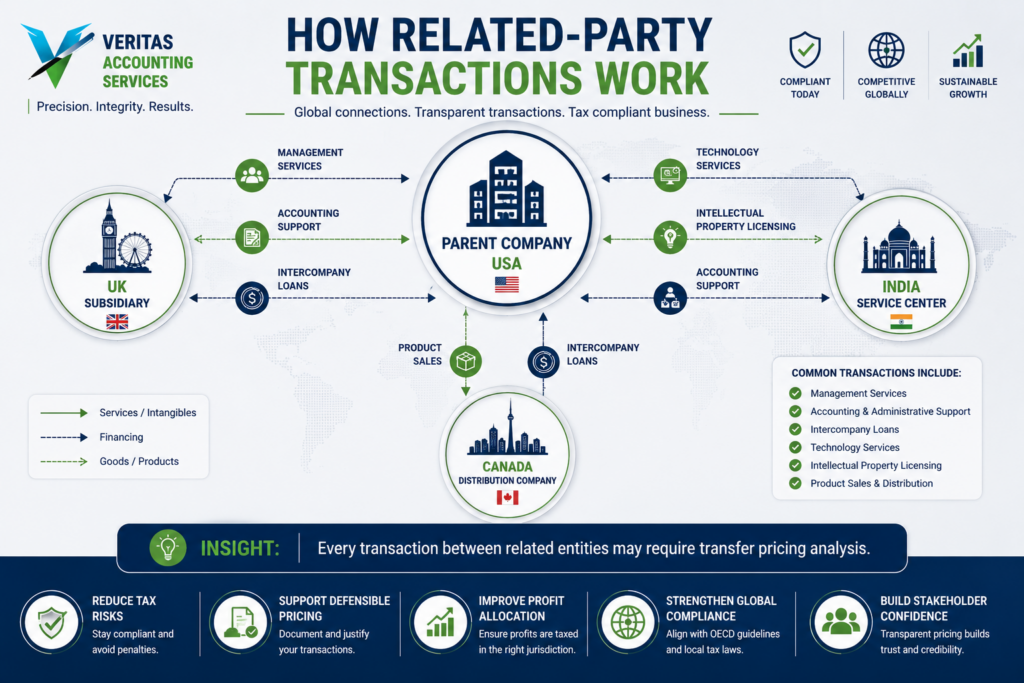
Your Simple Guide to Home Office Mistakes and Better Records

Working from home does not automatically create a deduction. Check eligibility, space, dates…

Your Simple Guide to Unpaid Invoice Mistakes and Better Records

An unpaid customer invoice is not automatically a tax deduction. Review the tax accounting method…